
Shift the 2003–07 Liberty into 2HI with the vehicle stopped and foot off the gas, make sure the transfer‑case lever clicks fully into the 2HI gate, then drive briefly on dry pavement to confirm no binding; if the part‑time 4WD light stays on, inspect or unplug the transfer‑case position sensor and check wiring for damage, scan for codes like P0837/P0839, and plan sensor replacement or pro help if needed—keep going for full diagnostic and repair steps.
Quick Fix: Shift to 2HI and Reset the Part‑Time 4WD Light
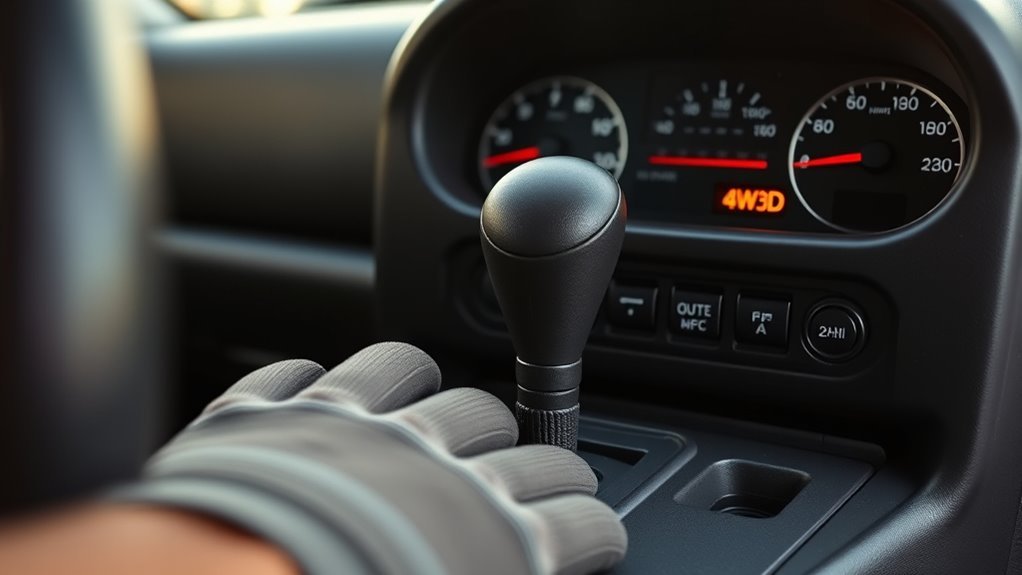
Start by putting the Liberty into 2HI while the vehicle is stopped and your foot’s off the accelerator; this guarantees the transfer case can disengage cleanly and often extinguishes the Part‑Time 4WD indicator. You’ll feel and see the lever settle into 2HI; that stationary, unthrottled state promotes correct sensor reading and transfer case disengagement. If the lamp persists, verify the transfer case selector is fully seated in the 2HI slot—partial engagement fools the system. As a temporary diagnostic, you can unplug a suspected faulty transfer case position sensor to see if the light clears, but don’t treat that as a long‑term solution. Consult the owner’s manual for exact procedures and torque or service notes. These steps preserve 4WD Benefits by preventing wear and erroneous lockups, support routine Jeep Maintenance, and keep your vehicle ready for Off Roading Tips and variable Driving Conditions. You’ll regain confident control and the liberation that comes from a predictable drivetrain.
Confirm You’re Really in 2HI: Lever Position, Feel, and Test Drive
While the transfer case lever may look like it’s in 2HI, confirm it’s fully seated by feeling the positive detent and confirming the lever rests squarely in the 2HI gate; a partial or marginal position can keep the Part‑Time 4WD light on. You’ll perform a quick lever adjustment check, then validate with controlled test conditions.
| Step | Action | Purpose |
|---|---|---|
| 1 | Feel detent | Confirm full engagement |
| 2 | Visual check | Verify lever alignment |
| 3 | Short drive | Assess driving sensations |
Shift smoothly into 2HI, feel for a solid click, and verify the lever isn’t floating between gates. Drive on dry pavement briefly—normal, quiet operation signals 2HI. Note any binding, grinding, or drag; those driving sensations could indicate engagement issues or sensor faults. If the light indicators persist after confirming position and sensations, you’ll need to inspect sensors and wiring. This methodical verification frees you from guesswork and steers you toward decisive action.
Troubleshoot a Persistent Part‑Time 4WD Light (Simple At‑Home Steps)
Start by confirming the transfer case lever is fully seated in 2H and apply slight upward pressure on the shift lever while stationary to rule out mispositioning. If the light stays on, inspect the transfer case position sensor for obvious damage or binding and try unplugging and reconnecting it to reset the circuit. If the indicator still persists after those steps, plan to replace the position sensor or have the transfer case inspected professionally.
Check Transfer Case Lever
Check that the transfer case lever is fully seated in 2H, since even slight mispositioning can keep the part‑time 4WD indicator lit; use transfer case troubleshooting and lever adjustment techniques immediately. Position the vehicle stationary, apply firm upward pressure on the lever, and shift it into 2H to guarantee full engagement. Inspect for binding or external pressure that prevents the lever from returning to its detent. Once seated, start driving on dry pavement; the light should extinguish if the mechanical engagement is correct. If the indicator remains lit after precise lever adjustment, you’ve narrowed the issue to the sensor or internal mechanism—liberate yourself from guesswork by preparing for further diagnostic steps. Document lever behavior for repair or parts ordering.
Inspect/Reset Position Sensor
Access the transfer case position sensor by removing the center console and visually inspect the connector and wiring for corrosion, loose pins, or damage; if everything looks intact you can unplug the sensor briefly to see whether the part-time 4WD light goes out, which indicates a faulty sensor or wiring fault that needs repair or replacement.
Start methodically:
- Verify the transfer case selector lever is properly positioned; shifting while moving will mislead diagnostics.
- Perform a wiring inspection: look for frays, corrosion, or pin looseness at the sensor connector.
- Temporarily unplug the sensor with the vehicle stationary; if the light extinguishes, pursue sensor replacement or wiring repair.
- After repair, confirm sensor calibration and monitor vehicle behavior during turns to guarantee liberation from persistent warnings.
Read Codes and Inspect the Transfer Case Position Sensor (Liberty 2003)
When your Part-Time 4WD light stays on, begin by scanning the Liberty’s computer for transfer case-related codes (common ones are P0837 and P0839) and then visually inspect the transfer case position sensor for damage, loose connectors, or misalignment of the selector lever; these steps help you quickly distinguish between an electrical/sensor fault and a mechanical selector issue. Use a scanner to capture any fault code, note freeze-frame data, and verify whether the code repeats.
| Item | Action |
|---|---|
| Scanner | Read codes, clear, re-scan |
| Visual | Check sensor, wiring, lever |
If you read persistent transfer case codes, suspect sensor calibration drift or failure. Inspect the sensor housing, connector pins, and mounting for wear or misalignment. Confirm selector lever alignment relative to the sensor; small mispositioning will trigger erroneous signals. If doubts remain after inspection, document findings and proceed with controlled diagnostic steps. You’ll want clear evidence before replacing parts so you reclaim control of the drive system without unnecessary expense.
Temporary Fix: Unplug the Sensor Safely and What to Watch While Driving
If you need a quick, temporary cure for the persistent Part‑Time 4WD light, you can safely unplug the transfer case position sensor while the Jeep is parked and the ignition is off; this will often extinguish the light by removing the sensor input that the ECU is flagging. The sensor accessibility is straightforward—it’s under the center console—so you can disconnect the plug without tools if you prefer. Do it only when stationary to prevent drivetrain shifts.
- Confirm ignition off and parking brake set before unplugging.
- Note baseline driving performance; test brief low‑speed runs first.
- Watch for loss of 4WD engagement, odd noises, or new dash warnings.
- Reconnect as soon as you plan repairs to restore system feedback.
This is a liberation tactic: regain dashboard calm without committing to a repair immediately. Monitor the vehicle closely; if behavior deviates, stop driving and reconnect or seek service to avoid longer‑term damage.
Replace the Transfer Case Position Sensor: Parts, Steps, and Costs
Start by gathering the correct replacement sensor (expect $50–$150), basic hand tools, jack stands, and an OBD‑II scanner so you can lift the Jeep safely, swap the unit on the transfer case, and clear any stored codes afterward. Verify sensor compatibility: match part numbers, connector type, and mounting orientation to your 2003 Jeep Liberty. You’ll lift and support the vehicle, locate the sensor on the transfer case, disconnect the wiring harness, and note the sensor position before removal.
Remove retaining fasteners, extract the old sensor, and install the new unit with the same alignment. Reconnect the wiring harness and torque fasteners to spec. Installation tips: keep connectors clean, avoid over‑tightening, and confirm wiring clip engagement to prevent intermittent faults. Lower the vehicle, start the engine, and use the OBD‑II scanner to clear codes and confirm the part‑time 4WD indicator resets. Inspect periodically to maintain liberation from repeated warnings.
When to Bring It to a Shop: Expected Diagnostics, Questions to Ask, and Price Ranges
Having replaced the transfer case position sensor yourself or verified basic checks, you’ll want professional help if the part‑time 4WD light stays on, codes like P0837/P0839 persist, or you lack the tools to test switch continuity and mechanical engagement. Take your Jeep in when the light won’t reset, you see drivability issues, or diagnostic tests show intermittent signals.
- Ask the shop what specific diagnostic tests they’ll run (OBD code read, continuity, actuator/mechanical inspection) and how they’ll isolate sensor faults versus linkage problems.
- Request a clear estimate that separates labor (typically $100–$200/hr) from parts; sensor replacement at a shop commonly runs $50–$150 plus labor.
- Confirm warranty coverage on parts and labor and get timelines for repairs so you can reclaim mobility without surprises.
- Ask about test-drive procedures and post-repair verification to guarantee the part‑time light won’t return.
You’ll leave informed, empowered, and ready to regain control.
Frequently Asked Questions
Why Does My Jeep Liberty Say Part Time?
Your Jeep Liberty says “Part Time” because its 4WD systems are engaged; you’re in part-time 4WD. For Jeep troubleshooting, check transfer case sensor, lever position, or codes (P0837/P0839) to restore proper 2HI indication.
What Does Part Time Mean on a Jeep Liberty?
A locked axle icon: part-time on a Jeep Liberty means its 4WD systems are engaged, coupling front and rear for extra traction. You’ll use it off-road or in slick conditions; practice Jeep maintenance to avoid drivetrain damage.
Why Is My 2005 Jeep Liberty Stuck in Part Time 4WD?
Your 2005 Jeep Liberty’s stuck part-time 4WD usually results from a faulty transfer case position sensor, misaligned gear engagement, or drivetrain issues; perform 4WD troubleshooting, check codes, inspect lever alignment, and replace the sensor if needed.
What Does Part Time Mean on My Dashboard?
“Part time” means your vehicle’s dashboard indicators show it’s in a limited four wheel drive mode for off-road/slippery use; you’ll want to shift to 2H for normal roads, ensuring lever and switches fully disengage.
Conclusion
If your part‑time 4WD light won’t go off, first confirm you’re actually in 2HI and try shifting again—about 70% of persistent indicator issues trace to engagement/sensor faults rather than major drivetrain failure. If simple resets don’t work, read codes and inspect the transfer case position sensor; unplugging it can be a temporary fix but limits feedback. Replace the sensor if faulty. Bring it to a shop when diagnostics exceed basic checks—expect $150–$600 depending on labor and parts.







Leave a Reply