
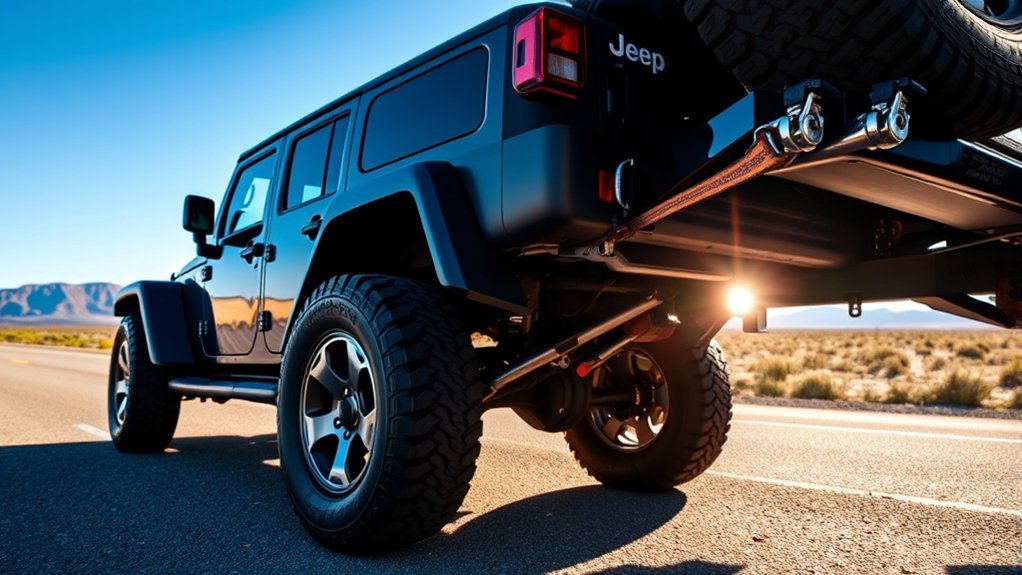
Flat towing a Jeep Wrangler with an automatic transmission can be convenient, but the setup must match the exact model year, drivetrain, transfer case, and towing equipment. The most important distinction is that the transfer case goes into Neutral while the automatic transmission normally ends in Park. Always confirm the complete procedure in the owner’s manual for your specific Jeep before moving it.
Quick Answer
Many four-wheel-drive Jeep Wranglers can be flat towed, including current models, but the exact sequence depends on the model year. For the 2026 Wrangler, Jeep requires the transfer case in Neutral, the automatic transmission in Park, all four wheels on the ground, and towing only forward. Always follow your VIN-specific owner’s manual.
Key Takeaways
- Verify flat-towing approval in the owner’s manual for your exact Wrangler model year and drivetrain.
- On current automatic models, the transfer case is placed in Neutral, but the transmission ends in Park.
- Use Jeep’s no-movement test to confirm that the transfer case is fully in Neutral.
- Rate the hitch, tow bar, baseplate, adapters, safety cables, and braking equipment for the Jeep’s actual loaded weight.
- Use supplemental brakes, a breakaway system, and legal lighting that comply with every jurisdiction on your route.
- Tow a current four-wheel-drive Wrangler forward with all four wheels on the ground. Do not use a front- or rear-wheel tow dolly.
At a Glance
| Time Required | About 20–45 minutes for the first careful setup; often 10–20 minutes after practice |
| Difficulty | Moderate; professional installation is recommended for the baseplate, wiring, and permanent braking components |
| Tools Needed | Rated tow bar, model-specific baseplate, safety cables, lighting harness, supplemental brake, breakaway device, locking pins, and any approved hitch riser or drop |
| Cost | Varies widely by equipment, Jeep configuration, and labor; the baseplate, tow bar, braking system, wiring, and installation usually make up most of the total |
Warning: A generic online procedure cannot replace your Jeep’s owner’s manual. Using the wrong transmission position, failing to confirm transfer-case Neutral, towing backward, or using an unapproved dolly setup can cause severe transmission or transfer-case damage that may not be covered by the vehicle warranty.
Understanding Flat Towing and Its Benefits
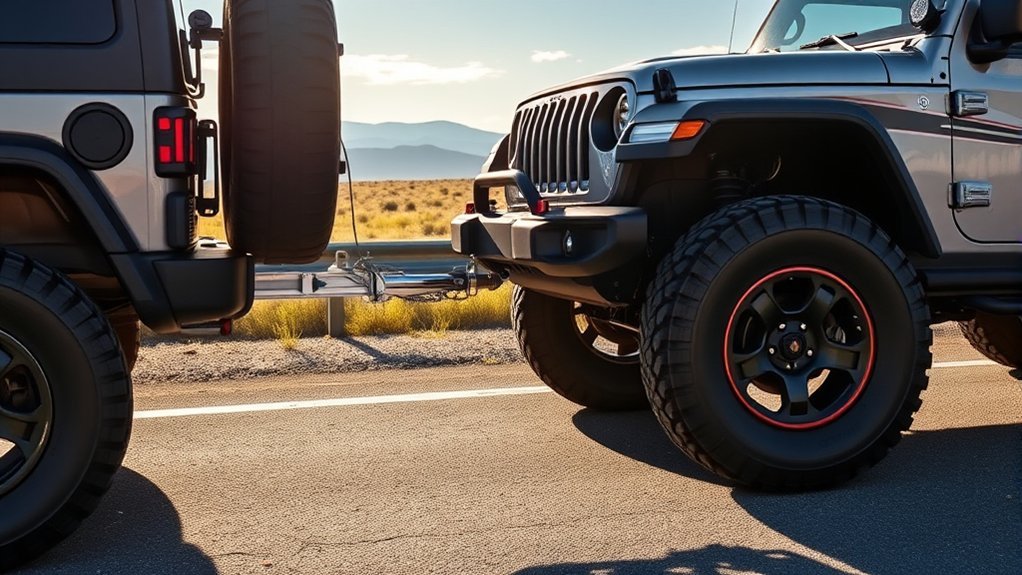
Flat towing, also called four-wheels-down or dinghy towing, means pulling the Jeep behind a motorhome with all four Jeep tires on the road. A tow bar connects the Jeep’s approved baseplate to the motorhome’s receiver hitch.
The method can be easier to store and connect than a full vehicle trailer. Once the permanent components are installed, the normal hookup uses a tow bar, safety cables, electrical connection, supplemental brake, and breakaway cable.
Flat towing does not eliminate wear. The Jeep’s tires, wheel bearings, steering parts, suspension, and towing hardware continue to operate while the vehicle is being pulled. Correct preparation is intended to prevent drivetrain damage; it does not make the trip wear-free.
The transfer case and transmission do different jobs during flat towing: the transfer case must disconnect the driveline, while a current Wrangler’s automatic transmission finishes in Park.
Is Your Jeep Wrangler Compatible for Flat Towing?
Do not decide compatibility from the word “Wrangler” or from the transmission type alone. Check the exact model year, drivetrain, transfer case, and original manufacturer procedure.
Verify the Model Year, VIN, and Owner’s Manual
- Find the 17-character VIN at the lower driver-side windshield or on the certification label inside the driver’s door opening.
- Confirm the model year, engine, transmission, and four-wheel-drive system.
- Open the correct manual through the official Mopar owner’s-manual portal.
- Search the manual for “Recreational Towing” or “Towing This Vehicle Behind Another Vehicle.”
- Follow that manual even when its instructions differ from a tow-bar dealer, forum, video, or older Wrangler procedure.
Note: Steering-lock and ignition procedures changed across Wrangler generations. Do not assume that every model needs a key left in ON, RUN, or ACC. Use the ignition and steering instructions printed for your exact model year.
Compatibility With Automatic Transmissions
An automatic transmission does not automatically prevent a four-wheel-drive Wrangler from being flat towed. The key is following the correct sequence.
For the 2026 Jeep Wrangler, Jeep specifies:
- All four wheels remain on the ground.
- The Jeep is towed in the forward direction.
- The transfer case is placed in Neutral.
- The automatic transmission is placed in Park after Neutral has been verified.
- A manual transmission is left in gear, not Neutral.
- Front- or rear-wheel dolly towing is not allowed for four-wheel-drive models.
Transfer Case Requirements
The transfer case must have a manufacturer-approved Neutral position for four-wheels-down towing. This Neutral position disconnects the front and rear driveshafts from the powertrain, allowing the Jeep to roll even when the automatic transmission is in Park.
Because the Jeep can roll freely in transfer-case Neutral, keep the brake pedal pressed and the parking brake firmly applied whenever the vehicle is not secured to the motorhome.
Warning: Never rely on the automatic transmission’s Park position to hold a Wrangler after the transfer case has entered Neutral. The transfer case has disconnected the driveline, so the vehicle can still roll.
Model Year Considerations
There is no reliable universal year range that covers every Wrangler configuration. Current models remain flat-tow capable when properly configured, while historical procedures may use different ignition, steering-lock, or transmission steps.
If the manual does not expressly approve four-wheels-down recreational towing, do not assume that removing a driveshaft or adding an aftermarket device makes the setup safe. Use a vehicle trailer with all four wheels off the ground unless the exact vehicle procedure and equipment have been approved by qualified sources.
| Vehicle finding | What to do |
|---|---|
| Manual expressly approves recreational flat towing | Follow every listed vehicle-preparation step and equipment restriction. |
| Transfer case has no approved Neutral setting | Do not flat tow unless the exact manual provides another approved method. |
| Manual is missing or vehicle has major drivetrain modifications | Obtain the correct manual and qualified inspection before towing. |
| Flat towing is not approved | Transport the Jeep on a properly rated vehicle trailer. |
Essential Gear for Flat Towing Your Jeep Wrangler
A safe system is only as strong as its lowest-rated component. Account for the Jeep, fuel, cargo, aftermarket bumpers, winches, racks, spare-tire changes, and anything stored inside it.
The 2026 Wrangler fleet guide, for example, lists an estimated base curb weight of about 4,320 pounds for the referenced gasoline Rubicon configuration and about 5,165 pounds for the Rubicon 4xe configuration. Cargo and accessories increase those figures.
Required Equipment Overview
- Motorhome receiver hitch: It must be approved for flat towing and rated above the Jeep’s actual loaded weight.
- Tow bar: Choose a model whose capacity exceeds the actual loaded towed weight.
- Model-specific baseplate: It must attach to approved structural points according to the baseplate manufacturer’s instructions.
- Safety cables: Use properly rated cables between the motorhome and Jeep. Cross them under the tow-bar connection when the equipment instructions call for that routing.
- Supplemental braking system: The Jeep should provide proportional or otherwise approved braking rather than relying only on the motorhome.
- Breakaway device: It must activate the Jeep’s supplemental brakes if the Jeep separates from the motorhome.
- Lighting system: Brake lights, turn signals, and tail lamps must operate with the motorhome without damaging either vehicle’s electronics.
- Electrical cable and connector: Use secure, weather-resistant connectors with enough slack for turns but not enough to drag.
- Charge line when required: Some braking systems draw from the Jeep’s battery. Follow the braking-system and vehicle instructions for battery support.
- Approved hitch riser or drop: Use one when needed to keep the tow bar within its manufacturer’s permitted angle.
- Locking or retaining pins: Install every required pin, clip, latch, or lock before departure.
Blue Ox’s flat-towing equipment guidance similarly identifies a rated tow bar, vehicle-specific baseplate, braking system, wiring, and properly sized receiver as core components.
Select Equipment by Actual Loaded Weight
Do not use “5,000 pounds” as a universal Wrangler equipment rating. A heavier 4xe, steel bumpers, a winch, larger spare tire, tools, and cargo can push the ready-to-tow weight above that figure.
When possible, weigh the prepared Jeep on a certified vehicle scale. Use the measured total as the minimum starting point when selecting:
- The motorhome’s allowable towed load
- The receiver hitch
- The tow bar
- The baseplate and adapters
- The safety cables
- Any riser, drop, extension, or dual-receiver accessory
- The supplemental brake
Pro Tip: Recalculate the towing setup after adding a winch, steel bumper, oversized spare, cargo rack, or other heavy accessory. The Jeep’s original brochure weight may no longer represent the load being pulled.
Safety Precautions Needed
Inspect the entire towing system before every trip. Look for loose baseplate hardware, missing clips, bent pins, cracked welds, damaged cable coating, frayed wiring, fluid leaks, unusual tire wear, and tow-bar arms that do not lock.
Do not attach a clamp-on tow bar to the Wrangler’s fascia or bumper unless the exact bumper and towing system manufacturers expressly approve that use. The current Jeep manual warns against fascia- or bumper-mounted clamp-on tow bars.
Follow the supplemental-brake and breakaway-system instructions exactly. Braking and breakaway rules vary among states and provinces, so check every jurisdiction on the planned route rather than relying on one generalized weight threshold.
Preparing Your Jeep Wrangler for Flat Towing
The following sequence reflects the 2026 Jeep Wrangler automatic-transmission procedure. It is a current example, not a replacement for another model year’s manual.
- Stop the Jeep completely on level ground.
- Press and hold the brake pedal.
- Shift the automatic transmission into Neutral.
- Turn the engine off.
- Shift the transfer-case lever into Neutral.
- Start the engine.
- Shift the automatic transmission into Reverse.
- Release the brake pedal for five seconds and confirm that the Jeep does not move.
- Press the brake, shift into Drive, release the brake for another five seconds, and again confirm that the Jeep does not move.
- Turn the engine off.
- Firmly apply the parking brake.
- With the engine off, shift the automatic transmission into Park.
- Attach the Jeep to the motorhome with the approved tow bar and all required connections.
- Release the parking brake only after the Jeep is fully connected and the departure checks are complete.
Warning: If the Jeep moves during the Reverse or Drive test, the transfer case is not fully in Neutral. Stop the procedure. Do not tow until Neutral can be selected and verified exactly as the owner’s manual requires.
Jeep also warns that transmission damage may occur if the automatic transmission is shifted into Park with the transfer case in Neutral while the engine is running. Turn the engine off before selecting Park when following the current procedure.
Step-by-Step Guide to Hooking Up Your Jeep
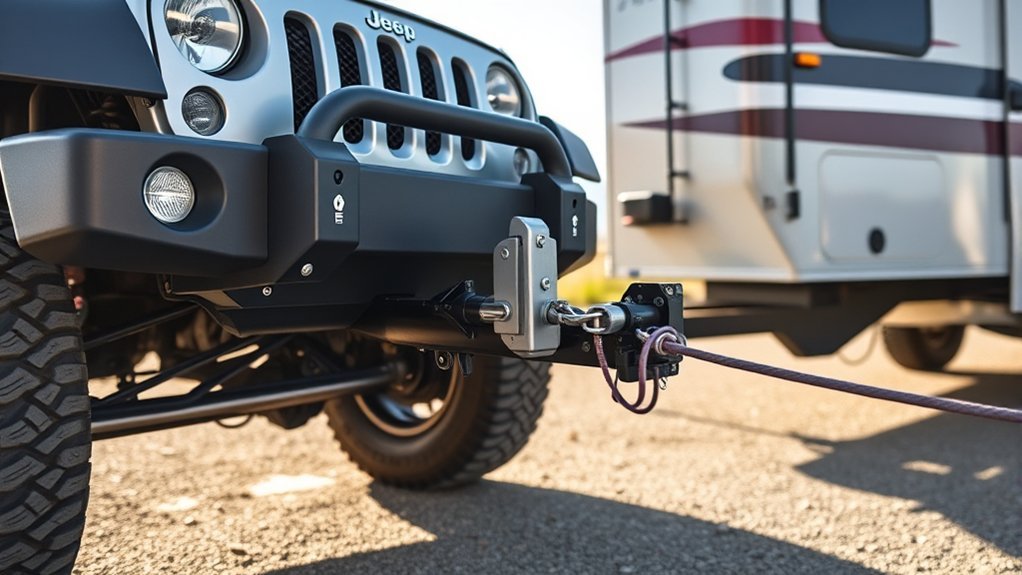
Park the motorhome and Jeep in a straight line on firm, level ground. Avoid completing the hookup where traffic, steep grades, mud, or loose gravel could make the vehicles move unexpectedly.
| Step | Action | Checkpoint |
|---|---|---|
| 1 | Secure the motorhome and Jeep on level ground. | Motorhome parking brake applied; Jeep parking brake applied. |
| 2 | Insert the tow bar into the receiver and secure it with the approved hitch pin and retaining clip or lock. | Pin fully seated; clip or lock installed. |
| 3 | Connect both tow-bar arms to the Jeep’s model-specific baseplate. | Every attachment pin and retainer installed. |
| 4 | Connect the safety cables to approved structural attachment points. | Correct routing, turning slack, and no contact with sharp edges or the road. |
| 5 | Connect the lighting cable and any approved battery charge line. | Cable cannot drag, pinch, or pull tight during turns. |
| 6 | Install or activate the supplemental braking system. | Brake unit passes its setup or self-test. |
| 7 | Attach the breakaway cable to the motorhome at a point separate from the safety-cable connection when required by its instructions. | Cable has turning slack but will pull the switch if separation occurs. |
| 8 | Complete the Jeep’s transfer-case and transmission procedure. | Transfer-case Neutral verified; automatic transmission in Park; parking brake still applied. |
| 9 | Pull the motorhome forward slowly to lock both tow-bar arms, following the tow-bar instructions. | Both arm-lock indicators show fully locked. |
| 10 | Test the lights and supplemental brakes with a helper. | Tail, brake, and both turn-signal functions confirmed. |
Pro Tip: Make a laminated departure checklist for your exact Jeep, tow bar, braking system, and motorhome. Follow it in the same order every time rather than relying on memory.
How to Prep Your RV for Flat Towing
The motorhome must be capable of controlling the Jeep, not merely pulling it on level pavement.
- Confirm the motorhome’s towing limit. Use the chassis and motorhome manufacturer ratings, including any lower limit created by the coach builder, hitch, or receiver extension.
- Check the available gross combined weight. A motorhome loaded near its limit may not have enough remaining capacity for the Jeep.
- Inspect the receiver. Look for corrosion, loose fasteners, cracks, deformation, or an unsupported extension.
- Check tow-bar height. Measure from the ground to the center of the motorhome receiver and from the ground to the Jeep’s baseplate attachment point while both vehicles are level.
- Correct the angle only with approved equipment. Follow the tow-bar manufacturer’s riser, drop, and receiver-extension limits.
- Confirm the turning envelope. Make sure the tow bar, Jeep bumper, motorhome body, cables, and accessories cannot contact during normal turns.
- Test the motorhome lights and brake controller or monitor. Repair any fault before departure.
Tow-bar height limits are product-specific. As one example, the Roadmaster Nighthawk owner’s manual requires that product to remain within its stated safe zone and explains how to measure the receiver and baseplate heights. Follow the instructions for the tow bar actually installed on your RV.
Key Towing Procedures Before Departure
Complete one slow walk-around after the drivetrain setup and another after pulling forward to lock the tow-bar arms.
- Transfer case confirmed in Neutral.
- Automatic transmission in Park for the current procedure.
- Correct ignition and steering condition for the exact model year.
- Parking brake released only after full connection.
- All tow-bar pins, retainers, locks, and latches installed.
- Both tow-bar arms fully extended and locked.
- Safety cables connected with safe turning slack.
- Electrical cord connected and clear of the pavement.
- Breakaway cable connected correctly.
- Supplemental braking system armed and tested.
- Brake lights, tail lights, and turn signals working.
- Jeep tires properly inflated and free of visible damage.
- Doors, hood, roof panels, windows, and cargo secured.
- No loose item can strike the brake pedal, steering wheel, or portable braking system.
- The planned route complies with applicable towing, braking, breakaway, lighting, and length rules.
Note: Recheck the complete hookup after the first few miles and at every fuel, meal, or rest stop. Stop sooner if a camera, monitor, passing driver, odor, vibration, or handling change suggests a problem.
Common Mistakes to Avoid When Flat Towing
- Leaving the automatic transmission in Neutral: Current Wrangler instructions finish with the transmission in Park after the transfer case is verified in Neutral.
- Confusing transmission Neutral with transfer-case Neutral: They are separate controls with different functions.
- Skipping the no-movement test: The Reverse-and-Drive test is how the current procedure confirms full transfer-case disengagement.
- Shifting into Park with the engine running: On the current procedure, the engine must be off before Park is selected while the transfer case is in Neutral.
- Copying another model year’s ignition setting: Steering and ignition systems changed across Wrangler generations.
- Using equipment rated only for a guessed curb weight: The ready-to-tow Jeep may be heavier because of cargo and accessories.
- Attaching to an unapproved bumper point: Use a model-specific baseplate or a bumper and adapter combination expressly approved by all involved manufacturers.
- Ignoring tow-bar angle: Excessive rise or drop can overload the bar, baseplate, receiver, and vehicle structure.
- Omitting supplemental brakes or a breakaway system: The motorhome should not be expected to stop the full combination without the required auxiliary system.
- Allowing cables to drag or bind: Provide enough turning slack without allowing contact with the road, exhaust, sharp edges, or moving parts.
- Backing up while connected: A four-wheels-down Jeep can quickly jackknife and damage the tow bar, baseplate, Jeep, or motorhome. Disconnect before reversing unless the equipment manufacturer expressly provides a different approved procedure.
- Using a tow dolly on a current four-wheel-drive Wrangler: Jeep requires all four wheels either on the ground for approved flat towing or off the ground on a vehicle trailer.
Troubleshooting Flat-Towing Problems
The Transfer Case Will Not Enter Neutral
- Return to level ground and restart the owner’s-manual sequence from the beginning.
- Hold the brake pedal and use the exact transmission and engine state required by the manual.
- Do not force the lever or assume it is in Neutral because it feels close to the detent.
- If Neutral cannot be positively selected and verified, do not tow the Jeep.
- Have the shift linkage, transfer case, or electronic controls inspected when the problem continues.
The Jeep Moves During the Reverse or Drive Test
Press the brake immediately, apply the parking brake, and stop the setup. Movement means the transfer case is not fully disengaged. Repeat the complete Neutral-selection procedure. Do not solve the problem by leaving the automatic transmission in Neutral.
The Front Tires Scrub or the Steering Does Not Track
- Stop in a safe location.
- Verify the ignition and steering-lock condition for the exact model year.
- Check that no steering-wheel lock, strap, accessory, or security device is preventing free steering movement.
- Inspect tow-bar height, alignment, arm locking, tire pressure, and baseplate connections.
- Do not continue if a tire is dragging, hopping, or remaining sharply turned.
A Tow-Bar Arm Will Not Release
Binding commonly occurs when the vehicles stop at an angle or on uneven ground. Keep both vehicles secured, follow the tow-bar manufacturer’s release procedure, and never place your body between the vehicles. Moving the motorhome or Jeep slightly may relieve pressure, but only do so according to the equipment instructions.
The Jeep Battery Discharges
- Check whether the supplemental brake requires a dedicated charge line.
- Inspect connector pins, grounds, fuses, and charge-line output.
- Confirm that the Jeep’s ignition state matches its manual.
- Do not disable the supplemental brake merely to reduce electrical draw.
Disconnecting and Shifting Out of Transfer-Case Neutral
Use the owner’s-manual procedure for the exact model year. For a 2026 Wrangler with an automatic transmission, Jeep specifies the following sequence:
- Stop on firm, level ground while leaving the Jeep connected to the motorhome.
- Firmly apply the Jeep’s parking brake.
- Start the Jeep’s engine.
- Press and hold the brake pedal.
- Shift the automatic transmission into Neutral.
- Turn the engine off.
- Shift the transfer-case lever from Neutral to the desired drive position.
- Shift the automatic transmission into Park.
- Release the brake pedal.
- Disconnect the Jeep from the motorhome.
- Start the engine.
- Press and hold the brake pedal.
- Release the parking brake.
- Shift into gear and confirm that the Jeep operates normally.
Warning: Secure the Jeep before removing tow-bar pins or cables. A Wrangler in transfer-case Neutral can roll even when its automatic transmission is in Park.
Post-Towing Maintenance for Your Jeep Wrangler
A brief inspection after each towing day can reveal damage before the next trip.
| Maintenance task | What to inspect |
|---|---|
| Tow bar and pins | Bending, looseness, corrosion, damaged latches, missing clips, and lubrication needs |
| Baseplate and mounting hardware | Movement, cracks, elongated holes, loose fasteners, or contact with body panels |
| Safety and breakaway cables | Abrasion, kinks, heat damage, failed coatings, hooks, and attachment points |
| Wiring and lights | Dragged cables, loose pins, water entry, blown fuses, and failed lamps |
| Supplemental brake | Mounting, pedal connection, breakaway function, stored faults, and battery condition |
| Jeep tires and steering | Uneven scrub, sidewall damage, abnormal heat, pressure loss, or steering that does not return normally |
| Drivetrain and fluids | Leaks, warning messages, unusual odors, noise, or abnormal operation; follow the normal maintenance schedule unless a problem occurred |
Frequently Asked Questions
Can a Jeep Wrangler with an automatic transmission be flat towed behind an RV?
Many four-wheel-drive Wranglers can be flat towed when their exact owner’s manual approves it. For the 2026 model, the transfer case must be in Neutral, the automatic transmission must finish in Park, all four wheels must remain on the ground, and the Jeep must be towed forward.
Should the automatic transmission be in Park or Neutral while towing?
For the current 2026 Wrangler procedure, the automatic transmission is temporarily placed in Neutral while the transfer case is shifted. After the transfer case is verified in Neutral and the engine is turned off, the automatic transmission is placed in Park for towing.
Does the ignition key need to stay in the ON position?
Not as a universal rule. Ignition switches, push-button systems, and steering locks differ by model year. Follow the ignition and steering instructions in the owner’s manual for your exact Wrangler rather than copying a procedure written for another generation.
Is a 5,000-pound tow bar enough for every Wrangler?
No. Some Wrangler configurations, including a current Rubicon 4xe, can exceed 5,000 pounds before cargo or accessories are added. Choose every load-bearing towing component according to the Jeep’s actual ready-to-tow weight and the equipment manufacturer’s ratings.
Can a four-wheel-drive Wrangler be carried on a tow dolly?
The 2026 Jeep manual does not allow front- or rear-wheel dolly towing for four-wheel-drive models. Use the approved four-wheels-down procedure or a suitable vehicle trailer that keeps all four Jeep wheels off the ground.
What should I do if the Jeep moves during the transfer-case test?
Press the brake, apply the parking brake, and stop the setup. Movement means the transfer case is not fully in Neutral. Repeat the manufacturer’s complete procedure and do not tow until the no-movement test is passed.
Do I need a supplemental braking system?
A properly selected supplemental brake improves control and may be required by the jurisdictions on your route. Use a compatible system with an appropriate breakaway device, and verify all state or provincial requirements before travel.
Conclusion
Flat towing a Jeep Wrangler safely depends on following the exact vehicle and equipment instructions, not a generic transmission rule. Verify your VIN-specific manual, place the transfer case in its approved Neutral position, complete the no-movement test, and leave the automatic transmission in the final position Jeep specifies. Then confirm that every towing component is rated for the Jeep’s actual loaded weight.
A careful hookup includes more than the tow bar. Use a model-specific baseplate, properly routed safety cables, working lights, supplemental brakes, a breakaway system, and correct hitch geometry. Complete the same written checklist before every departure, inspect the system at stops, and do not continue when the transfer case, steering, brakes, lights, or tow-bar locks cannot be positively verified.
Sources
- 2026 Jeep Wrangler Owner’s Manual — recreational-towing compatibility, transmission and transfer-case positions, Neutral verification, forward-only towing, dolly restrictions, and disconnection procedure
- Mopar Owner’s Manual Portal — model-year and VIN-specific vehicle instructions
- 2026 Jeep Wrangler Fleet Buyer’s Guide — current example curb weights and configuration differences
- Roadmaster Nighthawk Tow Bar Owner’s Manual — equipment ratings, inspection, safety-cable routing, steering movement, and tow-bar height guidance
- Blue Ox Flat-Towing FAQ — core tow-bar, baseplate, braking, wiring, and receiver equipment







Leave a Reply