
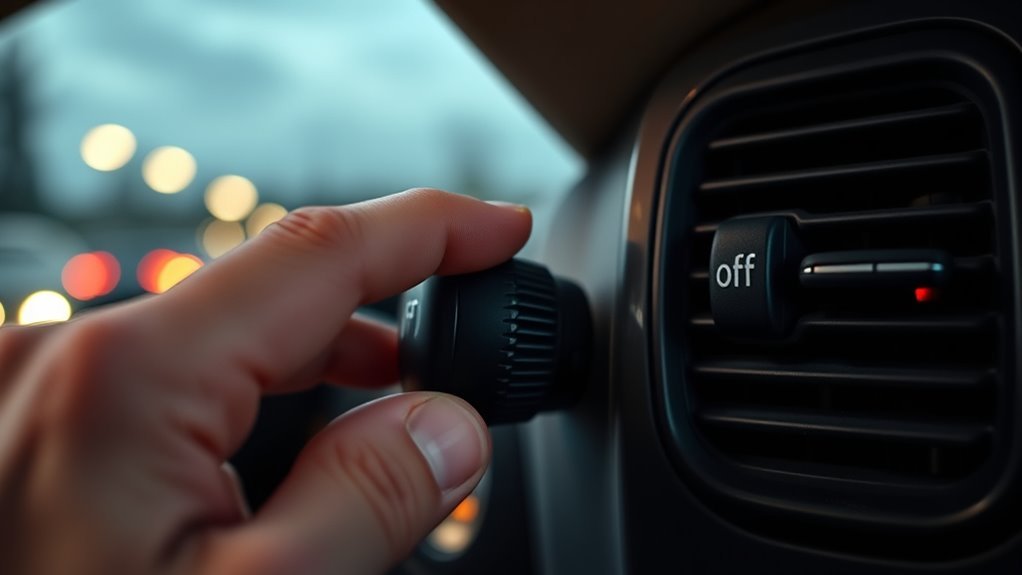
A Jeep Liberty’s PART TIME 4WD light should be on when the transfer case is in part-time four-wheel drive and off when it is fully in 2H or 2WD. If the light stays on, first determine whether the Jeep is still mechanically in 4WD or whether the transfer-case position switch is sending the wrong signal. The distinction matters because part-time 4WD can bind and damage the driveline on dry pavement.
Quick Answer
Move the transfer-case lever firmly into 2H or 2WD using the procedure in your Liberty’s owner’s manual. If the Jeep drives normally but the PART TIME light remains on, inspect and scan the transfer-case switch circuit. Do not keep driving on dry pavement if steering is heavy, the tires hop, or the driveline binds.
Key Takeaways
- The PART TIME light is a mode indicator. It normally illuminates in Command-Trac 4H or Selec-Trac 4 PART TIME.
- Do not use part-time 4WD or 4LO on dry, hard pavement. Those modes lock the front and rear driveline together.
- A light that remains on without tire scrub or binding often points to the transfer-case switch, connector, or wiring rather than an internal transfer-case failure.
- P0837 and P0839 identify a 4WD switch-circuit problem; they do not automatically prove that the switch itself is bad.
- Verify the VIN, transfer-case model, connector, and part number before ordering a replacement.
At a Glance
| Time Required | 10–20 minutes for basic checks; about 45–90 minutes for switch access and testing |
| Difficulty | Easy for shifting and visual checks; moderate for electrical testing or replacement |
| Tools Needed | Wheel chocks, flashlight, trim tool, socket set, OBD-II scanner, and a digital multimeter for circuit testing |
| Cost | Basic checks cost nothing. A current Mopar listing for one 2005 application shows about $100 online and a $145 MSRP for the switch; exact parts and labor vary by VIN and transfer case. |
Warning: Do not continue driving on dry pavement if the Jeep hops, scrubs its tires, resists turning, grinds, or feels as though the brakes are dragging. Those symptoms may mean the transfer case is still mechanically locked in part-time 4WD. Stop in a safe place and arrange professional diagnosis or towing.
What the PART TIME 4WD Light Means
The PART TIME light does not normally mean that the four-wheel-drive system has failed. It tells the driver that the transfer case is reporting a locked, part-time four-wheel-drive mode.
On the 2003–07 Jeep Liberty KJ, the exact selector depends on the installed transfer case:
| System | Lever Positions | PART TIME Light |
| Command-Trac | 2H, 4H, N, 4L | Normally on in 4H. The separate 4LO light is used in 4L. |
| Selec-Trac | 2WD, 4 PART TIME, 4 FULL TIME, N, 4LO | Normally on in 4 PART TIME. A separate FULL TIME light is used in 4 FULL TIME. |
There is no normal 2H or 2WD indicator. Therefore, a Liberty that is correctly in two-wheel drive should have the PART TIME, FULL TIME, and 4LO lights off after the bulb check.
Check the labels beside your transfer-case lever before following any procedure. The official 2007 Jeep Liberty owner’s manual explains both Command-Trac and Selec-Trac operation. Use the manual for your exact model year when its instructions differ.
Quick Fix: Shift Back to 2H or 2WD Safely
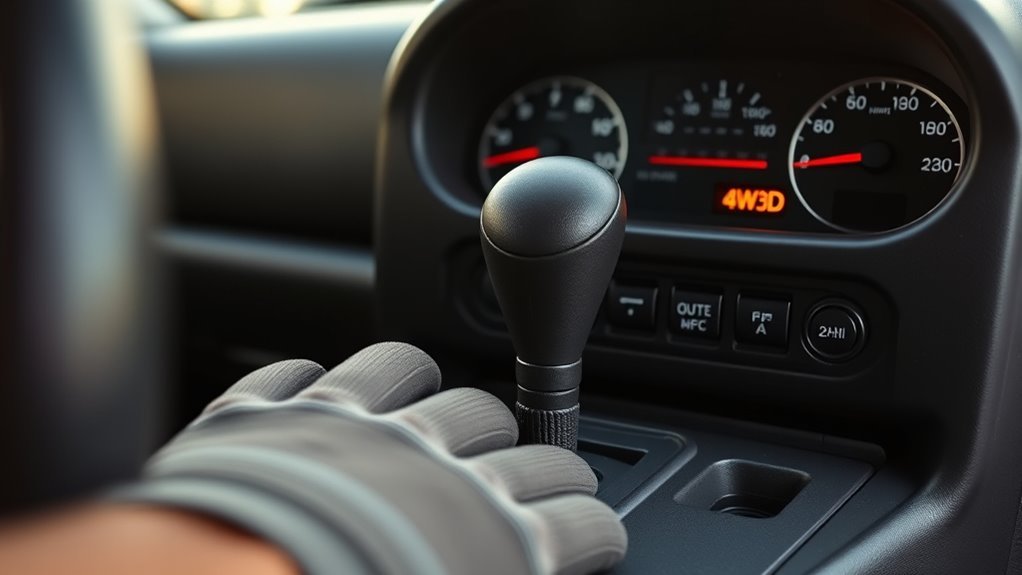
If the light appeared after using four-wheel drive, first try a complete, deliberate shift back into the normal road position. Keep the front wheels straight and move to an area where you can shift without traffic or obstacles.
When the Jeep is stopped:
- Set the parking brake and keep your foot firmly on the service brake.
- Move the transfer-case lever with steady, continuous pressure into 2H or 2WD. Do not leave it between detents.
- If an automatic-transmission Liberty does not complete the shift, the owner’s manual says it may help to move the transmission from Drive to Reverse and back to Drive while the vehicle remains controlled with the brake.
- Return the transmission to Drive and check the indicator.
When the Jeep is moving:
- Travel in a straight line at a safe speed. Jeep permits high-range shifts up to 55 mph, but a slow, controlled speed is better for troubleshooting.
- Move the lever firmly into 2H or 2WD.
- Momentarily release the accelerator once or twice to remove torque from the driveline and help the transfer case complete the shift.
- Do not attempt the shift while only the front or rear wheels are spinning.
Pro Tip: Look at the lever itself rather than relying only on the lamp. A worn linkage, damaged bushing, obstructed console trim, or partially seated lever can leave the transfer case between indicated positions.
Confirm Whether the Jeep Is Mechanically in 2WD
A light that remains on does not tell you by itself whether the transfer case is still locked. Use the Jeep’s behavior to separate a likely indication fault from a mechanical engagement problem.
| What You Notice | More Likely Explanation | Next Step |
| Normal steering, no tire scrub, no hopping, and normal coasting | The transfer case may be in 2WD while the switch or circuit reports the wrong position. | Scan for codes and inspect the switch connector and wiring. |
| Heavy steering, tire chirp, wheel hop, or driveline wind-up during a turn | The transfer case may still be mechanically locked in part-time 4WD. | Stop dry-road driving. Try the approved shift on a loose surface or obtain professional help. |
| Lever does not reach its detent or moves differently than before | Linkage, bushing, cable, console interference, or an internal shift problem may be present. | Inspect the external linkage before replacing an electrical switch. |
| The light flickers or changes when the console, connector, or wiring is moved | Loose terminals, corrosion, a broken conductor, or a worn switch is likely. | Inspect and electrically test the circuit. |
Also compare all four tires. They should match in specified size and be close in actual circumference and tread depth. A mismatched tire can keep tension in the driveline and make a transfer-case shift harder to complete.
Note: Do not make repeated tight circles on dry pavement to “test” whether 4WD is still engaged. If the transfer case is locked, that test creates the binding you are trying to avoid.
Read Codes Before Replacing Parts
Connect an OBD-II scanner and record all stored and pending codes before clearing anything. Two codes associated with the 4WD switch circuit are:
- P0837 — Four-Wheel Drive Switch Circuit Range/Performance: the reported signal does not match the expected range or operating state.
- P0839 — Four-Wheel Drive Switch Circuit High: the controller sees voltage above the expected range.
These codes identify a circuit problem, not a guaranteed bad switch. Possible causes include:
- A worn or internally open transfer-case position switch
- Corroded, spread, loose, or fluid-contaminated connector terminals
- A signal wire shorted to voltage, ground, or another circuit
- An open wire inside the harness
- Poor sensor ground or reference voltage
- Less commonly, a controller-input fault
Clear codes only after recording them and completing an inspection. Then cycle the lever through each position and rescan. A code that returns immediately with the ignition on often points toward an electrical fault. A code that returns only when the lever reaches one position may indicate a worn switch contact or a position-specific wiring problem.
Inspect the Transfer-Case Switch and Wiring
The component commonly called the transfer-case position sensor is a multi-position switch mounted on the top of the transfer case. On many KJ Libertys it can be reached from above by removing the center-console trim and exposing the transfer-case shifter opening. Access can vary with engine, transmission, transfer case, and interior trim.
Before taking the console apart:
- Park on level ground, apply the parking brake, place the transmission in Park or gear, and chock the wheels.
- Turn the ignition off and remove the key.
- Protect painted and plastic trim surfaces before using a trim tool.
- Photograph the console, shifter boots, connector routing, and clips before disassembly.
Inspect the switch area for:
- Transfer-case fluid or water inside the connector
- Green or white corrosion on the terminals
- Bent, recessed, loose, or spread pins
- Harness insulation rubbed through near brackets or the shifter opening
- Wires pulled tight when the drivetrain moves
- A connector lock that no longer holds securely
A technician can compare the switch resistance or signal voltage in each lever position with the model-specific wiring diagram. The reported scan-tool position should agree with the physical lever position. Do not pierce sealed wiring unless the service procedure specifically permits it; use back-probing adapters where possible.
Why Unplugging the Switch Is Not a Temporary Fix
Disconnecting the transfer-case switch may change the dashboard indication, but it does not repair the system or prove that the switch is defective. The controller may interpret a disconnected circuit as a different transfer-case position, an open circuit, or a high-voltage fault.
More importantly, the transfer case shifts mechanically through its lever and linkage. Unplugging the electrical switch does not guarantee that the driveline is in 2WD. It only removes or changes the position signal.
Warning: Do not use a disconnected transfer-case switch as a way to hide the light while continuing to drive. The driver can no longer rely on the dashboard to identify 2WD, part-time 4WD, full-time 4WD, or 4LO.
A connector may be unplugged briefly with the ignition off as part of a service-manual electrical test. Inspect it, take the required measurements, and reconnect it securely before operating the vehicle.
Replace the Transfer-Case Position Switch
Replace the switch only after confirming that the lever and linkage operate correctly, the connector is sound, and circuit testing points to the switch.
Do not order solely by “2003–07 Jeep Liberty.” The KJ used more than one transfer-case configuration. Verify:
- The 17-character VIN and model year
- Command-Trac or Selec-Trac
- The transfer-case identification tag or build information
- Connector shape and terminal count
- The original switch number and any official superseding number
You can check the vehicle identity through the NHTSA VIN Decoder, then use the VIN with a Jeep dealer or the official Mopar parts catalog to confirm the transfer-case application. For example, Mopar lists switch 5083138AA for certain 2005 configurations, but that does not make it correct for every Liberty.
A typical replacement sequence is:
- Secure the vehicle, switch the ignition off, and expose the transfer-case switch through the verified access route.
- Release the connector lock without pulling on the wires.
- Clean dirt from around the switch so contamination cannot fall into the opening.
- Remove the switch with the correct socket or service tool.
- Compare the new and old switches, sealing surfaces, connector keying, and part numbers.
- Install the replacement and tighten it to the specification for that transfer case. Do not guess the torque or overtighten the threaded case.
- Reconnect the harness and confirm that its lock is fully engaged.
- Reassemble the shifter boots and console without pinching the wiring.
- Clear stored codes, cycle the lever through all positions, and confirm that every indicator agrees with the selected mode.
As of July 2026, one official Mopar listing for a 2005 Selec-Trac application showed an online price of about $100 and a $145 MSRP for the switch. Prices, availability, and superseded part numbers can change, so verify the current listing before buying.
Post-Repair Checks
After the repair, perform a controlled verification:
- Start in 2H or 2WD and confirm that no four-wheel-drive mode light remains on.
- Move the lever through its positions while stationary and verify that the expected PART TIME, FULL TIME, or 4LO light appears.
- Test part-time 4WD only on a loose, snowy, icy, muddy, sandy, or otherwise low-traction surface.
- Shift back to 2H or 2WD and confirm normal steering and no tire scrub.
- Rescan for pending or returning codes.
- Recheck the switch area for a loose connector or fluid seepage.
No separate “calibration” should be assumed. The important check is that the physical lever position, scan-tool position, and dashboard indication agree.
When to Bring the Liberty to a Shop
Professional diagnosis is the safer choice when:
- The Jeep binds, hops, or resists turning on dry pavement
- The transfer-case lever will not enter or leave a position
- The vehicle is stuck in 4LO or transfer-case Neutral
- Grinding, repeated clunking, or a new fluid leak is present
- P0837 or P0839 returns after the switch and connector test correctly
- Multiple transmission, ABS, stability-control, or power-supply codes appear together
- You do not have a wiring diagram, multimeter, or safe access to the switch
Ask the shop to identify the installed transfer case and verify:
- Mechanical lever and linkage travel
- The transfer-case position shown in live scan data
- Switch resistance or signal voltage in every position
- Reference voltage, ground integrity, and signal-wire continuity
- Connector terminal tension and harness condition
- Correct operation after the repair on an appropriate road surface
Request an itemized estimate that separates diagnosis, parts, labor, taxes, and shop supplies. Labor varies by local rate, console configuration, corrosion, and whether the problem is electrical, linkage-related, or internal to the transfer case.
Frequently Asked Questions
Why does my Jeep Liberty say PART TIME?
The PART TIME light means the transfer-case switch is reporting a locked part-time four-wheel-drive mode. It should normally illuminate in Command-Trac 4H or Selec-Trac 4 PART TIME. If the lever is in 2H or 2WD but the light stays on, the switch, connector, wiring, linkage, or mechanical shift may need attention.
What does part-time 4WD mean on a Jeep Liberty?
Part-time 4WD locks the front and rear driveline together so both axles turn at the same average speed. It is intended for loose or slippery surfaces. It should not be used on dry, hard pavement because the tires cannot release the speed difference created while turning.
Why is my 2005 Jeep Liberty stuck in part-time 4WD?
Possible causes include driveline tension, incomplete lever travel, a worn linkage or bushing, unequal tires, or an internal transfer-case problem. If the Jeep has no binding and only the light is wrong, the transfer-case switch circuit is more likely. Do not assume that replacing the switch will free a mechanically stuck transfer case.
Can I drive with the PART TIME light on?
Only when the selected mode and road surface are appropriate. If the Jeep is truly in part-time 4WD, avoid dry pavement. If 2WD has been mechanically confirmed and the problem is only a false light, limited driving may be possible, but the mode indicator cannot be trusted until the fault is repaired.
Will unplugging the transfer-case switch turn off the light?
It may change the light or set a different circuit code, but it is not a repair and does not prove the switch is bad. It also removes reliable dashboard feedback. Disconnect the switch only with the ignition off during a proper electrical test, and reconnect it before driving.
What do Jeep Liberty codes P0837 and P0839 mean?
P0837 means the four-wheel-drive switch signal is outside its expected range or does not match the operating condition. P0839 means the switch circuit voltage is too high. Test the switch, connector, reference voltage, ground, signal wire, and controller input before replacing parts.
Conclusion
When a Jeep Liberty’s PART TIME light will not turn off, begin with the transfer-case lever and the correct factory shift procedure. Determine whether the vehicle is physically in 2WD before assuming the lamp is merely wrong. Any binding, wheel hop, tire scrub, grinding, or difficulty turning on dry pavement requires immediate attention.
If the Jeep drives normally in 2WD but the light remains on, scan for P0837 or P0839 and inspect the transfer-case-mounted position switch, connector, and wiring. Do not use an unplugged switch as a long-term workaround. Verify the exact transfer case and replacement part by VIN, complete the circuit tests, and confirm that the lever, scan data, and dashboard lights agree after repair.
Sources
- 2007 Jeep Liberty Owner’s Manual — Command-Trac and Selec-Trac modes, indicator behavior, shifting procedures, tire requirements, and dry-pavement warnings.
- 2006 Jeep Liberty Owner’s Manual — model-year operating and safety guidance.
- Mopar Transfer Case Switch 5083138AA — official component identification and application reference.
- Mopar 2005 Liberty Transfer-Case Parts Catalog — application-specific switch listing and current price context.
- NHTSA VIN Decoder — VIN and vehicle-identity verification.
- ISO 15031-6 Diagnostic Trouble Code Standard — standardized OBD diagnostic-code structure and definitions.






Leave a Reply