
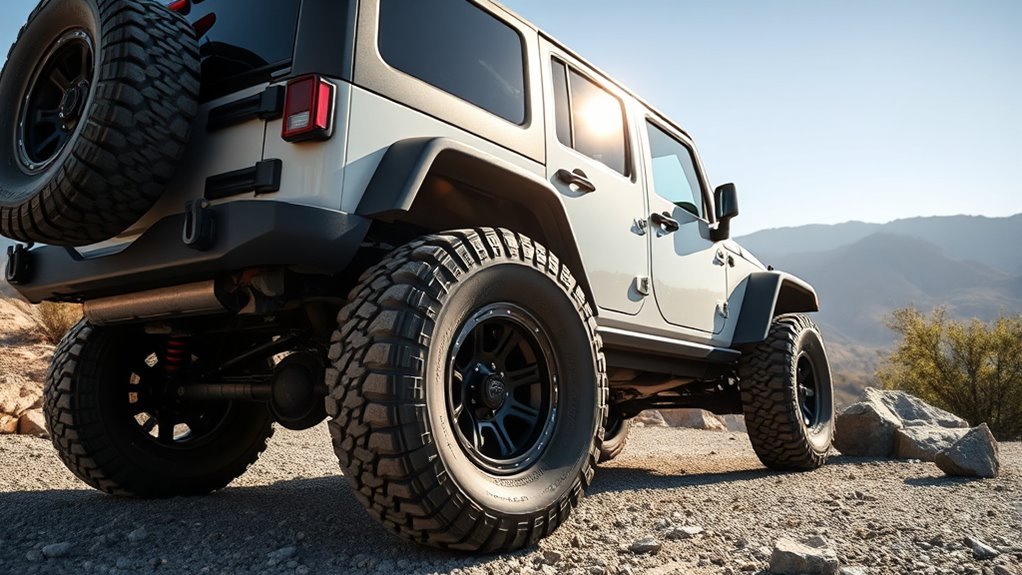
Thirty-five-inch tires can transform a Jeep Wrangler’s ground clearance and trail capability, but “will they fit?” has more than one answer. A tire may mount to the wheel and clear during normal street driving yet still hit the control arms, fender liners, flares, or bumper at full steering lock or full suspension compression.
Quick Answer
Yes, some JK and JL Wranglers can physically wear 35-inch tires at stock ride height, but a universal “bolt-on” answer is unsafe. Fit depends on model year, trim, actual tire size, approved rim width, wheel offset, and intended suspension travel. Street-only clearance may work; trail use usually needs more clearance, bump-stop control, and calibration.
Key Takeaways
- Do not shop by the word “35” alone. Verify the exact tire’s measured diameter, section width, load rating, and approved rim-width range.
- A stock 17×7.5-inch wheel may accept some narrower 35×11.50R17 tires, but many 315/70R17 and 35×12.50R17 tires require a wider wheel.
- A suspension lift can improve static clearance, but it does not automatically fix control-arm contact or protect the flares at full compression.
- Plan for tire-size calibration, alignment checks, possible gearing changes, and a safe way to carry the heavier full-size spare.
- Use your VIN, build sheet, door placard, owner manual, and the tire manufacturer’s current data sheet before ordering parts.
At a Glance
| Time Required | 30–60 minutes for a basic measurement and clearance inspection; longer if the suspension must be safely articulated |
| Difficulty | Moderate; professional mounting and a final alignment are recommended |
| Tools Needed | Tape measure, flashlight, straightedge, tire gauge, chalk, wheel chocks, and rated ramps or jack stands if suspension travel is checked |
| Cost | The inspection may be free; wheels, lift components, calibration, spare-tire support, alignment, and gearing can make the total vary widely |
Can 35s Fit a Stock Jeep Wrangler?
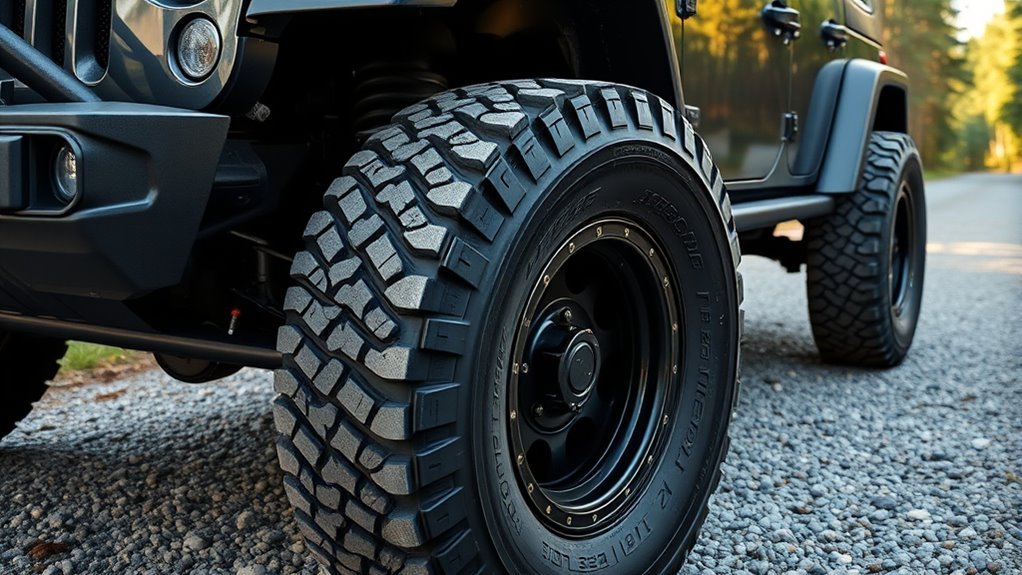
Some Wranglers can run a carefully selected 35-inch tire at stock ride height for normal road driving. That does not mean every 35 will fit every JK or JL, and it does not mean the tire will clear during off-road articulation.
The answer changes according to four definitions of “fit”:
- Wheel fit: The tire is approved by its manufacturer for the wheel’s diameter and width.
- Static fit: The mounted tire clears the body and suspension while the Jeep is parked.
- Street fit: The tire clears during normal steering, braking, driveway angles, and road bumps.
- Trail fit: The tire clears at full steering lock, full suspension compression, droop, and axle articulation.
A setup that passes the first three tests may fail the fourth. This is why a driver who stays on pavement may report “no rubbing,” while another driver with the same nominal tire size damages a liner or flare on the trail.
Warning: Do not mount a tire outside its approved rim-width range or below the vehicle’s required load and speed ratings. Jeep warns that unapproved tire-and-wheel combinations can change steering, handling, and braking and can place additional stress on steering and suspension parts. Verify the exact requirements in your model-year owner manual before installation.
Verify Your Jeep Generation, Trim, and Factory Equipment
Start with the VIN, build sheet, door-jamb tire placard, wheel markings, and owner manual. Do not rely only on the registration year or an online photo.
This is especially important for 2018 Wranglers. Mopar application information shows JK models continuing through 2018 while JL applications also begin in 2018. Confirm the generation before ordering a lift, wheel, calibration device, spare carrier, or steering part. The Mopar vehicle-information portal provides model-specific owner resources.
| Wrangler setup | Can a 35 fit? | Main checks |
|---|---|---|
| JL with a factory 35-inch package | Yes, as factory equipped | Use the original wheel, tire, pressure, calibration, axle, spare, and suspension specifications for that configuration. |
| Non-package JL at stock height | Sometimes for street use; not guaranteed for full articulation | Trim and fender design, tire width, wheel offset, control-arm clearance, bump stops, calibration, and spare support. |
| JK at stock height | Physical mounting may be possible, but dynamic clearance is highly setup-dependent | Wheel width, backspacing, front control-arm contact, fender clearance, bump stops, lift components, and tailgate support. |
| Any Wrangler used off-road | Only after a full articulation test | Full lock, full bump, droop, brake hoses, ABS wiring, flares, liners, bumper, and the spare assembly. |
Jeep currently offers factory 35-inch tires on certain Wrangler configurations. That confirms the platform can be engineered around the size, but it does not prove that every non-package Wrangler has the same wheel width, fender clearance, suspension tuning, axle ratio, calibration, or spare-tire hardware. Review the current Jeep Wrangler capability information as a factory reference, not as universal aftermarket approval.
Wheel Width Matters as Much as Tire Diameter
The tire sidewall designation is only the starting point. Before buying, open the manufacturer’s specification table for the exact size and load range. Confirm:
- Approved rim-width range
- Inflated overall diameter
- Inflated overall width
- Load index and maximum load
- Speed rating
- Tire weight
Current Nitto data illustrates why “a 35 is a 35” is unreliable:
| Example tire | Listed diameter | Listed overall width | Approved rim range |
|---|---|---|---|
| Ridge Grappler 35×11.50R17LT E | 34.76 in. | 11.42 in. | 7.5–10.0 in. |
| Ridge Grappler LT315/70R17 E | 34.41 in. | 12.72 in. | 8.0–10.5 in. |
| Ridge Grappler 35×12.50R17LT E | 34.76 in. | 12.52 in. | 8.5–11.0 in. |
| Trail Grappler LT315/70R17 D | 34.61 in. | 13.27 in. | 8.0–10.5 in. |
| Trail Grappler 35×11.50R17LT C | 34.76 in. | 11.42 in. | 7.5–10.0 in. |
These figures come from the current Nitto Ridge Grappler specification table and Nitto Trail Grappler specification table. Specifications may change, so check the data sheet again when ordering.
Note: A tire being narrow enough for a stock wheel does not guarantee Jeep clearance. It still must clear the steering, suspension, fenders, bumper, and body through the full range of movement.
How Offset and Backspacing Affect Clearance
Wheel width tells you whether the tire can be mounted correctly. Offset and backspacing determine where that tire sits under the Jeep.
- More positive offset or more backspacing moves the tire farther inward. This may improve outer-fender coverage but can increase contact with control arms, sway-bar links, steering parts, or the frame.
- Less positive or more negative offset, or less backspacing moves the tire outward. This can improve inner clearance but may increase flare contact, tire poke, steering scrub, bearing leverage, and bumper interference.
There is no universal “best” offset for every 35-inch tire. The correct geometry depends on wheel width, tire width, axle, brakes, steering parts, fender design, and local tire-coverage rules.
Pro Tip: Ask the installer to record the wheel width, offset, backspacing, tire specification, and clearance measurements on the invoice. Those numbers are far more useful than simply saying the Jeep has “35s.”
Measure These Points Before Buying 35s
A tape measure cannot duplicate full suspension movement, but it can identify an obviously incompatible plan. Record the current tire size, actual mounted diameter, wheel width, offset or backspacing, and the following gaps:
- Front inner clearance: Measure from the tire to the lower control arm, sway-bar link, frame, and other nearby parts with the steering centered and at both locks.
- Front outer clearance: Inspect the inner liner, flare edge, bumper corner, and any air dam or splash panel.
- Vertical clearance: Measure above the tire, but do not assume a fixed one-inch gap is enough. Suspension compression and steering angle change the required space.
- Rear clearance: Inspect the liner, flare, body seams, bumper, and shock or sway-bar area.
- Spare clearance: Check the tailgate carrier, bumper, rear camera, rear wiper where applicable, and center high-mounted stop light.
Also compare the new tire’s listed section width with the current tire. Half of the width increase generally moves toward the suspension and half toward the fender when wheel position is unchanged, although the mounted shape also depends on rim width.
How to Perform a Safe Dynamic Fitment Test
Final clearance must be checked after professional mounting and before demanding trail use.
- Park on level ground, set the parking brake, place the transmission in Park or in gear, and chock the wheels.
- Confirm that all tires are correctly seated, balanced, inflated to an appropriate cold pressure, and installed with working TPMS sensors where required.
- Turn the steering slowly from lock to lock while a helper watches the inner and outer front clearances.
- Drive slowly through a controlled parking-lot circle in both directions. Listen and feel for contact.
- Use rated ramps or professional shop equipment to load one corner at a time and inspect compression and articulation.
- Check the opposite side at droop, especially if a lift was installed. Verify that brake hoses and ABS wires are not pulled tight.
- Mark suspected contact points with chalk, correct the cause, and repeat the test.
- After the first controlled road test, inspect for polished metal, rubbed plastic, loose liner fasteners, unusual steering feel, or a TPMS warning.
Warning: Never crawl under a Jeep supported only by a jack. Use correctly rated ramps or jack stands on a firm, level surface, or have a qualified shop articulate the suspension.
A tire does not truly fit until it clears at full steering lock and through the suspension travel you intend to use.
Where 35-Inch Tires Commonly Rub
Contact location tells you which part of the setup must change. A lift is not the answer to every rubbing problem.
- Control arm or sway-bar contact at full lock: Usually points to tire width or wheel backspacing rather than vertical ride height.
- Front liner or bumper contact while turning: May require a wheel-position change or careful relocation or trimming of a nonstructural plastic panel.
- Flare contact at compression: Calls for more full-bump clearance, appropriate bump-stop control, different flares, a narrower tire, or another suspension solution.
- Rear liner, seam, or bumper contact: Requires inspection during articulation, not just while parked.
- Spare-tire or bumper contact: May require an adjustable carrier, relocation hardware, or tailgate reinforcement.
Do not cut structural sheet metal, steering parts, suspension mounts, brake components, or wiring to make a tire fit. If the contact point is structural or unclear, use a Jeep specialist.
Minimal Modifications to Run 35s Correctly
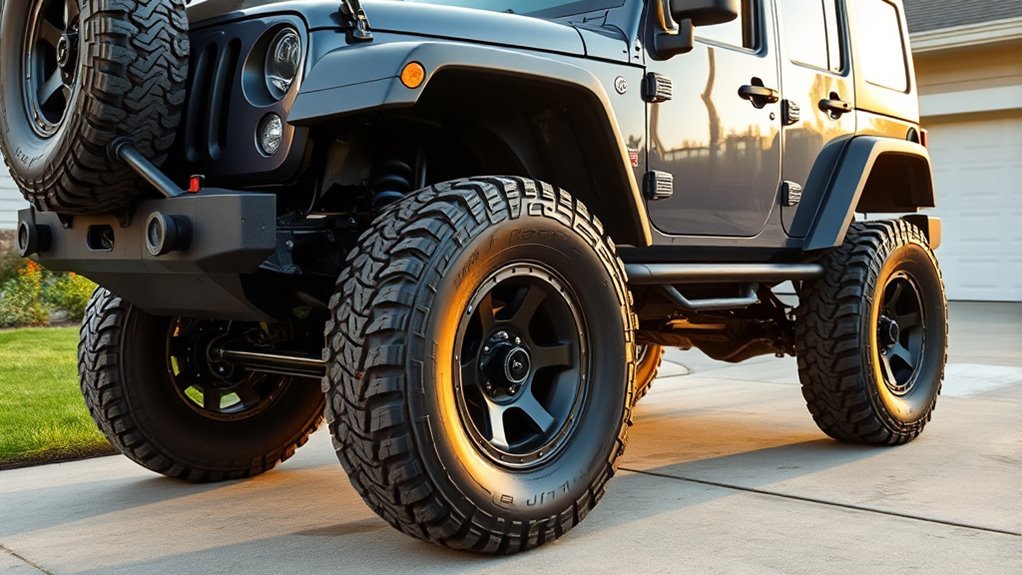
The least invasive solution is the one that corrects the actual contact point without creating a new problem elsewhere. Work through the following order.
- Choose a compatible tire and wheel: Start with approved rim width, sufficient load capacity, and a realistic overall width.
- Correct wheel position: Select offset and backspacing that balance inner clearance, outer clearance, and tire coverage.
- Relocate or trim only nonstructural plastic: Remove the minimum material needed and retain fasteners and splash protection wherever possible.
- Add a vehicle-specific lift when needed: A quality lift can improve ride-height clearance and articulation. Mopar’s Jeep Performance Parts catalog lists lift applications designed to accommodate larger tires, but the correct kit depends on generation, engine, weight, and intended use.
- Set full-bump clearance: Appropriate bump-stop length may be necessary to prevent the tire from entering the flare or body at compression.
- Center and align the axles: A lift can move an axle laterally. An adjustable track bar may be used to recenter it, but a heavy-duty track bar is not an automatic cure for larger tires.
- Calibrate tire size: Correct the speedometer and odometer and verify transmission behavior and warning systems.
- Support the spare: Confirm carrier strength, hinge support, bumper clearance, camera view, and brake-light visibility.
Do You Need Wheel Spacers?
Wheel spacers can move a tire outward and improve control-arm or frame clearance, but they should not be the automatic first choice. Moving the tire outward can create new contact at the flare or bumper and changes the leverage applied to wheel bearings and steering components.
Use spacers only after measuring the required movement. Choose a reputable, vehicle-specific design, follow its installation and torque instructions, confirm adequate hardware engagement, and recheck it at the manufacturer’s stated interval. An appropriately specified wheel is often the cleaner long-term solution.
Tire Pressure, Load Capacity, and TPMS
The maximum pressure molded into an LT tire’s sidewall is not a universal street-pressure recommendation. Pressure must support the Jeep’s actual axle loads while maintaining safe handling, braking, temperature control, and tread contact.
The original door placard applies to the original tire configuration. When changing to a different tire size or construction, have a qualified tire professional determine an appropriate cold pressure using the tire manufacturer’s load data. Never choose a tire with less load capacity than the vehicle requires.
Retain functioning TPMS sensors unless the vehicle and local rules permit otherwise. After installation:
- Confirm that each wheel reports pressure correctly.
- Check for a TPMS warning or “service tire pressure system” message.
- Use an accurate handheld gauge rather than relying only on the dashboard.
- Recheck cold pressure after temperature changes and before highway or trail travel.
How 35s Change Speedometer, Gearing, and Road Performance
A taller tire travels farther with each revolution. Without tire-size calibration, the speedometer and odometer will generally read lower than the Jeep’s true road speed and distance.
Re-gearing and recalibration are separate jobs:
- Tire-size calibration corrects the vehicle’s electronic tire-size setting and related displays or behavior supported by that model.
- Re-gearing changes the mechanical axle ratio to restore engine speed and torque multiplication.
Do not select 4.56 gears simply because that ratio is common in online discussions. A JK with 3.21 axle gears may feel a larger performance loss than a Jeep that started with a deeper ratio, but the correct replacement depends on the engine, transmission, transfer case, true tire diameter, vehicle weight, towing, terrain, and preferred highway speed. An axle specialist should calculate expected engine rpm in top gear before parts are ordered.
Larger and heavier tires may also cause:
- Slower acceleration
- More frequent transmission downshifts
- Reduced fuel economy
- Heavier or slower steering response
- More tread noise, depending on the tire
- Changed brake feel and heat load
These effects vary. Tire construction, tread, weight, inflation, wheel weight, engine, gearing, and driving style all matter.
Note: Re-gearing does not by itself correct an inaccurate speedometer. Complete the supported tire-size calibration separately.
Steering, Braking, and Alignment Checks
Larger tires add rotating mass and leverage. They can expose worn ball joints, tie-rod ends, wheel bearings, steering components, shocks, or control-arm bushings that seemed acceptable with the smaller factory tires.
Before installation, inspect those components and correct existing play. After installation:
- Set toe and verify steering-wheel center.
- Confirm that the axles are centered after any lift.
- Check caster and other alignment values against the suspension manufacturer’s instructions.
- Perform a low-speed braking and emergency-maneuver check in a safe, empty area.
- Stop driving and inspect the Jeep if it pulls, wanders, vibrates, rubs, or activates warning lights.
- Recheck lug-nut torque according to the wheel maker, installer, and owner-manual instructions.
Do Not Forget the 35-Inch Spare
A full-size spare is part of the fitment plan. A 35-inch LT tire and wheel can be much heavier than the original assembly and may sit closer to the bumper, brake light, rear camera, or rear wiper.
Inspect:
- Tailgate hinges and sheet metal
- Spare-tire carrier adjustment and load capability
- Rubber bump stops that support the tire against the tailgate
- Rear bumper clearance
- Center high-mounted stop light visibility
- Rear-camera position and field of view
- License-plate visibility where applicable
Mopar offers separate tailgate-reinforcement and oversized spare-carrier components for Wrangler applications, which shows that mounting the fifth tire is a separate engineering concern rather than an afterthought.
Off-Road Reality With 35-Inch Tires
Off-road articulation is where a borderline street setup usually reveals its weaknesses. As the axle moves, the tire follows an arc through the wheel well. Steering while compressed can move the tread and sidewall toward several contact points at once.
Aired-down tires can also bulge wider than they do at street pressure. Use pressures suitable for the tire, wheel, vehicle load, speed, and terrain. Do not return to highway speed at trail pressure.
After each demanding trail trip:
- Inspect the tread and sidewalls for cuts or polished rubbing marks.
- Check flares, liners, bumper ends, and fasteners.
- Inspect steering and suspension joints for looseness.
- Check wheel balance if new vibration appears.
- Verify tire pressure and TPMS operation.
- Inspect the spare carrier and tailgate hinges.
Repeated rubbing is not harmless. It can cut a tire, damage a flare, expose wiring, loosen a liner, or apply unwanted force to suspension and body parts.
Frequently Asked Questions
Can you put 35s on a stock Jeep Wrangler?
Sometimes. A carefully selected tire may mount and clear during normal street driving on certain JK or JL configurations. Full steering and off-road articulation often require additional wheel clearance, suspension changes, bump-stop control, or trimming. Verify the exact tire, wheel, trim, and intended use rather than relying on nominal diameter alone.
Can I run 35-inch tires without a lift?
A no-lift setup may work for limited street use on some Wranglers, especially with a narrower tire and compatible wheel. It may still rub at full lock, over large bumps, or during articulation. A lift can improve static clearance but does not replace wheel-width, offset, backspacing, and full-bump checks.
Will a 35×12.50R17 tire fit a stock 17×7.5 Jeep wheel?
Do not assume it will. Many 35×12.50R17 tires require a minimum 8.0- or 8.5-inch wheel, depending on the model. For example, the current Nitto Ridge Grappler 35×12.50R17 specification lists an approved 8.5–11-inch rim range. Use the exact tire manufacturer’s specification rather than a general Jeep forum answer.
Is 315/70R17 the same as 35×11.50R17?
No. They are separate size designations. Their actual diameter, overall width, approved rim range, weight, and load rating can differ. Current Nitto Trail Grappler data, for example, lists LT315/70R17 at 34.61 inches in diameter and 13.27 inches wide, while its 35×11.50R17 is 34.76 inches in diameter and 11.42 inches wide.
Do I need to regear my Jeep for 35s?
Not every Jeep requires immediate re-gearing, but taller and heavier tires reduce effective gearing. The need and correct ratio depend on the existing axle ratio, engine, transmission, true tire diameter, vehicle weight, towing, terrain, and desired highway rpm. Tire-size calibration is still required separately when supported.
Will 35s make the speedometer inaccurate?
Yes, when the new rolling diameter is larger than the size stored in the vehicle. The speedometer and odometer will generally under-report speed and distance until the supported tire-size setting is recalibrated.
Do I need a reinforced spare-tire carrier for a 35?
It depends on the carrier, wheel, tire weight, bumper clearance, and tailgate system. Check the carrier’s stated capacity and the Jeep’s hinges and support bumpers. Also verify the center brake light, rear camera, rear wiper, and bumper clearance. Mopar offers oversized carrier and tailgate-reinforcement systems for relevant Wrangler applications.
Conclusion
Thirty-five-inch tires can work on a Wrangler, but “stock Jeep” is not a complete fitment specification. A safe setup begins with the exact JK or JL model, trim, wheel dimensions, axle configuration, tire data sheet, and intended suspension travel.
For occasional street use, a narrower manufacturer-approved 35 may require fewer changes than a wide 35×12.50. For regular off-road use, plan for full-articulation clearance, proper bump stops, appropriate wheel geometry, calibration, alignment, and secure spare-tire support. Re-gearing may improve performance, but it must be selected for the Jeep’s engine, transmission, axle, and driving needs rather than copied from a generic recommendation.
Measure first, use current manufacturer specifications, and test the complete setup safely. That approach protects the tires, steering, body, and suspension while giving you the capability you expected from the upgrade.
Sources
- 2026 Jeep Wrangler Capability — current factory 35-inch tire availability and Wrangler capability information
- Mopar Vehicle Information and Owner Manuals — model-year owner resources and vehicle-specific guidance
- 2024 Jeep Wrangler Owner’s Manual — replacement tire, wheel, load-rating, handling, speedometer, and TPMS warnings
- Nitto Ridge Grappler Specifications — actual diameters, widths, load data, and approved rim-width ranges
- Nitto Trail Grappler Specifications — comparison data for 315/70R17, 35×11.50R17, and 35×12.50R17 sizes
- Jeep Performance Parts Catalog — lift, oversized spare-carrier, and tailgate-reinforcement applications





Leave a Reply