
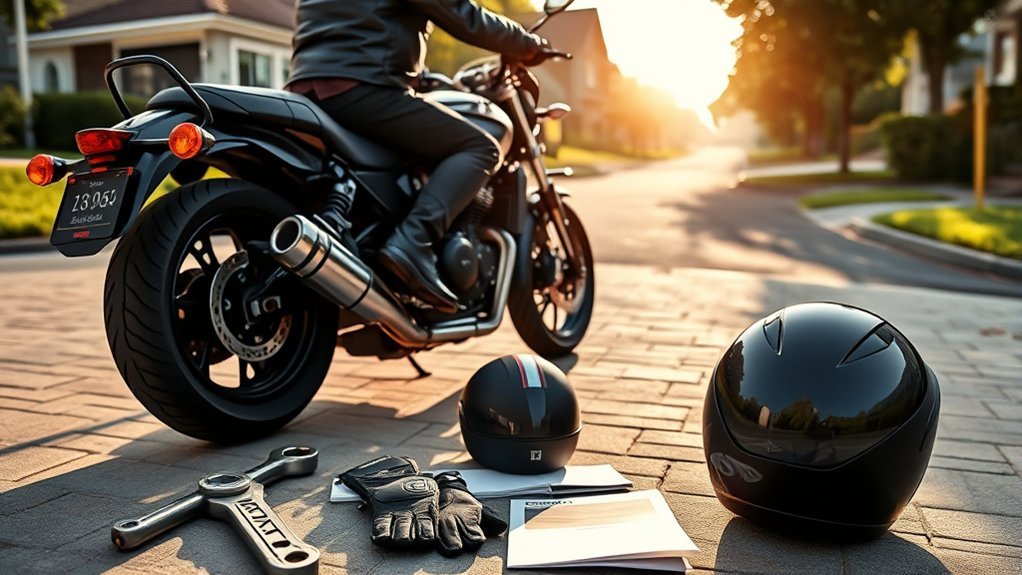
To ride a motorcycle, start with proper gear like a DOT-approved helmet, armored jacket, and reflective clothing for safety. Understand your bike’s components, including engine and brakes. When you’re ready, check that your motorcycle is in neutral, engage the clutch, and start it. Gradually release the clutch while applying throttle. Master braking techniques by using both front and rear brakes effectively. Avoid common mistakes like neglecting tire maintenance, and learn more about optimizing your riding experience.
Essential Tools for Motorcycle Riding: Gear Up Right
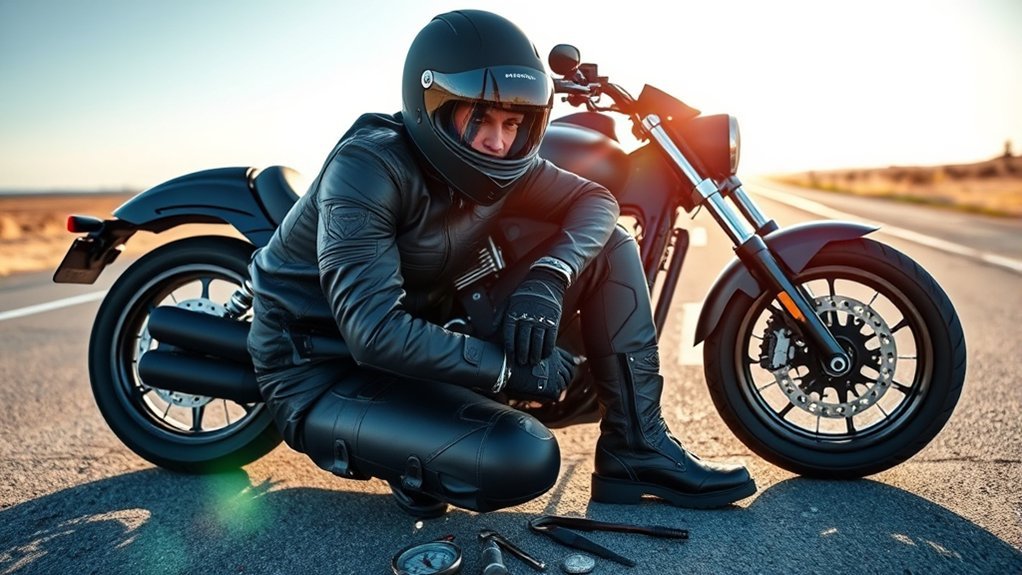
When you hit the road on a motorcycle, having the right gear is crucial for your safety and comfort. Start with a DOT-approved helmet; it’s your first line of defense.
Next, invest in necessary riding gear like an armored jacket, gloves, durable pants, and sturdy boots. These items greatly reduce your injury risk in case of a crash.
Invest in essential riding gear like armored jackets, gloves, durable pants, and sturdy boots to significantly reduce injury risks in crashes.
Don’t overlook visibility enhancements. Reflective vests or bright-colored jackets make you stand out, especially in low-light conditions, keeping you safer on the road.
Additionally, a well-stocked motorcycle toolkit is important. Include items like a tire repair kit, wrenches, and a first aid kit to handle common issues.
Regular maintenance tools, such as a tire pressure gauge and chain maintenance tools, guarantee your bike operates safely and efficiently. Gear up right, and you’ll enjoy longer, liberating rides with peace of mind.
Why Understanding Your Motorcycle Matters
Understanding your motorcycle’s key components is essential for a smooth and safe ride. Knowing how each part functions, from the transmission to the brakes, can enhance your control and responsiveness.
Plus, staying on top of maintenance guarantees your bike performs effectively and keeps you safe on the road.
Key Motorcycle Components Explained
Key motorcycle components play an essential role in your riding experience, impacting everything from performance to safety. Understanding these elements, such as engine specifications and brake systems, is vital for effective operation.
| Component | Importance |
|---|---|
| Engine Type | Affects performance and fuel efficiency |
| Transmission | Guarantees smooth gear changes |
| Brake Systems | Critical for stopping power and control |
| Tires | Influence traction and overall safety |
Familiarizing yourself with the engine type, whether it’s four-stroke or two-stroke, helps optimize your ride. Knowing the shifting pattern in your transmission prevents stalls, while understanding the distinction between front and rear brake systems enhances your control. Embrace this knowledge for a safer, more liberated ride.
Importance Of Proper Maintenance
Proper maintenance is essential for keeping your motorcycle in top shape and ensuring a safe ride.
Regularly checking your tire pressure is vital for ideal traction. Riding on bald or improperly inflated tires can lead to accidents, especially in wet conditions.
Familiarizing yourself with your bike’s maintenance schedule lets you address issues like tire wear and braking system functionality before they become serious problems. Understanding your motorcycle’s recommended tire specifications helps maintain safe riding conditions, enhancing grip and stability.
Routinely inspect your tires for tread depth and cracks to prolong their life. By prioritizing these maintenance tasks, you empower yourself for safer, more enjoyable rides.
Starting Your Motorcycle: Step-by-Step Process
Starting your motorcycle is an essential skill every rider should master. Follow this step-by-step starting procedure to get yourself ready for the open road:
Mastering the art of starting your motorcycle is crucial for every rider’s journey to the open road.
- Verify your motorcycle is in neutral by checking the gear indicator or gently rocking it back and forth with the clutch pulled in.
- Fully engage the clutch before pressing the starter button to prevent accidental movement.
- Turn on the ignition switch and perform an ignition check to confirm all lights and indicators are functioning.
- If necessary, activate the choke or tickler as per the manufacturer’s instructions for cold starts.
Once the engine is running, gradually release the clutch while applying a small amount of throttle. This will help you achieve a smooth take-off without stalling.
Mastering this process not only sets the tone for your ride but also guarantees safety and confidence as you embrace the freedom of the open road.
Mastering Clutch and Throttle Techniques
To ride smoothly, you need to master clutch engagement and throttle control.
Balancing these two elements will help prevent stalling and guarantee a seamless ride.
Practice regularly to build your confidence and skill in managing these techniques.
Clutch Engagement Techniques
Mastering clutch engagement is essential for smooth motorcycle operation. To excel, focus on clutch modulation and understanding the friction zone. Here are key techniques to practice:
- Pull the clutch lever fully before shifting to prevent stalling.
- Gradually release the clutch while applying throttle to balance power and movement.
- Identify the friction zone where the clutch begins to engage for smoother starts and stops.
- Practice at low speeds in a safe environment to build confidence and refine your skills.
Throttle Control Tips
While you navigate the complexities of motorcycle riding, effective throttle control is essential for achieving seamless acceleration and deceleration.
Balancing throttle modulation with clutch engagement is vital for smooth starts. Gradually release the clutch while applying throttle to maintain steady RPM, preventing stalling.
Listen to your engine’s sound and, if you have a tachometer, use it to determine ideal shift points. This awareness not only enhances engine responsiveness but also builds your confidence on the road.
Practicing in a low-traffic area allows you to refine these techniques without pressure.
Mastering the interplay between clutch and throttle will greatly improve your riding performance, liberating you to explore the open road with assurance and finesse.
Effective Braking Techniques: Mastering Front and Rear Control
Effective braking techniques are essential for safe motorcycle riding, as they enable you to maintain control in various situations.
Mastering both front and rear brakes is key, and understanding weight distribution is critical to your safety. Here’s how to brake effectively:
- Use a braking ratio of 60/40 to 70/30 for cruisers, or 80/20 to 90/10 for sport bikes.
- Gradually squeeze the front brake lever to avoid abrupt stops while engaging the rear brake gently.
- Start braking before entering a turn to maintain traction and stability.
- Regularly practice emergency stops to enhance your reaction time.
Motorcycle Gear Shifting Basics: When and How to Shift Gears

Shifting gears on a motorcycle is a fundamental skill that directly impacts your riding experience and control. To effectively master shifting techniques, you need to understand the gear patterns, which typically follow a sequential order from 1 to 5.
When shifting up, roll off the throttle, pull in the clutch, and press down on the shift lever. Smoothly release the clutch while reapplying throttle.
For downshifting, use the same initial steps: roll off the throttle, pull in the clutch, and shift down, but be mindful to match the engine RPM to the lower gear, often achieved by “blipping” the throttle.
Listening to your bike’s engine sound or watching the tachometer helps you identify the ideal shifting point, usually between 2,500-4,000 RPM.
Practicing these shifts in a controlled setting builds muscle memory and confidence, making your riding more fluid and enjoyable.
Don’t Make These Rookie Mistakes
As you commence your motorcycle journey, it’s essential to steer clear of common rookie mistakes that can compromise your safety and riding experience. Here are some key pitfalls to avoid:
- Neglecting braking techniques: Relying too heavily on one brake can lead to skidding. Aim for a balanced use of both front and rear brakes.
- Skipping visibility gear: Riding at night without reflective clothing or clear visors greatly decreases your visibility to others.
- Ignoring tire maintenance: Regularly check your tires for wear and adhere to the manufacturer’s specifications for PSI and replacement.
- Overlooking braking ratios: Different bikes require different braking ratios; know these to enhance your stopping power.
Maintaining Your Tires for Safety and Performance
Ensuring your motorcycle is equipped with well-maintained tires is essential for both safety and performance. Start by regularly checking your tire pressure according to your manufacturer’s specifications. Incorrect PSI can drastically affect handling, so don’t inflate them to the maximum sidewall limit; refer to the pressure indicated on your vehicle identification number (VIN).
Next, inspect your tires for tread wear. Look for wear bars and replace the tires before they become bald to maintain peak traction in various conditions. Additionally, keep an eye out for signs of damage, like dry rot or cracks, which can compromise your safety.
Always use tires that meet your motorcycle’s recommended specifications, as mismatched tires can lead to handling issues and increase your risk of accidents.
Continuous Learning and Improvement: Embrace the Journey

While riding a motorcycle can be exhilarating, it’s essential to embrace continuous learning and improvement to enhance your skills and safety on the road.
This mindset shift opens doors to better riding experiences. Here’s how you can guarantee you’re always growing:
- Recognize the Dunning-Kruger Effect; overconfidence can stunt your growth. Keep a “beginner’s mind.”
- Regularly practice and participate in training courses to develop your skills.
- Seek feedback loops from experienced riders and instructors for valuable insights.
- Stay informed about motorcycle operation, safety gear, and techniques to adapt to challenges.
Frequently Asked Questions
What Is the 1% Rule in Motorcycles?
The 1% Rule in motorcycles encourages you to improve your riding techniques by focusing on specific skills, like braking or cornering, each time you ride, while always wearing safety gear to enhance your overall proficiency.
What Does 2 Fingers Down Mean for Bikers?
The “2 fingers down” gesture among bikers signifies camaraderie and motorcycle etiquette. By extending two fingers, you acknowledge fellow riders, promoting unity and safety within the community. It’s a simple yet powerful biker hand signal.
What Is the 12 Second Rule for Motorcycles?
The 12-second rule means you should look 12 seconds ahead while riding. This helps you manage braking distance and maintain a safe following distance, enhancing your reaction time and overall safety on the road.
What Is 1 N 2 3 4 5 Gear Pattern Bike?
The 1 N 2 3 4 5 gear pattern on motorcycles allows smooth gear shifting across various types. Understanding this pattern liberates your riding experience, optimizing power and efficiency while enhancing control over your machine.
Conclusion
Riding a motorcycle isn’t just a skill; it’s an exhilarating adventure that’ll make you feel like a superhero on two wheels. By gearing up, understanding your bike, and mastering the essentials, you’re well on your way to becoming a confident rider. Remember to practice patience and learn from your mistakes. As you hit the road, embrace every twist and turn—each ride is an opportunity to grow. So, rev up and enjoy the ride of a lifetime!






Leave a Reply