
 Lysander Voss
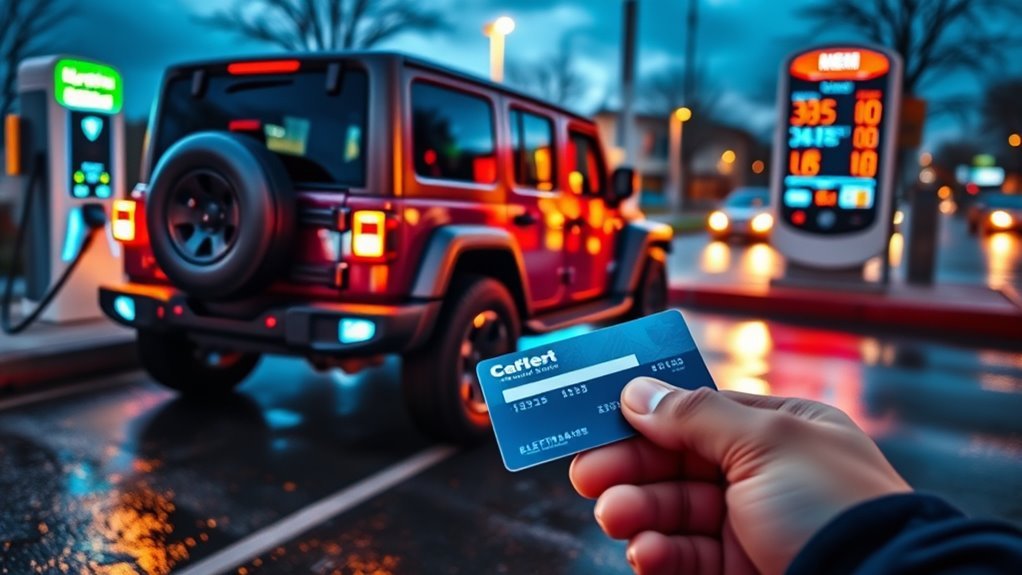
You’ll typically pay about $1.60–$3.00 to fully charge a Jeep 4xe at home because it has 17 kWh total with ~15 kWh usable; multiply usable kWh by your local rate (e.g., 15 kWh × $0.11 = $1.65) and add small efficiency losses. Level 1 is slow but cheap, Level 2 is faster and slightly more efficient, public/DC fast charging costs more. Continue for detailed per‑kWh examples, monthly estimates, and cost‑saving tactics.
Typical Cost to Fully Charge a Jeep 4xe
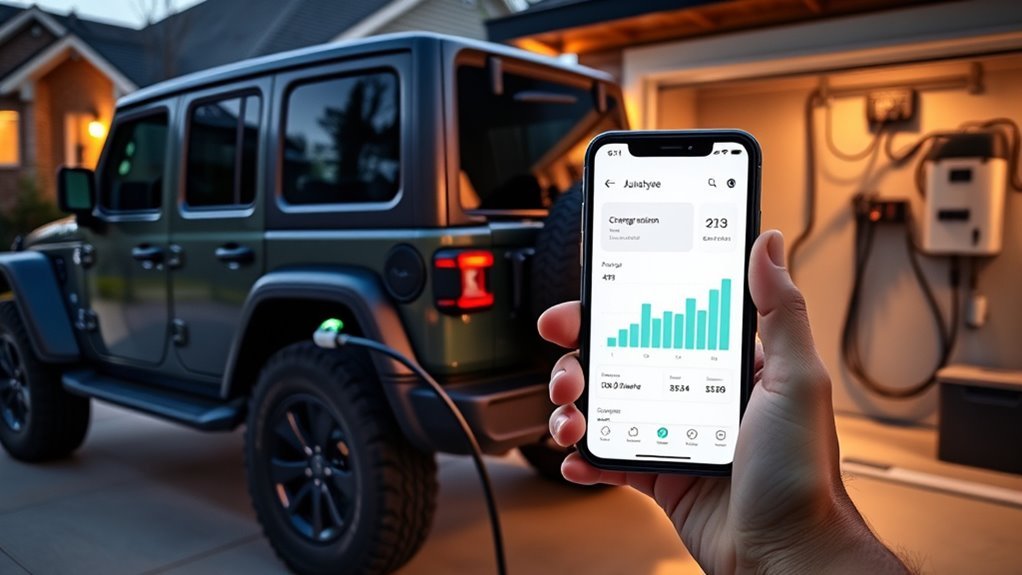
How much will it cost you to fully charge a Jeep 4xe? You’ll pay roughly $2.87 to top a 15 kWh battery at an average grid rate of $0.11/kWh. Regional variations matter: in NW Florida overnight charges with taxes/fees average about $2, while Oregon’s lower rates (~$0.06/kWh) drop the cost below $1. Your charging habits change monthly impact—many owners charge every other day, producing an average $30 rise in electric bills. Use a Kill A Watt monitor to measure actual consumption, validate utility billing, and apportion costs in shared housing. Compared with gasoline, that per-charge expense is clearly liberating: it frees you from frequent fuel stops and high pump prices. Stay tactical: schedule charging during off-peak windows, record session data, and adjust routines to exploit local rates and minimize total ownership cost.
How Battery Size and Usable kWh Determine Charge Cost
When you compare the Jeep 4xe’s 17 kWh battery with its 15 kWh usable capacity, you’re looking at the actual energy that determines per-charge cost. Multiply usable kWh by your local rate (e.g., 15 kWh × $0.11 ≈ $1.65) and then account for charging efficiency losses to get the true cost. Slight efficiency losses at the charger or inverter push the nominal per-charge estimate up, so factor those when projecting monthly bills.
Battery Capacity vs Usable
Because the Jeep 4xe’s battery is rated at 17 kWh but only 15 kWh is usable, you’ll be charged for roughly 15 kWh when you recharge from empty to full — not the full pack size — so use the usable kWh to calculate cost. Know the capacity comparison: total vs usable determines what you actually pay for and what you can drive on. Battery efficiency affects how much energy reaches the wheels versus heat and losses, but billing still aligns with meter kWh consumed. At ~$0.11/kWh, full fills cost about $1.595; frequency scales monthly cost (e.g., every other day ≈ $30/month). Use usable capacity and realistic efficiency figures to plan charging schedules, minimize wasted charge, and gain autonomy.
Per Charge Energy Cost
While the Jeep 4xe’s pack is 17.3 kWh, you’ll pay based on the usable 15 kWh, so multiply that usable capacity by your local rate to estimate a per‑charge cost. Use that simple calculation to free yourself from guesswork: at $0.11/kWh a full usable charge costs about $1.65; at $0.06/kWh it’s about $0.90. Regional variations matter for budgeting and route planning, and your charging habits—frequency and state of charge—drive real expenses.
- Compute: 15 kWh × local rate = per‑charge cost (precision beats estimates).
- Compare: use regional variations to optimize home vs public charging choices.
- Monitor: install a meter (e.g., Kill A Watt) to track consumption and validate costs.
Impact Of Charging Efficiency
Although the Jeep 4xe’s pack is rated at 17 kWh, you’ll be billed on roughly 15 kWh of usable energy, so charging efficiency directly sets your per‑charge cost: multiply 15 kWh by your local rate (e.g., $0.11/kWh ≈ $1.65; $0.06/kWh ≈ $0.90) and adjust for charger losses and conversion inefficiency, which can raise the effective kWh drawn from the grid above the usable 15 kWh. You should plan for ~2.9–3.0 kWh of losses on a full charge if your charger and vehicle are average. Use Level 2 charging to cut time to ~2h15 and reduce standby losses versus 12‑hour Level 1 sessions. Employ charging strategies and efficiency tips: schedule off‑peak fills, monitor consumption with a Kill A Watt, and avoid frequent shallow cycles to maximize cost‑effective liberation.
Level 1 Vs Level 2 Charging: Time, Efficiency, and Cost
When you compare Level 1 and Level 2 charging for the Jeep 4xe, the trade-offs are clear: you balance Charging convenience, speed, and marginal cost to suit your freedom to travel. Level 1 uses a 120V outlet, adds about 12 hours to replenish the 15 kWh usable pack, and costs roughly $2.87 at $0.11/kWh — ideal for overnight top-ups when you control your schedule. Level 2 uses 240V, cuts charge time to ~2 hours 15 minutes, and supports multiple daily trips with higher operational tempo; local rates can make it slightly more expensive, but the Efficiency comparison favors Level 2 for frequent long drives.
- Time: Level 1 ~12 hrs vs Level 2 ~2 hrs 15 mins — choose based on trip rhythm.
- Cost: Level 1 ≈ $2.87; Level 2 may be modestly higher depending on rates.
- Use case: Level 1 for overnight convenience; Level 2 for rapid turnaround and autonomy.
Public and DC Fast Charging: Price Ranges to Expect
When you use public Level 2 chargers, expect roughly $0.11–$0.27 per kWh, which translates to about $2.87 to fully charge a Jeep 4xe from empty depending on local rates. DC fast charging cuts the time—up to ~80% in ~30 minutes—but per-session or per-minute fees and provider location can push costs higher and vary widely. Also watch for flat fees, time-based penalties, or promotional/free stations that will change your net cost.
Public Charging Price Ranges
Public public charging for the Jeep 4xe typically runs from about $0.10 to $0.60 per kWh, with DC fast chargers commanding higher rates—commonly $0.30 to $0.80 per kWh—so expect faster fills to cost more. You’ll encounter varied charging networks and pricing strategies; some add session fees, others meter strictly per kWh. Monitor costs with smart EVSEs or apps to maintain transparency and control spending as you move freely.
- Expect Level 2 public stations to cost roughly $2–$5 for a ~15 kWh top-up; session fees can raise that.
- DC fast options speed recharge but increase per‑kWh expense; weigh time versus price.
- Use network apps to compare rates, avoid surprises, and optimize liberation through informed choices.
DC Fast Charge Costs
DC fast charging delivers high power (typically 50–350 kW) so you can add most of the Jeep 4xe’s 17.3 kWh battery from 0–80% in roughly 30 minutes. You’ll pay more than home charging: public DC rates typically run $0.10–$0.80 per kWh, so a full 17.3 kWh charge costs about $1.73–$13.84. For 0–80% you’re looking proportionally lower. Use fast chargers for range and time efficiency when you need freedom on the road. Compare charging network prices and access rules before you go. If you rely on DC fast often, evaluate subscription plans—some cut per-kWh fees and session costs. Plan routes around cost and availability to stay liberated and economical.
How to Calculate Your Per-Charge Cost (Reusable Formulas)
Start with a simple formula: multiply the Jeep 4xe’s usable battery capacity (15 kWh) by your local electricity rate to get the cost per full charge (e.g., 15 kWh × $0.11/kWh = $1.65). Use that reusable formula to compare options, track charging habits, and make precise cost comparisons across regions. If you want real data, measure with a Kill A Watt or similar monitor to capture actual losses and shared-living usage.
- Full-charge cost = usable kWh × $/kWh — plug in 15 kWh and your local rate for a baseline.
- Partial-charge cost = (kWh added) × $/kWh — useful when you top off or run mixed EV/ICE patterns.
- Monthly cost = (charges per month) × full-charge cost — e.g., every-other-day charging = ~15 charges/month × full-charge cost.
Apply these formulas, log real measurements, and use results to free yourself from billing surprises and optimize economical charging.
Cost Examples at 6¢, 11¢, and 27¢ per kWh
Because electricity rates vary widely, you can quickly see how little it costs to top up a Jeep 4xe: at 6¢ per kWh a full 15 kWh usable battery costs about $0.90, at 11¢ it’s roughly $1.65, and at 27¢ it rises to approximately $4.05. You’ll use these benchmarks for practical charging strategies and cost comparisons when planning trips or daily use.
Treat the 6¢ example as your low-cost baseline—schedule charging during off-peak or take advantage of time-of-use plans to approach that figure. The 11¢ rate represents an average case; at about $1.595 per charge it demonstrates clear savings versus gasoline, supporting the case for electrified freedom. The 27¢ scenario shows how regional pricing can erode savings; you’ll want to combine load-shifting and targeted charging to mitigate high rates. Use these numbers to evaluate ownership in your area and to choose charging strategies that align with your goal of mobility liberation.
How to Track and Split Charging Costs (Kill A Watt, Smart EVSEs)
When you want precise billing and fair cost-sharing for charging a Jeep 4xe, measure actual energy drawn with a plug-in meter or a smart EVSE and use those readings to allocate expenses. You’ll get accurate kWh figures instead of estimates, which makes charging strategies transparent and empowers you to free yourself from opaque fuel bills. A P3 International P4460 Kill A Watt EZ plugged into the EVSE or a compatible smart EVSE that logs sessions gives you verifiable consumption data. Use readings to create simple invoices or a shared spreadsheet that tracks each session, rate, and total cost. That way roommates or family members pay only for what they used.
- Use a Kill A Watt (P4460) to record kWh per session for straightforward cost sharing solutions.
- Deploy a smart EVSE with per-user logging to automate billing and enable scalable charging strategies.
- Reconcile monthly logs against utility rates to claim savings versus gasoline and maintain fairness.
Monthly and Annual Charging Costs by Driving Pattern
If you drive the Jeep 4xe regularly, your monthly and annual charging costs are predictable from simple inputs: usable battery capacity (15 kWh), your local electricity rate, and how often you recharge. At $0.11/kWh a full charge costs roughly $2.87. If you charge every other day (≈15 charges/month), expect about $43/month; some regions report $30/month with efficient habits and lower rates, while others add $70–$80 to electricity bills due to higher use or rates.
Your charging habits determine annual totals: multiply monthly spend by 12 for a baseline, then adjust for seasonal mileage. Daily commuting of 30–40 miles often maximizes electric miles per charge, lowering gas use and improving cost comparisons against fuel. In low-rate areas (e.g., $0.06/kWh), per-charge cost drops substantially, freeing you from frequent fuel stops. Track recharges, compute local rate impacts, and you’ll quantify savings precisely and claim control over your mobility costs.
When Charging a 4xe Makes Economic Sense (Use Cases and Trade-Offs)
Although charging patterns and local rates vary, you’ll usually see the best economics by charging a 4xe at home and using electric mode for short, frequent trips (roughly 30–40 miles), since a full 15 kWh charge costs about $2.87 at $0.11/kWh and can displace multiple gallons of fuel; in low-rate areas (≈$0.06/kWh) or with overnight Level 1 charging, per-charge costs drop further (some owners report ≈$2/night or ~$30/month), while relying on public charging or high electricity rates can erode those savings and change the trade-offs between electric miles and gasoline use.
- Prioritize home charging and electric mode for commutes: your driving habits determine how often a single charge replaces fuel, yielding clear cost savings versus a $4/gal fuel comparison.
- Use hybrid strategy for mixed trips: combine electric first for short trips, switch to gasoline for long hauls to maximize range and minimize cost.
- Factor user experiences: modest monthly bill increases (~$30) usually beat fuel-only costs, but verify local rates and charging access before committing.
Frequently Asked Questions
How Much Does It Cost to Fully Charge a Jeep Wrangler 4xe?
About $2.87 to fully charge a Jeep Wrangler 4xe at average electricity rates ($0.11/kWh); with charging efficiency and lower rates (e.g., $0.06/kWh) you’ll pay roughly $0.90, freeing you from fuel dependence.
Where Can I Charge My Jeep 4xe for Free?
You can charge your Jeep 4xe for free at shopping centers, parks, workplaces, libraries and some municipal public charging sites. Use apps like PlugShare to locate available charging stations and optimize your liberated, cost-free mobility.
Conclusion
You’ll typically pay $1.50–$5.00 to fully charge a Jeep 4xe at home depending on local rates, and knowing the usable kWh is key to accurate math. One striking stat: charging at 6¢/kWh vs 27¢/kWh cuts per-charge cost by ~78%, so time-of-use and utility rates matter more than charger type. Use the provided formulas and a smart EVSE or energy monitor to track kWh, optimize charging windows, and quantify savings month-to-month.