
 Lysander Voss
You’ll get a full Jeep 4xe charge in about 12–16 hours on Level 1 (120V), roughly 2–2.5 hours on a dedicated Level 2 (240V) setup, and about 30 minutes to reach ~80% on compatible DC fast chargers, though real times vary with state of charge, temperature, wiring and charger quality. Check circuit capacity, battery temperature and coolant system if charging seems slow. Keep this guide handy and you’ll learn practical fixes, setup tips and optimization strategies next.
How Fast Does a Jeep 4xe Charge? : Quick Answer
How fast does a Jeep 4xe charge? You’ll see clear tiers: Level 1 (standard 120V) is the slow, steady option—expect about 12–16 hours for a full charge from empty. Level 2 (240V) is the practical daily solution: with a 17.4 kWh battery and up to 7.7 kW charging, you’ll reach full in roughly 2–2.5 hours under ideal conditions. For long runs, DC fast charging is the liberation move: public fast chargers can bring you to about 80% in roughly 30 minutes, cutting downtime dramatically. When weighing charging alternatives, use time comparisons to choose what fits your rhythm—overnight at Level 1, rapid top-ups on Level 2, or a quick DC boost on the road. You’ll want to plan routes and stops with these benchmarks in mind so charging becomes predictable, efficient, and aligned with your need for mobility and independence.
What Affects 4xe Charging Speed? (Battery, SOC, Temp, Wiring)
Because several systems interact during charging, you’ll see wide variations in how fast a Jeep 4xe tops up. You’ll want to control the controllable: battery chemistry and state of charge (SOC) set baseline charge curves, so rates fall off as the pack nears full. Ambient temperature forces the thermal management system to heat or cool the battery, slowing or pausing charging when conditions are extreme. Wiring and outlet capacity determine how much power actually reaches the onboard charger; a 120V circuit delivers far less than a 240V installation. The 4xe’s onboard charger maxes near 7.7 kW, but actual power depends on SOC, temperature, and infrastructure.
- Battery chemistry and SOC: dictates charge profile and tapering behavior.
- Ambient temperature: triggers thermal control, affecting acceptance rate.
- Wiring/outlet capacity: limits delivered power; 120V vs 240V matters.
- Charging infrastructure & maintenance: station capability and coolant/maintenance prevent anomalies.
Understand these, and you’ll reclaim time and freedom from charging constraints.
How Long Is Level 1 Charging for the 4xe?
Level 1 charging the Jeep 4xe typically takes about 12–16 hours to go from empty to full on a standard 120-volt outlet, with many users seeing roughly 14 hours in real-world conditions. You’ll rely on Level 1 when you value simplicity and minimal infrastructure; it’s designed for overnight top-ups and daily commuting patterns. Charging efficiency drops as the state of charge climbs, so the final 10–20% takes noticeably longer due to tapering current and battery management protocols. Use a dedicated Level 1 Mopar charger on a 15-amp circuit to get the most consistent performance, but expect variance from outlet quality and ambient temperature. You won’t get rapid turnaround, yet you gain operational freedom: plug in at home, wake to a full battery, and avoid public chargers. For predictable routines and minimal setup, Level 1 is pragmatic—just plan charging windows to match your travel liberty and accept the slower charging curve as part of the trade-off.
How Fast Is Level 2 at Home? (Chargers, Adapters, Real 2–2.5 Hr Cases)
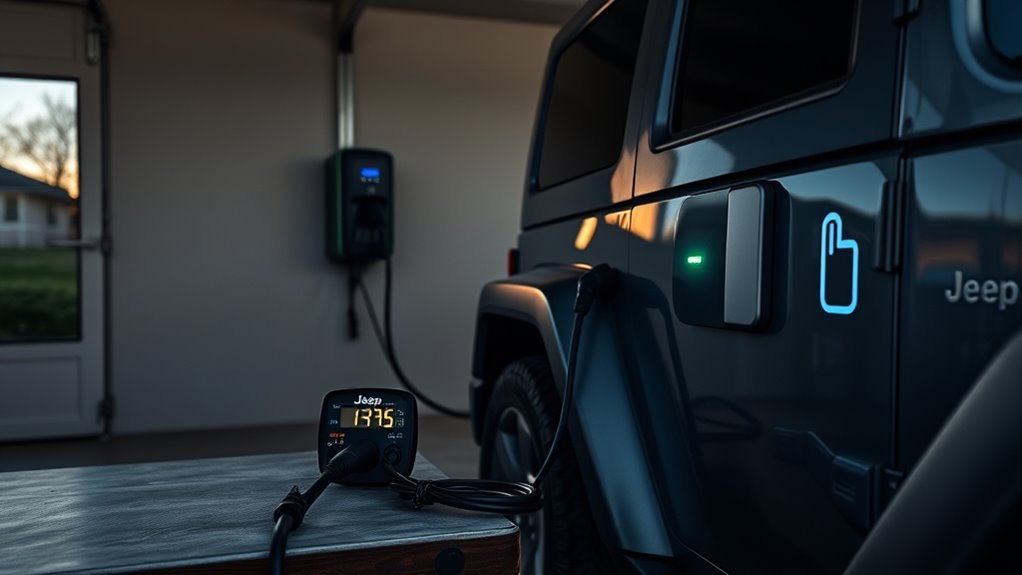
If overnight 120V charging feels too slow, upgrading to a 240V setup will shave hours off your recharge cycle: the 4xe’s onboard 7.7 kW charger lets a properly wired home Level 2 circuit refill the battery in roughly 2 to 2.5 hours from empty, with real-world reports showing about 2:35 to add ~15.6 kWh. You’ll get consistent, efficient home charging when you match the circuit and EVSE to the vehicle’s limits, avoiding bottlenecks and reducing downtime.
- Use a dedicated 240V / 40A or 32A circuit to deliver near the 7.7 kW or public 6.4 kW rates for predictable times.
- Hardwired Level 2 EVSEs beat adapters for safety, reliability, and sustained charge current.
- Monitor ambient temperature and state of charge — extremes and high SoC slow effective charge acceptance.
- Combine scheduled charging with efficiency tips: precondition while plugged in and prioritize off-peak power to maximize range and liberation from range anxiety.
Can DC Fast Chargers Add Significant Range in 30 Minutes?
How much range can you realistically add in half an hour? You can expect DC Fast Chargers to bring a Jeep 4xe to roughly 80% in about 30 minutes, delivering clear DC charging benefits for on‑the‑move freedom. At peak public stations the unit can accept up to 7.7 kW, so you’ll shave long stops into short breaks. Real‑world data shows 21–25 miles of all‑electric range added in about 10 minutes, so 30 minutes yields a substantial increment for longer legs.
| Scenario | Added Range |
|---|---|
| 10 minutes | 21–25 miles |
| 20 minutes | ~42–50 miles |
| 30 minutes | ~63–75 miles |
| 30 min to 80% | Charge to ~80% |
| 0→100% (opt.) | ~2 hours |
Use DC charging benefits strategically: it maximizes Range efficiency during travel while preserving your autonomy. Limit frequency to protect battery longevity; when you need range fast, this is liberation in motion.
What Common Problems Slow 4xe Charging : Checks & Fixes
Because charging performance depends on many systems beyond the cord, you should check a short list of likely culprits when your 4xe is slower than expected. Charging inefficiencies often trace to predictable sources—inspect them methodically so you can act without waiting.
- Charging equipment: Verify outlet voltage, circuit condition, and charger capacity. Weak or shared circuits cause slow rates and erratic behavior. Common troubleshooting starts here.
- Environmental extremes: High or low temps throttle charge control. Park in moderate conditions when possible to avoid automatic derating.
- Battery coolant system: Low coolant or air in lines can force the system to limit charging; dealer service may be required to purge and restore pressure.
- Vehicle diagnostics: Fault codes, software limits, or thermal management faults will reduce rates. Run a system scan or consult service to clear or address faults.
Be direct: rule out equipment and environment first, then escalate to coolant and vehicle diagnostics for decisive fixes.
How to Cut Charge Time and Choose the Right Setup
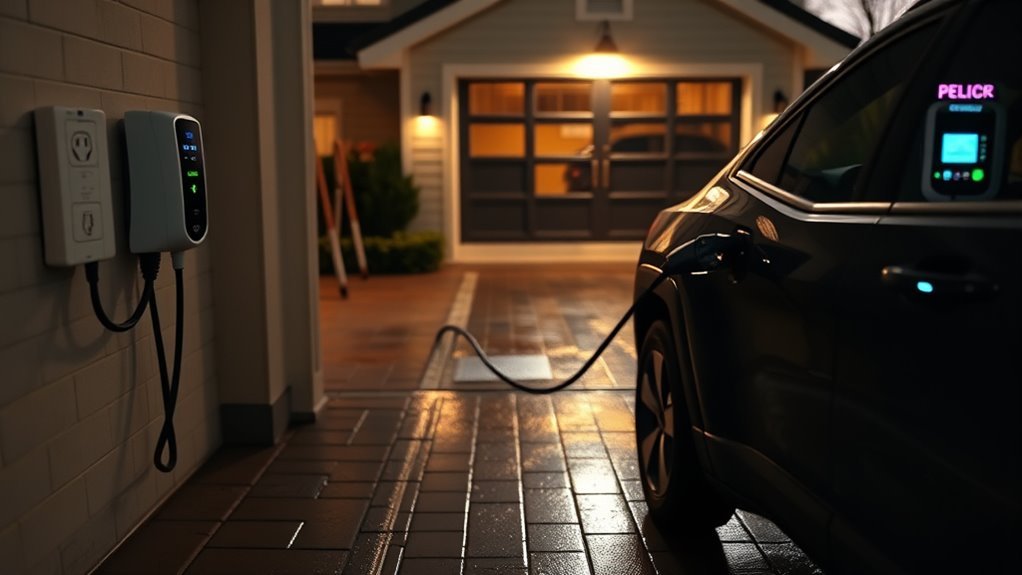
To cut charge time on your Jeep 4xe, upgrade to a Level 2 charger—expect roughly 2 hours versus 12–16 on Level 1. Make sure your 240V outlet and wiring are properly sized and installed, since poor wiring or adapters can bottleneck charging to 4–5+ hours. Also monitor battery coolant and temperature, because overheating or cold can throttle charge rates and reduce efficiency.
Upgrade To Level 2
Upgrading to a Level 2 charger cuts your Jeep 4xe’s plug-in time dramatically, taking you from overnight charging to roughly two hours when properly installed and configured. You get clear charger benefits: 240V, up to 7.7 kW, and reliable daily readiness. Check installation requirements up front — dedicated circuit, correct breaker, and professional wiring guarantee peak performance and safety.
- Faster turnaround — full charge in ~2 hours versus 12–16 with Level 1.
- Professional install — guarantees correct voltage, grounding, and dedicated circuit.
- Dongle option — connect stock charger to 240V for 4–5 hour fills if you delay full Level 2 buy.
- Daily liberation — minimal downtime; your Jeep’s ready when you are.
Choose decisive upgrades; commit to freedom.
Optimize Outlet Wiring
Now that you’ve committed to Level 2 charging, optimizing the outlet wiring is what actually delivers the 2–2.5 hour fills you expect. You should install a dedicated 240V circuit sized to the charger’s draw; proper circuit capacity prevents throttling and raises sustained current. Use high-quality cable and connectors, verify outlet insulation integrity, and minimize voltage drop by keeping runs short and gauge thick. If you stick with a dedicated 15A Level 1 circuit, expect longer fills; dongles can bridge to 240V but only when wiring and connectors meet spec. Test actual outlet voltage under load and address loose terminations or degraded insulation immediately. Do this right and you liberate your charging schedule—predictable, fast, and safe.
Manage Battery Temperature
Because battery chemistry and charging electronics are temperature-sensitive, you should manage pack temperature to preserve peak charge rates and avoid slowdowns or cutoffs. Control temperature to cut charge time and maintain freedom from unnecessary waits. Use battery insulation to reduce thermal swings when parked and precondition the pack before plugging in.
- Monitor: implement continuous temperature monitoring and check state of charge to avoid inefficient top-up charging.
- Precondition: heat or cool the pack using the vehicle’s thermal management before Level 2 charging to sustain near-peak 7.7kW rates.
- Coolant upkeep: maintain the coolant system, purge air bubbles, and inspect hoses to prevent thermal bottlenecks.
- Wiring: guarantee quality circuit installation so temperature control systems perform reliably.
Frequently Asked Questions
What Is the Best Mode to Drive a Jeep 4xe?
You’ll choose Hybrid mode for balanced hybrid efficiency and sustained electric performance; use Electric for short, emission-free trips and eSaver when conserving charge on long journeys—each lets you command freedom while optimizing power and range.
What Is the Break in Period for the Jeep 4xe?
Think of a handshake: the break-in period is 500 miles. You’ll follow break in tips, vary speeds, avoid heavy acceleration or towing, check maintenance, and you’ll gain optimized engine performance and freer, more confident driving.
Conclusion
You’ll usually restore a Jeep 4xe’s battery from 0–100% in about 7–9 hours on Level 1, 2–2.5 hours on a typical Level 2 home charger, and gain meaningful range in ~30 minutes on some DC fast chargers. Keep in mind battery size, state of charge, temperature and wiring affect times; proper 40-50A home wiring often halves Level 2 time. For perspective: a 400V/11.4 kWh battery charged at 6 kW fills to full in roughly 1.9 hours.