
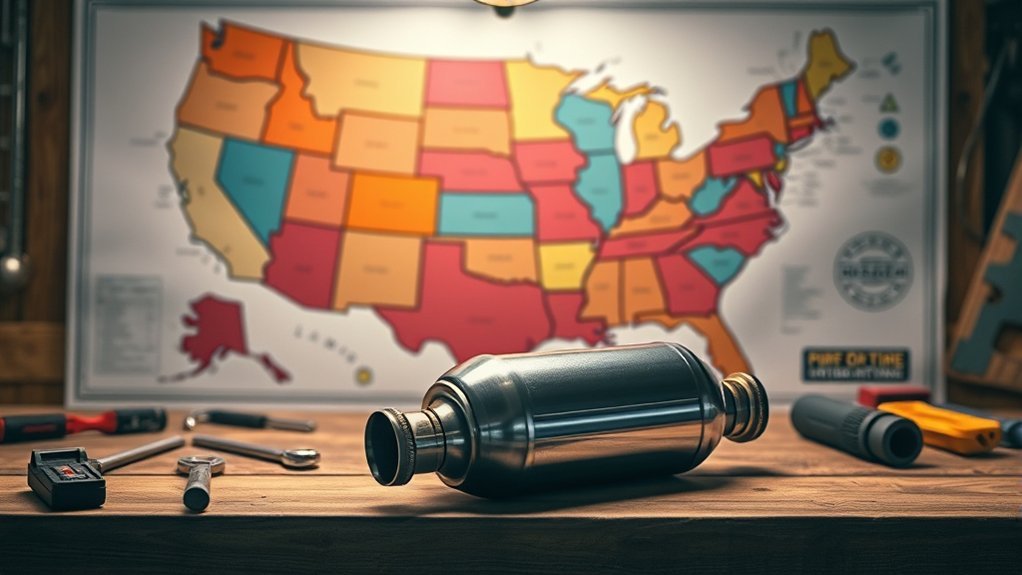
Catalytic converter laws vary markedly across the U.S., affecting vehicle compliance and emissions testing. Most states require functioning catalytic converters, with stricter regulations in California, Maine, and New York. Compliance with specific manufacturer specifications is essential, especially regarding aftermarket options. Failure to adhere can lead to fines, registration issues, and legal consequences. Understanding the nuances of these regulations is important. If you’re keen on understanding the specifics state-by-state, you’ll find valuable insights ahead.
Understanding Catalytic Converter Requirements Across the U.S
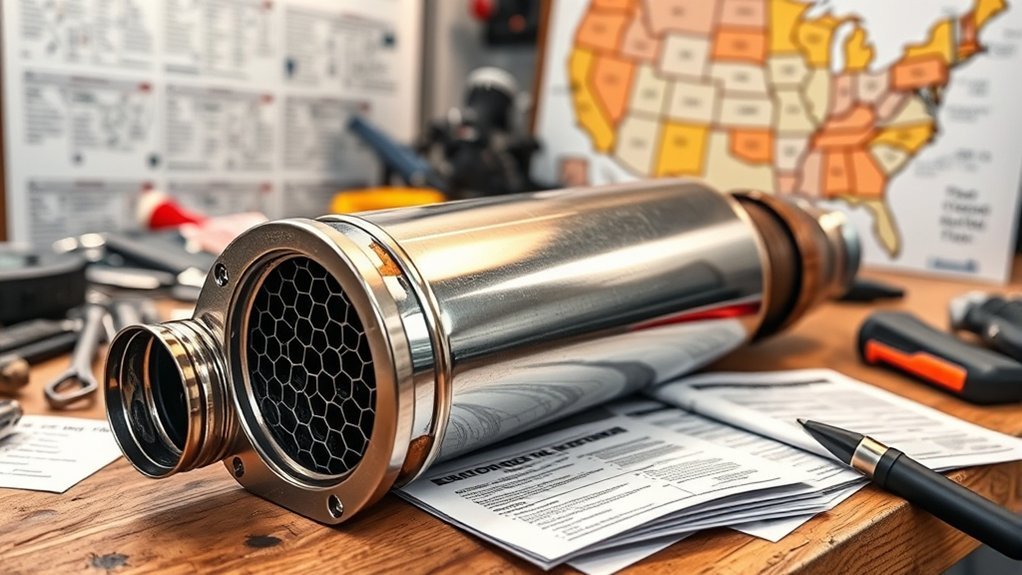
As you navigate the complexities of automotive regulations, it’s crucial to understand that most states mandate functioning catalytic converters for vehicles originally equipped with them.
The history of catalytic converters dates back to the 1970s, designed to reduce harmful emissions. Today, compliance is non-negotiable to avoid fines and registration issues. States like California, Maine, and New York enforce strict emissions testing, requiring specific catalytic converters based on your vehicle’s model year and emissions certification.
If you’re considering aftermarket options, verify they’re compliant with state laws. For instance, California mandates CARB-compliant converters, which must carry a CARB EO number.
Additionally, new legislation aims to combat catalytic converter theft, instituting rigorous recordkeeping and unique identification numbers. Some states even require electronic reporting of sales within tight deadlines.
Stay informed and verify your vehicle meets these evolving standards to enjoy the freedom of the open road without legal complications.
What Sets State Regulations Apart for Catalytic Converters?
While regulations surrounding catalytic converters aim to guarantee environmental compliance, they vary greatly from state to state, reflecting differing priorities and approaches.
For instance, California mandates CARB-compliant converters for all vehicles, while states like Maine and New York require compliance only for certain model years. Some states, such as Texas and Georgia, have taken a more stringent stance by criminalizing catalytic converter theft and requiring traceable identification on new converters to deter illegal sales.
Additionally, compliance checks differ markedly; states like Colorado enforce strict compatibility with OBD catalyst monitors and require a CARB EO number.
Recordkeeping requirements also diverge, with New Jersey and Arkansas mandating seller identification and documentation for detached converters.
Furthermore, some states necessitate electronic submission of sales records within tight timeframes, enhancing tracking capabilities to combat catalytic converter theft.
These variances highlight the complex landscape of state compliance regarding catalytic converters across the U.S.
Detailed Compliance Requirements for California and Colorado Catalytic Converters
Understanding the compliance requirements for catalytic converters in California and Colorado is vital for vehicle owners and mechanics alike. Here’s a breakdown of the key regulations in both states:
| Compliance Aspect | California | Colorado |
|---|---|---|
| Converter Type | CARB-compliant, labeled with CARB EO | Manufacturer-installed or CARB-approved |
| Installation Requirements | Adhere to Vehicle Application Catalog, 5-year/50,000-mile warranty | Must meet state emissions standards |
| Oxygen Sensors | Maintain original location | Maintain original location |
| Aftermarket Converters | Allowed for vehicles older than 5 years if CARB-compliant | Not specified, but must comply with standards |
| Compliance Monitoring | OBD catalyst monitors | OBD catalyst monitors |
For California compliance, all aftermarket converters must be CARB-compliant. In Colorado, regulations guarantee all vehicles uphold emissions standards, creating a unified approach to environmental responsibility.
Essential Steps to Take Before Replacing Your Catalytic Converter
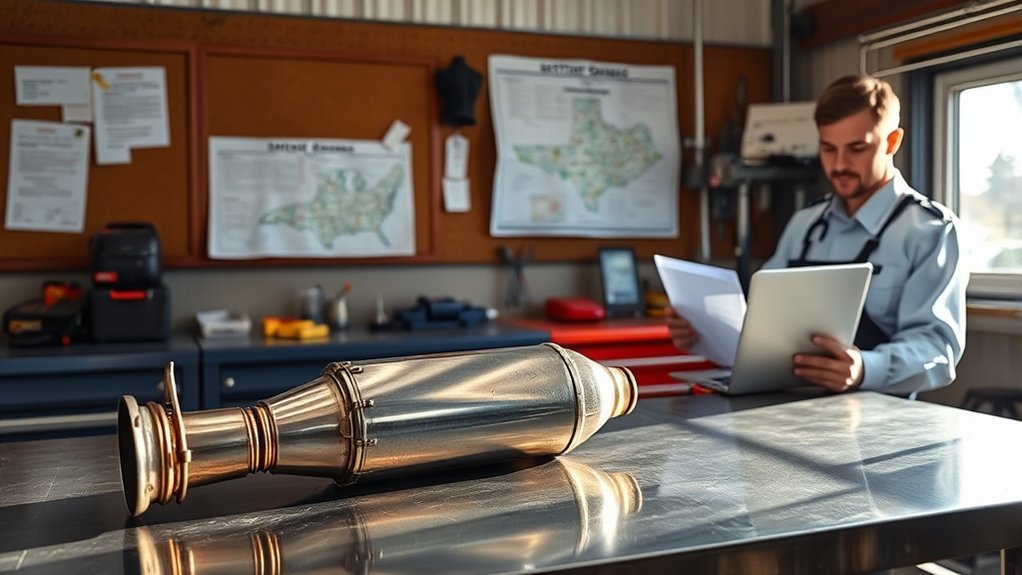
Replacing your catalytic converter requires careful preparation to guarantee peak performance and compliance with state regulations. Start by conducting thorough diagnostic procedures to retrieve all PCM trouble codes, which can highlight any underlying issues affecting performance.
Address any exhaust system leaks before installation, as these can hinder emissions control and lead to further problems.
Next, perform sensor checks on your O2 sensors to verify they’re functioning correctly. Malfunctioning sensors can trigger false trouble codes, complicating your repair efforts.
It’s also essential to verify that the replacement converter aligns with your vehicle’s emissions specifications by consulting the Emission Control Information label and the manufacturer’s Vehicle Application Catalog.
Lastly, always check state regulations regarding aftermarket converters. States like California and New York have stricter CARB requirements, so understanding these rules guarantees compliance and avoids future hassles.
Understanding the Consequences of Non-Compliance With Catalytic Converter Laws
Failing to comply with catalytic converter laws can have serious repercussions that extend beyond mere financial penalties. Non-compliance can lead to hefty fines, with amounts varying by state; for instance, Alabama imposes fines up to $10,000 and potential jail time, while Illinois classifies violations as a Class 4 felony.
Vehicles lacking a functioning converter may also face registration issues, emissions testing failures, and additional financial penalties for required repairs. In states like California, unauthorized alterations can result in misdemeanor charges and fines reaching $1,000.
Enforcement by the EPA and state agencies means violators may confront legal repercussions, including felony charges in jurisdictions like Texas. Ultimately, neglecting your state’s specific catalytic converter regulations can subject you to increased scrutiny and hinder your vehicle’s operation, making compliance not just a legal obligation but a necessity for vehicle ownership and freedom.
Tips for Ensuring Your Catalytic Converter Is Legally Compliant
To guarantee your catalytic converter complies with state laws, start by verifying the specific regulations in your area, especially if you’re in states like California or Colorado.
Next, check that the converter matches your vehicle’s emissions certification, as indicated on the Emission Control Information label.
This proactive approach can help you avoid legal issues and maintain your vehicle’s performance.
Verify State Regulations
How can you guarantee your catalytic converter complies with state regulations?
Start by checking your state’s emissions control information label and the Vehicle Emissions Control Information (VECI) label to verify your converter meets specific compliance requirements.
In states like California and New York, only CARB-compliant catalytic converters are legal for certain model years, so verify your vehicle’s emissions certification before buying a replacement.
Choose aftermarket converters with necessary certifications, like a CARB EO number, to avoid fines.
Keep detailed records of the sale, including seller identification and vehicle details, to comply with regulations aimed at preventing theft.
Finally, familiarize yourself with your state’s timeline for electronic reporting of transactions to verify full compliance.
Check Emissions Certification
Guaranteeing your catalytic converter meets legal compliance starts with understanding your vehicle’s emissions certification.
Locate the Emissions Control Information Label in your engine compartment; this label outlines your vehicle’s emissions specifications and standards.
Check if your vehicle is California Emissions Certified by examining the Vehicle Emissions Control Information (VECI) label, which signifies compliance with stringent state regulations.
Identify the Engine Family Number (EFN) on this label to guarantee you select the correct replacement catalytic converter according to manufacturer specifications.
Research state-specific requirements, especially in states like Maine and New York, where CARB-compliant converters are mandatory for certain models.
If the emissions label is missing, reach out to your Original Equipment dealer to obtain the necessary information for compliance.
Frequently Asked Questions
What States Require Carb-Compliant Catalytic Converters?
California, Maine, New York, Colorado, Massachusetts, and Oregon enforce CARB compliance regulations for catalytic converters. If you’re in these states, guarantee your vehicle meets their stringent requirements to avoid penalties and promote environmental responsibility.
How Many States Have Catalytic Converter Laws?
As of October 2023, around 50 states enforce catalytic converter regulations, ensuring state compliance. These laws target theft prevention and emissions standards, reflecting a nationwide effort to enhance vehicle integrity and environmental responsibility.
What Happens if You Put a Non-Carb-Compliant Catalytic Converter?
If you install a non-CARB-compliant catalytic converter, your vehicle’s performance might plummet faster than your dreams of freedom. You could face fines, failed emissions tests, and a costly replacement—talk about a buzzkill!
In What States Can You Remove a Catalytic Converter?
You can’t legally remove a catalytic converter in most states due to strict state regulations. Some states offer exemptions for specific vintage vehicles, but generally, it’s best to keep your catalytic converter intact to avoid penalties.
Conclusion
In maneuvering the maze of catalytic converter laws across the U.S., it’s essential to stay informed and compliant. Think of your vehicle as a well-tuned orchestra; each component must harmonize with regulations to avoid dissonance. By understanding state-specific requirements and taking proactive steps before replacement, you guarantee your car not only runs smoothly but also adheres to the legal symphony. Stay vigilant, and you’ll keep your ride on the right side of the law.






Leave a Reply