
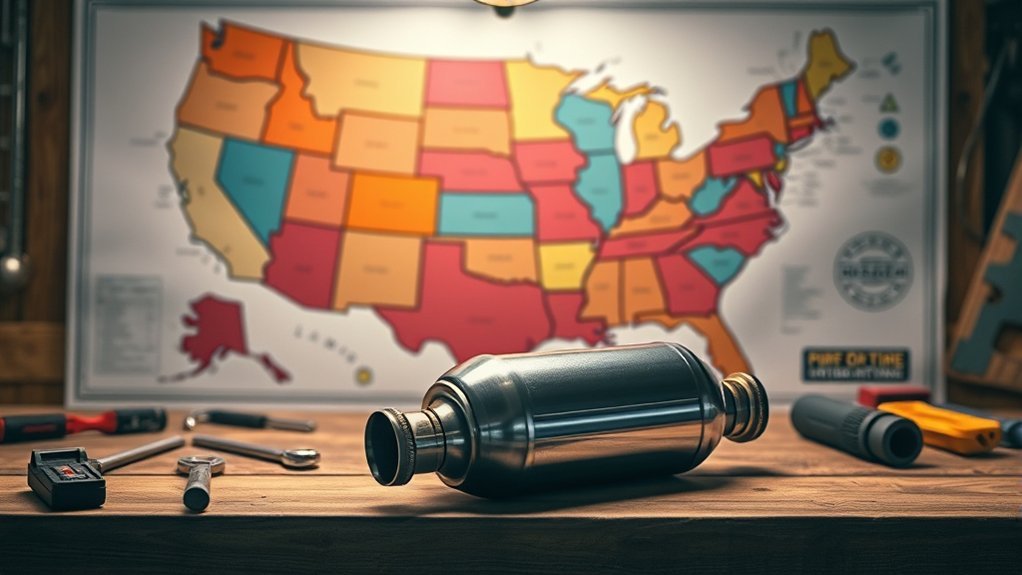
Catalytic converter laws in the United States have two layers: a federal anti-tampering rule that applies nationwide and state rules that may control which replacement converter can be sold or installed. Emissions-testing programs and theft-prevention laws add more variation, but they do not cancel the federal requirement to keep a vehicle’s emissions equipment working. This guide reflects rules verified through July 20, 2026 and is general information, not legal advice.
Quick Answer
Federal law makes it illegal nationwide to remove or disable a catalytic converter without restoring the emissions system to proper operation. California, Colorado, Maine, and New York impose stricter aftermarket replacement rules. Always match the replacement to the vehicle’s year, engine, emissions family, and state before installation.
Key Takeaways
- Federal law applies in every state, even where no emissions inspection is required.
- California, Colorado, Maine, and New York have verified rules requiring CARB-approved aftermarket converters in specified situations.
- A converter must match the exact vehicle application, including model year, engine, emissions certification, and engine family or test group.
- Check the emissions warranty before paying for a replacement; major emissions components are often covered for up to 8 years or 80,000 miles.
- Theft and scrap-sale laws regulate detached converters and transactions; they are separate from emissions-replacement rules.
Federal Catalytic Converter Law Applies in Every State
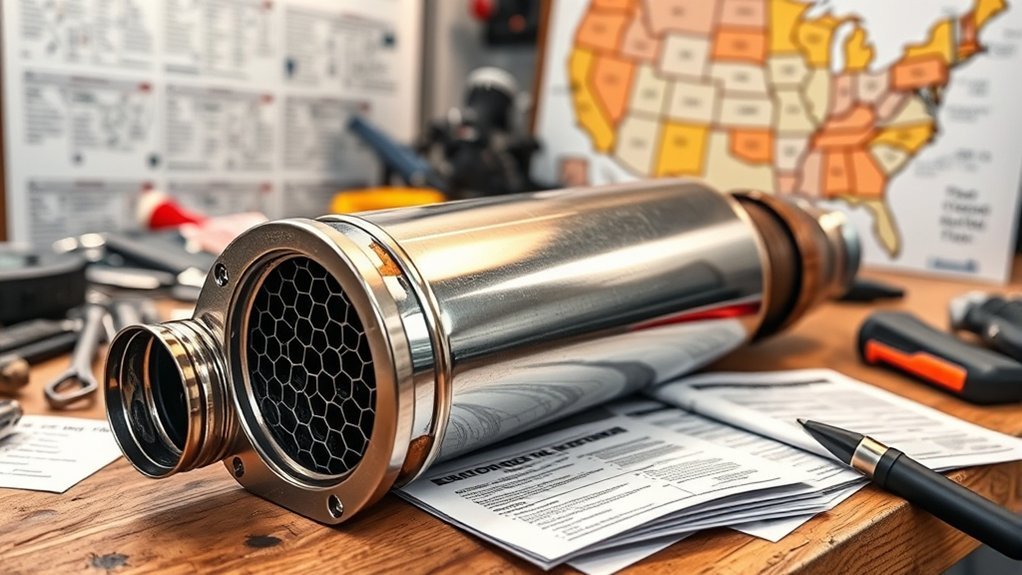
The federal Clean Air Act anti-tampering rule makes it illegal for a person to knowingly remove or render an emissions-control device inoperative after a vehicle has been sold. A converter may be removed temporarily for a necessary repair, but the emissions system must work properly when the repair is finished.
This means a straight pipe, “test pipe,” hollowed converter, or software change used to defeat catalyst monitoring is not legal for normal street use. The rule applies even if the vehicle is registered in a state or county without periodic emissions testing.
The EPA also prohibits the manufacture, sale, and installation of defeat devices intended to bypass or disable required emissions controls. Federal enforcement can apply to vehicle owners, repair shops, parts sellers, manufacturers, and fleets, depending on the conduct.
Warning: A state inspection exemption does not make catalytic converter removal legal. Inspection rules decide when a vehicle is tested; federal law decides whether required emissions equipment may be removed or disabled.
State-by-State Catalytic Converter Replacement Rules
The table below focuses on replacement-converter requirements, not every state’s inspection schedule or theft statute. Rules can depend on where the vehicle is operated or registered, its model year, weight class, fuel type, and emissions certification.
| Jurisdiction | Main Replacement Rule | Important Scope |
|---|---|---|
| Federal baseline | Do not remove or disable a required converter. Use a lawful replacement that restores proper emissions operation. | Applies nationwide. State rules may be stricter. |
| California | Use a new original-equipment converter or a new aftermarket converter covered by a valid CARB Executive Order for the exact vehicle application. | Used converters cannot be advertised, sold, or installed. The CARB EO, part number, model year, engine, and test group must match. |
| Colorado | Since January 1, 2021, use a new OEM converter or a new CARB-approved aftermarket converter. | The rule covers aftermarket converters for applicable spark-ignition vehicles under 14,001 pounds GVWR and prohibits used, recycled, or salvaged converters. |
| Maine | For model-year 2001 and newer gasoline vehicles under 14,000 pounds GVW that are CARB- or 50-state-certified, use OEM or a new CARB-certified aftermarket converter after warranty coverage ends. | Federal-only vehicles and pre-2001 vehicles may use a qualifying federal aftermarket converter. Used converters are prohibited on all vehicles. |
| New York | Use OEM or a new CARB-certified aftermarket converter on covered CARB- or 50-state-certified vehicles. | The state identifies model years 1993, 1994, and 1996 or newer in the covered vehicle group. Used, recycled, and salvaged converters are prohibited. |
| Other states | Follow the federal replacement policy unless the state has adopted a stricter rule. | Emissions inspections, registration rules, and detached-converter sale laws may still vary by state, county, or metro area. |
Note: A state may follow California standards for new vehicles without adopting California’s aftermarket catalytic converter rule. Do not assume that every “CARB state” has the same replacement requirements.
California and Colorado Catalytic Converter Requirements
California and Colorado both use CARB-based aftermarket standards, but the installation must still match the exact vehicle and state application. A generic “CARB compliant,” “49-state,” or “OBD-II compatible” description is not enough by itself.
| Compliance Item | California | Colorado |
|---|---|---|
| Legal replacement | New OEM or CARB-exempt aftermarket converter | New OEM or CARB-approved aftermarket converter |
| Application check | Match the EO and manufacturer catalog to year, make, model, engine, and test group | Use a manufacturer catalog approved for Colorado and verify the EO for the exact vehicle |
| Used converter | Not legal for sale or installation | Used, recycled, and salvaged converters are prohibited |
| Installation details | Follow the EO and manufacturer instructions; do not change the approved sensor or converter configuration | Follow Regulation 20, the EO, and the Colorado-approved application guide |
| Aftermarket warranty | CARB-certified aftermarket converters generally carry 5-year/50,000-mile emissions and construction coverage | CARB-approved aftermarket products use the applicable CARB warranty terms |
Use the CARB aftermarket catalytic converter database and guidance for California applications. Colorado owners and installers should also check the Colorado Department of Public Health and Environment requirements, because a part shown in a general catalog may not be approved for the vehicle’s Colorado application.
Emissions Testing and Converter Legality Are Different
An emissions inspection checks whether a covered vehicle meets a state or local testing program. Some programs use an OBD-II scan, a visual inspection, a tailpipe test, or a combination of checks. Coverage may depend on the vehicle’s age, fuel, weight, and registration county.
Catalytic converter legality is broader. A vehicle can be exempt from testing because of its age, location, or registration class and still violate federal law if its required converter has been removed or disabled. Likewise, passing an OBD test does not prove that an aftermarket converter was legally selected for a CARB-regulated state.
No emissions test does not mean no catalytic converter law.
Steps to Take Before Replacing a Catalytic Converter
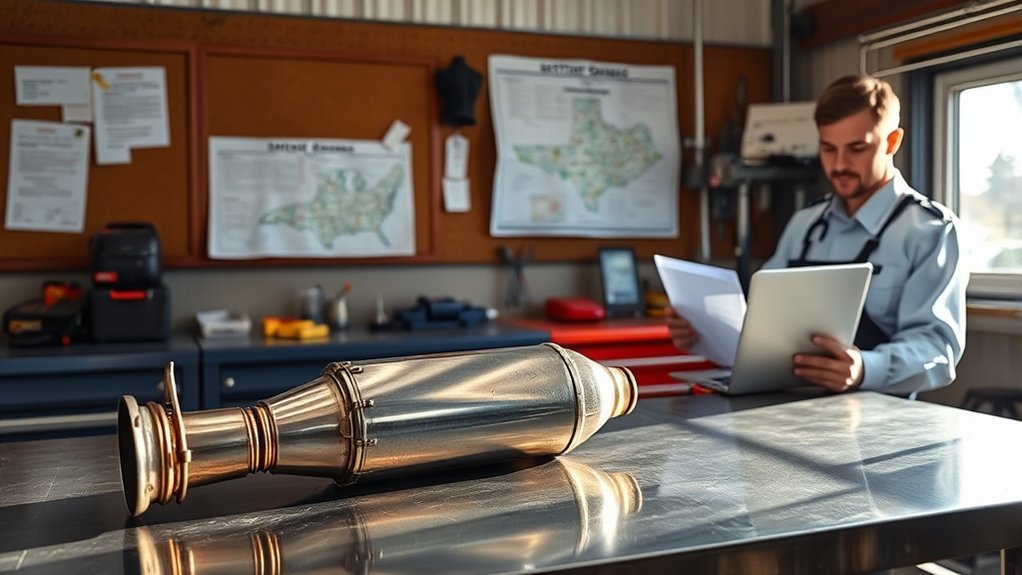
Replacing a converter without fixing the cause of failure can damage the new part and trigger the same trouble code again. Use this process before authorizing the repair:
- Read all diagnostic trouble codes. Do not replace a converter based only on a P0420 or P0430 code. Check freeze-frame data, fuel trims, misfire history, and related sensor codes.
- Inspect for upstream problems. Repair misfires, oil burning, coolant entry, rich fuel operation, exhaust leaks, and damaged wiring before installing the converter.
- Check the emissions warranty. The EPA identifies catalytic converters as major emissions components commonly covered for 8 years or 80,000 miles on eligible light-duty vehicles. Confirm coverage with the warranty booklet and an authorized dealer using the VIN.
- Find the VECI label. The Vehicle Emission Control Information label is usually under the hood or in the engine compartment. Record the model year, engine displacement, emissions certification, and engine family or test group.
- Identify the state rule. Determine whether the vehicle needs an OEM, CARB-approved, or federal aftermarket converter where it will be registered and operated.
- Verify the exact application. Match the part number and, where required, the CARB EO to the year, make, model, engine, and engine family. Do not select a universal converter by pipe size or engine displacement alone.
- Keep the records. Save the diagnostic findings, invoice, part number, EO number, warranty card, and photos of the converter label. Some state rules require installers to retain specific records.
Pro Tip: Give the parts supplier the VIN and a photo of the VECI label. The VIN confirms the vehicle configuration, while the label confirms the emissions family needed for a legal application lookup.
Safety Warning: Exhaust components can stay hot long after the engine is shut off. Never work under a vehicle supported only by a jack, and avoid cutting or welding near fuel lines, brake lines, wiring, or the high-voltage system on a hybrid vehicle.
How to Check Your Vehicle’s Emissions Certification
The VECI label is the best starting point. Look for wording such as “California,” “CARB,” “ARB,” or “50-state” certification, or wording showing that the vehicle conforms only to federal EPA standards. Also record the engine family or test group, because two vehicles with the same year, model, and engine size can require different converters.
If the label is missing or unreadable, contact an original-equipment dealer with the VIN. Do not guess from the license plate state, where the vehicle was purchased, or a parts website’s broad fitment result.
For Maine-specific coverage, review the Maine DEP catalytic converter standards. For New York, use the New York State DEC motor-vehicle pollution guidance, which explains covered model years, certification labels, used-converter restrictions, and aftermarket warranties.
Theft Laws and Detached-Converter Sales
Many states have added separate laws for catalytic converter theft and the sale of detached converters. These laws may require seller identification, proof of ownership, photographs, electronic records, delayed or non-cash payment, recycler licensing, or permanent markings.
Those rules serve a different purpose from emissions law. A person may possess a lawfully removed converter for recycling yet still be unable to install it on another vehicle. In California, Colorado, Maine, and New York, used, recycled, or salvaged converters are prohibited for vehicle installation under the state programs described above.
Because theft statutes and recycler rules change often, anyone selling a detached converter should check the current statute and recycler guidance in the state where the transaction occurs.
Consequences of Non-Compliance
The result depends on the conduct and jurisdiction. A vehicle may fail a visual or OBD emissions inspection, be unable to complete registration, require another repair, or trigger a check-engine light because the installed converter does not work with the vehicle’s catalyst monitor.
Businesses and individuals may also face federal or state enforcement for tampering, selling or installing defeat devices, installing a prohibited converter, falsifying records, or violating detached-converter transaction laws. Theft-related felonies and recycler penalties should not be confused with the penalty for a vehicle owner who simply has an incorrect replacement part.
Specific fine amounts change and often depend on whether the defendant is an owner, installer, retailer, recycler, manufacturer, or thief. Check the current law before relying on a dollar amount quoted online.
Tips for Keeping a Catalytic Converter Legal
- Do not remove, hollow, bypass, or electronically defeat a required converter.
- Check warranty coverage before buying a replacement.
- Use the VECI label and VIN to confirm the emissions certification and exact vehicle application.
- In California, Colorado, Maine, or New York, verify the applicable CARB EO and state-specific catalog rules.
- Confirm that all oxygen sensors, shields, flanges, and converter locations remain in the approved configuration.
- Fix misfires, rich operation, oil consumption, coolant leaks, and exhaust leaks before installation.
- Keep the invoice, warranty card, EO number, diagnostic report, and part label information.
Frequently Asked Questions
Which states require CARB-compliant aftermarket catalytic converters?
The verified state programs covered here are California, Colorado, Maine, and New York. California and Colorado broadly require CARB-approved aftermarket replacements for covered vehicles. Maine and New York apply detailed model-year and emissions-certification rules. Always confirm the current state guidance before ordering.
Can I remove a catalytic converter in a state without emissions testing?
No. Federal anti-tampering law applies nationwide. A state or county may not test your vehicle, but that inspection exemption does not authorize removing, hollowing, bypassing, or disabling required emissions equipment.
How do I know whether my vehicle needs a CARB or federal converter?
Check the state where the vehicle will be registered and operated, then read the VECI label under the hood. Record the emissions certification, engine family or test group, year, engine, and vehicle weight class. Match those details to the manufacturer’s state application catalog and any required CARB Executive Order.
What happens if I install a non-CARB converter where CARB approval is required?
The vehicle may fail inspection, display catalyst-efficiency or OBD compatibility faults, require replacement with the correct part, and expose the seller or installer to state enforcement. A “universal,” “high-flow,” or “OBD-II compatible” label does not replace an exact EO and application match.
Can a used catalytic converter be installed on another vehicle?
Do not assume it can. California, Colorado, Maine, and New York prohibit used, recycled, or salvaged converters for vehicle installation under their programs. Other states may have separate restrictions, and the replacement must still satisfy federal requirements and match the vehicle application.
Is a catalytic converter covered by an emissions warranty?
Often, yes. For many eligible light-duty vehicles, the federal emissions warranty covers the catalytic converter as a major emissions component for 8 years or 80,000 miles, whichever comes first. Longer state or manufacturer coverage may apply, so check the warranty booklet and ask an authorized dealer to verify coverage by VIN.
Conclusion
Catalytic converter compliance starts with the federal rule: do not remove or disable required emissions equipment. State rules then determine whether the replacement must be OEM, CARB-approved, or federally compliant. Before buying a part, check the warranty, VIN, VECI label, engine family, state program, and exact application. That process prevents failed inspections, repeat repairs, and avoidable legal problems.
Sources
- U.S. EPA: Transportation, Air Pollution, and Climate Change FAQs — federal anti-tampering law and emissions warranty coverage.
- U.S. EPA: Stopping Aftermarket Defeat Devices — federal enforcement against tampering and defeat devices.
- California Air Resources Board: Aftermarket Catalytic Converters — EO approval, labeling, application, and used-converter rules.
- Colorado Department of Public Health and Environment: Aftermarket Catalytic Converters — Regulation 20 requirements effective January 1, 2021.
- Maine DEP: Catalytic Converter Standards — covered vehicles, CARB requirements, warranty, records, and used-converter prohibition.
- New York State DEC: Controlling Air Pollution From Motor Vehicles — covered model years, VECI guidance, CARB replacements, and used-converter prohibition.






Leave a Reply