
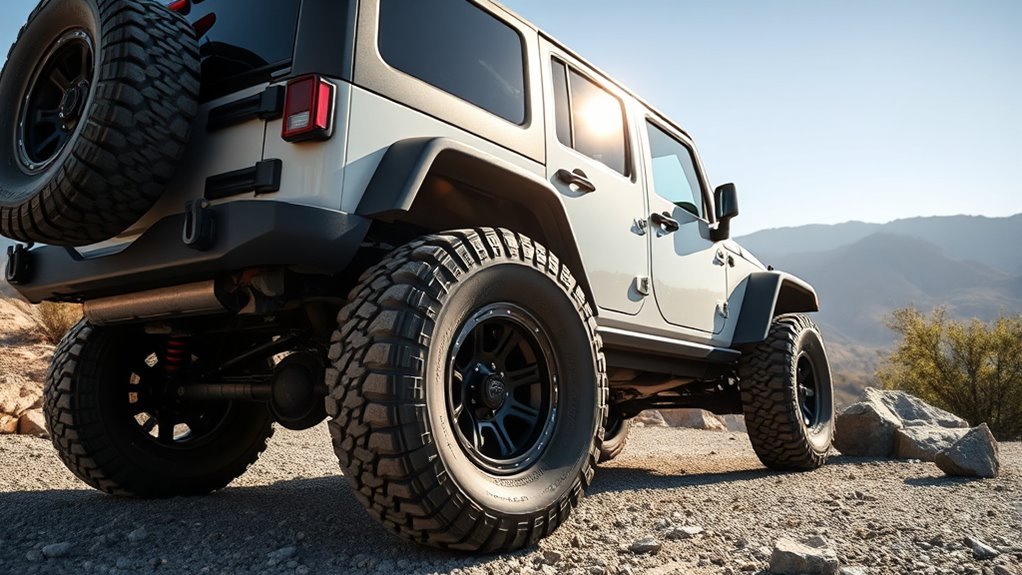
You can fit 35-inch tires on many stock JK/JL Wranglers with careful tire choice, wheel width, and minor trimming; expect occasional rubbing at full lock or articulation without at least a 2-inch lift. Verify actual tire diameters (brands vary), check ground-to-fender clearance, wheel offset, and suspension/splash-guard pinch points, and plan for reduced MPG, slower acceleration, and speedometer error unless you re-gear. Keep going to learn specific fitment checks, preferred tires, and minimal mods.
Can 35s Fit a Stock Jeep? Quick Answer
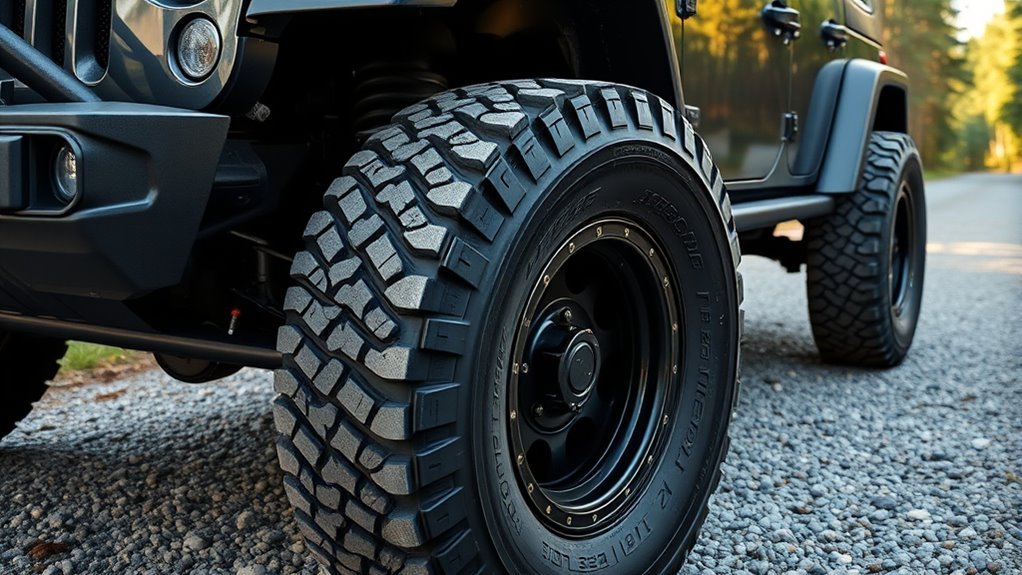
Wondering if 35s will fit your stock Jeep? You can mount 35-inch tires on a stock Wrangler, but you should plan for minor adjustments to avoid rubbing. Tire selection matters: some models like Nitto Ridge Grapplers measure ~34.76″, fitting 17″ stock wheels with minimal interference. Other brands or exact tread/wall profiles can induce rubbing at full lock or full flex.
Practically, you’ll weigh lift options and spacing. A 2-inch lift is commonly recommended to restore suspension and steering clearance, improving articulation and appearance while reducing contact chances. Wheel spacers can add clearance, but many owners skip them and rely solely on a modest lift. Expect variability: some run 35s with zero lift and occasional rub; others opt for the 2-inch compromise for consistent off-road confidence.
Make decisions based on intended terrain, tire specs, and your tolerance for occasional trimming or adjustments.
Which Jeep Models & Wheel Sizes Commonly Accept 35s
If you own a JK or JL Wrangler, you’ll find both platforms commonly accept 35s with the right wheel width and minor trimming. Stock 17×7.5–8.5 wheels (like on many 2017 Unlimited Sport and Rubicon models) can run 35-inch tires such as the Nitto Ridge Grappler, though some users report light rubbing without a lift. For reliable clearance, plan wheel widths per tire spec and consider a 2-inch lift to minimize interference.
JK And JL Fitment
While both the JK and JL will accept 35-inch tires, you’ll need to address wheel size, backspacing, and clearance to avoid rubbing and suspension interference. You’ll find stock JK wheels are typically 16×7.5 and JLs often 17×7.5; both can work with careful JK modifications and JL adjustments. Consider real-world tire measurements—some “35s” like Nitto Ridge Grapplers run ~34.76″—when planning.
- Lift and clearance: a 2-inch lift is commonly recommended to reduce rubbing at full articulation.
- Backspacing and offset: maintain conservative backspacing to keep tires from contacting control arms or fenders.
- Practical test: mount and flex-test before off-road use; minor rubbing on stock setups is reported.
Wheel Width Considerations
Because tire width dictates wheel choice and clearance, you should match 35-inch tires to appropriate wheel widths and models rather than forcing a one-size-fits-all setup. The 2017 Wrangler Unlimited Sport commonly accepts 35s on aftermarket 17x9s (Venom Rex VR-501); stock 17×7.5 rims can handle 35s like 35×12.50R17 with minor tweaks, though full-flex rub can occur. Fit varies by brand, so confirm actual tire dimensions. A 2-inch lift usually gives safer clearance and improved performance. Monitor tire pressure to preserve tire shape and avoid pinch issues. After mounting wider tires, verify wheel alignment to prevent uneven wear and maintain steering precision. Choose wheel width that balances sidewall support, clearance, and your freedom to explore.
| Jeep Model | Wheel Size | Typical 35 Fitment |
|---|---|---|
| JK/JL 2017 Wrangler | 17×9 | Good on aftermarket |
| Wrangler Sport | 17×7.5 | Possible with mods |
| Stock 16″ | 16×7 | Not recommended |
Measure These 4 Points to Predict Fitment
When planning 35-inch tires, measure four critical points to predict fitment and avoid surprises: you’ll combine practical checks with freedom-focused decisions, mindful of tire pressure and whether lift kits are in your future. First, measure ground-to-fender-arch height; you want at least 1 inch clearance with the tire inflated to your planned tire pressure and during suspension compression. Second, check tire-to-frame and suspension clearance—rotate steering full lock and articulate the suspension to guarantee no contact. Third, inspect the rear pinch seam and bumper-to-tire gap; tight rear clearances often need trimming or reshaping to prevent rubbing. Fourth, confirm wheel and rim spec: a stock 7.5-inch wheel must match a 35×12.50 tire’s recommended tire-to-rim ratios and backspacing to avoid interference. Use precise tools, document each measurement, and decide if modest lift kits or wheel changes will reveal the fitment you want without compromising safety or functionality.
Tires That Actually Measure True to 35
Check actual measured diameters before you buy, since many “35-inch” tires (for example some Nitto Ridge Grapplers) run closer to 34.76 inches and that difference can make or break fitment on a stock Wrangler. Brand-to-brand variance is significant, so compare published and real-world measurements for the exact model you’re considering. Also factor in your wheel backspacing and suspension, because even a nominally true 35 can rub if other geometry isn’t compatible.
Actual Measured Diameters
Tire diameter matters: not all “35-inch” tires actually measure 35.00″, so you should verify real-world measurements before assuming fitment on a stock Jeep. Check tire pressure and tread design when measuring—both affect rolling diameter under load and can mask true size. You’ll want measured figures, not just size stamps.
- Nitto Ridge Grappler 35s often measure ~34.76″, showing nominal sizes vary and can ease fitment on stock Jeeps.
- Nitto Trail Grappler M/T 315/70R17 (35 x 11.50) has fit stock wheels with minor rubbing that many owners corrected with simple adjustments.
- Always confirm the actual measured diameter for any candidate tire; a true 35.00″ may require lift or trimming, while slightly smaller tires might free you.
Brand Variance Impact
One key factor you’ll notice is that brand and model determine whether a claimed “35-inch” actually measures true to 35.00″; some models (like Nitto Ridge Grappler) run slightly undersized while others (certain Terra or Trail Grappler variants) track closer to nominal, and those differences directly affect clearance, rubbing, and whether you need trim or a small lift. You’ll want to compare tire model differences before buying: Nitto Ridge Grapplers measure ~34.76″, while Trail Grappler M/T 315/70R17 and some Terra Grapplers have measured closer to 35“. That variance creates fitment challenges on stock wheels and narrow 7.5″ rims—legal compatibility isn’t the same as proper fit. Choose models with verified measured diameters to minimize rubbing and intervention.
Where 35s Rub: Splash Guard, Flares, Bumper (How to Check)
When you fit 35-inch tires on a stock Jeep, inspect three key contact points: the splash guard, the flares, and the rear bumper area—these are where rubbing most commonly shows up under articulation and full suspension travel. You’ll remove the splash guard in under a minute to test free movement; it’s the quickest fix and often the source of noise. Check bumper clearance at full droop and compression—rear tires can contact the bumper during extreme articulation. The rear pinch seam usually gives extra room, but some setups still show minor contact at full flex.
Fit 35s? Check splash guard, flares, and rear bumper for rubbing through full travel—remove guard first.
- Splash guard: remove and rotate wheel through travel to confirm no contact.
- Flares: observe at full compression; rubbing noises may appear though flare damage is rare.
- Bumper clearance: back the Jeep onto a ramp or use a helper to cycle suspension and watch for rear tire-to-bumper contact.
Be methodical, deliberate, and uncompromising—liberate your Jeep without guessing.
Minimal Mods to Run 35s: 2 Lift, Offset, Spacers, Trimming
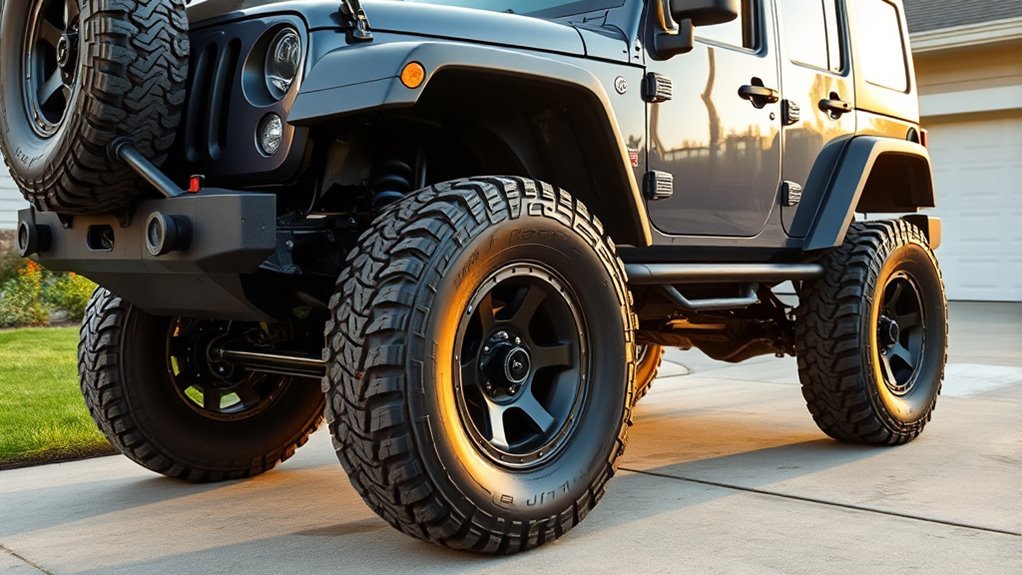
Now that you’ve checked splash guards, flares, and bumper clearance, you can focus on the smallest, most effective changes to make 35s work on a stock Wrangler. A 2-inch lift is the baseline: it gives reliable clearance adjustments for articulation and turning without heavy suspension work. Pair that lift with wheel offset that moves the tire inward or outward as needed to avoid suspension and body contact; target offsets depend on your wheel width and hub specs.
Some owners add modest wheel spacers to fine-tune stance and clear knuckles, but spacers aren’t always required—use them only after measuring clearances under load. Trim fender liners or bumpers where full lock causes rub; remove minimal material and test articulation. Consider a heavy-duty track bar to maintain steering center and reduce wander with larger tires. Finally, verify tire brand compatibility—sizes and construction vary, so choose a brand with a proven fit for your Wrangler to guarantee predictable clearance adjustments and durability.
How 35s Change On‑Road Performance: MPG, Speedo, Gearing
Although 35-inch tires give your Wrangler a tougher look and off-road capability, they also change on-road performance in measurable ways: expect reduced acceleration and lower MPG from the stock 3.21 gears, altered steering and braking feel from the larger rotational mass, and an inaccurate speedometer unless you recalibrate with a device like ProCal.
You’ll feel immediate tradeoffs: slower 0–60, heavier steering response, increased tire noise at highway speeds, and longer stopping distances. Fuel economy drops because of added rotating mass and rolling resistance; your odometer and speed readout will also lie without recalibration. Re-gearing to 4.56 is the common mechanical remedy to restore usable acceleration and highway cruising comfort.
- Acceleration and gearing: 3.21 undergears 35s; 4.56 recommended to recover performance.
- Economy and speedo: expect lower MPG and false speed/mileage unless calibrated.
- Handling and NVH: altered steering response, changed brake feel, more tire noise.
Plan logically—liberate your Jeep’s capability by addressing gearing and calibration.
Off‑Road Reality With 35s: Flex, Flare Wear, and Long‑Term Planning
Because bigger tires change suspension geometry and tire travel, you’ll start noticing rub at full flex and on tight turns unless you address clearance. Expect flexibility issues as the wheel arcs further into the wheelwell during articulation; testing showed rubbing noise at full compression even though no flare damage occurred. You’ll need to manage approach lines and obstacle selection to avoid sustained contact that could stress rear flares.
Practical fixes: a 2-inch lift is the simplest, restoring tire-to-body clearance and improving off-road capability without major chassis work. For long-term planning, evaluate flare modifications — either heavy trimming of stock flares or installing aftermarket flares designed for 35s. Trim cautiously; repeated rub accelerates wear and can deform flares over time. Monitor clearance after each trail session and adjust tire pressure, suspension preload, or bump stops to limit extreme travel. Do this and you’ll keep freedom on the trail without compromising the Jeep’s structure or your ability to go farther.
Frequently Asked Questions
Can You Put 35S on a Stock Jeep?
Yes—you can fit 35s on a stock Jeep, but you’ll face tight tire clearance and potential rubbing with stock suspension; you’ll want a 2-inch lift, careful wheel backspacing, or spacers, and expect drivetrain and gearing tradeoffs.
Can I Put 35-Inch Tires on My Jeep Without a Lift?
About 60% of owners report rubbing, so you can fit 35-inch tires without a lift but you’ll face tire clearance issues and worsened gear ratios. You’ll want a 2″ lift or regear to free performance.
Conclusion
Think of your stock Jeep as a city car transformed into a rugged mule: 35s can be the stronger hooves, but you’ll need to check stance, wheel backspace, and clearance first. Small mods—lift, different offset, spacers, or trimming—are the shoeing that prevents rubbing and preserves steering, speedometer, and fuel economy. If you plan long off‑road journeys, invest in proper gearing and suspension upgrades so the mule stays surefooted and reliable.




Leave a Reply