
The IMSA results from the Rolex 24 at Daytona highlight thrilling finishes and standout performances. Felipe Nasr led the No. 7 Penske Porsche to a historic third consecutive victory, while the No. 57 Mercedes-AMG took the GTD class win by just 1.3 seconds. Notable retirements reshaped the standings, showcasing the unpredictable nature of endurance racing. As you explore further, you’ll uncover more insights into strategies, upcoming events, and what to expect in the IMSA season ahead.
IMSA Results and Rolex 24 Highlights
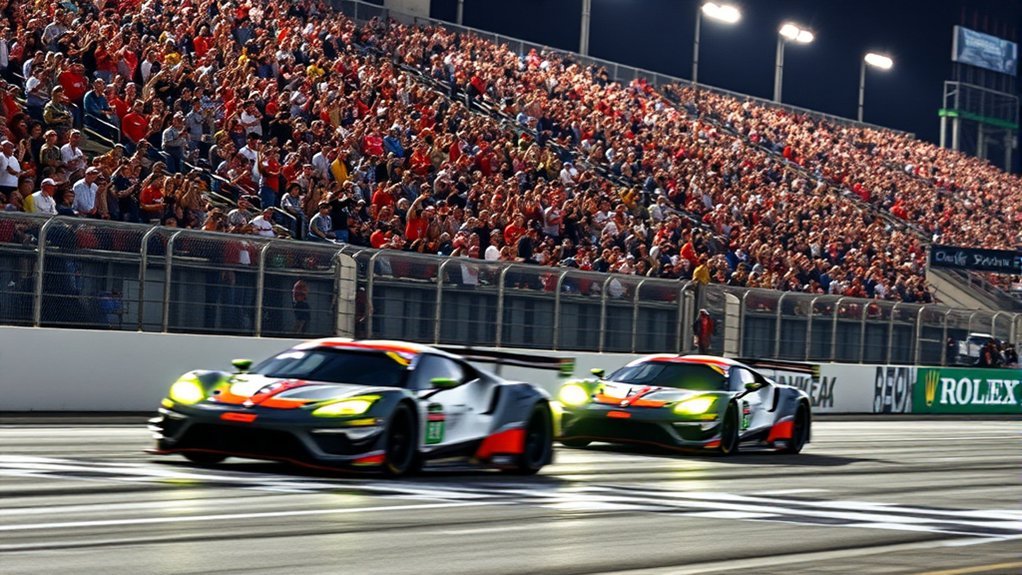
As the sun set on the 24-hour endurance challenge, the Rolex 24 at Daytona delivered thrilling moments and unexpected turns, showcasing the high-stakes world of IMSA racing.
Felipe Nasr and the No. 7 Penske Porsche claimed their third consecutive victory, edging out the No. 31 Whelen Cadillac by just 1.5 seconds.
In the LMP2 class, CrowdStrike Racing by APR executed brilliant strategies, securing their first win while finishing 5.6 seconds ahead of the No. 43 Inter Europol Competition.
The GTD performance also shone brightly, as the No. 57 Mercedes-AMG triumphed with a narrow 1.3-second victory after Philip Ellis made a daring late pass on Nicki Thiim.
With a staggering 120 caution laps due to fog and incidents, the race tested teams’ endurance and adaptability.
Each strategy and performance shift highlighted the intense competition and unpredictability inherent in this premier endurance race.
Key Highlights From the Rolex 24 at Daytona
At the Rolex 24 at Daytona, you witnessed Felipe Nasr’s historic third consecutive victory, showcasing his skill behind the wheel of the No. 7 Penske Porsche.
The GTD class delivered an electrifying showdown, with the No. 57 Mercedes-AMG clinching the win by a razor-thin margin.
Additionally, a record-setting caution period highlighted the challenges drivers faced, impacting strategy and performance throughout the race.
Nasr’s Historic Three-Peat
Despite the intense pressure from competitors, Felipe Nasr clinched his third consecutive victory at the Rolex 24 at Daytona, solidifying his place among racing legends.
By driving the No. 7 Penske Porsche to a nail-biting win just 1.5 seconds ahead of Jack Aitken’s No. 31 Whelen Cadillac, Nasr etched his legacy into the annals of motorsport history.
This historic performance places him among only 17 drivers with three or more overall wins, joining the ranks of icons like Helio Castroneves and Peter Gregg.
In the final moments, Nasr’s skill shone as he defended his lead with mere inches to spare, showcasing the endurance and strategy required in this grueling event.
It’s a reflection of his remarkable talent and relentless drive.
Intense GTD Class Battle
The GTD class delivered an electrifying spectacle during the Rolex 24 at Daytona, enthralling fans with its nail-biting finish. The No. 57 Mercedes-AMG clinched victory by just 1.3 seconds after Philip Ellis executed a masterful pass on Nicki Thiim with under 20 minutes to go. This race showcased fierce driver rivalries and strategic GTD strategies, culminating in a dramatic 185 mph collision that left both drivers shaken but racing.
| Position | Car Number | Team |
|---|---|---|
| 1 | 57 | Mercedes-AMG |
| 2 | 75 | 75 Express |
| 3 | 1 | Paul Miller Racing |
The close competition highlighted the skill and intensity required in this thrilling class, making it a standout event.
Record Caution Periods Set
While many fans anticipated high-speed action at the Rolex 24 at Daytona, the race’s record-setting caution periods reshaped the narrative.
With a staggering 120 caution laps, competitors faced unique caution strategies amidst visibility challenges. A particularly long caution period lasted six hours and 33 minutes, driven by heavy fog that severely impaired sightlines. This forced drivers into a rhythm often described as auto-pilot, yet the adverse conditions constantly tested their focus and performance.
Over the course of the race, caution laps averaged 65 mph, contributing to a total distance of 427 miles during interruptions. These factors not only extended the event’s duration but also influenced the strategic decisions teams had to make throughout the race.
Analyzing Fastest Laps and Consistency Across Classes
When you examine the fastest laps from the race, Frederik Vesti’s impressive 1:35.826 stands out, showcasing the Cadillac V-Series.R’s capabilities.
Meanwhile, Laurin Heinrich and Alex Palou demonstrate solid consistency, with lap times that reflect their competitive edge within their respective classes.
This variation in lap times highlights not only the strengths of different vehicles but also the intriguing patterns of performance across the field.
Fastest Lap Analysis
Analyzing the fastest laps from the recent IMSA race reveals not just individual prowess but also the distinct performance characteristics across different vehicle classes.
Frederik Vesti’s record of 1:35.826 in the BMW M Hybrid V8M exemplifies peak speed, while Laurin Heinrich’s 1:36.236 in the Cadillac V-Series.R showcases competitive strength.
Alex Palou’s lap at 1:36.401 indicates the Acura ARX-06M’s reliable performance. Importantly, lap time comparisons show that several drivers hovered around the 1:46-1:49 range, reflecting variability in vehicle performance.
LMP2 vehicles generally outpaced GTD contenders, emphasizing the diverse capabilities and strategies at play.
These insights into fastest laps illuminate how each class’s unique engineering influences overall race dynamics, inviting fans to appreciate the nuances of each machine.
Consistency Trends Observed
As you explore the consistency trends observed during the IMSA race, it’s clear that maintaining a steady lap time is essential for success across various vehicle classes.
Frederik Vesti’s impressive fastest lap of 1:35.826 highlights his strong driver performance, while Laurin Heinrich’s competitive 1:36.236 secures him a top spot in the GTP category.
Many drivers showcased remarkable consistency, clocking laps between 1:46-1:49, proving their ability to adapt to race challenges.
However, notable lap time variability emerged among different vehicle types, with some drivers struggling to maintain their pace.
The impact of race duration, especially during caution periods, further influenced lap time consistency, as strategies had to shift, reminding you that rhythm is key in this high-stakes environment.
Breakdown of Class Results: LMP2, GTD, and GT3
While the race unfolded, the class results showcased the intense competition across LMP2, GTD, and GT3.
In LMP2, Toby Sowery, Alex Quinn, Malthe Jakobsen, and George Kurtz clinched victory in the Crowdstrike Racing by APR ORECA LMP2 07, employing sharp LMP2 strategies to outmaneuver their competitors. Their close finishes highlighted the class’s fierce rivalries, with Inter Europol Competition’s entries finishing just behind.
In the GTD category, Kenny Habul, Maro Engel, Will Power, and Chaz Mostert drove the No. 57 Mercedes-AMG to secure a thrilling win, edging out Winward Racing by a mere 1.3 seconds—an impressive display of GTD tactics.
Finally, the GT3 class saw Corvette Racing by Pratt Miller Motorsports finish third, reflecting the competitive spirit across various manufacturers.
Impact of Notable Retirements
The intense competition in LMP2, GTD, and GT3 was further complicated by notable retirements that reshaped the race’s dynamics.
The retirements of high-profile drivers like Romain Grosjean and Mike Rockenfeller markedly affected their teams’ standings and overall performance. For instance, Pratt Miller Motorsports lost Manuel Espirito Santo and Pietro Fittipaldi, diminishing their competitiveness in LMP2.
Similarly, TDS Racing’s chances dwindled when David Heinemeier Hansson and Charles Milesi exited the race, undermining their potential points.
In the GTD category, DXDT Racing faced setbacks with the retirements of Salih Yoluc and Charlie Eastwood, which hindered their efforts.
These retirement effects not only reshuffled positions across classes but also underscored how unpredictable endurance racing can be.
Ultimately, these retirements illustrated how driver performance intertwines with team success, making every lap count in this thrilling motorsport arena.
Driver Insights and What’s Next for IMSA?
With Felipe Nasr’s historic third consecutive victory at the Rolex 24 fresh in mind, drivers and teams are now focusing on what lies ahead in the IMSA season.
Felipe Nasr’s remarkable third win at the Rolex 24 sets the stage for an exciting IMSA season ahead.
The competition is heating up, and performance analysis will be vital for success. Here are three key driver strategies to take into account:
- Adapt to Conditions: The recent record caution periods forced teams to rethink their strategies. Expect drivers to practice adaptability under varying visibility conditions.
- Tire Management: Steering through the unique challenges of Sebring will require careful tire strategies. Drivers need to guarantee peak performance without compromising wear.
- Team Communication: Effective communication during pit stops and throughout the race is essential for maximizing efficiency and minimizing errors.
As IMSA heads to Sebring on March 21, expect these strategies to shape the competitive landscape and influence the outcomes of future races.
Stay tuned for thrilling action ahead!
Upcoming Events: What to Expect From IMSA and Daytona
As the excitement from Felipe Nasr’s recent triumph at the Rolex 24 fades, IMSA fans can look forward to a thrilling lineup of events in the coming weeks.
The season resumes at Sebring on March 21 with the 74th annual Twelve Hours of Sebring, featuring five divisions battling for supremacy.
Meanwhile, Daytona International Speedway gears up for NASCAR’s season opener from February 11-15, spotlighting events like the Daytona 500 pole qualifying and race.
As IMSA enhances fan engagement, it aims to replicate the electrifying atmosphere of the Rolex 24, ensuring competitive racing across multiple classes.
The upcoming Daytona weekend will also include qualifying Duels and a Truck Series race, amplifying the excitement.
With these preparations, both IMSA and Daytona promise a fascinating experience, inviting you to be part of this exhilarating journey in motorsport.
How to Stay Updated on IMSA News and Results
Staying informed about IMSA news and results is essential for any dedicated motorsport fan who wants to keep up with the latest developments. Here’s how you can guarantee you’re always in the loop:
- Sign Up for the IMSA Mailing: Provide your first name, last name, email, and address. By subscribing, you’ll receive timely updates about race results and important announcements, with the freedom to opt-out anytime.
- Check Online Resources: For real-time information, visit the IMSA website where you can find the latest race results, point standings, and driver performances.
- Follow Official Announcements: Stay ahead of the game by keeping an eye on IMSA’s social media platforms for news on upcoming events, like the season resuming at Sebring on March 21.
Frequently Asked Questions
How Much Money Do IMSA Drivers Make?
IMSA drivers’ salaries vary considerably, with top-tier athletes earning between $200,000 and $500,000. An earnings breakdown shows that lower-tier drivers might make $50,000 to $100,000, often enhanced by sponsorships and performance bonuses.
Who Has the Most Wins in the IMSA?
In the world of IMSA legends, Scott Pruett’s 60 historic victories stand tall. His dominance showcases not just talent but a relentless drive, making him a symbol of success within this thrilling racing arena.
Is IMSA Better Than F1?
IMSA’s endurance races offer deeper fan engagement through diverse vehicle classes and team dynamics, while F1’s speed thrills. It depends on what you value—strategic teamwork or high-octane solo performance. Both have unique merits.
Why Doesn’t Ferrari Race in IMSA?
Ferrari’s not racing in IMSA ‘cause they’re too busy basking in their European glory. With a rich history in endurance racing, IMSA regulations just don’t fit their grand plan. Who needs North America, right?
Conclusion
As you soak in the thrilling results from the IMSA, it’s clear that each race is a tapestry woven with speed, strategy, and unexpected turns. With the Rolex 24 at Daytona setting the stage, you can almost hear the engines roaring like a symphony of power. Keep your eyes peeled for upcoming events, as the excitement continues to unfold. Stay connected to the latest IMSA news, so you won’t miss a beat in this high-octane adventure!







Leave a Reply