
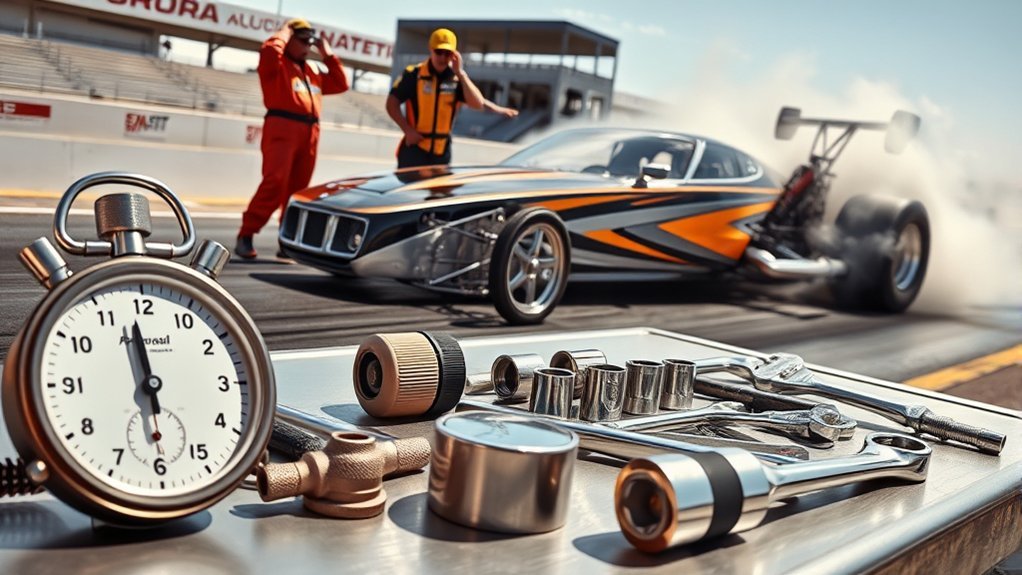
To drag race successfully, start by understanding the basics, including key metrics like reaction time and elapsed time. Gather essential tools such as a timing light, spark plug tools, and a tire pressure gauge. Before each run, make sure your vehicle is safe and properly tuned. Master your launch techniques and stay focused during your race. Finally, analyze your timeslip to improve. By following these steps, you can enhance your performance and avoid common race day mistakes with just a few more insights.
Understanding the Basics of Drag Racing
When you plunge into the world of drag racing, you’ll quickly discover it’s not just about speed; it’s a precise blend of skill and strategy.
Understanding drag racing history is essential, as it shapes the sport’s evolution and vehicle classification. Races occur on controlled surfaces, either an eighth mile or a quarter mile long, designed for maximum grip.
Before you hit the track, make sure you have a valid driving or motorsport license, and that your vehicle meets roadworthy standards. Familiarize yourself with the starting line’s Christmas tree, which signals the countdown to launch.
Your reaction time (RT) is critical; it measures how quickly you respond to the green light. Finally, grasp performance metrics like elapsed time (ET) and terminal speed (MPH)—lower ETs and higher speeds generally lead to better results.
Embrace the challenge, and you’ll thrive in this exhilarating motorsport.
Essential Tools and Equipment for Your First Drag Race
Before you hit the track, you’ll need a solid checklist of must-have tools and equipment to guarantee everything runs smoothly.
From tuning and adjustment tools to essential safety gear, being prepared can make all the difference on race day.
Let’s break down what you should pack to maximize your performance and keep safety a top priority.
Must-Have Tools Checklist
Preparing for your first drag race involves more than just knowing how to launch your car; it requires the right tools to make quick adjustments and guarantee peak performance.
Start with a timing light and distributor wrench for precise timing adjustments. Don’t forget carburetor tuning tools like jets and a vacuum gauge to optimize fuel delivery.
Essential spark plug tools—such as a socket, ratchet, and gapping tool—ensure your engine ignites efficiently. An extensive set of SAE/metric sockets and wrenches will help with quick repairs.
Finally, pack a tire pressure gauge and air supply to manage grip on the track. Effective tools organization and tool maintenance will elevate your racing experience, empowering you to focus on the thrill of competition.
Essential Safety Equipment
While you might be enthusiastic to hit the track, prioritizing safety gear is essential for your drag racing experience.
To guarantee your protection and comply with safety regulations, you need to invest in quality gear and conduct regular gear inspections.
Here’s what you should have:
- An approved helmet for high-speed protection
- A fire suit to shield you from flames
- Proper harnesses for secure seating
- A roll cage to protect against rollovers
- A valid driving or motorsport license for legal competition
Tuning and Adjustment Tools
Having the right tuning and adjustment tools is vital for maximizing your performance on the drag strip. Start with carburetor tuning tools like jets and vacuum gauges to optimize your engine’s fuel delivery. A timing light for ignition adjustments is fundamental, as well as spark plug gapping tools to guarantee your engine runs efficiently.
Don’t forget a complete screwdriver set and wrenches for quick suspension adjustments; fine-tuning traction bars can dramatically enhance your vehicle’s handling. A ratchet with sockets and a valve spring seat pressure tester will help maintain valve performance in high-revving situations.
Finally, keep a quality tire pressure gauge for slicks and essential repair fluids on hand, making sure you’re ready to tackle any challenges race day throws your way.
Preparing Your Vehicle: Safety Checks and Adjustments
Before you hit the track, conducting a thorough inspection of your vehicle’s safety equipment is essential to confirm a successful drag racing experience.
This isn’t just about speed; it’s about safety and confidence as you release your ride’s potential.
Make certain to check the following:
- Safety equipment like helmets and fire systems meet current standards.
- Tire pressure is adjusted for ideal track conditions.
- Nitrous tuning is precise to avoid rich or lean conditions.
- Suspension adjustments are set for stability during launches.
- Brake checks, ignition parts, and fuel lines are all functioning properly.
These steps confirm you’re not only ready to race but also protected from unexpected mechanical failures.
Embrace the freedom of the track with peace of mind, knowing your vehicle is primed for performance and safety.
Get your adrenaline pumping, and let the race begin!
Mastering Launch Techniques in Drag Racing
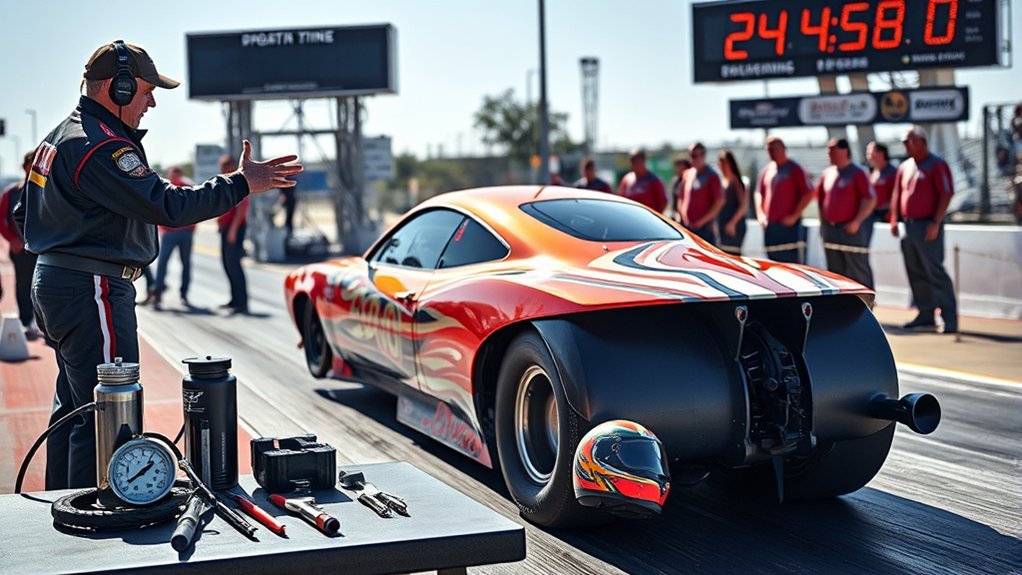
With your vehicle primed for safety and performance, it’s time to focus on one of the most vital aspects of drag racing: the launch. Mastering your launch timing is essential; hold your left foot firmly on the brake while gradually increasing revs with your right foot to build torque.
Mastering your launch timing is crucial; build torque while firmly holding the brake for a successful drag racing start.
Release the brake at the ideal moment when the amber lights illuminate on the Christmas tree to avoid a red light disqualification.
Understanding your vehicle characteristics is equally important. Different engines respond variably; some may bog down, while others spin out, requiring you to adjust your technique accordingly.
For all-wheel-drive cars, grip can be an issue during launch, while rear-wheel-drive vehicles benefit from weight transfer. Consistent practice of your launch technique not only enhances reaction times but also greatly impacts the vital 60-foot measurement on your timeslip, setting the stage for a successful race.
Why Staying Focused Matters During Your Race?
While racing down the track, staying focused is crucial for not just your performance but also your safety. Mental discipline and race concentration are essential to avoid distractions that can lead to mistakes. By keeping your eyes straight ahead, you’ll enhance your performance and stay aware of the track conditions.
- Prevent costly errors that could derail your run.
- Optimize your launch technique for the best reaction times.
- Make quick decisions in unexpected situations.
- Avoid jumping the start and facing disqualification.
- Enjoy the thrill of pure racing without distractions.
When you prioritize focus, you empower yourself to navigate the track with confidence. This mental engagement isn’t just about speed; it’s about harnessing your full potential and achieving liberation on the asphalt.
Analyzing Your Timeslip After Each Run
After each run, take a close look at your timeslip to understand key metrics like your reaction time and 60-foot time.
These numbers reveal your launch performance and can highlight areas where you can improve for future races.
Understanding Key Metrics
Analyzing your timeslip after each drag race is essential for honing your skills and improving your vehicle’s performance. Here’s what to focus on:
- Reaction Time (RT): A quick start is significant; negative values mean a false start.
- 60-foot Time: This reflects your launch performance and impacts your overall elapsed time (ET).
- 1/8th Mile & 1/4 Mile Times: These measure your performance at different stages, highlighting your shifting efficiency.
- Terminal Speed: The MPH at the finish line showcases your vehicle’s top-end power.
- ET vs. Terminal Speed: Understand how these metrics correlate to identify tuning opportunities.
Mastering these drag racing fundamentals can set you free on the track, revealing your true potential as a racer.
Identifying Improvement Areas
Once you’ve familiarized yourself with the key metrics on your timeslip, it’s time to pinpoint areas for improvement.
Start by analyzing your reaction time (RT); quicker responses to that green light can be honed with practice and mental focus.
Next, focus on your 60-foot time, which showcases your launch technique. Optimizing this can dramatically enhance your run.
Don’t ignore your 1/8th mile time; it reveals how well you’re shifting gears and maintaining power.
Also, evaluate your terminal speed (MPH) at the end of the run; higher speeds indicate effective engine performance.
Finally, compare your ET with terminal speed. A slower ET paired with high terminal speed often signals launch or shifting issues needing your attention.
Top 5 Mistakes to Avoid on Race Day
When you’re gearing up for race day, avoiding common pitfalls can make all the difference between a trophy and a disappointing finish.
Here are the top five mistakes to steer clear of:
Avoid these top five race day mistakes to ensure a successful performance and a shot at victory.
- Performing unnecessary burnouts, which can damage your vehicle and annoy fellow racers; focus on efficiency.
- Neglecting vehicle maintenance; tune air bleeds, main jets, and shock settings for ideal track performance.
- Skipping practice on launching techniques; mastering your car’s characteristics is essential.
- Ignoring tire pressure management; monitor and adjust for maximum grip throughout the day.
- Underestimating mental preparation; concentrate on your strategy instead of fixating on opponents.
Effective Strategies for Continuous Improvement as a Racer
To continuously improve as a racer, it’s essential to adopt a mindset focused on growth and learning. Start by engaging in consistent practice to refine your techniques and boost your reaction times.
Analyze both your defeats and successes; this reflection will reveal insights that enhance your skills. Implement performance tracking by utilizing metrics from your timeslips, concentrating on key aspects like reaction time and 60-foot times to sharpen your racing strategy.
Additionally, don’t underestimate the mentorship benefits of connecting with experienced racers. Their insights can help you navigate challenges and accelerate your growth.
Regularly tune your vehicle to adapt to varying track conditions, as understanding how to optimize performance based on environmental factors is vital for success.
Embrace this journey of continuous improvement, and you’ll find yourself not just racing, but evolving as a competitor.
Leveraging Community Feedback for Performance Improvement
How can you take your racing performance to the next level? Leveraging community feedback is key. Engaging with fellow racers can reveal valuable insights and elevate your skills.
Here’s how to tap into community insights:
- Share experiences to learn from others’ successes and mistakes.
- Observe seasoned racers to identify effective strategies.
- Get feedback on your launch techniques for more consistent runs.
- Build relationships for mentorship opportunities with experienced racers.
- Participate in discussions to foster a collaborative learning environment.
Frequently Asked Questions
How Fast Can a 12 Year Old Go in a Jr. Dragster?
In a junior dragster, you can reach speeds up to 85 mph. However, be mindful of speed limits, as safety regulations cap elapsed times at 7.90 seconds, ensuring a thrilling yet controlled racing experience for young drivers.
What Is the Best Strategy to Win a Race?
“Slow and steady wins the race.” Focus on your reaction time to the lights and choose your lane wisely. Analyze every run, adapt your strategy, and remember: consistency is key to victory.
Did Brittany Force Go 343 Mph?
Yes, Brittany Force did achieve an astonishing speed of 343 mph, breaking speed records in drag racing. This performance metrics highlight her exceptional skill and the advancements in technology within the sport, elevating her legacy.
Is 12 Seconds Fast for a Quarter-Mile?
Yes, a 12-second quarter mile is fast for most street-legal vehicles. It showcases impressive quarter mile performance, especially for novice drivers. In drag racing times, achieving this requires tuning and precise driving techniques.
Conclusion
As you rev up for your next drag race, remember that each run is a stepping stone on your path to mastery. Like a finely tuned engine, your skills will refine with practice and feedback. Stay focused, learn from your timeslips, and embrace the thrill of competition. Avoid common pitfalls, and keep your eyes on the prize—crossing that finish line first. With dedication and the right tools, you’ll transform from a novice into a seasoned racer, blazing down the strip.






Leave a Reply