

Wheel alignment prices vary by vehicle, suspension design, location, and the amount of work needed to bring the wheels back within the manufacturer’s specifications. As a practical 2026 planning range, many U.S. drivers can expect to pay about $50 to $200 for a routine wheel alignment before suspension repairs, special adjustment parts, or electronic calibration. Pricing in this guide was reviewed on July 20, 2026.
Quick Answer
In 2026, a routine wheel alignment in the U.S. commonly costs about $50 to $200 before repairs or calibration. Front-end service is usually cheaper, while four-wheel service costs more. Your final price depends on the vehicle, local labor rates, worn or seized parts, modifications, and electronic reset requirements.
Key Takeaways
- A front-end alignment often costs roughly $50 to $100, while a four-wheel alignment commonly costs about $100 to $200.
- The advertised price may not include worn suspension parts, seized adjusters, shims, steering-angle resets, or other vehicle-specific procedures.
- Pulling, an off-center steering wheel, and unusual tire wear can indicate misalignment, but vibration and noise may have other causes.
- Ask for the initial and final alignment readings so you can see what was measured and adjusted.
- Follow your owner’s manual and have the alignment inspected after a hard impact, steering or suspension repair, or a noticeable change in handling.
At a Glance
| Time Required | Often about 45–90 minutes, but rust, repairs, calibration, and shop workload can extend the visit |
| Difficulty | Professional service requiring precise measurements and vehicle-specific specifications |
| Tools Needed | Alignment rack, computerized measuring system, turnplates, steering-wheel lock, and vehicle specifications |
| Cost | Approximately $50–$200 for routine service before repairs, parts, taxes, or electronic calibration |
Why Does Wheel Alignment Matter?
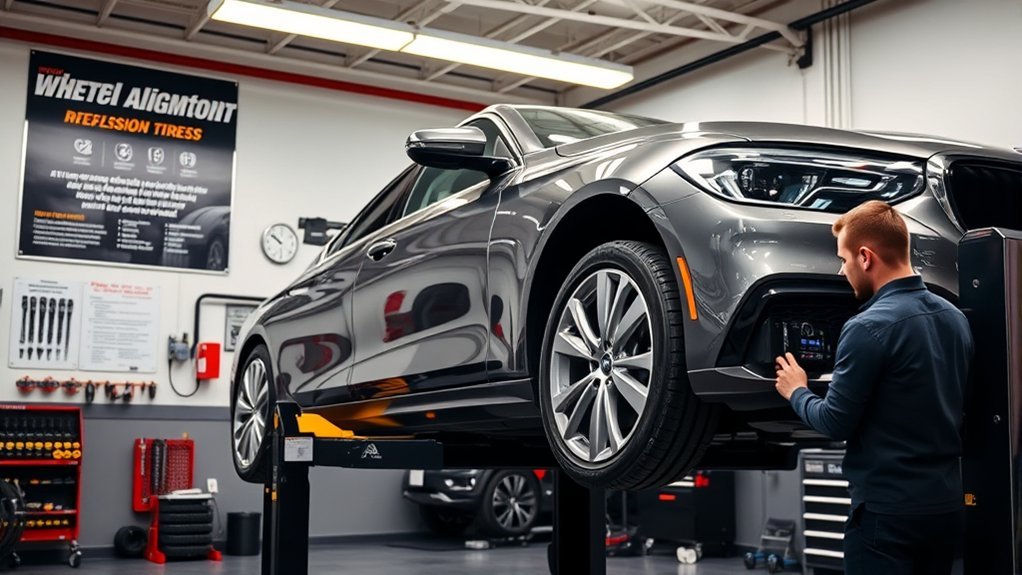
A wheel alignment adjusts the angles of the steering and suspension so the tires point in the correct direction and meet the road as the vehicle manufacturer intended. According to AAA’s wheel alignment guide, the main measurements are camber, caster, and toe.
- Toe describes whether the fronts of the tires point slightly toward or away from each other when viewed from above.
- Camber is the inward or outward tilt of a wheel when viewed from the front.
- Caster describes the steering-axis angle that helps the vehicle track straight and allows the steering wheel to return after a turn.
- Thrust angle describes the direction in which the rear wheels push the vehicle in relation to its centerline.
Correct alignment supports predictable steering and handling. When the settings are outside specification, the vehicle may pull or drift, the steering wheel may sit crooked while the vehicle travels straight, or the tires may develop rapid wear on an inner or outer edge.
Alignment also helps the tread contact the road more evenly. It cannot reverse tire wear that has already occurred, but correcting the underlying geometry may prevent the pattern from getting worse. Proper alignment may also reduce unnecessary rolling resistance, although drivers should not expect a guaranteed fuel-economy increase.
An alignment does not adjust the tires themselves. It adjusts the steering and suspension angles that control how the wheels sit and travel.
How Much Does Wheel Alignment Cost in 2026?
A reasonable planning range for a routine wheel alignment is $50 to $200. A current nationwide service-provider guide from Jiffy Lube lists approximately $50 to $75 for a front-end alignment and $100 to $168 for a four-wheel alignment. Actual quotes may be lower or higher because shops price the service by vehicle, location, equipment, warranty, and required adjustments.
| Service Type | Typical Planning Range | Common Application |
| Front-end or two-wheel alignment | About $50–$100 | Some older vehicles or vehicles with a non-adjustable solid rear axle |
| Thrust-angle alignment | Varies by vehicle and shop | Measures the rear thrust line and aligns the front wheels to it |
| Four-wheel alignment | About $100–$200 | Most modern cars, crossovers, and vehicles with adjustable front and rear suspension |
| Lifetime or multi-service package | Vehicle- and provider-specific quote | Drivers keeping the same vehicle long enough to use the service repeatedly |
The shop should select the alignment method based on the vehicle’s suspension and manufacturer procedures, not simply on whether the vehicle has front-, rear-, all-, or four-wheel drive. Most modern vehicles benefit from measurements at all four wheels even when some rear angles are not adjustable.
What Is Included in a Wheel Alignment?
A complete standard alignment commonly includes:
- Checking tire pressure and visible tire condition.
- Inspecting steering and suspension parts for looseness, wear, or damage.
- Placing the vehicle on an alignment rack.
- Attaching and compensating computerized measuring targets or sensors.
- Measuring camber, caster, toe, and thrust angle as applicable.
- Comparing the readings with the vehicle manufacturer’s specifications.
- Adjusting the available angles.
- Centering the steering wheel.
- Printing the initial and final measurements.
- Performing a road test when appropriate.
These steps are consistent with the standard alignment process described by Firestone Complete Auto Care. However, not every advertised price includes every adjustment, part, electronic reset, or diagnostic procedure.
Pro Tip: Ask for the before-and-after alignment printout. The report should show each measured angle, the vehicle’s acceptable specification range, and whether the final reading is within that range.
Factors Influencing Wheel Alignment Costs
The basic rack time is only one part of an alignment quote. Your final cost may change because of the following factors.
Vehicle and Suspension Design
Luxury, performance, modified, lowered, lifted, and specialty vehicles may require additional setup time or equipment. Some vehicles have many adjustable angles, while others require special bolts, shims, bushings, or manufacturer procedures to correct an angle that is not normally adjustable.
Front-End Versus Four-Wheel Service
A front-end alignment measures and adjusts the front axle. A four-wheel service measures all four corners and adjusts the available front and rear angles. Because it involves more measurements and potential adjustments, four-wheel service generally costs more.
Worn or Damaged Components
An alignment cannot remain accurate if a tie-rod end, ball joint, bushing, control arm, wheel bearing, strut mount, or other steering or suspension component is loose or damaged. The shop may need to repair the vehicle before it can complete the alignment.
Rust and Seized Adjusters
Corrosion can make adjustment bolts, sleeves, or eccentric cams difficult to move. Extra labor or replacement hardware may be required, especially on vehicles exposed to road salt.
Vehicle Modifications
Lift kits, lowering springs, adjustable control arms, aftermarket wheels, wheel spacers, and collision repairs can change the alignment range. A modified vehicle may require custom specifications or additional parts to reach the intended settings.
Steering-Angle and Safety-System Calibration
Some modern vehicles require a steering-angle-sensor reset after the mechanical alignment. Depending on the year, make, model, and repair procedure, additional safety-system or driver-assistance calibration may also be required. Hunter Engineering explains that the electronic steering angle may need to be reset to match the vehicle’s corrected thrust line.
Note: Ask whether the quoted price includes the required steering-angle reset, diagnostic scan, or safety-system calibration for your exact year, make, model, and trim.
Location and Shop Type
Labor rates, taxes, equipment, technician training, warranty terms, and local competition affect pricing. An independent shop may charge less than a dealership or national chain, but the lowest price is not automatically the best value. Confirm that the shop has current specifications and equipment suitable for your vehicle.
Wheel Alignment Versus Wheel Balancing
Wheel alignment and wheel balancing are different services, even though shops often perform them during the same visit.
- Alignment adjusts steering and suspension angles so the wheels point and sit correctly.
- Balancing corrects uneven weight in each tire-and-wheel assembly by adding or repositioning small wheel weights.
A crooked steering wheel, pulling, or edge wear may suggest an alignment problem. A speed-related vibration felt through the steering wheel, seat, or floor more often points toward imbalance, tire damage, a bent wheel, or another mechanical problem. Michelin provides a detailed comparison in its guide to wheel alignment and balancing.
Warning: Severe pulling, shaking, noise, or a sudden handling change after hitting a pothole or curb can indicate tire, wheel, steering, brake, or suspension damage. Do not assume an alignment alone will make the vehicle safe. Have the vehicle inspected before continuing at highway speed.
When Should You Get a Wheel Alignment?

There is no single alignment interval that applies to every vehicle. Follow the maintenance and inspection guidance in your owner’s manual. As a practical guideline, AAA recommends checking alignment at least annually and after tire replacement or a significant pothole or curb impact.
Schedule an inspection sooner when you notice:
- The vehicle consistently pulls or drifts on a flat, straight road.
- The steering wheel remains off-center while the vehicle travels straight.
- The inner or outer edges of a tire wear faster than the rest of the tread.
- The tread develops feathering, in which one side of each tread block feels smoother than the other.
- The handling or steering response changes after a pothole, curb strike, or collision.
- Steering or suspension parts have been replaced.
- The ride height has changed because of new springs, a lift kit, a lowering kit, or worn suspension parts.
Checking alignment when buying new tires can help protect the investment, but new tires do not automatically mean the vehicle needs adjustment. A measurement can show whether the existing settings are within specification.
Other Causes of Alignment-Like Symptoms
Not every pull, vibration, or unusual wear pattern is caused by alignment. A complete diagnosis may also include checking:
- Tire pressure on all four tires.
- Uneven, damaged, separated, or mismatched tires.
- Wheel balance and bent wheels.
- Road crown or strong crosswinds.
- Brake drag.
- Loose or worn steering and suspension parts.
- Ride-height differences.
- Wheel-bearing play.
The National Highway Traffic Safety Administration’s tire guidance recommends regular pressure, tread, and condition checks and following the vehicle manufacturer’s tire-rotation instructions. These basic checks help separate inflation or wear problems from alignment problems.
Ways to Reduce Wheel Alignment Costs
You can reduce the cost without choosing a shop solely because it has the lowest advertised price.
- Compare complete quotes: Ask whether the price covers all four wheels, final adjustments, the measurement printout, shop fees, and taxes.
- Ask about a measurement-only check: Some shops offer a free or discounted alignment inspection. Confirm whether adjustment is included before authorizing work.
- Use current promotions: Tire shops and service centers may bundle an alignment with new tires or offer seasonal coupons.
- Correct worn parts first: Paying for an alignment before repairing a loose component may lead to a second alignment charge.
- Protect the suspension: Slow down for potholes, avoid striking curbs, maintain tire pressure, and inspect the vehicle after a hard impact.
- Consider an independent repair facility: A qualified independent shop may have lower labor rates than a dealership while still using modern alignment equipment.
- Evaluate lifetime packages mathematically: Divide the package price by the normal one-time price. A hypothetical $240 package compared with a $120 one-time alignment breaks even after the second covered service.
Before buying a lifetime package, read the written terms. Confirm whether it is limited to the current owner and vehicle, whether recommended checks are included, whether adjustments are covered, and whether parts, custom alignment settings, electronic calibration, or modified vehicles are excluded.
Questions to Ask Before Booking
- Is this quote for a front-end, thrust-angle, or four-wheel alignment?
- Does it include the initial inspection and final measurement printout?
- Are camber, caster, toe, and thrust-angle adjustments included when adjustable?
- Could shims, bolts, bushings, or other parts cost extra?
- Will you inspect the steering and suspension before adjusting the vehicle?
- Does my vehicle require a steering-angle reset, diagnostic scan, or safety-system calibration?
- What written warranty applies to the service?
- Will you contact me before performing additional repairs?
Frequently Asked Questions
Can I perform a wheel alignment at home?
You can use strings, toe plates, or measuring tools to perform a basic toe check on some vehicles, but that is not the same as a complete alignment. Accurate camber, caster, toe, thrust-angle, and runout measurements require a level surface, vehicle-specific specifications, and professional equipment. Modern vehicles may also require an electronic steering reset.
What symptoms indicate a need for wheel alignment?
Common signs include consistent pulling on a flat road, an off-center steering wheel, rapid inner- or outer-edge tire wear, feathered tread, and a handling change after a pothole or curb strike. These symptoms can have other causes, so the vehicle should be measured and inspected before parts or services are approved.
How long does a wheel alignment take?
Many routine appointments take roughly 45 to 90 minutes, but there is no guaranteed standard time. The visit may take longer when adjustment hardware is rusty, suspension parts are worn, special parts are required, the vehicle is modified, or electronic resets and calibration must be completed.
Do all vehicles require the same alignment method?
No. The correct method depends on the year, make, model, suspension design, available adjustments, ride height, drivetrain layout, and manufacturer procedures. Some vehicles receive a front-end or thrust-angle service, while most modern passenger vehicles benefit from four-wheel measurements.
Is wheel alignment covered under a vehicle warranty?
Routine alignment is commonly treated as maintenance or normal wear and is often excluded. Coverage may apply when a warranted steering or suspension defect caused the problem, but the written warranty controls. The FTC also states that using an independent repair facility does not by itself cancel a manufacturer’s warranty.
Is wheel alignment the same as tire balancing?
No. Alignment changes steering and suspension angles. Balancing corrects uneven weight in a rotating tire-and-wheel assembly. A shop may recommend both services, but one does not automatically include or replace the other.
Do I need an alignment after installing new tires?
New tires do not automatically require an alignment, but checking the measurements is a sensible way to protect them. An inspection is especially useful when the old tires showed uneven wear, the steering wheel is off-center, the vehicle pulls, or suspension work was recently completed.
Conclusion
In 2026, most drivers should budget approximately $50 to $200 for a routine wheel alignment before repairs or calibration. The price alone does not tell you whether a quote is a good value. Confirm which wheels will be measured, what adjustments are included, whether the steering and suspension will be inspected, and whether your vehicle requires an electronic reset.
Address pulling, an off-center steering wheel, and unusual tread wear early, but do not assume every vibration or handling problem is caused by alignment. A proper inspection and before-and-after measurement report will show whether the vehicle was out of specification and what the technician corrected.
Sources
- Jiffy Lube: The Cost of a Wheel Alignment — current front-end and four-wheel alignment price estimates.
- AAA: Guide to Vehicle Wheel Alignment and Suspension — alignment definitions, symptoms, service timing, and alignment types.
- Michelin: Wheel Alignment and Balancing Explained — differences between alignment and wheel balancing.
- NHTSA TireWise — tire pressure, tread, rotation, inspection, and safety guidance.
- Hunter Engineering: Steering Angle Sensor Reset — electronic reset procedures following mechanical alignment.
- Federal Trade Commission: Auto Warranties and Service Contracts — maintenance, normal-wear exclusions, independent service, and warranty rights.







Leave a Reply