
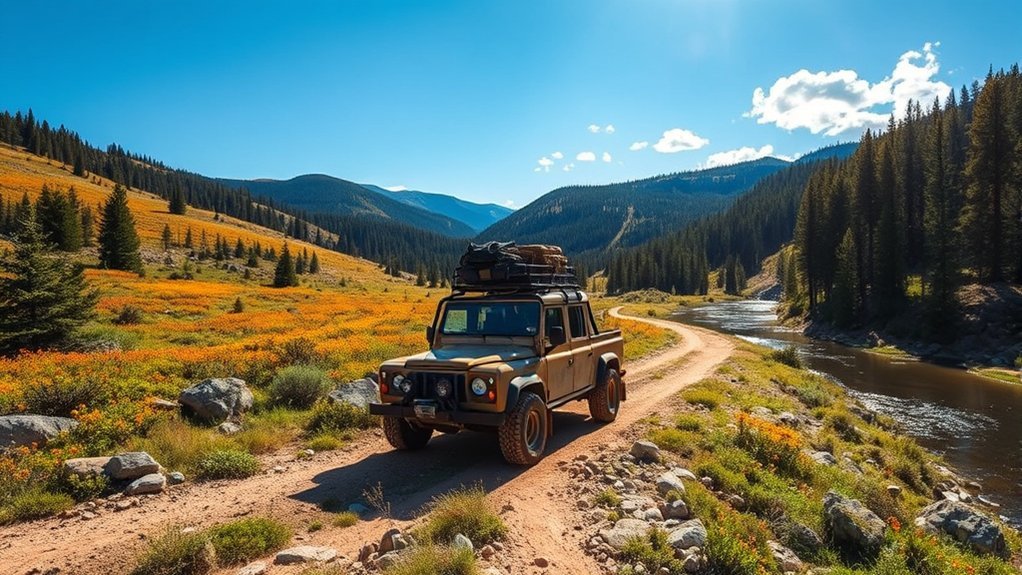
Overlanding is self-reliant, vehicle-based travel in which the journey, remote camping, and exploration matter as much as the destination. A first trip does not require a heavily modified truck. It does require a legal and dependable vehicle, a route matched to your skill level, enough water and fuel, offline navigation, emergency communication, and a clear plan for changing weather, closures, or mechanical problems.
Quick Answer
Overlanding is vehicle-supported travel that combines road exploration, remote camping, and self-sufficiency over one or more days. Unlike recreational off-roading, the goal is usually the journey rather than the hardest obstacle. Beginners should start with a short legal route, a reliable vehicle, basic recovery gear, offline maps, extra water, and an emergency plan.
Key Takeaways
- Overlanding is about self-reliant travel and camping, not simply driving the most difficult trail.
- A stock vehicle may be suitable when its clearance, tires, payload, range, and drivetrain match the route.
- Legal access changes. Check current land-manager maps, permits, fire restrictions, weather, and closures before every trip.
- Carry redundant navigation, water, first aid, a full-size spare, safe recovery equipment, and a way to call for help outside cell coverage.
- Start with a one- or two-night shakedown trip close to services before attempting a remote multi-day route.
At a Glance
| Time Required | One or two nights for a beginner shakedown trip; weeks or months for an expedition |
| Difficulty | Easy to expert, depending on terrain, weather, remoteness, and driver experience |
| Tools Needed | Route-suitable vehicle, full-size spare, tire tools, recovery gear, offline maps, shelter, water, first aid, and emergency communication |
| Cost | No fixed amount; budget for fuel, food, permits, ferries, campsites, maintenance, and any missing safety gear |
What Is Overlanding and Why Is It Popular?
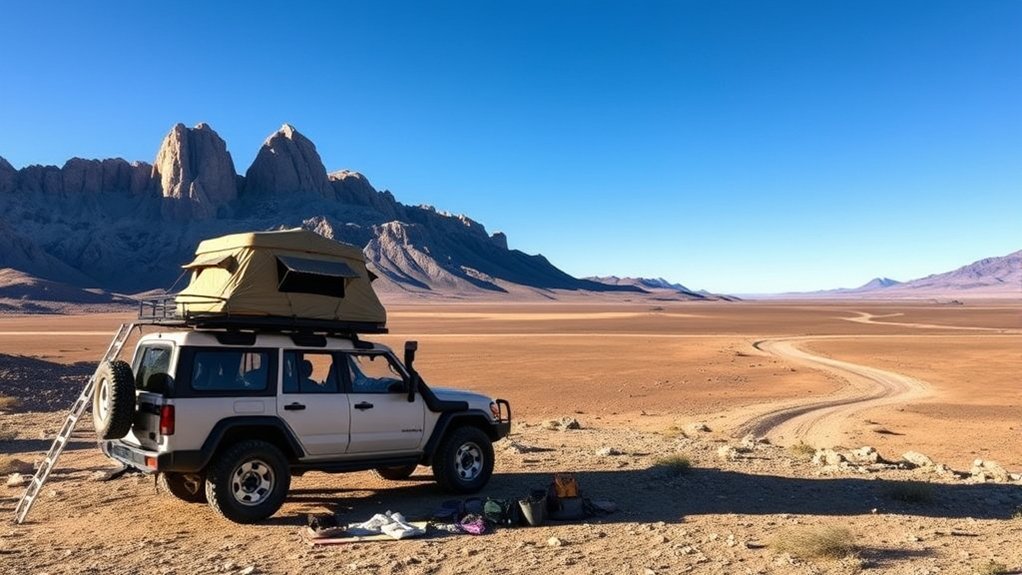
Overlanding is commonly understood as self-reliant travel to places where the route and experience are central to the trip. It may include paved back roads, gravel roads, forest roads, desert tracks, beaches, or technical four-wheel-drive terrain. Trips can last a weekend or cross countries over many months.
The term has historical links to long overland journeys, including livestock and commercial travel, but modern recreational overlanding has no single official definition. In practice, most trips share four traits:
- Vehicle-supported travel: The vehicle carries people, shelter, food, water, tools, and safety equipment.
- Self-sufficiency: Travelers prepare for limited services, weak cell coverage, changing weather, and minor mechanical problems.
- Multiple destinations: The route often includes moving camps rather than staying at one campground.
- Responsible access: Drivers follow legal routes, local camping rules, fire restrictions, and low-impact practices.
Overlanding has become more visible through outdoor media, vehicle-accessory markets, route-sharing apps, and social communities. That visibility can make the activity look equipment-heavy, but the core idea is simpler: travel slowly, prepare carefully, and use a vehicle to explore responsibly.
A capable overland setup is not the vehicle with the most accessories. It is the vehicle and plan that safely match the route.
How Overlanding Differs From Off-Roading and Camping
Overlanding, off-roading, and camping overlap, but they place the emphasis in different places. A trip can include all three.
| Activity | Main Goal | Typical Pattern | Vehicle Demands |
|---|---|---|---|
| Overlanding | Travel, exploration, and self-sufficiency | One or more nights with changing camps | Depends on the selected route |
| Off-roading | Driving challenge, recreation, or access | Often a day trip or loop from a base | May require low range, clearance, armor, or specialized tires |
| Car camping | Camping near a parked vehicle | Usually a developed or established campsite | Often suitable for ordinary passenger vehicles |
Overlanding does not automatically mean extreme rock crawling or remote international travel. A weekend route through legal forest roads with a different campsite each night can qualify. Likewise, an off-road trail is not necessarily an overland route if the driver returns to the same base after a few hours.
Key Vehicle Requirements for Overlanding
The best vehicle is not a specific model. It is a dependable vehicle whose drivetrain, clearance, tires, payload, size, fuel range, and service condition match the route. A two-wheel-drive vehicle can handle many paved and graded-gravel trips. Deep sand, mud, ledges, steep grades, or rough desert roads may require high clearance, four-wheel drive, low range, and stronger tires.
Vehicle Capability and Reliability
Evaluate the route before modifying the vehicle. Check the land manager’s route description, surface, seasonal limits, water crossings, width restrictions, and recommended vehicle type. Then compare those demands with your vehicle.
- Ground clearance: Enough clearance reduces the chance of high-centering or damaging low components.
- Tires: Tires must be in good condition, correctly rated for the vehicle and load, and appropriate for the surface.
- Drivetrain: All-wheel drive helps on loose surfaces, while true four-wheel drive and low range provide more control on difficult terrain.
- Payload: Passengers, water, fuel, a rooftop tent, armor, drawers, tools, and recovery gear all count against the vehicle’s payload capacity.
- Range: Plan fuel stops conservatively and keep a reserve for detours, headwinds, soft surfaces, or backtracking.
- Repair access: Consider parts availability, tire size, and whether the vehicle can be serviced along the route.
Note: Verify specifications for the exact VIN, model year, trim, tire size, and installed options. Use the owner’s manual and certification label for payload, towing, tire-pressure, jacking, and recovery information; specifications from another model year or trim may not apply.
Pre-Trip Inspection and Maintenance
A reliable stock vehicle is usually safer than a heavily modified vehicle with unresolved maintenance problems. Before departure, inspect or service:
- Tire tread, sidewalls, pressures, valve stems, and the full-size spare
- Engine oil, coolant, brake fluid, transmission fluid, and visible leaks
- Battery condition, charging system, terminals, and secure mounting
- Brakes, steering, suspension, wheel bearings, and lug-nut torque
- Belts, hoses, lights, wipers, air filter, and windshield condition
- Jack, wheel tools, spare-key access, and any vehicle-specific tools
- Open safety recalls through the National Highway Traffic Safety Administration recall lookup
Useful Modifications Without Overbuilding
Start with the problem the route creates, not with a shopping list. Common upgrades include all-terrain tires, underbody protection, a secure cargo system, additional lighting where legal, a compressor, a recovery kit, and suspension changes designed for the actual loaded weight.
A rooftop tent, refrigerator, winch, auxiliary battery, or larger fuel tank may improve convenience or range, but each adds weight, cost, maintenance, and complexity. Drive a few short trips before deciding what the vehicle truly needs.
Warning: Do not exceed the vehicle’s payload, axle, tire, roof-load, or gross vehicle weight ratings. Added suspension height does not increase the manufacturer’s weight ratings. An overloaded vehicle can handle poorly, overheat tires and brakes, and suffer component failure.
Essential Gear for an Overlanding Trip
Pack for the route’s hazards and remoteness. Secure every heavy item so it cannot become a projectile on rough roads or during a sudden stop.
Vehicle and Recovery Gear
- Full-size spare tire, pressure gauge, repair kit, and compressor
- Vehicle-rated jack with a stable base for sand or soft ground
- Shovel, traction boards, work gloves, and basic hand tools
- Rated recovery strap or kinetic rope, rated shackles, and approved recovery points
- Jumper pack or jumper cables suitable for the vehicle
- Spare fuses, key fluids, and model-specific parts justified by the route
- Fire extinguisher rated for vehicle use and mounted where it is reachable
Warning: Vehicle recovery can be deadly when equipment or attachment points fail. Never attach a recovery strap to a tow ball, tie-down loop, suspension part, or an unknown point. Use equipment within its rated limits, clear bystanders from the recovery zone, and get hands-on training before using a winch or kinetic rope.
Camping, Food, and Water
- Weather-appropriate tent, vehicle shelter, or rooftop tent
- Sleeping bag or quilt, insulated pad, and dry clothing
- Stove and fuel allowed under current fire restrictions
- Food for the planned trip plus an emergency reserve
- Water containers protected from damage and contamination
- Water filter or purifier appropriate for the local water hazards
- Trash storage and the human-waste system required by the land manager
Ready.gov uses one gallon of water per person per day as a basic emergency-kit planning amount for drinking and sanitation. Remote travel, hot weather, altitude, children, pets, cooking, and vehicle trouble can require more. Do not treat one gallon as a universal ceiling.
Navigation, First Aid, and Communication
- Downloaded offline maps plus a paper map or second independent navigation source
- Current official route map, permit, and land-manager contact information
- First-aid kit matched to the group, climate, trip length, and known medical needs
- Satellite messenger or personal locator beacon for remote travel
- Phone charging, spare batteries, and protected emergency power
- Whistle, headlamp, signaling mirror, and visible emergency markers
Pro Tip: Separate gear into “must reach immediately,” “needed at camp,” and “emergency only.” Keep first aid, fire suppression, communication, water, warm layers, and recovery gloves accessible without unloading the vehicle.
Planning an Overland Journey Safely
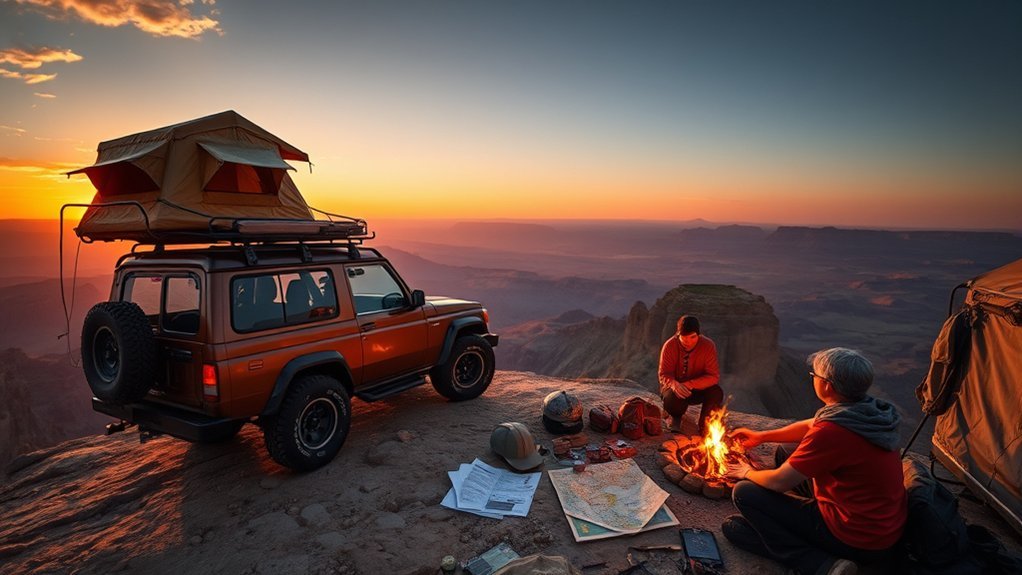
Good planning reduces the chance that a simple delay becomes an emergency. Use the following process for every route, even one you have driven before.
1. Match the Route to the Vehicle and Group
Consider the least experienced driver, the least capable vehicle, passenger needs, pets, medical concerns, and the amount of daylight available. Avoid a route when the group cannot safely self-recover, turn around, or wait for help.
2. Confirm Legal Access and Current Conditions
Identify every land manager the route crosses. Download current maps, read alerts, and verify whether the route is open to your vehicle class. On National Forest System lands, the Motor Vehicle Use Map is the legal reference for designated motorized routes; a line on a commercial app does not by itself make a road legal.
Check permits, camping limits, seasonal gates, fire restrictions, ferry schedules, private-property boundaries, and any rules for beach driving or off-highway vehicles.
3. Review Weather and Route Hazards
Check the forecast before departure and again when service is available. Rain far upstream can flood a wash even when the sky above you is clear. Snow, wildfire, extreme heat, high winds, and freeze-thaw cycles can quickly change road conditions.
Warning: Never drive around a barricade or enter a flooded road because the water “looks shallow.” The National Weather Service advises drivers to turn around rather than drive through floodwater; depth, current, and road damage may be impossible to judge from the vehicle.
4. Calculate Fuel, Water, Food, and Time Reserves
Base fuel calculations on off-pavement consumption, not highway mileage. Add margin for detours, idling, soft sand, wind, or a closed exit. Carry enough water and food to remain safe if the group is delayed beyond the planned return time.
5. Build a Redundant Navigation Plan
Save maps and route files on more than one device. Mark fuel, water, hospitals, ranger stations, legal campsites, bailout roads, and turnaround points. Do not follow an old GPX track blindly; roads can be closed, washed out, rerouted, or returned to private use.
6. File a Trip and Communication Plan
Give a trusted person your route, vehicle description, license plate, traveler names, planned camps, check-in times, and the time they should contact authorities if you miss a check-in. Explain how your satellite device or radio will be used and which messages mean “delayed but safe” versus “send help.”
7. Practice Before Remote Travel
Learn how to change a tire on uneven ground, use the vehicle’s four-wheel-drive system, read a map, place a spotter, reverse safely, and use recovery equipment. Test all camp systems during a nearby overnight trip before relying on them far from services.
8. Set Turnaround Rules
Decide in advance what ends or changes the trip: a weather warning, an injured traveler, a second tire failure, low fuel, rising water, a blocked road, loss of communication, or arrival at a difficult obstacle after the turnaround time. Turning around is good judgment, not failure.
Licenses, Permits, and Radio Rules
There is no universal U.S. “overlanding license.” Requirements depend on the vehicle, road, land manager, and activity. At minimum, use a properly licensed driver and a vehicle that meets registration, insurance, equipment, and street-legal requirements for the roads being traveled.
Additional requirements may include:
- National or state park entrance fees and camping reservations
- Off-road vehicle permits, education certificates, or nonresident stickers
- Beach-driving permits and vehicle-ferry reservations
- Fire permits or complete fire bans
- Special-use permits for large groups, commercial trips, or organized events
- Border, customs, insurance, vehicle-import, or visa documents for international travel
Communication rules also matter. The Federal Communications Commission identifies GMRS as a licensed radio service. FRS operation does not require an individual license when compliant FRS equipment is used. A satellite messenger may require an active subscription and a clear view of the sky; test the device and account before departure.
Responsible Overlanding and Campsite Ethics
Overlanding is not automatically sustainable. Heavy vehicles can widen routes, damage soil crusts, spread invasive plants, disturb wildlife, and leave human waste or fire scars. Responsible travel requires specific choices:
- Stay on designated roads and established campsites unless the land manager expressly allows otherwise.
- Do not create bypasses around mud, gates, rocks, or other obstacles.
- Avoid travel when wet roads are easily damaged.
- Pack out trash, toilet paper, food scraps, and waste where required.
- Use toilets when available and follow location-specific human-waste rules.
- Clean mud and seeds from tires, recovery boards, and undercarriages before moving between regions.
- Keep food secured and follow local wildlife-storage rules.
- Use stoves or fires only when allowed, and follow active restrictions.
- Respect private property, archaeological sites, livestock, quiet hours, and other visitors.
The Bureau of Land Management’s public-land camping guidance notes that dispersed camping is generally limited to 14 days within a 28-day period, but local limits vary. It also directs drivers to stay on designated roads unless an area is specifically open to cross-country motorized use. Always follow the local rule rather than assuming a nationwide limit applies.
Best Overlanding Routes for Beginners in the U.S.
A beginner route should have clear legal access, manageable terrain, reliable navigation, reasonable bailout options, and conditions that match the vehicle and season. No route stays “beginner-friendly” in every weather event. Confirm current information immediately before departure.
Popular Beginner Routes
- Moab, Utah: The region has everything from graded roads to extreme rock-crawling trails. Beginners should choose a specifically rated easy route, use current BLM travel maps, and avoid assuming that a famous Moab trail is suitable for a stock vehicle.
- Trans-New Hampshire Overland Adventure Route: This is a community-developed route rather than one continuously managed public road. Confirm the current route package, fees, private-road permissions, seasonal closures, and vehicle requirements with the route organizer and each land manager.
- South Core Banks, North Carolina: The island is reached by boat or ferry, not by a road from the mainland. Drivers need an annual off-road vehicle permit, should reserve vehicle-ferry space, and need to prepare for soft sand, tides, weather, and limited services. The National Park Service posts current ORV permit information.
- Trans-Wisconsin Adventure Trail: This 600-plus-mile community route was developed mainly for dual-sport and adventure motorcycles. High-clearance vehicles may require reroutes. Verify each segment’s legal access, surface, seasonal status, and suitability before treating it as a vehicle overland route.
- Mojave Road, California: This historic desert route is roughly 150 miles and commonly takes about three days. The National Park Service says it is not regularly maintained, includes rough and sandy sections, and recommends four-wheel drive. It is better viewed as a step up after shorter trips, not as a no-risk first outing. Check the official Mojave Road guide and current road conditions before travel.
Beginner Route Selection Checklist
| Question | Beginner-Friendly Answer |
|---|---|
| Is the route legal and currently open? | Confirmed through the land manager, not only a crowd-sourced map |
| Can the vehicle complete it? | Clearance, tires, drivetrain, width, payload, and range meet the published requirements |
| Can the group turn around? | Frequent bailout points and no required obstacle beyond the group’s skill |
| Is help reasonably available? | Known check-in plan, emergency communication, and a realistic rescue delay |
| Are weather risks manageable? | No active warning, dangerous heat, deep snow, flood threat, or high fire risk |
Safety Tips for Beginners
- Travel with another well-prepared vehicle when the route is remote or recovery is likely.
- Walk an obstacle before driving it and use one trained spotter with agreed hand signals.
- Keep speeds low enough to stop within the visible road distance.
- Do not continue after repeated tire damage, overheating, brake problems, or steering changes.
- Avoid deep mud and water crossings until you have route-specific knowledge and training.
- Never rely on cell service, a single navigation app, or a single weather screenshot.
- Stop early enough to set camp in daylight and inspect the site for hazards.
Essential Gear Recommendations for Beginner Routes
For a first trip, prioritize reliable basics over permanent vehicle modifications:
- Season-appropriate shelter and sleep system
- Full-size spare, tire tools, repair kit, compressor, and pressure gauge
- Water, food, medications, and delay reserves
- First-aid kit and fire extinguisher
- Offline maps, official route map, compass, and charging backup
- Shovel, traction boards, gloves, and route-appropriate rated recovery gear
- Satellite communicator or personal locator beacon where cell coverage is unreliable
- Warm layers, rain protection, sun protection, headlamps, and emergency blankets
First Overlanding Trip Checklist
- Choose a one- or two-night route close enough to exit if equipment fails.
- Verify the legal route, campsites, permits, closures, fire rules, and weather.
- Inspect the vehicle and resolve warning lights, leaks, weak tires, or overdue maintenance.
- Weigh the loaded vehicle when payload may be close to its limit.
- Download maps and save paper or second-device backups.
- Calculate fuel, water, food, and medication with delay reserves.
- Test the tent, stove, lights, refrigerator, battery, radio, and satellite device.
- File a trip plan and set check-in and overdue times.
- Secure all cargo and keep emergency equipment accessible.
- Review turnaround rules with every driver before leaving pavement.
Frequently Asked Questions
What types of vehicles are best suited for overlanding?
Reliable SUVs, pickups, vans, crossovers, and even passenger cars can work when matched to the route. Difficult terrain may require high clearance, four-wheel drive, low range, stronger tires, and recovery points. Choose by payload, reliability, range, size, and route requirements rather than by appearance or brand reputation alone.
How much does an overlanding trip typically cost?
There is no useful universal price. A short trip in an owned, maintained vehicle with existing camping gear may mainly cost fuel, food, permits, and camping fees. Rentals, ferries, long distances, specialty tires, repairs, communications subscriptions, or vehicle modifications can raise the total sharply. Build the budget from the actual route and avoid treating accessories as required expenses.
Are specific licenses required for overlanding?
The United States has no general overlanding license. You may need a valid driver’s license, registration, insurance, park pass, campsite reservation, ORV permit, beach-driving permit, nonresident sticker, fire permit, or radio license. International travel can add passports, visas, customs documents, insurance, and temporary vehicle-import rules.
Can families participate in overlanding adventures?
Yes. Choose shorter days, predictable camps, safe child restraints, extra water and clothing, age-appropriate activities, and quick exit options. Account for medications, allergies, food storage, temperature control, sleep routines, and the longer time a family may need for stops or emergencies.
How do I find overlanding communities or groups?
Look for local four-wheel-drive clubs, outdoor organizations, route cleanups, skills classes, owner groups, and moderated online communities. Evaluate advice against official land-manager rules and your owner’s manual. A popular GPX file or social post is not proof that a route is legal, open, or safe.
Can I overland in a stock vehicle?
Often, yes. Many maintained gravel roads and mild forest routes need no lift or permanent modification. Start with maintenance, suitable tires, a full-size spare, safe cargo storage, navigation, water, and communication. Modify only when a repeated route requirement justifies the added weight, cost, and complexity.
Conclusion
Overlanding is less about building an extreme vehicle than about making sound decisions away from routine services. Start with a short legal route, learn the vehicle, pack for delays, and turn around before conditions exceed the group’s ability. With careful planning, responsible campsite habits, and equipment matched to the trip, each journey can build the skills and confidence needed for longer adventures.
Sources
- U.S. Forest Service Motor Vehicle Use Map FAQ — legal motorized-route designations on National Forest System lands
- Bureau of Land Management: Camping on Public Lands — dispersed-camping limits, permits, fire restrictions, and designated-route guidance
- National Park Service: Mojave Road 4-Wheel-Drive Route — route length, typical travel time, terrain, camping, and vehicle recommendation
- National Park Service: Cape Lookout Beach Driving Permit — current ORV permit requirements for North and South Core Banks
- Ready.gov: Build a Kit — baseline emergency water and supply planning
- Federal Communications Commission: General Mobile Radio Service — GMRS licensing and service information






Leave a Reply