

A truck towing package is a model-specific group of towing equipment and vehicle features. It may include a receiver hitch, trailer wiring, a brake controller, added cooling, a different axle ratio, towing software, mirrors, or other upgrades. Because packages vary widely, the safest choice is the one listed for your truck’s exact VIN and the fully loaded trailer you plan to tow.
Quick Answer
A truck towing package equips a specific truck configuration for trailer use. Common features include a receiver hitch, wiring, cooling upgrades, towing software, and an available trailer-brake controller. Always verify the package by VIN and confirm the truck’s payload, axle, hitch, tire, and combined-weight limits before towing.
Key Takeaways
- There is no universal list of equipment included in every truck towing package.
- Use the VIN, build sheet, door labels, owner’s manual, and model-year towing guide to identify your truck’s equipment and ratings.
- An aftermarket hitch or suspension aid does not automatically increase the manufacturer’s towing, payload, axle, or combined-weight ratings.
- The lowest-rated part of the entire setup—including the truck, hitch, ball, tires, and trailer—sets the practical limit.
- Weigh the truck and trailer as loaded for travel instead of relying only on brochure maximums or the trailer’s dry weight.
At a Glance
| Time Required | About 30–60 minutes to verify ratings; several hours or more for installation, depending on the equipment and truck |
| Difficulty | Moderate for research and basic bolt-on parts; advanced for brake wiring, programming, bed-mounted hitches, cooling upgrades, or frame work |
| Tools Needed | Owner’s manual, VIN or build sheet, model-year towing guide, tire and door labels, trailer scale or public scale, torque wrench, and vehicle-specific installation tools |
| Cost | Varies widely by truck, hitch type, wiring, brake controller, cooling equipment, programming, and labor; obtain a VIN-specific written quote |
What Is a Truck Towing Package?
A truck towing package is a collection of factory-installed or manufacturer-approved features intended to prepare a particular truck configuration for towing. The exact contents can change with the model year, trim, engine, transmission, axle ratio, drivetrain, cab, bed length, and wheel or tire option.
For example, one manufacturer’s standard trailering package may provide a receiver platform and 4-pin and 7-pin connectors, while a separate max-towing package changes other equipment or is available only with certain engines, wheels, and body configurations. Check the current manufacturer trailering guide rather than assuming that every package includes upgraded brakes, suspension, cooling, or a trailer-brake controller.
Note: A package name such as “Tow,” “Heavy-Duty Tow,” or “Max Tow” is not a universal industry rating. Compare the actual equipment and ratings listed for the truck’s VIN, not the package name alone.
Why a Truck Towing Package Matters
Towing places extra load on the engine, transmission, cooling system, brakes, tires, suspension, frame, electrical system, and rear axle. A properly matched factory package can provide equipment that helps those systems manage the additional load.
Depending on the truck, useful towing features may include a correctly rated receiver, sealed trailer connectors, an integrated brake controller, larger mirrors, added powertrain cooling, an appropriate axle ratio, tow-specific transmission programming, trailer-light monitoring, camera views, and trailer-sway mitigation.
These features can improve convenience, heat management, braking coordination, visibility, and handling. They do not remove the need to load the trailer correctly, maintain the truck and trailer, or stay below every applicable rating.
The reliable way to confirm that a loaded truck-and-trailer combination stays within its limits is to weigh it and compare the measured axle, vehicle, trailer, and combined weights with every applicable rating.
Key Components of a Truck Towing Package
No single component list applies to every truck. Verify which of the following items are installed on your vehicle.
Receiver Hitch and Mounting Structure
The receiver connects the trailer to the truck through a ball mount, hitch ball, pintle assembly, or weight-distribution equipment. The receiver label states its maximum gross trailer and tongue-weight ratings. The ball mount, ball, coupler, and related hardware also have separate ratings.
Every item must be rated for the loaded trailer and used in the configuration described by its manufacturer. A higher-rated receiver does not override a lower truck, axle, tire, or trailer limit.
Trailer Wiring and Connectors
A basic 4-pin connector commonly supports trailer tail, turn, and brake lights. A 7-pin connector can add circuits for electric trailer brakes, auxiliary power, reverse lights, or other functions. Pin assignments and equipment requirements must match the truck and trailer.
Factory wiring may integrate more cleanly with the truck’s computers and trailer-detection systems. An aftermarket harness must use the correct connectors, circuit protection, wire gauge, grounding points, and routing.
Trailer-Brake Controller
A compatible controller tells equipped electric or electric-over-hydraulic trailer brakes how much braking to apply. An integrated controller may communicate with the truck’s antilock brakes and stability systems, while an aftermarket controller may operate as a separate device.
A controller must be compatible with the trailer’s brake type and adjusted according to the truck, controller, and trailer instructions. Too little gain can leave the truck doing too much of the stopping; too much gain can lock or jerk the trailer brakes.
Cooling and Powertrain Equipment
Some packages add or require transmission, engine-oil, battery, alternator, radiator, fan, or driveline equipment intended for towing. Other trucks already include enough cooling for their published rating, so an optional cooler may not be part of the package.
An axle ratio or powertrain combination can also affect the manufacturer’s GCWR and maximum trailer rating. These configuration differences cannot be identified reliably by looking at the receiver alone.
Suspension, Brakes, Tires, and Mirrors
Higher-capacity truck configurations may use different springs, axles, frames, brakes, wheels, or tires, but those parts are not automatically included in every towing package. Extendable mirrors and camera systems may also be optional.
Helper springs, air springs, or other leveling products can reduce visible rear sag when installed and used correctly. They do not increase the GVWR, payload rating, rear GAWR, tire rating, or manufacturer’s trailer rating.
Tow/Haul Mode and Towing Software
Tow/Haul mode generally changes transmission shift behavior, holds lower gears longer, and may provide grade-braking support. Exact behavior varies by vehicle. It can help the truck manage a load, but it does not increase towing capacity.
Some newer trucks also provide trailer profiles, light checks, blind-zone settings, camera views, tire-pressure monitoring, route planning, or sway-related stability functions. Review the owner’s manual before relying on any feature.
How to Choose the Right Truck Towing Package
1. Identify the Exact Truck
Record the VIN, model year, trim, cab, bed length, drivetrain, engine, transmission, axle ratio, wheel size, and installed options. Then check:
- The certification and tire labels on the driver’s door or doorframe
- Any separate trailering-information label
- The original window sticker or factory build sheet
- The towing section of the exact model-year owner’s manual
- The manufacturer’s model-year towing guide or VIN-based towing calculator
Do not rely on a search result or sales listing that describes a different cab, engine, axle, or drivetrain. Current manufacturer guidance notes that the ratings of an individual truck can differ from the maximum number advertised for the model line.
2. Find the Loaded Trailer Weight
Start with the trailer’s GVWR and cargo-capacity labels. Do not assume its dry or shipping weight is the weight you will tow. Add installed batteries, propane, water, fuel, tools, food, luggage, accessories, recreational equipment, and dealer-installed options.
The best measurement is the trailer’s actual weight when loaded for the trip. Use a public scale that can provide truck, trailer, and axle weights.
3. Estimate Tongue or Pin Weight
Tongue weight is the downward load a conventional trailer places on the hitch. Pin weight is the load a fifth-wheel or gooseneck trailer places over the truck bed. Both count against the truck’s payload and rear-axle capacity.
Many manufacturer guides use approximately 10%–15% of loaded trailer weight for conventional trailers and a higher percentage for fifth-wheel or gooseneck trailers. Follow the ranges in both the truck and trailer manuals because some trailer designs require different loading.
4. Check Every Weight Rating
- Payload: The weight available for occupants, cargo, hitch equipment, and tongue or pin load.
- GVWR: The maximum permitted weight of the loaded truck, including tongue or pin weight.
- Front and rear GAWR: The maximum load allowed on each truck axle.
- GCWR: The maximum permitted combined weight of the loaded truck and loaded trailer.
- Trailer weight rating: The manufacturer’s trailer limit for the exact truck configuration.
- Receiver and hitch ratings: Limits for the receiver, ball mount, ball, coupler, and weight-distribution equipment.
- Tire and wheel ratings: The load each tire and wheel can safely carry at the specified pressure.
- Trailer GVWR and axle ratings: The trailer’s own maximum loaded and axle weights.
Useful payload check: Available payload minus occupants, in-cab and bed cargo, accessories, hitch hardware, and tongue or pin weight must be zero or greater.
Useful combined-weight check: GCWR minus the truck’s actual loaded weight gives the remaining combined capacity available for the trailer, subject to every other rating.
Pro Tip: Payload often becomes the limiting number before the advertised tow rating. Check the payload label and rear-axle weight before shopping by maximum trailer weight alone.
5. Work Through a Payload Example
Assume a travel trailer weighs 7,000 pounds when loaded and places 12% of that weight on the hitch. Its estimated tongue weight is 840 pounds.
If the truck’s payload label shows 1,650 pounds, subtract:
- 840 pounds of trailer tongue weight
- 350 pounds of occupants
- 150 pounds of cargo
- 80 pounds of hitch and related hardware
That leaves only 230 pounds of payload. More bed cargo or a higher actual tongue weight could overload the truck even if the trailer remains below the advertised maximum towing number.
6. Match the Hitch and Braking System
Choose the hitch type specified by the truck and trailer manufacturers. A conventional weight-carrying receiver, weight-distributing hitch, gooseneck hitch, and fifth-wheel hitch transfer loads differently and are not interchangeable.
Confirm whether the trailer needs brakes, a compatible controller, a breakaway system, safety chains, or other equipment under the truck and trailer instructions and the laws where you register and operate the combination.
Factory Tow Package vs. Aftermarket Equipment
Factory Towing Package
A factory package is installed as part of a defined vehicle configuration. It may be tied to a specific GCWR, axle ratio, cooling system, wiring system, software calibration, hitch, wheel size, or other equipment. Choosing the correct factory configuration before buying a truck is often the simplest way to obtain a documented higher towing rating.
Aftermarket Towing Equipment
Aftermarket equipment can add a receiver, wiring, controller, mirrors, bed-mounted hitch, transmission cooler, or other useful hardware when compatible parts are available. It can also replace worn or damaged equipment.
However, installing parts that resemble those in a factory package does not prove that the truck is identical to the factory-rated configuration. The frame, axle, brakes, powertrain, cooling, software, certification, and other components may differ.
Warning: Never exceed the truck’s VIN-specific trailer, payload, GVWR, GAWR, GCWR, tongue-weight, tire, or hitch limits because an aftermarket part has a higher number printed on it. The lowest applicable rating controls the setup.
Can a Towing Package Increase Towing Capacity?
A factory package can be required for a manufacturer’s higher published trailer rating. In that situation, the higher rating applies to the factory-defined configuration identified in the towing chart—not automatically to every truck fitted later with a receiver or accessory.
Adding an aftermarket hitch can make it physically possible to connect a trailer, and other equipment can improve function or reliability. It does not by itself change the ratings on the vehicle labels or create a new manufacturer-certified towing limit.
Before attempting a retrofit intended to duplicate a factory package, obtain written guidance from the vehicle manufacturer or a qualified dealer using the VIN. Ask which parts, software, labels, cooling equipment, axle components, and other changes are required and whether any official rating changes.
How to Install a Truck Towing Package: DIY or Call a Pro?
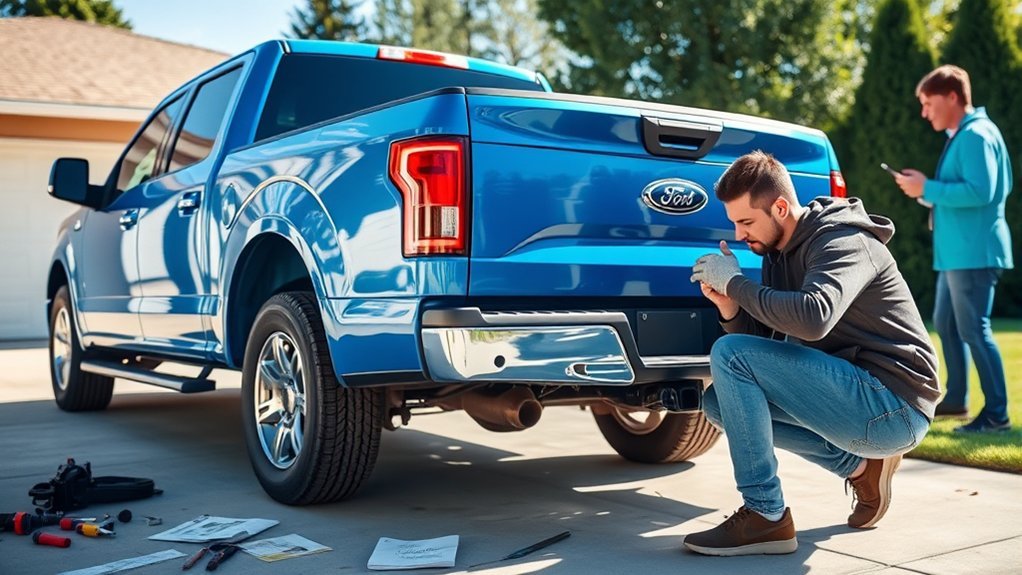
A bolt-on receiver or plug-in wiring harness may be a reasonable DIY project when the manufacturer provides complete instructions and the installer has the correct tools. Other towing upgrades require advanced mechanical, electrical, fabrication, programming, or calibration work.
When DIY Installation May Be Reasonable
- The part is listed for the exact VIN, model year, body configuration, and powertrain.
- The installation is bolt-on and uses existing factory mounting points.
- No welding, frame alteration, brake-line work, programming, or high-current wiring is required.
- You have a calibrated torque wrench and can follow every torque specification.
- You can safely raise and support the truck at its approved lifting points.
- You can test the lights, connectors, controller, and trailer brakes after installation.
When to Use a Professional Installer
- The hitch requires drilling, welding, bed removal, frame modification, or precise fifth-wheel or gooseneck placement.
- The truck requires computer programming or coding to recognize a controller or trailer module.
- The job involves brake lines, powertrain cooling, suspension changes, high-current circuits, or complex wire splicing.
- Rust, collision damage, aftermarket bumpers, fuel tanks, exhaust parts, spare-tire hardware, or other equipment interferes with installation.
- The instructions require special fixtures, lifting equipment, alignment procedures, or manufacturer service information.
- You cannot verify the part number, rating, mounting method, or warranty terms.
Warning: Apply the parking brake, chock the wheels, and follow the truck’s approved lifting procedure. Never work under a vehicle supported only by a jack. Do not drill, weld, splice safety-critical circuits, or modify the frame unless the vehicle and equipment manufacturers expressly authorize the procedure.
Installation Checklist
- Confirm all part numbers and ratings for the truck’s VIN and trailer type.
- Read the complete truck, hitch, wiring, controller, and trailer instructions before starting.
- Inspect the frame and mounting points for corrosion, cracks, deformation, or prior repairs.
- Keep wiring away from exhaust heat, sharp edges, driveshafts, suspension travel, and pinch points.
- Use the supplied or specified fasteners; do not substitute ungraded hardware.
- Tighten every fastener in the stated sequence with a calibrated torque wrench.
- Verify connector pin functions, grounds, fuses, and circuit protection.
- Test all trailer lights and brakes before entering traffic.
- Set brake-controller gain according to the controller and trailer instructions in a safe, open area.
- Reinspect fasteners and wiring after the initial use and at the intervals specified by the equipment manufacturer.
Warranty Considerations
Dealer installation may simplify parts verification and service documentation, but it is not an unconditional guarantee that every modification or future repair will be covered. Aftermarket parts also do not automatically void the entire vehicle warranty.
The Federal Trade Commission’s auto-warranty guidance explains that warranty coverage generally remains in effect when aftermarket parts are used. A manufacturer may still deny coverage for damage caused by an incompatible part, poor installation, misuse, or overloading. Keep receipts, part numbers, instructions, scale tickets, torque records, and installation documentation.
Pre-Tow Safety Checklist
- Confirm that the loaded truck, trailer, combination, and axle weights remain within all ratings.
- Verify that the receiver, ball mount, ball, coupler, and hitch pins are the correct sizes and ratings.
- Close and secure the coupler latch, then install its locking pin or approved retainer.
- Attach safety chains as directed by the vehicle and trailer manufacturers; do not let them drag.
- Attach the breakaway cable to a secure point separate from the safety chains when required.
- Raise and secure the tongue jack, stabilizers, steps, doors, ramps, and awnings.
- Test tail, turn, brake, hazard, marker, and license-plate lights.
- Test the trailer brakes and controller response.
- Check truck and trailer tire pressures when cold using their labels and manuals.
- Inspect tire tread, sidewalls, valve stems, wheel condition, and lug-nut torque.
- Adjust mirrors and enter the trailer’s dimensions in any compatible driver-assistance systems.
- Secure all cargo against forward, rearward, upward, and sideways movement.
- Use Tow/Haul mode when directed by the owner’s manual.
- Allow more following distance and plan for wider turns, longer stopping distances, and reduced acceleration.
The National Highway Traffic Safety Administration advises drivers not to overload a vehicle or trailer and to secure cargo so it cannot shift or leave the vehicle.
Trailer Loading and Sway Prevention
Place cargo so the trailer remains within its axle, tire, and tongue- or pin-weight limits. Keep heavy items low, secure them against movement, and balance the load from side to side. Do not move heavy cargo behind the trailer axle merely to reduce tongue weight; too little tongue weight can reduce stability.
If sway begins, remain calm and avoid abrupt steering. Follow the tow-vehicle and trailer instructions, reduce speed smoothly, and stop in a safe location to inspect the load, hitch, tires, suspension, and weather conditions. Electronic sway-control features are aids, not substitutes for correct loading and safe speed.
Legal Towing Limits and Required Equipment
The manufacturer’s ratings establish the vehicle and equipment limits. Operating laws determine what is required on public roads. Depending on the jurisdiction and combination, laws may address:
- Trailer brakes and brake controllers
- Breakaway devices
- Safety chains or secondary couplings
- Lighting and reflectors
- Maximum dimensions and weight
- Mirrors and rearward visibility
- Speed restrictions
- License classes or endorsements
- Commercial vehicle rules
These requirements vary by state and by whether the towing is private or commercial. NHTSA’s trailer-brake and towing-equipment guidance distinguishes federal manufacturing requirements from FMCSA commercial-use rules. Check the motor-vehicle agency or current statutes for every state in which you will operate.
Truck Towing Package Maintenance
Inspect towing equipment before each trip and follow the maintenance intervals in the truck, trailer, hitch, brake-controller, and axle manuals.
- Look for loose, missing, stretched, or corroded hitch fasteners.
- Check the receiver, welds, mounting points, ball mount, coupler, and safety chains for cracks, bending, or unusual wear.
- Keep the hitch ball and fifth-wheel or gooseneck components lubricated where instructed.
- Inspect electrical connectors for water, dirt, bent pins, corrosion, damaged seals, and loose grounds.
- Test the trailer brakes, controller, breakaway switch, battery, and lighting.
- Check truck and trailer tires for correct cold pressure, damage, uneven wear, and sufficient load rating.
- Inspect suspension, shocks, wheel bearings, brakes, and fluid levels at the specified intervals.
- Retorque removable hitch hardware and trailer wheel nuts only according to the applicable instructions.
Stop using any component that is cracked, bent, badly corroded, loose, or involved in a collision until it has been inspected by a qualified professional.
Three Questions to Answer Before Buying
- What does the package include? Obtain the equipment list for the exact model year and VIN. Do not assume a hitch, controller, suspension change, or cooling upgrade is included because of the package name.
- Will it handle the intended trailer? Compare the trailer’s loaded weight and tongue or pin weight with the truck’s payload, GVWR, GAWR, GCWR, trailer rating, hitch rating, and tire limits.
- Is factory or aftermarket equipment the better fit? A factory configuration usually provides the clearest documented ratings. Aftermarket equipment can add useful capability and connections but must be compatible and cannot be assumed to raise certified limits.
Frequently Asked Questions
Can I use the same towing package on any truck model?
No. Receivers, wiring, brake controllers, cooling equipment, bed hitches, software, and mounting points are vehicle-specific. Match every part to the exact model year, cab, bed, drivetrain, powertrain, and VIN. Also confirm that installation does not interfere with the spare tire, exhaust, fuel system, sensors, or driver-assistance equipment.
Does installing a hitch increase my truck’s towing capacity?
Not by itself. A hitch allows a trailer to connect to the truck and has its own rating, but it does not automatically change the truck’s payload, GVWR, GAWR, GCWR, tire limits, or manufacturer trailer rating. Use the lowest applicable rating for the complete setup.
How does towing affect fuel efficiency?
Towing normally increases energy use because the truck must move more weight and overcome additional aerodynamic drag and rolling resistance. Trailer shape, frontal area, speed, wind, terrain, tire pressure, driving style, and total weight can have a major effect. Slower, smoother driving is usually more efficient than frequent acceleration and high-speed travel.
Do I need a trailer-brake controller?
You need a compatible controller when the trailer uses controllable electric or electric-over-hydraulic brakes and the vehicle, trailer, or applicable law requires one. Requirements vary by location and trailer weight. Hydraulic surge brakes operate differently and normally do not use a conventional in-cab electric controller.
What are the legal towing limits in my area?
Start with the truck, hitch, tire, and trailer manufacturer ratings. Then check the current laws of the state or states where you will tow for brake, breakaway-device, safety-chain, lighting, mirror, dimension, speed, licensing, and commercial-use requirements. A legal equipment threshold does not give permission to exceed a manufacturer rating.
How should I maintain a truck towing package?
Inspect the hitch, fasteners, chains, wiring, connector pins, controller, trailer brakes, breakaway system, tires, wheels, and lights before trips. Follow the truck and equipment manufacturers’ lubrication, torque, inspection, and replacement intervals. Have bent, cracked, loose, or heavily corroded parts inspected before towing again.
Can I customize my towing package?
Yes, when compatible equipment is available. You may be able to add a receiver, wiring, brake controller, towing mirrors, camera, bed hitch, or other accessories. Verify every part and installation method for the VIN, and remember that customization does not automatically increase the truck’s official ratings.
Conclusion
A truck towing package can provide the hitch, electrical, cooling, braking, visibility, and software features needed for safer and more convenient towing. The package name alone does not tell you what the truck can safely handle.
Identify the equipment by VIN, use the exact model-year towing guide, calculate payload and tongue or pin weight, and weigh the loaded combination. Stay within the truck, axle, tire, hitch, trailer, and combined-weight ratings. When installation requires frame work, complex wiring, programming, braking changes, or bed-mounted hardware, use a qualified professional.
Sources
- Chevrolet Trailering and Towing Guide — truck configuration, hitch equipment, weight ratings, tongue weight, loading, and towing features
- General Motors Trailering Technology and Smart Towing Guidance — vehicle-specific labels, configuration limits, tires, loading, and current towing practices
- Chevrolet Driver Mode Control Guide — Tow/Haul mode operation and limitations
- National Highway Traffic Safety Administration Towing Equipment FAQs — federal trailer-brake, coupling, and commercial-rule context
- NHTSA Secure Your Load Guidance — cargo securement and overloading safety
- Federal Trade Commission Auto Warranty Guidance — aftermarket parts and vehicle-warranty considerations







Leave a Reply