
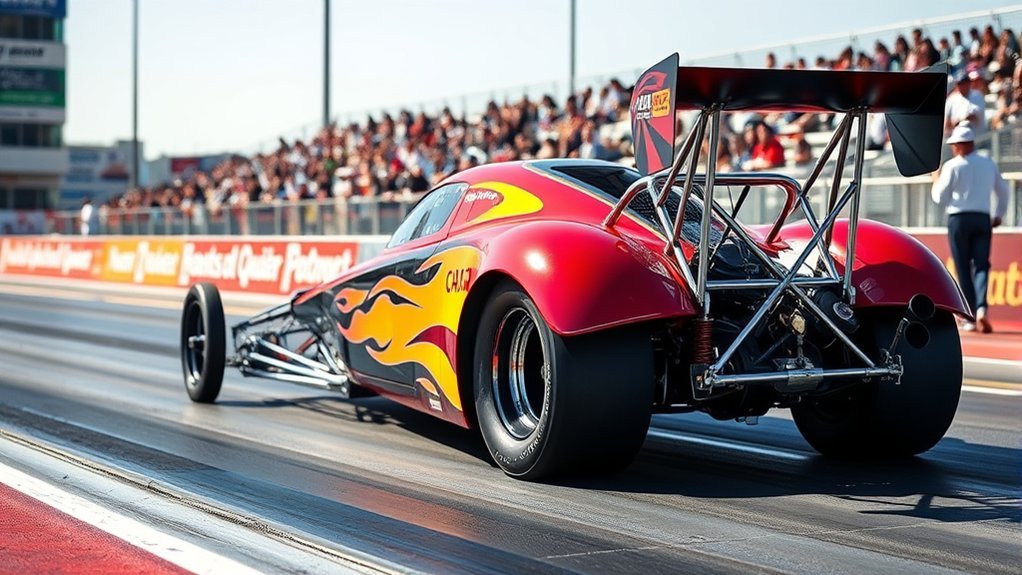
Drag-racing roll cage requirements are not set by one simple nationwide or state-by-state rule. The correct structure depends on the sanctioning program, elapsed time, trap speed, vehicle type, body and floor modifications, weight, and the host track’s current technical rules. Before cutting or welding, confirm the requirement for your exact car and event.
Quick Answer
For most NHRA Summit E.T. cars, a roll bar is required at 11.00–11.49 seconds, while a roll cage is generally required at 10.99 seconds or quicker or above 135 mph. Important exceptions apply to certain unaltered full-bodied cars and designated Street Legal events, so confirm the current rulebook and track before fabrication.
Key Takeaways
- NHRA rules are based mainly on the racing program, elapsed time, speed, vehicle construction, and body style—not simply the state where the track is located.
- A roll bar generally covers fixed-roof cars running 11.00–11.49 seconds, while a cage is generally required at 10.99 or quicker or above 135 mph.
- An unaltered full-bodied car running 10.00–10.99 may be allowed to use a roll bar instead of a full cage.
- Qualifying unaltered OEM cars at designated NHRA Street Legal events may operate under different model-year limits.
- The current rulebook, amendments, class rules, and host track’s tech decision always take priority over an online summary.
At a Glance
| Time Required | About 30–60 minutes for a preliminary rule review; fabrication and inspection time varies by vehicle and specification. |
| Difficulty | High. Rule interpretation and structural fabrication should involve an experienced racing fabricator and the appropriate tech official. |
| Tools Needed | Current rulebook and amendments, recent time slip, vehicle weight, modification list, interior photos, and the host track’s contact information. |
| Cost | Rule verification may be free. Fabrication, padding, restraints, finishing, and certification vary widely, so obtain a vehicle-specific written quote. |
Warning: Do not use an online article as a fabrication drawing. An incorrectly designed, mounted, welded, or padded cage can fail technical inspection and may increase injury risk. Get confirmation from the applicable track tech official or chassis inspector before buying tubing, altering the interior, or applying paint or powder coating.
How Drag Racing Roll Cage Requirements Are Set

A drag car does not receive its roll-cage requirement from elapsed time alone. The technical inspector may also need to know:
- The sanctioning organization and racing program.
- The vehicle’s quarter-mile or eighth-mile elapsed time.
- Its maximum trap speed.
- Whether it has a fixed roof, removable roof, T-top, or convertible body.
- Whether the firewall, floor, rear body structure, frame, or unibody has been altered.
- The vehicle’s weight and chassis construction.
- Whether it is an OEM Street Legal vehicle or a purpose-built race car.
- The class-specific and track-specific supplemental rules.
The current NHRA Rulebook provides the base requirements. Racers must also check the current NHRA rulebook amendments, because amendments can take effect during the season.
Note: A host track may use NHRA, IHRA, SCCA, another sanctioning body, or its own supplemental technical rules. The track’s designated official decides whether a vehicle may compete at that event.
NHRA Roll Bar vs. Roll Cage Thresholds
The following table summarizes the general NHRA Summit E.T. thresholds for common full-bodied cars. It is a starting point rather than a substitute for the complete rulebook.
| Vehicle or Performance | General Requirement | Important Qualification |
|---|---|---|
| Fixed-roof car running 11.00–11.49 seconds in the quarter mile | Roll bar | Equivalent eighth-mile range is generally 7.00–7.35. |
| Car running 10.99 seconds or quicker | Roll cage generally required | A qualifying unaltered full-bodied car running 10.00–10.99 may use a roll bar instead. |
| Any car exceeding 135 mph | Roll cage generally required | Speed can trigger the requirement even when the elapsed time is slower. |
| Convertible running 11.00–13.49 seconds | Roll bar | Equivalent eighth-mile range is generally 7.00–8.25. |
| Convertible running 10.99 or quicker or exceeding 135 mph | Roll cage | Convertible-specific provisions apply. |
| T-top vehicle running 11.00–11.49 seconds | Roll bar | Street Legal T-tops quicker than 11.49 must meet the Summit rollover-structure rules. |
The Full-Bodied 10.00–10.99 Exception
A full-bodied car running between 10.00 and 10.99 seconds may be permitted to use a roll bar instead of a full cage when its firewall, floor, and body from the firewall rearward remain unaltered. Wheel tubs are permitted under the stated NHRA provision.
This exception should not be assumed after floor replacement, firewall alteration, major chassis work, or another structural modification. Send the track clear photographs and a modification list before building around the exception.
Pro Tip: Ask the tech official to confirm the applicable rule section in writing. Include the vehicle year, body style, current best elapsed time and speed, expected future performance, floor and firewall changes, and whether the car still has its OEM frame or unibody structure.
NHRA Street Legal OEM Exceptions
Designated NHRA Street Legal events provide a separate path for qualifying production vehicles. These provisions are intended for legitimate street-driven machines with registration, insurance, license plates, and functioning original safety systems.
| OEM Model Years | Permitted Performance Limit | Conditions |
|---|---|---|
| 2008–2013 | No quicker than 10.00 seconds and no faster than 135 mph | Must meet the current Street Legal eligibility and OEM-safety requirements. |
| 2014–current | No quicker than 9.00 seconds and no faster than 150 mph | Must remain within the current OEM-production and Street Legal conditions. |
Unaltered OEM antilock brakes, airbags, frame or unibody construction, floors, firewall, seats, seat belts, and other safety-related systems must function as the manufacturer intended. Tires may differ from the original equipment, but they must be DOT-approved.
Convertibles quicker than 13.49 seconds and T-top vehicles quicker than 11.49 seconds must still meet the applicable Summit Racing Series roll-bar and roll-cage requirements. A track may also impose a stricter limit or decline a vehicle that does not fit its event format.
Roll Bar, Full Cage, and SFI Chassis Differences
A roll bar normally centers on a main hoop behind the driver, rear braces, a driver-side bar, and a crossbar used for seat support and shoulder-harness mounting. Its purpose is to provide basic rollover protection for vehicles within the rulebook’s permitted performance range.
A full roll cage adds structure around the driver and is designed to provide protection from multiple directions. NHRA specifies geometry, attachment, tubing, welding, bracing, driver clearance, and other construction details according to the vehicle type.
An SFI-spec chassis is a more tightly controlled structure built to an applicable specification selected by elapsed time, weight, body, floor, firewall, and frame construction. The SFI specifications list includes several different full-bodied drag-racing chassis standards. One SFI number does not fit every car.
The faster the car becomes, the less useful a generic “six-point cage” description is. Construction must match the exact rulebook or SFI specification for that vehicle, weight, elapsed time, and class.
Requirements Based on Speed and Vehicle Construction
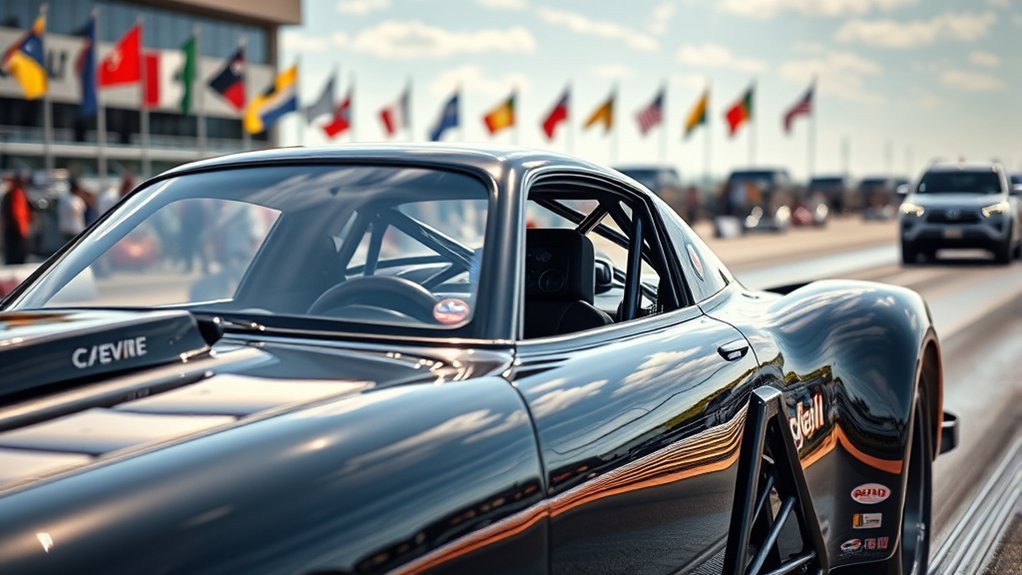
Elapsed time is only one part of the decision. Two cars with the same time slip may require different structures because one has a stock floor and firewall while the other has a tube chassis, altered floor, lightweight body, or open cockpit.
For full-bodied cars, the current NHRA rules distinguish among:
- Cars with an OEM frame or unibody.
- Cars with stock or modified floors and firewalls.
- Rulebook-spec cages for slower combinations.
- SFI-spec chassis for faster or heavier combinations.
- Open-bodied cars, dragsters, altereds, and Funny Cars.
Full-bodied cars running 8.49 seconds or quicker or exceeding 180 mph generally enter the applicable SFI-specification framework. The exact SFI specification depends on more than elapsed time, so a chassis builder should not select it from speed alone.
Materials, Welding, Padding, and Restraints
Tubing and Welding
NHRA construction requirements identify permitted tubing dimensions and welding processes for the applicable design. In the general regulations, 4130 chromoly and Docol R8 tubing require an approved TIG process, while mild-steel tubing may use an approved MIG or TIG process. Welds must be free of slag and porosity, and grinding the completed structural welds is prohibited under the cited rules.
Do not choose tubing from a social-media diagram or from a cage built for another racing organization. The diameter, wall thickness, attachment plate, brace, and welding requirements may change with the vehicle and specification.
Roll-Cage Padding and Head Protection
A roll bar or cage must be padded wherever the driver’s helmet may contact it. Cars running 9.99 seconds or quicker require padding meeting SFI Spec 45.1 in the applicable helmet-contact areas. Thin weather stripping or soft decorative foam is not an acceptable substitute for motorsports impact padding.
When a roll bar or cage is installed, the driver also needs an appropriate padded head protector behind the helmet. A reinforced seat headrest may satisfy the rule when it meets the stated location and construction requirements.
Driver Restraint System
Cars required by the rules to have a roll bar or cage also require a qualifying quick-release driver-restraint system. The current NHRA general regulations recognize applicable SFI 16.1, 16.5, 16.6, or 16.7 systems and require the complete system to release in one action. The belts, shoulder harness, anti-submarine strap, seat, and mounting points must work as one properly installed system.
Applicable competition restraints normally require periodic replacement or recertification based on their date labels. Check every tag before arriving at the track.
When NHRA Chassis Certification Is Required
Not every roll bar or street-car cage receives an NHRA chassis sticker. Certification applies when the class or performance level requires it.
The NHRA general regulations identify named professional and sportsman classes, along with applicable 9.99-or-quicker E.T. chassis, that must have a serialized chassis sticker before participating at an NHRA member track. Chassis are generally recertified every three years unless the applicable class or SFI specification requires another interval.
An inspector may need access to tubing, welds, inspection holes, dimensions, and certification documents. Contact an inspector through the official NHRA Chassis Inspector Locator before final paint, upholstery, or powder coating interferes with inspection.
Why State-by-State Roll Cage Tables Are Misleading
California, Texas, Florida, Ohio, and New York do not each replace the NHRA rulebook with a simple statewide elapsed-time threshold. A track in any of those states may follow NHRA rules, another sanctioning organization, or its own approved supplement.
State law becomes relevant when the vehicle is registered, inspected, insured, or driven on public roads. NHRA Street Legal vehicles must satisfy the highway-safety requirements of the state where they are registered, but that does not turn the NHRA cage threshold into a state statute.
A street-driven cage may also affect interior trim, airbags, visibility, access, seating positions, and insurance terms. Do not assume a rear seat remains suitable merely because it physically fits behind the tubing. No passenger should occupy a seating position compromised by cage bars, removed restraints, reduced head clearance, or missing interior protection.
SCCA Roll Cage Rules vs. NHRA Rules
SCCA requirements apply to SCCA programs such as Road Racing, Race Experience, and Time Trials; they are not a substitute for NHRA drag-racing rules. The SCCA General Competition Rules are updated during the season, and each program can have its own safety level and class requirements.
For example, the current SCCA Race Experience vehicle requirements call for a cage with at least six attachment points. However, the permitted tubing diameter and wall thickness vary with vehicle weight. A 1.500-inch × 0.095-inch tube is one listed option for a specific weight range, not a universal SCCA cage size.
If the same car will participate in both drag racing and an SCCA program, obtain approval under both rule sets. Passing one organization’s inspection does not automatically guarantee acceptance by the other.
How to Confirm the Correct Cage Before Building
- Name the exact event and class. Determine whether you are entering Summit E.T., Street Legal, a specific NHRA class, an SCCA program, or an independent track event.
- Record the car’s performance. Use its quickest elapsed time and fastest trap speed, not an average run.
- Plan for expected upgrades. A cage built only for today’s speed may become obsolete after a power increase.
- Document construction changes. List firewall, floor, wheel-tub, frame, unibody, suspension, and body modifications.
- Confirm vehicle weight. Faster SFI-spec combinations can be separated by weight as well as elapsed time.
- Send the information to tech. Ask the host track or chassis inspector which rulebook sections and SFI specification apply.
- Choose a qualified fabricator. The builder should have documented experience with the exact sanctioning body and specification.
- Confirm inspection timing. Determine whether the structure must be inspected before paint, interior reassembly, or final finishing.
How to Prepare Your Vehicle for Track Tech
A compliant roll bar or cage is only one part of technical inspection. Before the event, complete a full vehicle and equipment check.
- Check for fuel, oil, brake-fluid, transmission-fluid, and coolant leaks.
- Secure the battery with an approved hold-down and verify whether a master cutoff is required.
- Install the required coolant overflow or recovery container.
- Inspect tires for damage, adequate condition, and correct event eligibility.
- Verify wheel studs, lug-nut engagement, and lug-nut tightness.
- Check the throttle return, brakes, steering, suspension, and driveline.
- Inspect the cage, braces, attachment points, padding, seat, and head protector.
- Check the date and condition of the helmet, harness, protective clothing, and other SFI-labeled equipment.
- Confirm that required window nets, arm restraints, driveshaft loops, axle-retention devices, fire systems, or parachutes are present for the car’s performance level.
- For Street Legal participation, verify that the OEM airbags, ABS, seats, seat belts, frame or unibody, firewall, floor, and other required safety systems remain functional.
- Bring the current rules, chassis certification records, competition license, registration, insurance, and any written tech guidance required for the event.
Note: Equipment such as a helmet, jacket, harness, driveshaft loop, axle-retention device, or parachute may become mandatory at a different elapsed time or speed than the cage. Passing the cage requirement alone does not make the entire car legal for competition.
Why Compliance Matters for Safety and Competition
The primary purpose of a roll bar or cage is occupant protection. A properly engineered structure can help preserve survival space and manage loads during a rollover or major impact. Its effectiveness depends on the tubing, geometry, mounting, weld quality, seat, harness, padding, head protection, and the driver’s position working together.
A cage may also increase chassis stiffness, but that should not be treated as a guaranteed performance upgrade. Added weight and structural changes can affect vehicle balance or class eligibility. Safety and rules compliance should drive the design.
What Happens If the Car Fails Technical Inspection?
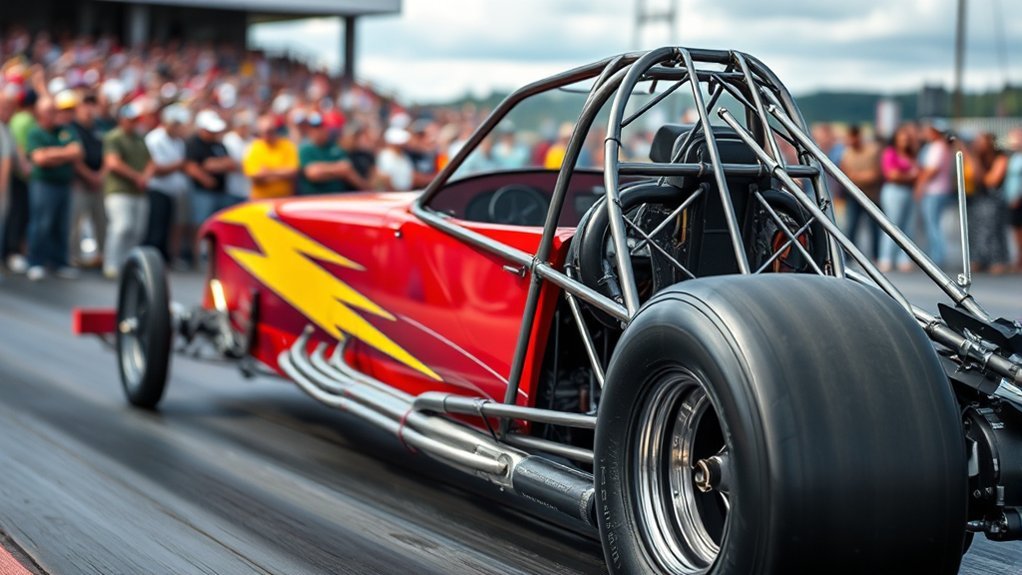
A car that does not meet the applicable rollover-structure or safety requirements may be denied permission to run until the problem is corrected. Depending on when the violation is discovered, the racer may also lose qualifying runs, be removed from eliminations, or be disqualified under the event rules.
Common reasons for rejection include:
- The wrong cage or roll-bar design for the elapsed time, speed, or body style.
- Incorrect tubing dimensions or material.
- Poor, incomplete, ground, or inaccessible welds.
- Improper floor, frame, rocker, or mounting-plate attachment.
- Insufficient helmet clearance or driver coverage.
- Missing side bars, braces, seat-support bars, padding, or head protection.
- An expired chassis sticker or restraint-system date.
- A car running quicker or faster than its approved equipment permits.
Do not assume that noncompliance automatically produces a fine or permanent venue ban. Those outcomes depend on the specific event, conduct, and governing policy. The immediate practical risk is that the car will not be allowed to compete.
Frequently Asked Questions
What are the NHRA rules for a roll cage?
Under the general Summit E.T. rules, a cage is normally required at 10.99 seconds or quicker or above 135 mph. A qualifying full-bodied car with an unaltered firewall, floor, and rearward body may use a roll bar from 10.00–10.99. Faster cars can require an applicable SFI-spec chassis based on elapsed time, weight, body, and construction.
Does every 10.99-second car need a full cage?
No. A roll cage is the general rule at 10.99 or quicker, but a qualifying unaltered full-bodied car running 10.00–10.99 may use a roll bar. Separate provisions may also apply to qualifying unaltered OEM cars at designated NHRA Street Legal events. The current rulebook and track tech official must confirm the exception.
What are the SCCA roll cage requirements?
SCCA requirements depend on the program, class, vehicle weight, logbook status, and construction date. SCCA Race Experience, for example, requires at least six cage attachment points and uses a weight-based tubing table. A 1.500-inch × 0.095-inch tube is only one option in one weight range, not a universal specification.
When does an NHRA roll cage need chassis certification?
Certification is required when the class or performance level calls for a serialized chassis sticker. The NHRA general regulations include applicable 9.99-or-quicker E.T. chassis and several named classes. Recertification is generally required every three years unless the class or SFI specification states another interval.
Were the Ford Mustang II or Chevrolet Corvair banned from NHRA?
There is no reliable basis for a blanket claim that those model names are banned from current NHRA competition. Eligibility depends on the class, body configuration, chassis, construction, safety equipment, and current rules. Ask tech about the exact vehicle and intended class rather than relying on a list of supposedly banned models.
Can a caged street car keep its rear seat?
Physical retention of the seat does not prove that it remains safe or legal to use. Cage tubes can reduce head clearance, interfere with restraints, or create hard contact points. Do not carry a passenger in a compromised seating area. Verify the design with the fabricator, track, registration authority, insurer, and any applicable highway-safety rules.
Conclusion
Drag-racing roll cage requirements must be matched to the exact vehicle and event. Start with the current rulebook and amendments, then account for elapsed time, trap speed, roof type, floor and firewall changes, weight, chassis construction, and Street Legal eligibility. Confirm the design with the host track or chassis inspector before fabrication. A properly selected structure, seat, harness, head protector, and padding system protects the driver and prevents expensive inspection failures.
Sources
- 2026 NHRA Rulebook — Summit E.T. thresholds, construction requirements, padding, restraints, and chassis certification.
- 2026 NHRA Rulebook Amendments — current in-season technical changes and clarifications.
- NHRA Street Legal — OEM production-car limits, eligibility conditions, and convertible and T-top provisions.
- SFI Foundation Specifications List — drag-racing chassis, roll-cage padding, restraints, and related specifications.
- SCCA Cars and Rules — current SCCA General Competition Rules and program information.
- SCCA Race Experience Vehicle Requirements — attachment-point, tubing, padding, and construction requirements for that SCCA program.







Leave a Reply