
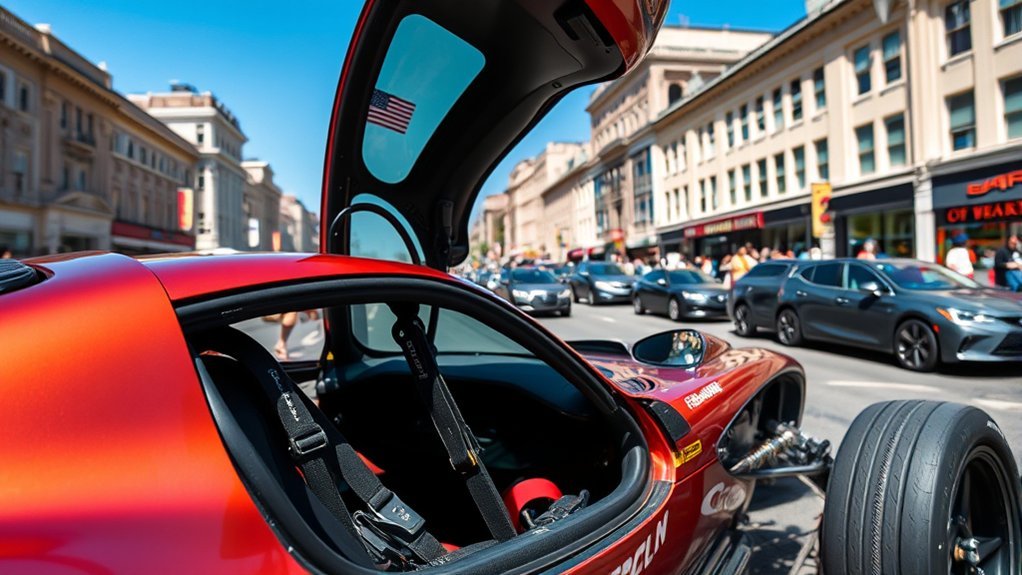
A racing harness can hold you firmly in the seat on a track, but that does not automatically make it a legal or safe replacement for the factory seat belt on public roads. Street legality depends on the exact harness, its certification, how it is installed, the vehicle’s original safety system, and the law in the state where you drive.
Quick Answer
Most competition-only racing harnesses should not be used as substitutes for a factory three-point seat belt on public roads. A harness may be acceptable only when the manufacturer certifies it for road-vehicle use, the installation matches its instructions, the original safety systems remain functional, and the applicable state law recognizes the restraint.
Key Takeaways
- There is no reliable nationwide rule that makes every racing harness legal or illegal in every road vehicle.
- A competition label from FIA or SFI is not proof that a harness satisfies federal road-equipment requirements or a state seat-belt law.
- NHTSA does not “DOT approve” commercial harnesses; manufacturers certify applicable products to federal standards.
- Keeping the factory three-point belt is usually the safest arrangement for a dual-purpose street and track car, but retaining it does not automatically legalize a separate harness.
- A safe track restraint is a complete system involving the harness, seat, anchors, belt geometry, rollover protection, helmet, and sometimes a frontal head restraint.
Warning: This article provides general U.S. legal and safety information, not legal advice or approval of a particular installation. Do not remove or disable a factory belt, airbag, pretensioner, occupant sensor, or other safety component without written vehicle-specific guidance from the vehicle and restraint manufacturers.
What Racing Harness Street Legality Really Means

Asking whether a racing harness is street legal involves more than counting its straps. You must answer four separate questions:
- Is the harness sold and certified for use in road vehicles?
- Does the state’s law treat it as an acceptable safety belt?
- Is it installed in the exact vehicle and seating position covered by the manufacturer’s instructions?
- Does the installation preserve the vehicle’s original crash-protection systems?
Many inexpensive four-, five-, and six-point harnesses are sold for competition, off-road, display, or limited recreational use. An FIA or SFI label may show that a product meets a motorsport standard, but it does not by itself establish compliance with a state road-use law or a Federal Motor Vehicle Safety Standard.
A small number of vehicle-specific restraint products may be manufacturer-certified for road use. That certification is normally limited to listed vehicle models, seats, anchor locations, and installation methods. A product that is acceptable in one car is not automatically acceptable in another.
Note: “DOT approved” is not the correct description. The National Highway Traffic Safety Administration does not preapprove or endorse commercial vehicle equipment. Manufacturers are responsible for certifying that products subject to a federal safety standard comply with that standard.
Federal Standards and State Seat-Belt Laws
Federal and state rules serve different purposes. Federal standards regulate new vehicles and applicable motor-vehicle equipment. State laws generally regulate how registered vehicles and restraints are used on public roads.
FMVSS 208: Occupant Crash Protection
Federal Motor Vehicle Safety Standard 208 establishes occupant crash-protection requirements for new vehicles. Modern vehicles may use a coordinated system that includes a three-point belt, retractor, pretensioner, load limiter, seat structure, occupant sensor, steering-column design, and airbags.
Installing a fixed racing harness does not reproduce the way that complete factory system was designed and crash-tested. It may also hold the occupant in a different position relative to an airbag.
FMVSS 209: Seat-Belt Assemblies
FMVSS 209 covers applicable seat-belt assemblies used in passenger cars, multipurpose passenger vehicles, trucks, and buses. It includes requirements involving webbing, strength, elongation, buckles, hardware, durability, and labeling.
A racing harness sold only as competition equipment should not be assumed to comply with FMVSS 209. Ask the manufacturer for a written compliance statement identifying the exact model and standard. A logo, marketplace description, or seller’s use of the word “legal” is not enough.
FMVSS 210: Seat-Belt Anchorages
FMVSS 210 establishes requirements for the location and strength of seat-belt anchorages in new vehicles. A factory anchor designed for one belt path should not be assumed suitable for every racing-harness layout.
Drilling through sheet metal, wrapping a shoulder strap around an unsuitable brace, or attaching several straps to one unverified point can create a serious failure risk. Anchor design must account for load direction, backing plates, material strength, corrosion protection, and the harness manufacturer’s instructions.
The Federal “Make Inoperative” Rule
Federal law restricts a manufacturer, distributor, dealer, or motor-vehicle repair business from knowingly making federally required safety equipment inoperative. NHTSA has explained that this particular federal restriction does not directly apply in the same way to an individual owner working on their own used vehicle. However, state equipment laws, inspection rules, registration requirements, negligence law, and insurance terms may still apply.
The practical lesson is not that owner removal is acceptable. It is that the legal analysis must identify who performed the work, which original systems were affected, and what the state requires for road operation.
Three-Point Seat Belts vs. Racing Harnesses
A factory three-point belt and a racing harness are built for different environments. A modern road restraint must protect occupants in varied seating positions and crash directions while working with airbags and allowing normal movement. A competition harness is intended to hold a properly positioned driver tightly in a prepared vehicle.
| Feature | Factory Three-Point Belt | Competition Racing Harness |
|---|---|---|
| Primary environment | Public-road vehicles and varied everyday crashes | Prepared competition vehicles and controlled track use |
| Occupant movement | Retractor permits normal movement and locks during a qualifying event | Adjusted tightly to minimize movement |
| Vehicle integration | May work with pretensioners, load limiters, airbags, seat sensors, and factory anchors | Requires compatible seats, anchors, geometry, and other competition equipment |
| Certification | Part of the vehicle’s certified road-safety system | Often FIA- or SFI-rated for competition; that alone does not prove road legality |
| Best use | Normal street driving | Track use when permitted by the event and installed as a complete system |
Four-, Five-, and Six-Point Harnesses
A conventional four-point harness uses two shoulder straps and two lap straps. Without a tested anti-submarining design, the occupant may slide beneath the lap portion during a frontal impact. Do not assume that adding two shoulder straps to a lap belt creates a safe system.
Five- and six-point competition harnesses add one or two anti-submarining straps. The straps must pass through compatible seat openings and attach at the correct locations and angles. They cannot simply be routed around the front of an ordinary seat cushion.
Some specialized four-point systems use manufacturer-designed anti-submarining technology. Any such claim must apply to the exact harness, vehicle, seating position, and installation being considered.
Movement, Emergency Exit, and Visibility
A tightly adjusted harness can make it harder to lean forward to check cross traffic, reach controls, use a parking payment machine, or look around an obstruction. It may also slow emergency exit unless the occupant knows how to operate the buckle quickly.
These limitations matter on public roads even when the harness performs well in a competition environment.
State-Law Examples for Racing Harnesses
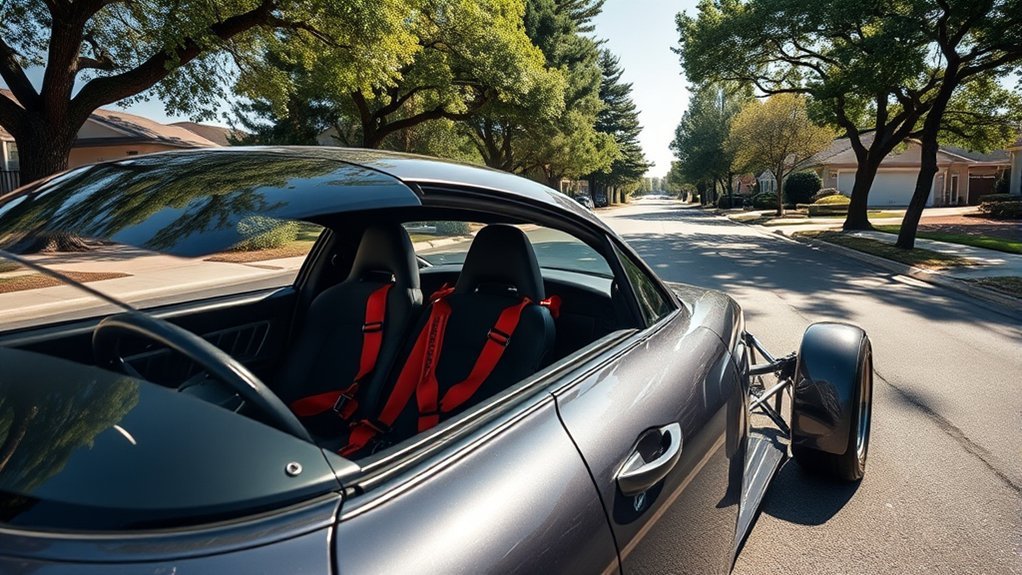
State statutes rarely provide a simple list of approved racing-harness designs. They commonly require occupants to use a “safety belt,” “approved safety belt,” or the belt with which the vehicle is equipped. The meaning of those terms and related equipment rules must be checked in the current statute and regulations.
| State | What the Official Law Shows | Practical Meaning |
|---|---|---|
| California | Vehicle Code §27315 contains the state’s primary safety-belt requirements and has been subject to amendments with different operative versions. | Do not rely on a generic claim that a racing harness is either automatically permitted or prohibited. Check the currently operative text and applicable equipment regulations. |
| Florida | Florida Statutes §316.614 defines a safety belt by reference to FMVSS 208 and requires applicable occupants to be restrained. | The lack of a routine statewide vehicle inspection does not make a competition-only harness a lawful substitute. |
| Michigan | MCL §257.710e requires applicable drivers and passengers to wear a properly adjusted and fastened safety belt. | The law should not be described simply as “vague.” Whether a harness qualifies requires product- and rule-specific verification. |
| New York | Vehicle and Traffic Law §1229-c requires a safety belt approved by the commissioner. Where a position has both lap and shoulder portions, the statute generally requires both to be used. | Wearing a competition harness while leaving the factory belt unused should not be assumed compliant. |
| Texas | Transportation Code §545.413 requires applicable occupants of passenger vehicles equipped with safety belts to be secured by a safety belt. | The statute does not create a general rule that every aftermarket racing harness is acceptable. |
| New Hampshire | RSA 265:107-a requires properly adjusted restraints for drivers and passengers under 18. New Hampshire does not have a general mandatory belt-use law for adults. | The absence of a general adult-use mandate does not certify a harness, approve its installation, or remove other equipment and liability concerns. |
No inspection requirement, motorsport label, seller claim, or decision by an individual officer can substitute for the current statute and written certification for the exact restraint system.
How to Check Racing Harness Legality in Your State

Use the following process before buying, installing, or driving with an aftermarket harness:
- Identify the exact product. Record the manufacturer, model number, number of straps, buckle type, production date, and every label on the harness.
- Obtain written certification information. Ask the manufacturer whether the exact model is certified for motor-vehicle road use and which FMVSS requirements apply. Do not rely only on a retailer’s listing.
- Confirm vehicle compatibility. Check whether the manufacturer lists your exact vehicle, model year, seat, and seating position.
- Read the current state statute. Look for definitions of “safety belt,” “approved safety belt,” equipment-maintenance rules, and requirements to use both lap and shoulder portions.
- Check inspection and registration rules separately. Passing an inspection does not necessarily resolve a belt-use violation, and a state without inspections may still enforce safety-belt laws.
- Ask the appropriate authority in writing. Contact the state police, highway patrol, DMV, or inspection agency. Give them the product documentation rather than asking only whether “racing harnesses” are legal.
- Contact the insurer. Disclose safety-system changes and request a written response about coverage requirements. Do not assume a modification automatically voids or preserves coverage.
- Use a qualified installer. The installer should follow the harness, seat, vehicle, and sanctioning-body instructions and document every anchor and component used.
Pro Tip: For a dual-purpose car, keep the complete factory three-point restraint operational and use the competition harness only at events where the setup has been inspected and accepted. Never wear the factory belt and racing harness together unless the restraint manufacturer expressly instructs you to do so.
Safety Risks of Racing Harnesses on Public Roads
A racing harness is not an isolated accessory. Its performance depends on the seat, anchorages, strap angles, occupant position, roof structure, airbags, helmet use, and other safety equipment.
Airbags, Pretensioners, and Load Limiters
A modern factory belt may include an explosive pretensioner that removes slack and a load limiter that manages force on the occupant’s chest. Airbag timing and deployment may also be designed around the expected movement of an occupant wearing the original belt.
A fixed harness can change that movement. Removing the factory buckle or seat may also trigger fault codes or affect occupant-detection and airbag logic. A warning light is not the only concern; a system can be physically incompatible even when no warning is visible.
Rollover and Roof Crush
A tightly fitted harness keeps the torso upright. In a competition car, that restraint may be used with a properly designed roll cage, racing seat, helmet, and head-and-neck protection. A street car may not have that complete system.
A harness bar is an attachment structure, not automatic rollover protection. Do not treat it as a substitute for a correctly engineered roll bar or cage.
Belt Routing and Shoulder Angle
Shoulder straps routed too far downward can place excessive compression on the spine. Straps routed too high, spread too far apart, twisted, or passed around the side of an incompatible seat can also perform poorly.
The correct angle varies with the harness, seat, occupant, and use. Follow the exact restraint-manufacturer instructions rather than a universal angle copied from a forum or another vehicle.
Seat Compatibility and Submarining
Shoulder and anti-submarining straps need correctly positioned seat openings with smooth edges. Routing webbing over an ordinary seatback or around the front of a seat cushion can change the load path and damage the webbing.
The lap straps must sit low across the pelvis rather than the abdomen. Anti-submarining straps must be adjusted and anchored as designed. Loose webbing can allow substantial occupant movement before the harness begins controlling the body.
Emergency Response
Drivers, passengers, corner workers, and emergency personnel must be able to release the buckle. Competition harnesses should be adjusted firmly whenever they are used; wearing one loosely for comfort defeats its intended geometry.
Best Practices for Track Harness Installation
These practices do not make a harness street legal, but they reduce common installation errors in a track-only or properly prepared competition vehicle:
- Use a current, traceable harness. Check the label, manufacture date, homologation, and event rules. Avoid counterfeit, unidentified, expired, sun-damaged, cut, chemically contaminated, or frayed webbing.
- Match the harness to the seat. Use a seat designed for the number and location of straps being installed.
- Use verified anchor points. Follow the vehicle builder’s and harness manufacturer’s specifications for anchors, hardware, backing plates, and load direction.
- Do not share unapproved anchors. Never assume that one bolt or factory point can safely carry several straps.
- Keep webbing flat. Straps should not be twisted, pinched, routed across sharp edges, or placed where seat movement can cut them.
- Set the lap belt low. It should load the pelvis, not the soft abdomen.
- Route shoulder straps correctly. Follow the specified height, spacing, and angle for the harness and seat.
- Install anti-submarining straps correctly. Five- and six-point systems require compatible seat openings and specified anchor locations.
- Inspect the complete system regularly. Check webbing, stitching, adjusters, buckle, eye bolts, clips, mounting plates, seat mounts, and supporting structure.
- Replace crash-loaded or damaged equipment. Follow the manufacturer and event rules even when damage is not obvious.
The FIA safety-harness guidelines emphasize inspection of webbing, buckles, hardware, and attachments, including replacement when crash loading or damage may have reduced the system’s ability to protect the driver.
Warning: Do not attach shoulder straps to a rear-seat child-restraint tether point, thin parcel shelf, seat frame, or unverified crossbar. These parts may not be designed for the direction or magnitude of a racing-harness load.
Myths About Racing Harness Street Legality
Myth: Any Five-Point Harness Is Safer Than a Three-Point Belt
A five-point layout can provide excellent control in a compatible competition system. It is not automatically safer in a road car with an ordinary seat, no rollover protection, active airbags, unsuitable anchors, or incorrect belt geometry.
Myth: Keeping the Stock Belts Automatically Makes the Harness Legal
Retaining the original belt is usually preferable to removing it, especially in a street-driven car. However, wearing only the harness may still fail a law requiring use of the vehicle’s approved lap-and-shoulder belt. The unused harness can also obstruct a passenger, seat mechanism, or airbag area.
Myth: No Vehicle Inspection Means No Harness Restrictions
Inspection requirements and road-use laws are different. Florida, for example, does not become unrestricted merely because ordinary passenger vehicles are not subject to a recurring statewide safety inspection.
Myth: An FIA or SFI Label Means Street Legal
FIA and SFI specifications are associated with motorsport equipment and event requirements. They do not replace FMVSS certification or a state’s legal definition of an acceptable road safety belt.
Myth: An Officer Ignoring the Harness Makes It Legal
An officer may not notice the modification or may exercise discretion during one stop. That does not establish compliance for a later stop, inspection, crash investigation, lawsuit, or insurance claim.
Alternatives for Dual-Purpose Street and Track Cars
Retain the Factory Three-Point Belt
For ordinary road use, the safest default is the complete factory restraint in good working order. Do not remove the retractor, buckle, pretensioner, wiring, warning system, or original anchor hardware merely to simplify a track installation.
Use a Properly Designed Dual-Restraint Setup
Some track cars retain the factory belt for street driving and add a separate harness for closed-course use. The seat and cabin must safely accommodate both systems without crossed webbing, obstructed airbags, damaged belts, or unapproved shared anchors.
Use each system only as its manufacturer directs. Do not combine both restraints on your body unless the documentation specifically requires or permits that arrangement.
Consider a Vehicle-Specific Road-Certified System
A manufacturer may offer a restraint certified for road use in specific vehicles. Verify the exact part number, vehicle model, model year, seating position, seat type, installation hardware, and written certification. A similar-looking universal harness is not equivalent.
Do Not Replace a Three-Point Belt With a Lap-Only Belt
A lap-only belt is not a sensible performance upgrade for a modern seating position originally equipped with a three-point restraint. It removes upper-torso restraint and may disrupt the vehicle’s designed occupant-protection system.
Use Supportive Seating Carefully
A supportive seat can reduce the need to brace against the steering wheel during track driving. However, replacing a factory seat can affect side airbags, occupant sensors, seat strength, belt geometry, and legal compliance. Use vehicle-specific components and preserve required safety functions.
Insurance and Liability Considerations
A safety-system modification does not produce the same insurance result in every case. The effect may depend on the policy, whether the modification was disclosed, whether the vehicle was used on a track, and whether the change contributed to an injury or loss.
Tell the insurer about modifications before relying on coverage. Ask whether track use is excluded and whether the company requires receipts, photographs, professional installation, or an agreed-value policy. Keep the response with the vehicle records.
After a crash, investigators may examine the belt, seat, anchors, airbags, warning lights, installation records, and product documentation. A vehicle that did not receive a citation can still face civil, insurance, or safety questions.
Frequently Asked Questions
Is a five-point harness street legal?
Not automatically. A five-point harness may be acceptable only if the exact product is certified for road-vehicle use, installed in an approved vehicle configuration, and recognized by the applicable state law. Most competition-only five-point harnesses should not replace the factory three-point belt on public roads.
Does a racing harness count as a seat belt?
It is a restraint, but it does not necessarily satisfy the legal definition of a safety belt for road use. The answer depends on the harness’s certification, the vehicle installation, and the wording of the state statute or regulation.
Can a police officer stop me for not wearing the factory seat belt?
Yes, depending on the state’s primary or secondary enforcement law and whether the harness qualifies as the required safety belt. An officer may reasonably investigate when the factory lap-and-shoulder belt is visibly unused.
What is the only state without a general adult seat-belt law?
New Hampshire does not have a general mandatory seat-belt-use law for adults age 18 and older. It does require properly adjusted restraints for drivers and passengers under 18. Other vehicle, equipment, insurance, and negligence rules can still apply.
Is a harness legal if I keep the factory seat belt installed?
Keeping the factory belt helps preserve the original street restraint, but it does not automatically make the harness legal. You may still be required to wear the approved factory lap-and-shoulder belt while driving on public roads.
Does a harness bar make a racing harness safe?
No. A harness bar may provide a shoulder-strap routing or attachment point when specifically engineered for that use, but it does not verify the seat, anchors, belt angles, anti-submarining straps, roof protection, or legal compliance. It is not automatically a roll bar.
Conclusion
A competition racing harness is not automatically a legal or safer replacement for the factory three-point seat belt. Federal standards govern new vehicles and applicable restraint equipment, while state laws control required use on public roads. The exact harness certification, vehicle, seat, anchors, installation, and original safety systems all matter.
For a dual-purpose car, keep the complete factory restraint available for street driving. Use a competition harness only when the entire track-safety system follows the restraint manufacturer’s instructions and the event’s rules. Before driving on public roads, verify the current state statute and obtain written product and installation information instead of relying on a seller, forum post, inspection rumor, or motorsport label.
Sources
- 49 CFR §571.208 — Occupant Crash Protection — federal occupant-protection requirements for new vehicles.
- 49 CFR §571.209 — Seat-Belt Assemblies — performance requirements for applicable seat-belt assemblies.
- 49 CFR §571.210 — Seat-Belt Assembly Anchorages — federal anchorage location and strength requirements.
- NHTSA Interpretation 10173 — explains manufacturer self-certification and that NHTSA does not preapprove commercial products.
- NHTSA Interpretation 07-005877 — discusses the federal “make inoperative” provision and individual-owner modifications.
- FIA Standard Guidelines for Safety Harnesses — competition-harness inspection, damage, replacement, and system-safety guidance.







Leave a Reply