
Overlanding combines road travel, remote camping, and self-reliance. A good first trip does not require an extreme vehicle or expensive build. It requires a route that matches your vehicle, a legal place to camp, enough supplies, reliable navigation, and a plan for problems such as weather, closures, flat tires, or poor cell service.
Quick Answer
Overlanding is self-supported vehicle travel in which the journey and remote camping are central to the experience. Beginners should start with a short legal route, match the terrain to their vehicle, stay within payload limits, carry navigation and emergency gear, and verify permits, closures, weather, and fire rules before leaving.
Key Takeaways
- You do not always need four-wheel drive; the vehicle must match the road, weather, obstacles, and recovery options.
- Check the vehicle placard, owner’s manual, payload, axle ratings, tire condition, and spare before loading camping gear.
- Use official land-management maps and current alerts to confirm where driving and camping are legal.
- Carry offline navigation, a paper backup, water, food, first aid, recovery gear, tools, and a way to call for help outside cell coverage.
- Start with a local overnight shakedown trip before attempting a remote multi-day route.
At a Glance
| Time Required | Several hours for a local overnight plan; one or more days for a remote multi-day route |
| Difficulty | Beginner to advanced, depending on terrain, remoteness, weather, and vehicle requirements |
| Tools Needed | Official maps, offline navigation, paper map, tire gauge, basic tools, recovery gear, first aid, and emergency communication |
| Cost | Varies widely; budget for fuel, food, permits or campsites, maintenance, and any gear you do not already own |
What Is Overlanding and Why Choose It?
Overlanding is self-supported vehicle travel built around the journey, not only the destination. A trip may follow pavement, gravel, forest roads, desert tracks, or technical four-wheel-drive routes and often includes camping away from developed services.
The appeal is flexibility. You can explore public lands, stay closer to nature, and travel at your own pace. However, remote travel also shifts more responsibility to you. You must know where driving and camping are legal, carry what you need, protect the land, and be prepared to turn around when conditions exceed your skills or equipment.
Overlanding does not have to mean a heavily modified truck. A stock crossover, SUV, van, or pickup can handle many maintained dirt-road trips when the route, weather, tires, clearance, and load are appropriate. Build experience before adding costly equipment.
Overlanding vs. Off-Roading: Key Differences
Overlanding and off-roading overlap, but they usually emphasize different goals. Off-roading often centers on driving obstacles or a specific trail. Overlanding combines travel, camping, navigation, logistics, and self-sufficiency over a longer route.
Trip Duration and Focus
An off-road outing may last a few hours and return to the same trailhead or base camp. An overlanding trip may last one night, a weekend, or several weeks and requires planning for food, water, sleep, fuel, waste, and route changes.
- Off-roading: the driving challenge is usually the main activity.
- Overlanding: travel and camping are the main experience, with off-pavement driving as one part of the journey.
- Both: require legal access, sound judgment, environmental care, and equipment suited to the route.
Purpose and Goals
The goal of overlanding is not to create a new path through untouched land. Responsible travelers stay on roads and routes open to motor vehicles, use legal campsites, and avoid damaging vegetation, soil crusts, streambanks, and cultural sites.
Self-reliance means carrying essential supplies and knowing how to manage common problems. It does not mean taking avoidable risks or expecting a rescue. A safe traveler changes the plan when weather, fatigue, road damage, wildfire, or mechanical trouble raises the risk.
Vehicle Requirements
There is no single best overlanding vehicle. A two-wheel-drive vehicle may be suitable for maintained gravel roads, while steep grades, deep sand, loose rock, mud, or ledges may require low-range four-wheel drive, higher clearance, stronger tires, and experienced spotting.
Reliability, payload, range, and serviceability matter more than appearance. Useful features may include:
- Healthy tires with suitable load ratings and a full-size spare
- Enough ground clearance for the chosen route
- Factory-rated recovery points and compatible recovery equipment
- Skid plates where exposed components may contact rocks
- Secure storage that keeps heavy items low and prevents movement
- A suspension in good condition and sized for the actual loaded weight
Essential Vehicle Features for Overlanding
Start with the vehicle you own and select routes it can safely handle. Four-wheel drive improves traction on many difficult roads, but it does not improve braking, make a vehicle immune to rollover, or replace careful line choice. Ground clearance, approach and departure angles, tire sidewalls, wheelbase, and driver skill can be just as important.
Payload, Axle Ratings, and Weight Distribution
Camping builds can become overloaded quickly. Passengers, water, fuel cans, a roof tent, drawers, bumpers, a winch, tools, and recovery gear all count toward the vehicle’s load. Compare the loaded vehicle with its gross vehicle weight rating and axle ratings. The tire-and-loading placard also lists vehicle capacity information and the manufacturer’s recommended cold tire pressure.
Note: Verify specifications for the exact model year, trim, tire size, and configuration. Use the VIN label, door-jamb placard, owner’s manual, and manufacturer documentation rather than a generic online payload figure.
Keep dense items low and between the axles when possible. Roof loads raise the center of gravity and may reduce stability on side slopes, abrupt turns, or uneven ground. Never exceed the vehicle or roof-rack manufacturer’s limits.
Tires, Clearance, and Protection
Choose tires for the route and climate rather than for appearance. Check tread, sidewalls, valve stems, the spare, and repair tools before departure. On the highway, set pressure according to the vehicle manufacturer’s cold-pressure guidance unless the manufacturer provides another approved condition-specific recommendation. Drivers who reduce pressure for sand or rough terrain need an accurate gauge and compressor and must reinflate before returning to highway speeds.
Skid plates and rock rails can reduce damage on rocky routes, but they do not make poor line choice safe. Inspect factory protection and mounting points after impacts.
Maintenance Before Departure
Complete overdue service before adding remote miles. Check engine oil, coolant, brake fluid, belts, hoses, battery security, leaks, brakes, steering, suspension, wheel bearings where serviceable, lights, wipers, and tire condition. Confirm that the jack can lift the loaded vehicle and that the lug wrench fits the installed wheels.
Pro Tip: Load the vehicle exactly as it will travel, take a short highway and dirt-road shakedown drive, then recheck tire pressure, loose cargo, rack fasteners, fluid leaks, and suspension behavior.
Must-Have Gear for an Overlanding Adventure
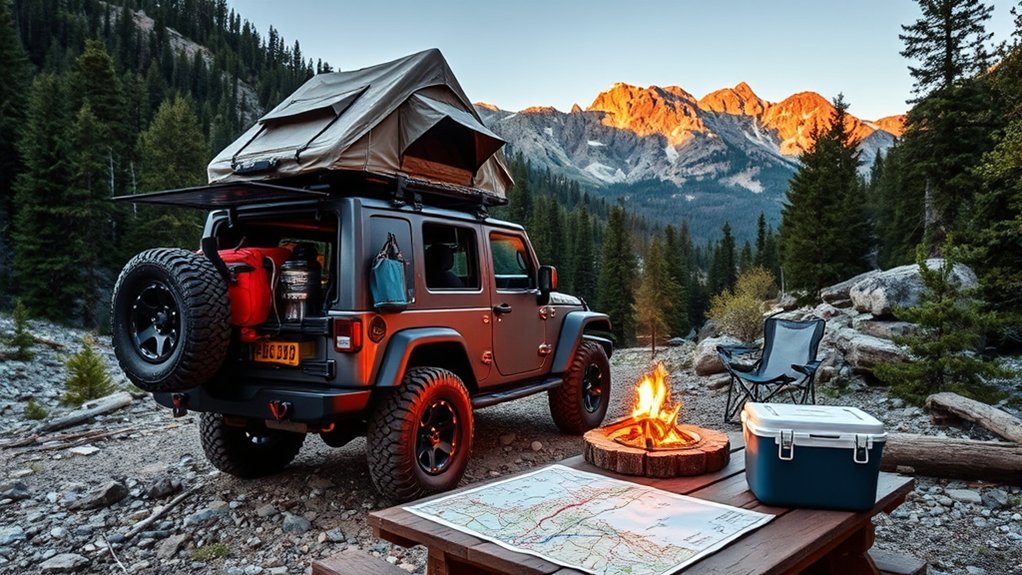
Pack for the specific route, season, group, and vehicle. The goal is not to carry every gadget. It is to cover shelter, water, food, navigation, communication, first aid, vehicle problems, changing weather, and sanitation without exceeding payload limits.
Essential Overlanding Equipment
- Shelter and sleep: ground tent, vehicle sleeping platform, or rooftop tent; weather-rated bedding; repair kit
- Water and food: enough safe water for the plan plus a reserve, simple meals, backup no-cook food, and a treatment method where local conditions allow water collection
- Cooking: stable stove, approved fuel storage, lighter or matches, cookware, and a fire extinguisher suitable for the setup
- Navigation: official land map, downloaded offline map, paper map, compass, and saved coordinates for fuel, water, exits, and emergency services
- Communication: charged phone, vehicle charger, power bank, and a satellite communicator or personal locator beacon where cell coverage is unreliable
- Medical and personal: first aid kit, needed medicines, sun protection, insect protection, layers, gloves, and hygiene supplies
- Vehicle support: tire gauge, compressor, tire repair supplies, full-size spare, jack base, basic tools, fluids appropriate for the vehicle, fuses, and lighting
- Recovery: rated recovery points, traction boards, shovel, and vehicle-compatible straps, shackles, or winch equipment used according to manufacturer instructions
- Waste: trash bags, toilet system or locally approved waste method, and supplies for packing out waste where required
Warning: Never run a fuel-burning stove, heater, lantern, charcoal grill, or engine inside a tent, sleeping vehicle, or other enclosed space. Carbon monoxide is colorless and odorless and can cause unconsciousness or death.
Vehicle Preparation Checklist
- Confirm the road’s minimum clearance, traction, tire, and drivetrain needs.
- Check payload, axle ratings, roof limits, tire load ratings, and cargo security.
- Inspect all tires, including the spare, and test the compressor.
- Check fluid levels, leaks, battery security, brakes, steering, and suspension.
- Confirm that recovery points and recovery gear are rated and compatible.
- Test lights, chargers, navigation, satellite devices, and emergency contacts.
- Carry the key, wheel-lock key, jack tools, fuse information, and owner’s manual.
Overlanding Route Planning: Steps, Tips, and Tools
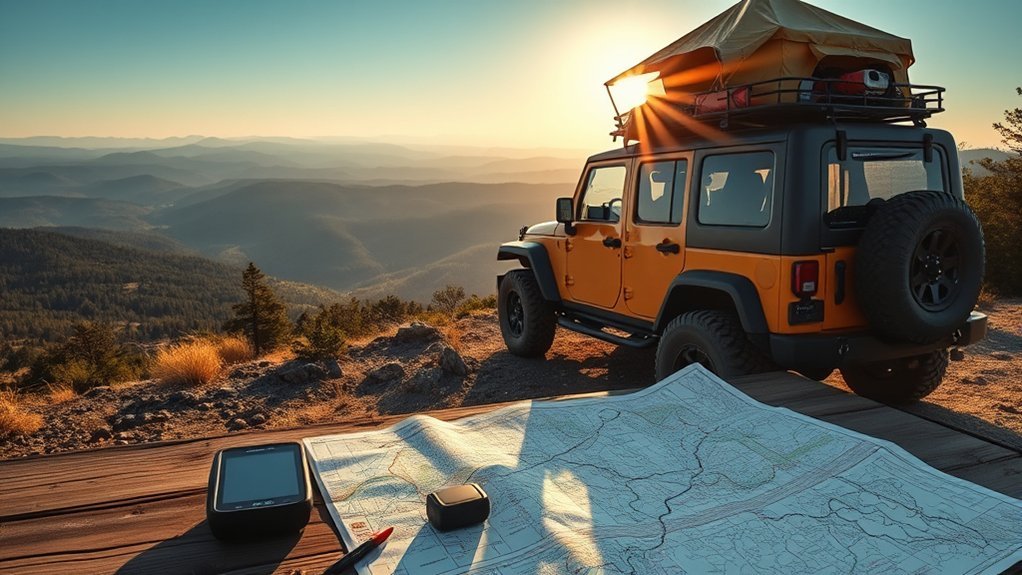
A navigation app can help you discover roads and download maps, but it does not replace official travel rules. On National Forest System lands, a Motor Vehicle Use Map identifies routes legally designated for motorized travel. BLM, National Park Service, state, tribal, county, and private lands may use different maps, permits, gates, seasons, and camping rules.
A route line in an app is not proof that the road is open, public, passable, or legal for your vehicle today.
Route-Planning Steps
- Define the trip: choose dates, group size, daily driving time, camping style, and a realistic difficulty level.
- Match the vehicle: compare road descriptions with clearance, drivetrain, tire, fuel-range, and recovery needs.
- Confirm legal access: check the managing agency’s map, permit page, alerts, seasonal closures, and camping rules.
- Check conditions: review weather, wildfire restrictions, flood risk, snow, heat, road damage, water availability, and recent agency notices.
- Plan logistics: mark fuel, water, campsites, toilets, medical help, bailouts, turnaround points, and the last reliable resupply.
- Build backups: download maps, carry paper copies, save coordinates, and create shorter alternate routes.
- Share a trip plan: give a responsible contact the route, vehicle description, travelers, check-in time, and overdue instructions.
Commercial apps such as onX Offroad and Gaia GPS can be useful for planning and offline navigation. Their free and paid features change, so review the current plan details before relying on offline maps, trail data, or land-boundary layers. Cross-check app information with the land manager.
Permits, Camping, and Private Property
Do not assume undeveloped land is open for camping. BLM dispersed-camping rules vary by office, and many areas have stay limits, designated-site requirements, fire rules, or temporary closures. National parks often require backcountry permits or restrict vehicles to specific roads and campsites.
Respect gates, signs, private-property boundaries, tribal regulations, and seasonal closures. Turn around rather than drive around a gate, create a bypass, widen a road, or enter a route that is not designated for your vehicle class.
Safety and Emergency Preparedness
Remote travel reduces the margin for error. Begin with a written plan and conservative decisions. The National Park Service recommends leaving a travel itinerary with an emergency contact, including the route, travelers, vehicle, dates, and the time the contact should report you overdue.
| Equipment | Purpose | Check Before Departure |
|---|---|---|
| First aid kit | Manage minor injuries until professional care is available | Restock supplies and pack personal medicines |
| Satellite communicator or locator beacon | Emergency contact outside cell coverage | Charge, update, activate, and send a test message |
| Tire kit and compressor | Repair or manage common tire problems | Confirm capacity, fittings, plugs, gauge, and spare condition |
| Recovery equipment | Move a stuck vehicle when conditions allow | Inspect ratings, wear, mounting points, and instructions |
| Water, food, and weather layers | Support an unplanned delay | Add a reserve based on climate, remoteness, and group needs |
Recovery Safety
Vehicle recovery can create extreme forces. Use only rated recovery points and gear, follow the equipment and vehicle manufacturers’ instructions, and keep bystanders away from the line of pull. Do not attach a recovery strap to a tow ball, suspension part, tie-down loop not rated for recovery, or an unknown anchor.
Before winching, inspect the rope, anchor, rigging, battery, and recovery path. Reduce slack gradually, use a line damper when directed, and never step over or stand in line with a tensioned rope. Practice in a controlled setting before an emergency.
Weather, Fire, and Health
Check official weather and land-agency alerts immediately before departure and during the trip when possible. Flash floods, wildfire, snow, extreme heat, and wind can turn a familiar road into an unsafe route. Carry a no-fire meal plan because restrictions may prohibit campfires, charcoal, or some stoves.
Treat backcountry water according to current public-health guidance and local hazards. Filtration or disinfection does not remove every chemical, toxin, or contaminant, so do not collect water from a questionable source merely because you have a filter.
What Makes the Overlanding Lifestyle Unique?
Overlanding rewards patience, practical skills, and attention to the land. The most memorable part may be a quiet campsite, a long scenic road, or solving a small problem far from services—not driving the hardest obstacle.
Self-Reliance Without Recklessness
Self-reliance includes route research, basic vehicle knowledge, first aid, safe food and water practices, navigation, weather awareness, and the judgment to stop early. It also means recognizing when professional recovery or emergency help is safer than improvising.
Exploration Beyond Tourist Routes
Public backroads can reveal landscapes and communities that highway travel misses. Slow down near homes, livestock, hikers, cyclists, horses, and other campers. Support local fuel stations, stores, campgrounds, and services while respecting private property and local rules.
Connection With Nature
Follow the Leave No Trace principles: plan ahead, use durable surfaces, dispose of waste properly, leave natural and cultural objects in place, minimize fire impacts, respect wildlife, and consider other visitors.
- Use existing roads and campsites rather than creating new tracks.
- Pack out trash, food scraps, and recovery debris.
- Store food and scented items as the local land manager requires.
- Keep noise and campsite lighting reasonable.
- Do not cut vegetation, collect artifacts, or disturb wildlife.
Top U.S. Destinations for Overlanding
Conditions, permits, and closures change. Use the examples below as planning starting points, then open the official destination page before committing to the trip.
White Rim Road, Utah
The White Rim Road in Canyonlands National Park is a roughly 100-mile backcountry route around and below the Island in the Sky mesa. The National Park Service requires a permit for all White Rim trips. Overnight demand can be high, water is not available at campsites, and road conditions may require a high-clearance four-wheel-drive vehicle and self-recovery preparation.
Big Bend River Road, Texas
River Road in Big Bend National Park crosses remote desert terrain. The official road page describes it as a 51-mile primitive road and directs travelers to use high clearance and true four-wheel drive. Check current conditions, fuel range, heat, water needs, campsite permits, and closures before entering.
Alabama Hills, California
Alabama Hills National Scenic Area offers dramatic Sierra Nevada views and dirt-road access near Lone Pine. Camping is limited to designated sites, and the BLM requires a free camping permit. Sites are first come, first served, so arrive with a legal backup campground and check current fire restrictions.
Trans-Wisconsin Adventure Trail
The Trans-Wisconsin Adventure Trail is a community-created route rather than a single official trail managed by one agency. Route files, mileage, surfaces, and legal access can change. Verify every segment with current Wisconsin, county, municipal, forest, and private-property information. Do not rely on an old GPS track as proof of access.
Green Ridge State Forest, Maryland
Green Ridge State Forest is a large public forest with primitive camping and public-road access. Its promoted trail system is primarily for hiking, mountain biking, and horseback riding, so it should not be treated as a network of motorized overlanding loops. Confirm which roads are public and open, then use legal campsites and current Maryland DNR guidance.
Post-Trip Vehicle Maintenance
Inspect the vehicle soon after the trip so small problems do not become failures on the next one.
- Wash dirt, mud, road salt, and plant material from the body, wheels, radiator area, brakes, and undercarriage without forcing water into sensitive components.
- Inspect tires for cuts, punctures, bulges, uneven wear, and damaged valve stems; check the spare and reset cold pressure for normal driving.
- Look for bent skid plates, loose fasteners, damaged exhaust parts, leaking shocks, torn boots, and fresh fluid leaks.
- Check brakes, steering, suspension, wheel bearings where applicable, lights, wipers, and battery mounts.
- Clean and dry tents, bedding, recovery ropes, traction boards, tools, cookware, and water containers before storage.
- Restock first aid, food, water treatment, repair supplies, batteries, and medications.
- Record damage, repairs, fuel use, road notes, and equipment changes in a maintenance log.
Warning: Never work beneath a vehicle supported only by its emergency jack. Use a stable, rated lifting and support method on firm ground, or have a qualified shop perform the inspection.
Overlanding Apps, Forums, and Communities
Use a mix of official and community resources:
- Official maps and alerts: USFS Motor Vehicle Use Maps, BLM field-office pages, National Park Service road and permit pages, state land agencies, and county road departments
- Navigation apps: onX Offroad and Gaia GPS; compare current free and paid features and download needed maps before losing service
- Community knowledge: Expedition Portal, Overland Bound, regional clubs, and local groups for recent observations and trip ideas
- Training and events: manufacturer recovery classes, first-aid courses, local trail stewardship days, Overland Expo events, and vehicle-specific clubs
Community reports can identify washouts, snow, or difficult obstacles, but they may be incomplete or wrong. Confirm legal access and restrictions with the agency that manages the land.
Frequently Asked Questions
What types of vehicles are best suited for overlanding?
The best vehicle is reliable, within its payload limits, easy to service, and capable of the planned route. Pickups, SUVs, vans, crossovers, and even some two-wheel-drive cars can work on suitable roads. Technical routes may require low-range four-wheel drive, higher clearance, protective equipment, and stronger tires.
How do I find overlanding trails near me?
Start with the agency that manages nearby public land. Use USFS Motor Vehicle Use Maps, BLM and NPS maps, state recreation maps, and county road information. Navigation apps and forums can help with discovery, but confirm that each road is open, legal, and suitable before driving it.
What is the average cost of an overlanding trip?
There is no reliable universal average. A local trip in a vehicle you already own may cost little beyond fuel, food, and a campsite or permit. A first trip that requires tires, camping equipment, recovery gear, or repairs can cost far more. Estimate fuel as planned miles divided by expected loaded fuel economy, then add food, fees, maintenance, and a contingency.
Can I overland alone, or should I travel in a group?
Solo travel is possible, but it requires a larger safety margin. Choose a conservative route, leave a detailed trip plan, carry dependable communication, avoid difficult recoveries, and set firm turnaround times. A second capable vehicle can add help and recovery options on remote or technical routes.
What are the best camping practices during overlanding trips?
Camp only where allowed, use existing durable sites, follow fire and food-storage rules, keep water sources clean, control pets, minimize noise, and pack out trash and food scraps. Use the local land manager’s approved method for human waste because requirements differ by environment and destination.
Do I need four-wheel drive to start overlanding?
No. Many beginner trips use paved roads, maintained gravel, and legal campsites that do not require four-wheel drive. Four-wheel drive becomes important on routes with steep grades, loose surfaces, deep sand, mud, rocks, or route-specific agency requirements. Always match the route to the vehicle and current conditions.
How much water should I carry?
The amount depends on heat, altitude, activity, trip length, cooking, hygiene, passengers, pets, and the reliability of resupply. Follow destination-specific guidance, carry a delay reserve, and do not depend on an unverified natural source. In hot deserts, vehicle trouble can increase water needs quickly.
How do I know whether I need a permit?
Open the official page for every park, forest, BLM field office, state property, tribal area, or other land manager on the route. Check permits for driving, camping, fires, entry, parking, and group size. Recheck shortly before departure because closures and restrictions can change after you plan.
Sources
- U.S. Forest Service — Motor Vehicle Use Map FAQ — legal motorized-route designations on National Forest System lands
- Bureau of Land Management — Camping on Public Lands — dispersed-camping rules and stay-limit guidance
- National Highway Traffic Safety Administration — TireWise — cold tire pressure and tire-safety guidance
- National Park Service — Camping Safely Before the Trip — itineraries, emergency contacts, and trip preparation
- U.S. Consumer Product Safety Commission — Camping Equipment and Carbon Monoxide — enclosed-space stove, heater, and lantern hazards
- National Park Service — Leave No Trace — minimum-impact travel and camping principles
Conclusion
A successful overlanding trip starts with a realistic route, a dependable vehicle, legal access, and disciplined preparation. Begin close to home, learn how the loaded vehicle behaves, and improve one system at a time. The best setup is not the one with the most equipment; it is the one that gets you out and back safely while protecting the places you came to explore.






Leave a Reply