
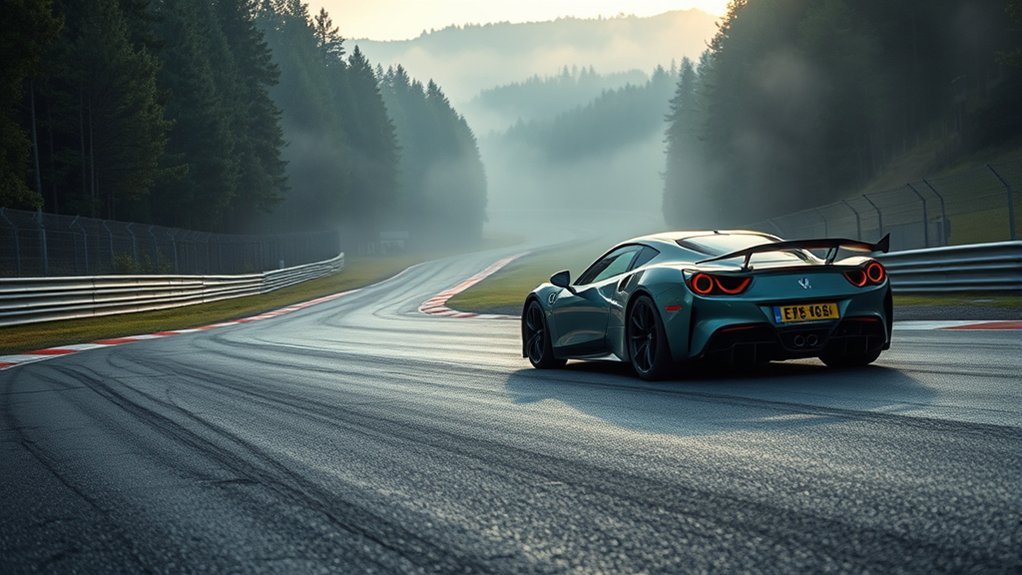
Nürburgring lap times are among the best-known performance benchmarks in the automotive world, but the numbers are easy to misunderstand. A prototype, a production road car, an electric sedan, and a Tourist Drive car may all use the Nordschleife while following different rules. To compare their times fairly, you need to check the track distance, vehicle category, production status, timing method, tires, driver, and date.
Quick Answer
The fastest officially listed Nürburgring Nordschleife lap is the Porsche 919 Hybrid Evo’s 5:19.546 prototype run. The production-road-car benchmark is the Mercedes-AMG ONE at 6:29.090. These times are not directly comparable with Bridge-to-Gantry laps, older track configurations, media tests, or records from different vehicle categories.
Key Takeaways
- Official Nürburgring records use a complete 20.832-kilometer Nordschleife lap with a flying start.
- Prototype, production, modified, electric, and autonomous vehicles appear in separate categories.
- The Porsche 919 Hybrid Evo holds the fastest overall listed time, while the Mercedes-AMG ONE leads production road cars.
- Bridge-to-Gantry times are unofficial, shorter, and cannot be converted to full-lap times with one fixed formula.
- Weather, tires, vehicle setup, driver skill, track condition, and category rules can change the result.
Current Nürburgring Lap Records
Note: The following table shows selected official benchmarks current through July 20, 2026. It is not a single fastest-cars ranking because the Nürburgring separates vehicles by production status, powertrain, body segment, and special category.
| Category | Vehicle | Time | Driver | Date |
|---|---|---|---|---|
| Overall / prototype | Porsche 919 Hybrid Evo | 5:19.546 | Timo Bernhard | June 29, 2018 |
| Electric prototype | Volkswagen ID.R | 6:05.336 | Romain Dumas | June 3, 2019 |
| Prototype / pre-production | Ford GT Mk IV | 6:15.977 | Frédéric Vervisch | April 1, 2026 |
| Production road car | Mercedes-AMG ONE | 6:29.090 | Maro Engel | September 23, 2024 |
| Prototype / pre-production | Ford Mustang GTD Competition | 6:40.835 | Dirk Müller | March 24, 2026 |
| Electric luxury car | Porsche Taycan Turbo GT with Manthey Kit | 6:55.533 | Lars Kern | April 15, 2026 |
| Electric super-sports car | YANGWANG U9 Xtreme | 6:59.157 | Moritz Kranz | August 22, 2025 |
| Autonomous driving | Xiaomi YU7 GT with Track Package | 10:29.483 | No driver | June 8, 2026 |
The Porsche 919 Hybrid Evo remains the fastest vehicle on the official list, but it was an unrestricted evolution of a racing prototype rather than a production road car. Its time should not be used as a direct measure of how a customer vehicle performs.
The Mercedes-AMG ONE holds the more relevant benchmark for production road cars. Its 6:29.090 lap was completed in documented production specification with standard Michelin Pilot Sport Cup 2 R MO tires and was certified through the Nürburgring’s official process.
The Volkswagen ID.R remains a major electric benchmark, but it also belongs to the prototype category. Production electric cars are divided into classes such as luxury cars, electric super-sports cars, SUVs, and modified vehicles.
A Nürburgring time only becomes meaningful when the vehicle class, track distance, production status, and verification method are shown beside it.
How Official Nürburgring Lap Times Are Verified
Since the 2019 season, the Nürburgring has officially recorded, confirmed, and published Nordschleife record attempts under a common framework. The system is designed to make current attempts easier to compare than older manufacturer claims.
According to the Nürburgring’s official record rules and database, a verified attempt normally includes:
- A complete lap: The vehicle covers the full 20.832-kilometer Nordschleife with a flying start.
- A defined start and finish: Timing uses the official line in the T13 section.
- Calibrated timing equipment: The measurement is not based only on an onboard display or video timer.
- Notarial supervision: A notary witnesses the timing and certification process.
- Vehicle inspection: A neutral testing organization documents the car and checks standard conformity when the category requires it.
- Category assignment: Vehicles are grouped using German Federal Motor Transport Authority segments and specially defined Nürburgring classes.
Recent official attempts commonly identify TÜV Rheinland as the testing organization. Racing cars, prototypes, and concept vehicles do not need to prove series-production conformity in the same way as production-category cars, but they must still be listed in the correct class.
Note: An officially measured lap is not always a class record. A manufacturer may submit a verified time that is slower than the existing category leader but still useful as a documented performance benchmark.
Full Laps vs. Bridge-to-Gantry Times
Not every time described as a “Nürburgring lap” covers the same distance. Before comparing two cars, identify the timing format.
| Format | Approximate distance | Typical use | Directly comparable? |
|---|---|---|---|
| Official full lap | 20.832 km | Current official record attempts with a flying start at T13 | Yes, when category and conditions also match |
| Older measured configuration | About 20.6 km | Many manufacturer and media times published before the current standard | Only with another time using the same configuration |
| Bridge to Gantry | Roughly 19 km | Unofficial personal timing associated with Tourist Drives | No; compare only with similarly measured BTG laps |
Bridge-to-Gantry, often shortened to BTG, generally measures from the bridge near the Antoniusbuche area to the gantry before the end of Döttinger Höhe. It excludes part of the official lap and is not one of the Nürburgring’s formal record categories.
There is no dependable formula for adding a few seconds to a BTG time and turning it into a full-lap result. The missing time changes with acceleration, top speed, traffic, the exact timing points, and how the driver enters or leaves the measured section.
Pro Tip: When two sources show different times for the same car, check the stated distance first. A 20.6-kilometer time, 20.832-kilometer time, and BTG time may all be genuine while describing different laps.
Why Nürburgring Lap Times Matter
The Nordschleife combines high-speed sections, compressions, crests, changing corner radii, major elevation changes, and uneven surfaces. One lap can expose problems that may be harder to reproduce during shorter tests.
Manufacturers use the circuit for several related purposes:
- Vehicle development: Engineers can study suspension movement, brake temperature, tire behavior, cooling, aerodynamics, and stability over a long and demanding lap.
- Benchmarking: A team can compare a new model with earlier versions and competing vehicles.
- Durability testing: Repeated laps place heavy loads on brakes, tires, powertrain cooling, bushings, dampers, and electronic control systems.
- Marketing: A verified record gives a manufacturer a clear, memorable performance claim.
- Enthusiast engagement: Record videos and technical reports encourage debate about drivers, tires, setup, aerodynamics, and vehicle design.
Events such as the Nürburgring 24 Hours, manufacturer test sessions, track days, and Tourist Drives also give the circuit a broader place in automotive culture. Professional teams, engineers, owners, and spectators may use the same general venue, but they are not operating under the same rules.
What a Fast Nürburgring Time Does Not Prove
A fast lap is strong evidence of track performance under the conditions of that attempt. It does not automatically make one car better in every type of use.
A Nürburgring time alone does not fully measure:
- Ride comfort on normal roads
- Fuel economy or electric range
- Cabin noise and refinement
- Long-term repair costs
- Cargo and passenger usefulness
- Cold-weather or poor-road performance
- Emergency handling by an average driver
- Performance on a different tire or in heavy rain
Track-focused tires, aggressive alignment, stiff suspension settings, large aerodynamic parts, and powerful brakes can improve a lap while reducing comfort, tire life, ground clearance, or everyday efficiency.
How Car Specifications Affect Nürburgring Lap Times
No single specification determines a Nordschleife result. The fastest vehicles combine usable power, grip, braking, aerodynamic stability, thermal control, and a skilled driver.
Power and acceleration: High output helps on Döttinger Höhe and when accelerating away from slower corners. Power has less value when the tires cannot transmit it or the car cannot remain stable over crests and bumps.
Weight and weight distribution: Lower mass can reduce braking distances and direction-change loads. Balanced weight distribution and a low center of gravity can improve stability, but suspension tuning and tire capacity remain important.
Aerodynamics: Downforce can raise cornering speed and improve braking stability. Too much drag may reduce speed on long straights, so active aerodynamic systems can provide an advantage.
Tires: Tire construction and compound have a major effect on braking, steering response, traction, and cornering. A road-legal track tire can produce a much quicker lap than a touring tire fitted to the same vehicle.
Brakes and cooling: The Nordschleife repeatedly converts high speed into heat. Strong brakes are not enough if the pads, fluid, battery, engine, transmission, or cooling system cannot maintain performance through the lap.
Suspension and body control: The circuit is not a smooth modern Grand Prix track. Dampers, springs, bushings, active systems, ride height, and wheel travel must control the car over bumps, compressions, and elevation changes.
Driver knowledge: A professional who knows the Nordschleife can carry speed through blind crests, place the car accurately, manage tires, and plan energy use. Driver differences can account for a meaningful part of the gap between two laps.
Weather, Track, and Tire Conditions
Track conditions can change during the same day. Temperature affects tire grip, engine output, battery temperature, brake cooling, and aerodynamic performance. Wind can also influence high-speed stability.
A damp section or dirt left by another vehicle can cost time and raise risk. Official record sessions reduce traffic variables, but the surface and weather still need to be documented when interpreting the result.
For a fair comparison, look for:
- Dry or wet track conditions
- Ambient and track temperature
- Tire make, model, and production status
- Factory alignment or record-specific setup
- Driver identity and experience
- Full-lap onboard footage
- Independent timing and inspection
Recent Nürburgring Record Developments
The official record database continued to expand during 2025 and 2026.
- In April 2025, the Xiaomi SU7 Ultra Prototype improved its prototype lap to 6:22.091.
- In August 2025, the YANGWANG U9 Xtreme recorded 6:59.157 in the electric super-sports-car category.
- In April 2026, the Ford GT Mk IV recorded 6:15.977 in the prototype and pre-production category.
- In March 2026, the Ford Mustang GTD Competition recorded 6:40.835 and was listed in the prototype and pre-production group.
- In April 2026, the Porsche Taycan Turbo GT with Manthey Kit recorded 6:55.533 in the electric luxury class.
- In April 2026, the Xiaomi YU7 GT with Track Package recorded 7:22.755 in the electric SUV, off-road vehicle, van, and pickup category.
- On June 8, 2026, a Xiaomi YU7 GT completed the first officially timed driverless Nordschleife lap in 10:29.483, creating the Autonomous Driving category.
These results show why a current record article needs more than a single “fastest cars” list. New entries may establish a category, improve a model benchmark, or document a technical achievement without threatening the overall record.
Debates and Discrepancies in Record Claims
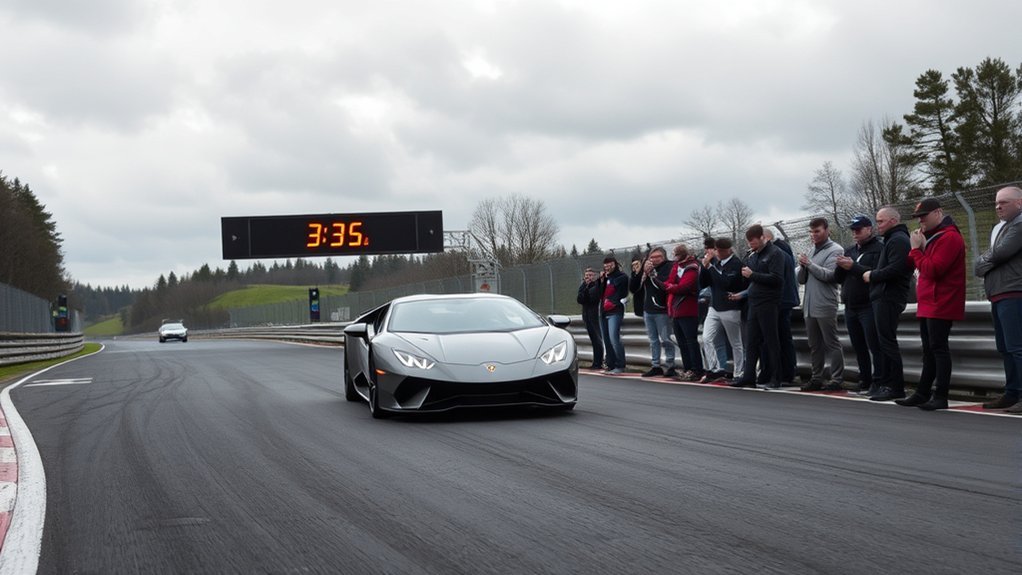
Disagreements usually begin when a headline leaves out an important qualification. A car may be described as the “fastest” when it is actually the fastest model from one brand, the fastest in one body segment, or the fastest using a certain powertrain.
Common sources of confusion include:
- Production status: A prototype may use bodywork, weight reduction, battery systems, or aerodynamics unavailable to buyers.
- Vehicle category: A production supercar, compact car, SUV, modified vehicle, and prototype do not compete for the same official classification.
- Track distance: Older 20.6-kilometer laps and BTG times cannot be placed directly beside current full-lap records.
- Tires: Road-legal track tires can differ greatly from standard touring tires.
- Modifications: Roll cages, suspension parts, power changes, weight reduction, and aerodynamic equipment may affect the class.
- Timing method: Video timers, GPS apps, media tests, and calibrated official timing do not carry the same authority.
- Track conditions: Dry weather, temperature, wind, and surface condition can change the outcome.
Past disputes involving vehicles such as the Radical SR8, Porsche 918 Spyder, and Nissan GT-R Nismo often centered on road legality, production status, or modifications. Modern official categories reduce some of this uncertainty, but older claims still need careful context.
How to Compare Nürburgring Times Fairly
Use the following checklist before deciding that one car is faster than another:
- Confirm the circuit. Make sure both times were recorded on the Nordschleife rather than the Grand Prix circuit or a combined layout.
- Check the distance. Compare 20.832-kilometer laps with the same format.
- Match the category. Do not place a prototype directly against a customer production car without clearly stating the difference.
- Check production status. Look for documented standard conformity and whether the exact specification was available to buyers.
- Identify the tires. Confirm whether the car used standard tires, an approved option, or a special development compound.
- Check the timing authority. Give more weight to calibrated, notarized official laps than to an edited video or unsupervised app timer.
- Review the date. Track resurfacing, rule changes, and new vehicle variants can make an older comparison less useful.
- Review the conditions. Dry weather and an empty track provide a different opportunity from traffic or mixed conditions.
Preparing for an Official Record Attempt
An official record attempt is a manufacturer-level test program rather than an ordinary track-day lap. The team first chooses the correct vehicle category and prepares the car without violating that category’s rules.
Preparation may include:
- Documenting the exact vehicle specification and options
- Confirming that tires and aerodynamic parts are allowed in the selected class
- Inspecting brakes, wheel fasteners, suspension, fluids, cooling systems, and safety equipment
- Testing energy use, fuel load, tire pressure, and temperature targets
- Using a professional driver with extensive Nordschleife experience
- Booking a controlled record slot with suitable timing and verification support
- Recording complete onboard footage and technical data
- Preparing for inspection by the appointed neutral testing organization
A roll cage or another modification is not automatically required or permitted. Adding nonstandard equipment may move the car into another class or prevent it from qualifying as a standard production vehicle.
Tourist Drives Are Not Record Attempts
Members of the public can drive the Nordschleife during scheduled Tourist Drives if they meet the applicable licensing, vehicle, and access rules. This does not give a driver an official record attempt.
During Tourist Drives, the circuit operates under German road-traffic rules. The official Nürburgring safety regulations require an eligible roadworthy vehicle and prohibit unsafe conduct such as overtaking on the right or continuing with a coolant, oil, or fuel leak.
Warning: A Tourist Drive is not a race or a safe place to chase an online lap-time target. Traffic, yellow flags, closures, motorcycles, changing grip, and drivers with different experience levels may all be present. Slow down for hazards, follow marshal instructions, and stop immediately if the vehicle develops a fluid leak or mechanical problem.
Official rules also address vehicle registration, proof of insurance for vehicles not licensed in Germany, speed restrictions, noise, roadworthiness, and recording. Drivers should read the current rules before visiting because operational requirements can change.
The Evolution of Nürburgring Lap Records
Nordschleife records reflect changes in tires, aerodynamics, hybrid systems, battery performance, materials, simulation, and data analysis.
| Year | Vehicle | Time | Why it matters |
|---|---|---|---|
| 1983 | Porsche 956 | 6:11.13 | Stefan Bellof set the long-standing racing benchmark. |
| 2018 | Porsche 919 Hybrid Evo | 5:19.546 | An unrestricted prototype cut more than 50 seconds from Bellof’s time. |
| 2019 | Volkswagen ID.R | 6:05.336 | Established the leading electric-prototype benchmark. |
| 2024 | Mercedes-AMG ONE | 6:29.090 | Improved the production-road-car record and broke the 6:30 barrier. |
| 2025 | YANGWANG U9 Xtreme | 6:59.157 | Went below seven minutes in the electric super-sports-car class. |
| 2026 | Xiaomi YU7 GT | 10:29.483 | Completed the first officially timed autonomous lap without a driver. |
The progression is not only a story of more power. Modern gains also come from tire technology, active aerodynamics, energy management, brake control, lightweight materials, simulation, and detailed track data.
Frequently Asked Questions
How long is the Nürburgring Nordschleife?
The current official record configuration is 20.832 kilometers, or about 12.94 miles. Official record laps use a flying start and the defined start and finish line in the T13 section.
Can anyone attempt an official Nürburgring lap record?
No. Qualifying members of the public may drive during Tourist Drives, but an official record attempt requires a controlled record session, calibrated timing, notarial supervision, vehicle documentation, inspection, and assignment to an official category.
Who verifies official Nürburgring lap times?
Official attempts use calibrated measurement equipment and are supervised by a notary. A neutral testing organization documents the vehicle and checks production conformity when the selected category requires it. Recent record attempts commonly identify TÜV Rheinland.
What is the difference between a full lap and a Bridge-to-Gantry time?
An official full lap covers 20.832 kilometers. A Bridge-to-Gantry time covers a shorter, unofficial section commonly associated with Tourist Drives. There is no fixed number of seconds that can reliably convert a BTG time into an official full-lap time.
Are Nürburgring lap times affected by weather?
Yes. Rain, wind, track temperature, ambient temperature, and surface contamination can affect tire grip, braking, cooling, power delivery, and driver confidence. Times from different days should be compared with these conditions in mind.
What vehicles are not allowed during Tourist Drives?
Vehicles must meet the applicable German roadworthiness rules. The official regulations exclude unsuitable or unapproved vehicles, including quad bikes and vehicles that cannot meet the stated minimum design-speed requirement. A vehicle leaking coolant, oil, or fuel must not continue driving.
Why do two sources sometimes list different times for the same car?
The sources may be using different track distances, vehicle specifications, tires, dates, or timing methods. One may show a 20.6-kilometer lap while another uses the current 20.832-kilometer standard. A third may report an unofficial BTG or media-test time.
Conclusion
Nürburgring lap times reveal how effectively a vehicle combines power, grip, braking, aerodynamics, cooling, and driver control on one of the world’s most demanding circuits. The number alone, however, is not enough. Always check whether the vehicle was a prototype or a production model, which category it entered, what distance it covered, and how the time was verified. With that context, the records become useful engineering benchmarks instead of misleading headline numbers.
Sources
- Nürburgring Record Drives — current official categories, lap times, track distance, and verification process.
- Nürburgring: Mercedes-AMG ONE Record — production-road-car time, driver, tires, and certification.
- Porsche Newsroom: 919 Hybrid Evo Record — overall prototype time and historical context.
- Volkswagen Newsroom: ID.R Electric Record — electric-prototype time, driver, and average speed.
- Nürburgring: First Official Autonomous Lap — Xiaomi YU7 GT time and creation of the Autonomous Driving category.
- Nürburgring Tourist Drive Safety Regulations — vehicle eligibility, road-traffic rules, leaks, noise, and driver obligations.







Leave a Reply