
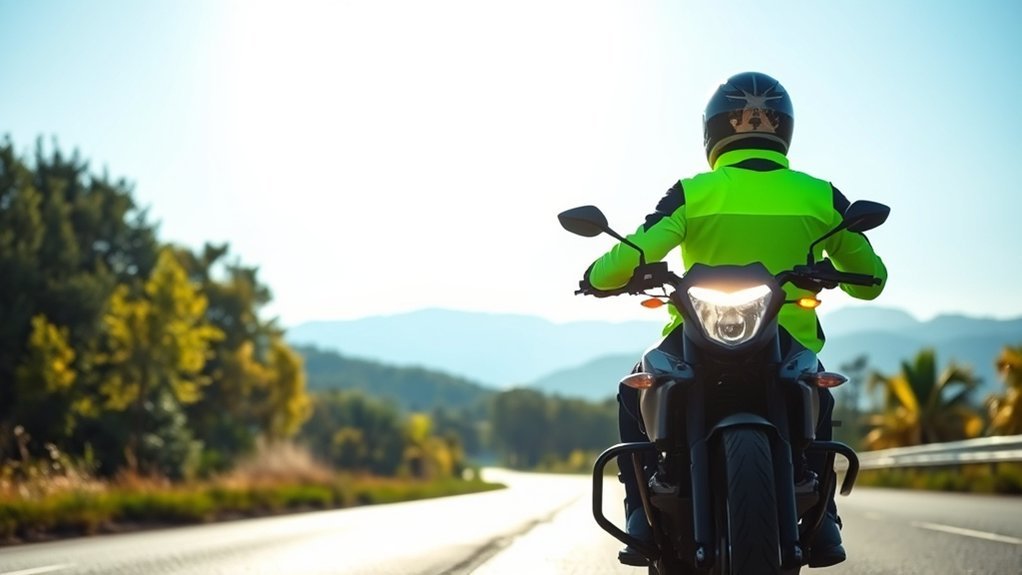
Improving motorcycle visibility takes more than wearing a bright jacket or adding a powerful light. The strongest approach combines conspicuous riding gear, clean and compliant lighting, flexible lane positioning, clear signals, adequate space, and constant hazard scanning. These measures can help other road users detect you sooner, but none can guarantee that a driver has seen you.
Quick Answer
To make yourself more visible on a motorcycle, wear bright or fluorescent gear by day and retroreflective material at night, keep every required light clean and working, use a compliant headlamp, stay out of blind spots, signal early, and choose the lane position that gives you the best view, space cushion, and escape route.
Key Takeaways
- Bright or fluorescent colors are most useful in daylight; retroreflective material becomes especially valuable when vehicle headlights shine on it at night.
- Use only motorcycle-compatible lighting that meets applicable requirements, is aimed correctly, and does not create glare or hide the turn signals.
- There is no single lane position that is safest in every situation. Move within your lane as traffic, sight lines, road surfaces, and escape paths change.
- Search about 12 seconds ahead, maintain at least a two-second following gap in ordinary conditions, and add more space at night or in poor weather.
- Ride as though other drivers may not detect you, even when you believe you have made eye contact.
At a Glance
| Time Required | About 5–15 minutes for a pre-ride check; 15–45 minutes to add approved reflective material; longer for a professional lighting installation |
| Difficulty | Easy for gear, cleaning, and checks; moderate to advanced for electrical or headlamp changes |
| Tools Needed | Owner’s manual, microfiber cloth, helmet-safe cleaner or mild soap and water, and basic hand tools only when approved lighting work is required |
| Cost | $0 for better positioning and routine checks; approximately $10–$300 or more for reflective materials, riding gear, or compliant lighting |
Choose High-Visibility Gear for Better Motorcycle Safety
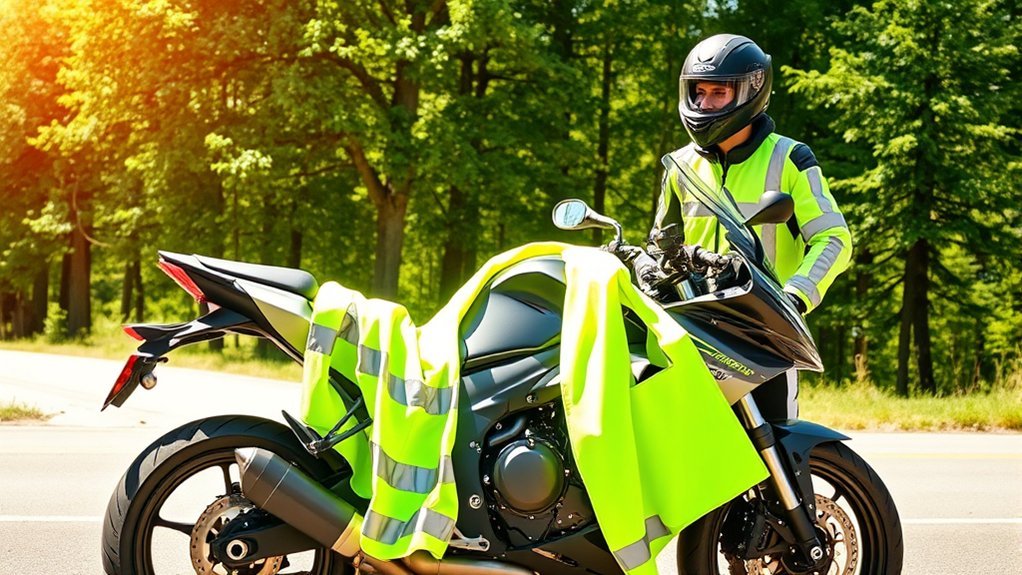
Your upper body and helmet form a large part of the visible rider-and-motorcycle outline. A bright jacket, vest, or helmet can therefore make you easier to pick out against traffic and roadside clutter. The National Highway Traffic Safety Administration recommends brightly colored clothing with reflective material as part of responsible riding.
Fluorescent yellow, yellow-green, orange, and red-orange materials are designed to stand out in daylight. However, no color provides maximum contrast against every background. Yellow-green may blend into summer vegetation, while orange or red may blend into construction zones, autumn foliage, or vehicle brake lights. Choose a color that contrasts with the roads and surroundings where you ride most often.
At night, fluorescent color alone is not enough. Add retroreflective panels or strips that return light toward the headlights of an approaching vehicle. Useful locations include the front and back of the torso, the sides of the arms and legs, the sides and rear of the helmet when the helmet manufacturer allows adhesives, and the motorcycle’s panniers or luggage.
Protective performance still comes first. Choose a properly fitted motorcycle jacket, pants, gloves, boots, and a helmet that meets applicable standards. A high-visibility vest can be worn over protective clothing, but it should fit securely so it does not flap, obscure lights, or interfere with controls.
Note: Built-in LEDs on a backpack, helmet accessory, or jacket are supplemental aids. They do not replace required motorcycle lights, reflective material, safe lane positioning, or an escape plan. Check local laws before using illuminated or flashing accessories.
A 2004 case-control study found a lower adjusted risk of crash-related injury among riders who reported wearing reflective or fluorescent clothing. The result supports conspicuous gear, but it shows an association rather than proving that clothing alone prevents a crash.
Upgrade Your Motorcycle Lights for Enhanced Visibility
Your lighting system has two jobs: helping you see the road and helping other road users recognize your motorcycle’s presence, direction, and intentions. More brightness is not automatically better. Beam pattern, aim, color, compatibility, and glare control matter as much as output.
Choose a Compatible, Compliant Headlamp
Do not choose a replacement only because it is LED, brighter, or a certain diameter. A motorcycle may use a model-specific assembly, a sealed or integral beam, or a replaceable-bulb housing. The replacement must fit the mounting system, match the motorcycle’s electrical design, provide the correct high- and low-beam pattern, and comply with applicable lighting requirements.
In the United States, NHTSA’s current LED headlamp interpretation explains that LED technology can be used in a compliant integral-beam headlamp. It also warns that an LED light source is not automatically compliant when inserted into a housing designed for a different replaceable bulb.
Use a complete road-legal assembly or a motorcycle-manufacturer-approved replacement. Confirm compatibility in the owner’s or service manual, verify the seller’s compliance documentation, and have the beam aimed after installation. Check state law because rules governing modifications to an in-use motorcycle may differ.
Install Auxiliary Lighting Carefully
Properly designed auxiliary lamps can make a motorcycle’s frontal outline easier to recognize and may improve illumination on dark roads. Mounting two legal lamps with adequate separation can also give other drivers a better sense of the motorcycle’s width and distance. However, the lamps must not glare into oncoming traffic or overpower required turn signals.
Before installation, confirm all of the following:
- The lamp color, placement, output, and operating pattern are legal in your state.
- The lights remain steady-burning unless a specifically permitted system is used.
- The beam is aimed below the eyes of oncoming drivers and does not scatter upward.
- The lamps do not block or visually mask the headlamp, turn signals, reflectors, or license plate.
- The brackets cannot contact the tire, brake hose, suspension, steering, or hot exhaust components.
- The wiring includes the correct fuse, weatherproof connections, abrasion protection, and a suitable relay when required.
NHTSA explains that supplemental lighting must not impair required lighting through confusing colors, distracting activation, glare, or masking of signal lamps.
Warning: Incorrect wiring can cause a short circuit, fire, charging-system problem, or loss of required lights. Follow the motorcycle manufacturer’s instructions and use a qualified technician when you are unsure. On an electric motorcycle, never open the traction battery or touch orange high-voltage cables or connectors.
Perform Regular Lighting Checks
Check the lighting system before every ride. Turn the ignition on and verify the low beam, high beam, tail lamp, front and rear turn signals, hazard lights if equipped, and license-plate light where required. Apply the front brake and rear brake separately to make sure each control activates the brake light.
Clean lamp lenses and reflectors with products approved for the material. Replace failed bulbs or assemblies promptly. If the headlamp appears unusually high, low, or off-center, check the aim according to the service manual rather than adjusting it by guesswork.
Also inspect added wiring for loose connectors, cracked insulation, chafing, corrosion, or heat damage. If the lights flicker, dim at idle, blow fuses, or cause charging warnings, stop using the accessory until the circuit is inspected.
Use Reflective Gear for All-Day Visibility
High-visibility color and retroreflective material perform different jobs. Combining them gives you broader coverage across daylight, dusk, rain, and darkness.
Choose Colors That Contrast in Daylight
Use a bright or fluorescent jacket, vest, helmet, or rain shell where it creates contrast with your normal riding background. Large uninterrupted panels are generally easier to recognize than a few small accents. Keep the material clean because road film and mud reduce color contrast.
A light-colored helmet can also make head movement easier for another driver to notice. Movement is a valuable visual cue, particularly near intersections, although you should never move your head or motorcycle solely to attract attention when doing so would interfere with control or hazard scanning.
Add Retroreflective Coverage From Multiple Angles
Place approved retroreflective material where headlights can reach it from the front, rear, and sides. Useful areas include the chest, back, shoulders, lower legs, luggage, and side-facing surfaces. Clean reflective strips gently and replace them if they peel, crack, or lose reflectivity.
Ask the helmet manufacturer before placing tape, decals, lights, or adhesive mounts on a helmet shell. Certain adhesives, solvents, or drilling methods can damage the shell or liner and may void the warranty.
| Condition | Most Useful Aids | Important Limitation |
|---|---|---|
| Daylight | Bright or fluorescent upper-body gear, light helmet, operating headlamp or factory DRL | Choose contrast for the background; one color does not stand out everywhere. |
| Dawn and Dusk | Bright color plus retroreflective material and clean lighting | Low contrast and sun glare can hide both riders and road hazards. |
| Night | Retroreflective front, side, and rear coverage; properly aimed headlamp and working tail lamp | Fluorescent color alone provides limited benefit without daylight. |
| Rain or Fog | Low beam, reflective rain gear, clean visor, greater following distance | High beam can reflect from droplets and make it harder to see. |
Use Daytime Lighting Without Creating Glare
Many modern motorcycles automatically operate the headlamp whenever the engine or ignition system is active. Others use a factory daytime running lamp. Make sure the intended daytime light is actually on before entering traffic; do not assume the switch position or dashboard symbol confirms that every lamp is working.
Daytime lighting can help a motorcycle stand out, but it does not make the rider impossible to miss. Background clutter, sun angle, hills, curves, vehicle pillars, distraction, and poor distance judgment can still prevent timely detection.
If your motorcycle did not come with a DRL, do not splice in a generic kit without checking the owner’s manual, charging-system capacity, lighting controls, and local law. A properly functioning factory headlamp may already provide the intended daytime conspicuity.
Avoid aiming lamps upward or using excessively bright settings in traffic. Use high beam only when permitted, when it will not glare or confuse other road users, and in accordance with the motorcycle manufacturer’s instructions.
Position Yourself in Traffic to See and Be Seen
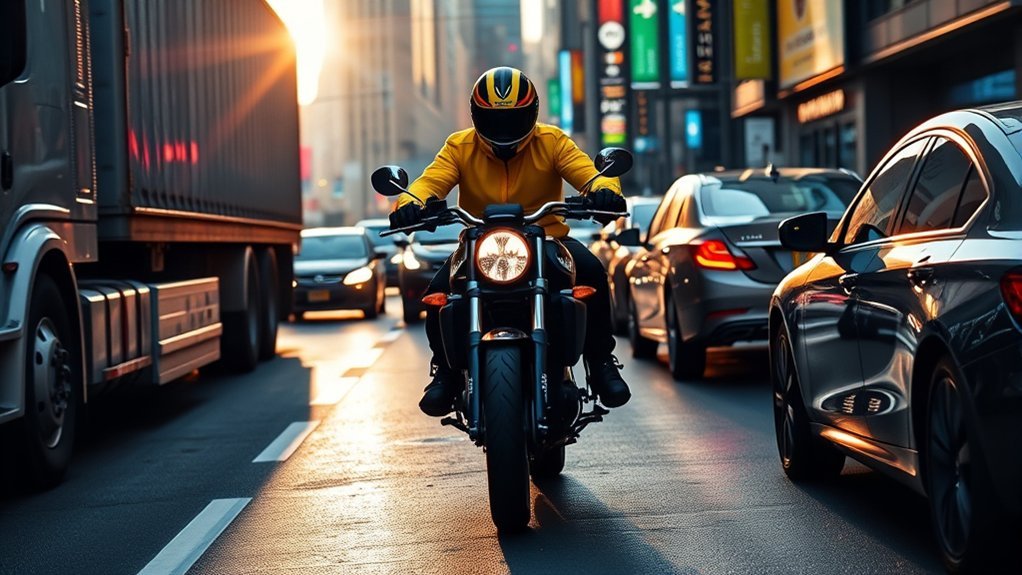
Lane position is not a fixed rule. Use the part of the lane that improves your view, helps others see you, avoids surface hazards, preserves space, and leaves an escape path. The best position can change several times within one block.
Adjust Lane Position as Conditions Change
- Move away from a vehicle’s blind spot rather than remaining beside it.
- Position yourself where you can see the driver’s mirror, but do not assume that means the driver has seen you.
- Use a lane position that lets you see around the vehicle ahead without following too closely.
- Avoid oil, gravel, standing water, steel plates, potholes, and debris.
- Keep space on at least one side whenever possible so you have somewhere to move.
- When another vehicle passes, a central position often gives you more clearance from the passing vehicle and the road edge.
The Motorcycle Safety Foundation Operator Manual recommends a minimum two-second following gap in ordinary conditions. Increase that gap in darkness, rain, fog, heavy traffic, or whenever your view is blocked.
Improve Visibility at Intersections
Intersections, driveways, and side streets require extra attention because a driver may turn across your path or enter your lane. Slow enough to respond, cover the controls when risk is high, and select a position that gives both you and the other driver the earliest possible view.
Search for front-wheel movement, a change in the vehicle’s position, turn signals, and openings in traffic. Do not rely on eye contact. A driver can look toward you without consciously recognizing your motorcycle or accurately judging its speed.
Search your planned path about 12 seconds ahead. This gives you time to identify a developing conflict, separate hazards, adjust speed, and choose an escape route before emergency action is required.
Communicate Clearly
Use turn signals for every turn and lane change, and cancel them afterward. Check mirrors frequently and perform a head check before moving laterally. When slowing, activate the brake light early enough to warn the driver behind you. A brief horn signal may help gain attention, but it should never replace braking, spacing, or an escape plan.
When stopped in traffic, remain alert to vehicles approaching from behind. Keep the motorcycle ready to move when appropriate, watch the mirrors, leave space in front, and identify a safe escape area. Do not weave while stopped to attract attention; unpredictable movement can confuse other drivers and reduce your control.
Pro Tip: Ask three questions whenever traffic changes: Can I see the threat? Can the other road user detect me? Where will I go if the answer to either question is no?
Maintain Your Helmet and Visor for Clearer Vision
Visibility also means being able to see hazards clearly. A dirty, fogged, scratched, or unsuitable visor can hide brake lights, pedestrians, lane markings, and road debris.
- Follow the helmet manufacturer’s cleaning instructions.
- Use lukewarm water, mild soap, or a cleaner specifically approved for the visor and its coatings.
- Soften dried insects with a damp cloth before wiping; do not scrape them off.
- Use a clean microfiber cloth and avoid paper towels, abrasive pads, ammonia, gasoline, brake cleaner, or household solvents.
- Inspect the visor for cracks, deep scratches, distorted areas, loose hardware, and a damaged seal.
- Use an approved anti-fog insert or treatment and ensure the helmet ventilation system is open and clean.
- Use a clear visor in darkness. Do not continue riding after sunset with a dark visor if it prevents you from seeing hazards clearly.
Keep the helmet exterior clean so bright or reflective areas remain visible. Do not drill the shell or attach unapproved lights, cameras, mounts, paint, or adhesive materials without checking the helmet manufacturer’s instructions.
Adapt Your Riding for Weather and Low-Light Conditions
Poor weather reduces your ability to see and be seen while also reducing tire grip. Slow down before visibility becomes severely limited, increase your following distance, and use smooth steering, throttle, and brake inputs.
Rain
Use the low beam, wear reflective waterproof gear, and keep the visor clear. Avoid sudden lane changes and leave extra space for braking. Painted markings, metal covers, leaves, oil residue, and standing water may be especially slippery.
Fog
Use low beam rather than high beam because bright light can reflect from suspended droplets and reduce contrast. Lower your speed so you can stop within the distance you can see. If visibility becomes too poor to identify the road edge, lane, and traffic movement, leave the roadway at a safe location.
Night
Wear retroreflective material, reduce speed, and use high beam only when you are not following or approaching another vehicle and the law permits it. Never ride faster than the distance illuminated by your headlamp allows you to stop.
Sun Glare and Changing Light
Keep the visor clean, use approved eye protection, and expect other drivers to have the same glare problem. Increase space and avoid lingering where a driver looking into the sun may not detect you. Carry a clear visor if your ride may continue after dark.
Complete a Five-Minute Visibility Check
Before entering traffic, walk around the motorcycle and complete this routine:
- Headlamp: Verify low and high beams and inspect the lens for dirt, cracks, or condensation.
- Rear lighting: Confirm the tail lamp and license-plate light work where required.
- Brake light: Test the front-brake lever and rear-brake pedal separately.
- Signals: Check every turn signal and hazard light, then confirm the switch cancels correctly.
- Reflectors and reflective material: Clean them and replace loose or damaged pieces.
- Mirrors: Adjust both mirrors after you are seated in your normal riding position.
- Helmet and visor: Check clarity, ventilation, closure, and fit.
- Gear contrast: Choose bright, reflective, or waterproof layers for the expected light and weather.
- Route conditions: Check for darkness, fog, heavy rain, construction, or sun glare that may require more time and space.
The Motorcycle Safety Foundation’s visibility guidance also stresses using the headlight, reflective material, appropriate lane position, blind-spot avoidance, signals, space, and an escape route.
Frequently Asked Questions
What is the 1% rule in motorcycles?
There is no recognized motorcycle-visibility rule stating that a rider should see 1% of the distance ahead. In motorcycle culture, “one-percenter” commonly has a separate club-related meaning. For road safety, use established practices such as scanning about 12 seconds ahead and maintaining an adequate following gap.
What is the 12-second rule for motorcycles?
The 12-second guideline means searching the road and your intended path roughly 12 seconds ahead. It helps you detect intersections, turning vehicles, surface hazards, and traffic changes early. It is not a 12-second following-distance rule.
What does two fingers down mean for bikers?
Two fingers pointed downward are commonly used as an informal greeting or wish for a safe ride. The gesture is optional and not universal. Keep both hands on the controls when traffic, braking, cornering, or road conditions require your full attention.
How can I make myself more visible on a motorcycle?
Combine bright daytime gear, retroreflective nighttime material, clean working lights, clear signals, flexible lane positioning, blind-spot avoidance, and adequate space. No single accessory can replace a complete visibility and hazard-management strategy.
What color is most visible on a motorcycle?
Fluorescent yellow-green, orange, and red-orange are strong daytime choices, but contrast matters more than naming one universal best color. At night, add retroreflective material because fluorescent color alone does not return headlight illumination toward the driver.
Are aftermarket LED motorcycle headlights legal?
Not every LED product is legal or compatible. A complete compliant assembly designed for the motorcycle may be acceptable, while placing an LED source in a housing designed for another bulb is not automatically compliant. Check the product documentation, owner’s manual, beam aim, and state law before installation.
Should I use my high beam during the day?
Follow the motorcycle manufacturer’s instructions and local law. A high beam may improve conspicuity in some daylight conditions, but it should not glare, distract, or obscure your signals. A functioning factory headlamp or DRL, appropriate gear, and safe positioning remain essential.
Can high-visibility gear prevent a motorcycle crash?
No. Conspicuous gear may help another road user detect you sooner, but it cannot overcome every blind spot, distraction, obstruction, or judgment error. Continue to manage speed, space, lane position, braking readiness, and escape routes.
Conclusion
The most effective motorcycle visibility strategy uses several layers. Wear protective gear that contrasts with the background, add retroreflective coverage for darkness, keep required lights and the visor clean, use only compatible and lawful lighting, signal clearly, and change lane position as conditions change. Search well ahead, preserve space, and always keep an escape option. These steps can improve conspicuity, but the safest assumption is still that another driver may not have detected you.
Sources
- National Highway Traffic Safety Administration — Motorcycle Safety — protective gear, visibility, lighting checks, reflective material, licensing, and rider preparation
- NHTSA — Strategies to Increase Rider Conspicuity and Use of Protective Clothing — evidence and limitations for clothing, headlights, and auxiliary visibility technology
- Motorcycle Safety Foundation — If You Ride a Motorcycle — visibility, blind spots, signaling, lane positioning, protective equipment, and escape routes
- Motorcycle Safety Foundation — Motorcycle Operator Manual — 12-second searching, following distance, dynamic lane position, intersections, night riding, and conspicuity
- NHTSA — LED Headlamp Interpretation — FMVSS 108 requirements for LED integral-beam and replaceable-bulb headlamps
- BMJ — Motorcycle Rider Conspicuity and Crash-Related Injury — observational evidence concerning reflective or fluorescent clothing, helmet color, and daytime headlight use

Leave a Reply