
A low advertised rate can make a motorcycle look affordable, but the rate in an advertisement is not necessarily the rate you will receive. The best way to judge a motorcycle loan is to compare annual percentage rates, loan terms, fees, total interest, and monthly payments from several lenders before choosing a bike or signing a contract.
Quick Answer
A good motorcycle loan rate in 2026 is the lowest competitive APR you personally qualify for after comparing several lenders. As of July 2026, one leading motorcycle lender advertises rates from 6.49% APR for excellent credit, while the Federal Reserve’s latest 24-month personal-loan benchmark is 11.86%.
Key Takeaways
- There is no universal motorcycle loan rate for everyone with the same credit score.
- Compare APR rather than the interest rate alone because APR may include lender fees.
- Credit history, income, debts, down payment, term, loan amount, vehicle, and lender policy can all affect your offer.
- A longer term lowers the monthly payment but normally increases total interest.
- Verify whether a lender uses a soft or hard credit inquiry before requesting a rate.
At a Glance
| Time Required | About 1–3 hours to check credit, collect documents, compare lenders, and review offers |
| Difficulty | Moderate; the calculations are simple, but loan disclosures require careful review |
| Tools Needed | Credit reports, proof of income, identification, bank information, motorcycle price, and a loan calculator |
| Cost | Comparing offers can be free, but lender fees, taxes, registration, insurance, and optional products may increase the total amount financed |
Note: This article provides general educational information, not individualized financial advice. Advertised rates can change without notice, and approval depends on the lender’s current underwriting rules and your complete financial profile.
What Are Motorcycle Loan Rates in 2026?
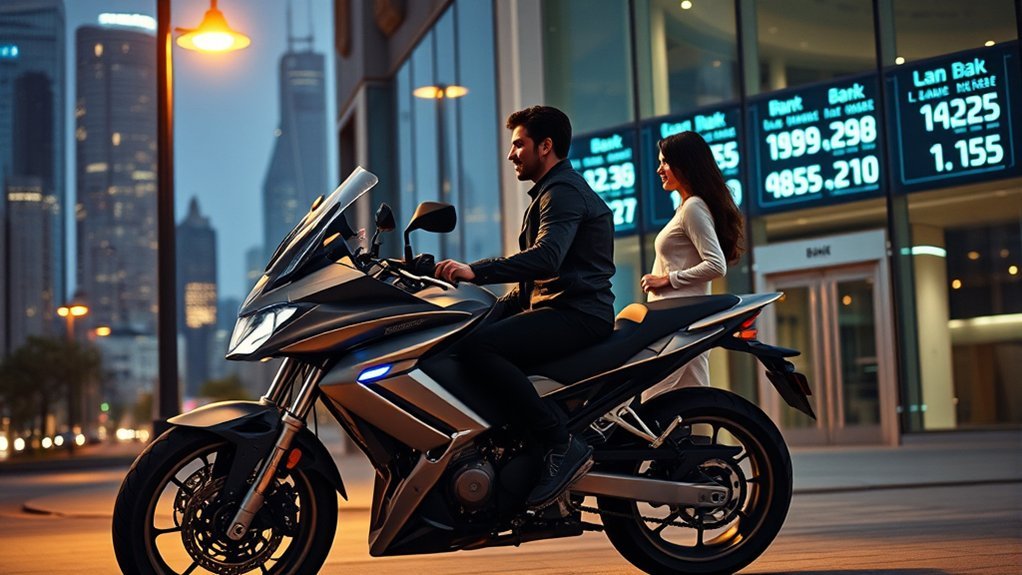
There is no official national average published specifically for all motorcycle loans. Motorcycle buyers may use secured vehicle financing, unsecured personal loans, dealer-arranged credit, credit-union loans, or manufacturer promotions. These products use different approval standards, fees, collateral rules, and loan terms.
As of July 2026, LightStream advertises motorcycle financing from 6.49% APR for borrowers who meet its excellent-credit requirements and select AutoPay. The lender states that the actual APR depends on the loan purpose, amount, term, payment method, and credit profile. Advertised rates are also subject to change.
For broader context, the Federal Reserve’s July 8, 2026 G.19 report lists an 11.86% rate for 24-month personal loans at commercial banks in May 2026. That figure is not a motorcycle-loan average, but it provides a useful benchmark for comparing an unsecured personal-loan offer.
A good motorcycle loan rate is not one fixed number. It is an APR that is competitive for your complete financial profile and affordable when you count the total cost—not just the monthly payment.
APR Versus Interest Rate
The interest rate is the price charged for borrowing the principal. The annual percentage rate, or APR, measures the interest rate plus certain lender fees as a yearly percentage. The Consumer Financial Protection Bureau explains that APR is the better standardized figure for comparing loan costs.
Always compare APR with APR. A loan advertising a lower interest rate may cost more if it includes a large origination fee or other finance charges.
Understanding Your Credit Profile for Motorcycle Loans
Your credit score is important, but it does not determine your motorcycle loan rate by itself. Lenders may also evaluate your credit history, income, existing debts, requested loan amount, term, down payment, employment stability, and the motorcycle you plan to buy.
The following table shows the standard base FICO score categories. It does not assign APRs because lenders set their own pricing and approval rules.
| FICO Score Range | FICO Category | Possible Lending Effect |
|---|---|---|
| Below 580 | Poor | Options may be limited, and approved offers may carry high costs. |
| 580–669 | Fair | Approval may be possible, but pricing can vary widely by lender and overall profile. |
| 670–739 | Good | Borrowers may have access to competitive offers, but the lowest advertised rate is not guaranteed. |
| 740–799 | Very Good | A strong complete application may qualify for favorable terms. |
| 800–850 | Exceptional | Borrowers generally present lower credit risk, although other underwriting rules still apply. |
These categories come from FICO’s consumer credit-score guidance. FICO also notes that there is no single minimum score required by every lender.
Other Factors That Affect the Rate
According to the CFPB’s vehicle-financing guidance, lenders commonly consider:
- Your credit scores and payment history
- Your income and existing monthly debt obligations
- The amount you want to borrow
- The loan term
- Your down payment relative to the motorcycle’s value
- Whether the motorcycle is new or used
- The lender’s own underwriting and pricing rules
Pro Tip: Do not treat 670, 720, or any other score as a guaranteed rate threshold. Ask each lender for the APR, term, amount financed, monthly payment, total of payments, and every fee in writing.
Secured vs. Unsecured Motorcycle Loans: Which Is Right for You?
A secured motorcycle loan gives the lender a legal interest in the bike. An unsecured personal loan does not use the motorcycle as collateral. Neither option is automatically best or cheapest for every borrower.
| Feature | Secured Motorcycle Loan | Unsecured Personal Loan |
|---|---|---|
| Collateral | The motorcycle usually secures the debt. | The motorcycle normally does not secure the debt. |
| Title | The lender may hold a lien until the loan is paid. | The lender generally does not place a vehicle lien. |
| Vehicle rules | The lender may restrict age, mileage, value, dealer, or insurance coverage. | There may be fewer motorcycle-specific restrictions, but use-of-funds rules can still apply. |
| Pricing | Collateral may reduce lender risk, but the APR still depends on the complete application. | Pricing may rely more heavily on credit, income, debts, amount, and term. |
| Default risk | The lender may repossess the motorcycle after default, subject to the contract and applicable law. | The lender cannot normally repossess a bike that was not pledged, but missed payments can still lead to collections, lawsuits, and credit damage. |
Warning: With a secured loan, failing to make required payments can put the motorcycle at risk of repossession. Repossession may not erase the entire debt if the bike is sold for less than the remaining balance and allowed costs.
Effective Strategies to Secure Competitive Motorcycle Loan Rates
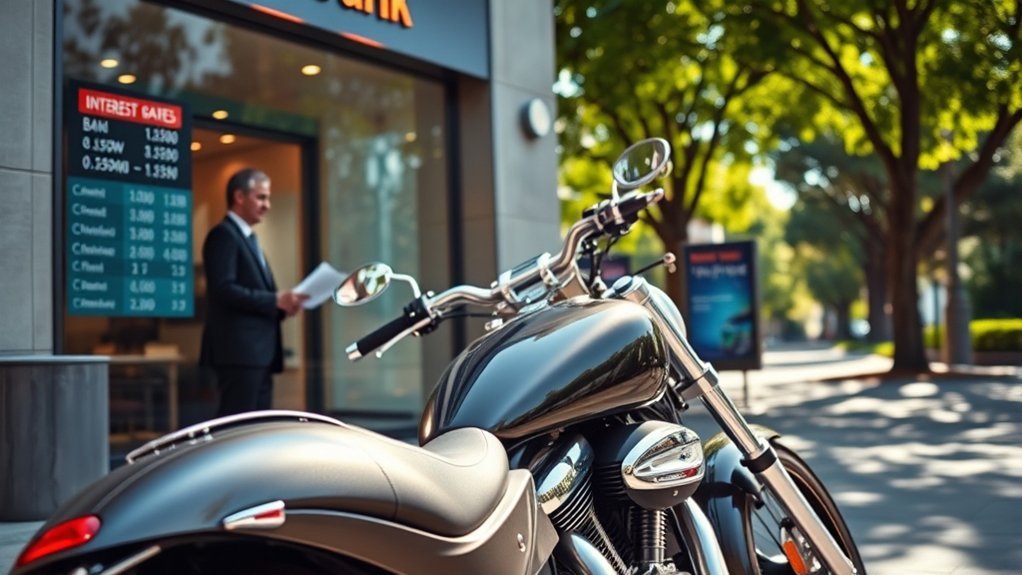
Improving your application and comparing lenders can matter more than trying to reach one specific score. Begin before visiting a dealership so that you know your budget and have an outside financing offer to compare.
Improve Your Credit Score
Check all three credit reports for incorrect balances, unfamiliar accounts, duplicate debts, or payment-history errors. The CFPB directs consumers to AnnualCreditReport.com for federally authorized free credit reports.
To strengthen your credit profile:
- Make every payment on time.
- Bring past-due accounts current when possible.
- Reduce revolving credit-card balances.
- Avoid taking on unnecessary new debt before applying.
- Dispute inaccurate report information with the reporting company and information provider.
- Keep older accounts open when doing so does not create fees or overspending risk.
Lower credit utilization can help, but 30% is not a guaranteed approval threshold. Reducing balances as much as reasonably possible is generally more useful than aiming for one supposedly perfect percentage.
Compare Multiple Lender Offers
Request offers from more than one source, which may include a bank, credit union, online lender, dealership, or manufacturer-affiliated finance company. Compare the same loan amount and similar terms whenever possible.
Record these details for every offer:
- APR and interest rate
- Fixed or variable rate
- Loan amount
- Loan term
- Monthly payment
- Total of payments
- Total interest
- Origination, document, or application fees
- Prepayment penalty, if any
- Required down payment
- Collateral and title-lien rules
- Required insurance coverage
- Optional add-ons included in the amount financed
The lowest payment is not always the least expensive offer. A long loan can reduce the monthly bill while substantially increasing total interest.
Use Prequalification Options Carefully
Some lenders let you check estimated rates with a soft credit inquiry, which does not affect your credit score. Other lenders require a hard inquiry when you submit the application.
Do not assume that every “check your rate” process is a soft pull. For example, LightStream states that its application uses a hard inquiry and that it does not provide loan preapprovals.
When hard inquiries are necessary, the CFPB advises keeping vehicle-loan shopping within roughly 14–45 days. Credit-scoring models generally treat qualifying inquiries made during the applicable shopping window as a single rate-shopping event.
Improve Your Chances of Securing a Good Loan Rate
A stronger application reduces the lender’s risk and may improve the terms offered. Focus on the amount borrowed and the affordability of the complete purchase rather than trying to qualify for the most expensive bike available.
Make a Down Payment and Borrow Less
A down payment reduces the amount financed and can improve the loan-to-value ratio. It also lowers the monthly payment and total interest when the APR and term stay the same.
Before deciding how much to borrow, include:
- Motorcycle selling price
- Sales tax
- Title and registration charges
- Dealer documentation or preparation fees
- Protective riding gear
- Insurance premium or required coverage
- Immediate maintenance for a used motorcycle
- Optional warranties or service contracts
Avoid financing optional products automatically. The CFPB notes that many dealer add-ons are optional and negotiable. Adding them to the loan means paying interest on them as well as their purchase price.
Choose the Shortest Affordable Loan Term
A shorter term usually produces a higher monthly payment but less total interest. A longer term lowers the payment but can keep you in debt after the motorcycle has lost a large share of its value.
Compare at least two terms using the same loan amount and APR. Choose the shortest term whose payment fits comfortably after insurance, fuel, maintenance, registration, and emergency savings.
Pro Tip: Set your maximum total purchase price before discussing monthly payments with a dealer. Negotiating only around a payment makes it easier to hide a longer term, extra products, or a higher amount financed.
Dealer, Credit Union, Bank, or Online Lender?
Each financing source has advantages and limitations. Comparing them before purchasing gives you a better chance of recognizing a competitive offer.
| Financing Source | Possible Advantage | What to Check |
|---|---|---|
| Credit union | Member-focused underwriting and potentially competitive vehicle-loan terms | Membership rules, motorcycle age limits, loan minimums, and required collateral |
| Bank | Existing-customer discounts or familiar account management | Whether motorcycle loans are offered directly and whether the purchase must be through a dealer |
| Online lender | Fast applications and possible flexibility for dealer or private-party purchases | Soft versus hard inquiry, origination fees, funding rules, and whether the loan is secured |
| Dealer-arranged financing | Convenience and access to several lenders through one application | Dealer rate markup, add-ons, term length, and whether an outside offer can be matched or beaten |
| Manufacturer promotion | Occasional low promotional APR on eligible new motorcycles | Expiration date, eligible models, required credit tier, down payment, term restrictions, and whether choosing the rate means giving up a rebate |
Motorcycle Loan Payment Examples
The monthly payment depends on the amount financed, APR, and term. The examples below assume a fixed-rate, fully amortizing $15,000 loan with equal monthly payments and no added fees.
| APR | Term | Approx. Monthly Payment | Approx. Total Interest |
|---|---|---|---|
| 6.49% | 36 months | $460 | $1,548 |
| 6.49% | 48 months | $356 | $2,071 |
| 6.49% | 60 months | $293 | $2,605 |
| 11.86% | 36 months | $497 | $2,900 |
| 11.86% | 48 months | $394 | $3,911 |
| 11.86% | 60 months | $333 | $4,956 |
| 20.00% | 36 months | $557 | $5,068 |
| 20.00% | 48 months | $456 | $6,910 |
| 20.00% | 60 months | $397 | $8,844 |
The table shows why a payment alone can be misleading. At 20% APR, extending the loan from 36 to 60 months lowers the payment by about $160, but it increases total interest by approximately $3,776.
How to Compare Motorcycle Loan Offers
Place the offers side by side and follow this order:
- Match the amount financed. One offer may appear cheaper because it assumes a larger down payment.
- Compare APR with APR. Do not compare one lender’s interest rate with another lender’s APR.
- Match the term. A 60-month offer should not be judged against a 36-month offer by payment alone.
- Check the total of payments. This shows how much all scheduled payments add up to.
- Identify every fee. Look for origination, document, application, late-payment, returned-payment, and prepayment charges.
- Remove unwanted add-ons. Ask whether warranties, service contracts, GAP products, theft protection, or credit insurance are optional.
- Review collateral rules. Confirm title-lien, insurance, age, mileage, dealer, and private-party restrictions.
- Read the final disclosure before signing. Make sure the written figures match the offer you accepted.
Warning: Never sign a blank or incomplete financing document. Do not rely only on a verbal promise that the rate, payment, term, or optional products will be changed later.
How to Apply for Motorcycle Loans
A prepared application is easier to compare and less likely to be delayed. Exact requirements vary, but lenders commonly request identity, income, housing, employment, debt, and purchase information.
- Set a complete budget. Include the motorcycle, taxes, registration, insurance, gear, and expected maintenance.
- Check your credit reports. Review them before allowing lenders to make hard inquiries.
- Estimate an affordable payment. Leave room for repairs, insurance deductibles, and emergency savings.
- Collect documents. Prepare a government-issued ID, Social Security number, recent pay stubs or other income records, employment information, housing payment, bank details, and proof of address.
- Gather motorcycle information. You may need the purchase price, vehicle identification number, model year, mileage, dealer or seller information, and purchase agreement.
- Check inquiry policies. Confirm whether an initial rate check is soft or hard.
- Request several offers. Keep hard-pull rate shopping within the applicable scoring-model window when practical.
- Compare the written terms. Review APR, payment, term, total interest, fees, collateral, and optional products.
- Submit the final application. Verify that every figure is accurate and provide requested documents promptly.
- Read the final contract. Do not take possession or send money until you understand the loan and purchase terms.
Using a Co-Signer
A qualified co-signer may improve approval chances or help obtain better terms, but the co-signer is not merely a reference. The co-signer becomes legally responsible for the debt if the primary borrower does not pay.
Warning: Late payments can damage both parties’ credit, and the lender may pursue the co-signer for the unpaid balance. Both people should receive and review the complete contract before signing.
If the Rate Is Too High
You do not have to accept the first offer. Consider:
- Buying a less expensive motorcycle
- Making a larger down payment without draining emergency savings
- Choosing a reliable used motorcycle
- Paying down revolving debt before reapplying
- Correcting credit-report errors
- Comparing a credit union, bank, dealer, and online lender
- Waiting until your income or credit profile is stronger
- Asking whether a shorter term or different loan amount changes the APR
If a lender denies the application or offers less favorable terms because of information in a credit report, review the adverse-action notice. It should identify the credit reporting company and explain how to request the relevant report.
Frequently Asked Questions
What is a good interest rate for a motorcycle loan in 2026?
A good rate is an APR near the low end of the offers available for your complete credit and financial profile. As of July 2026, an advertised motorcycle-loan minimum of 6.49% exists for qualifying excellent-credit borrowers with AutoPay, while the Federal Reserve’s latest 24-month personal-loan benchmark is 11.86%. Your best comparison is several written offers for the same amount and term.
How can I get a lower motorcycle loan APR?
Review your credit reports, correct errors, pay bills on time, reduce revolving balances, borrow less, consider a reasonable down payment, and compare several lenders. A shorter term may also reduce total interest, although it produces a higher monthly payment.
Why can motorcycle loan APRs be high?
Rates may be high when a borrower has limited or damaged credit, high existing debt, unstable income, a small down payment, or a long requested term. Some lenders may also view motorcycles as higher-risk collateral because they can depreciate, sustain major damage, or be harder to recover and resell than other vehicles.
How much is the payment on a $15,000 motorcycle loan?
At 6.49% APR, the approximate payment is $460 for 36 months, $356 for 48 months, or $293 for 60 months. At 11.86% APR, it is approximately $497, $394, or $333 for those same terms. Fees or financed add-ons would increase the payment.
Does motorcycle loan prequalification affect my credit score?
It depends on the lender. A soft-pull rate check does not affect the score, but a full application generally uses a hard inquiry. Read the lender’s credit-authorization language before submitting the form rather than assuming that “check your rate” means a soft pull.
Is dealer motorcycle financing always more expensive?
No. A dealer or manufacturer may offer a competitive promotion, especially on an eligible new motorcycle. However, dealer-arranged financing can include lender rate markups or optional products. Obtain an outside offer first and compare the APR, term, amount financed, fees, and total of payments.
Conclusion
A good motorcycle loan rate in 2026 is not determined by one advertisement or one credit-score cutoff. Use current offers, your full financial profile, and the total borrowing cost to judge whether a loan is competitive. Compare APRs for the same amount and term, check all fees and optional products, and understand whether the motorcycle secures the debt.
Before signing, make sure the payment leaves room for insurance, maintenance, riding gear, and emergencies. Walking away from an unaffordable offer is usually safer than stretching the term or financing a motorcycle that exceeds your budget.
Sources
- LightStream Motorcycle Loans — current advertised motorcycle APR, AutoPay qualification, and rate limitations
- Federal Reserve Consumer Credit G.19 — current commercial-bank personal-loan benchmark
- Consumer Financial Protection Bureau: Interest Rate vs. APR — APR definition and loan-comparison guidance
- Consumer Financial Protection Bureau: How Lenders Set Vehicle-Loan Rates — underwriting factors and rate-shopping guidance
- Consumer Financial Protection Bureau: Free Credit Reports — official credit-report access and review guidance
- FICO Credit Score Guidance — FICO score categories and lender-use limitations






Leave a Reply