

Motorcycle lane filtering laws vary sharply across the United States, and a maneuver that is legal on one side of a state line may lead to a citation on the other. As of July 19, 2026, six states have verified statewide rules permitting lane splitting, lane filtering, or a limited form of passing between traffic. Each uses different speed, road, vehicle, and traffic conditions.
Quick Answer
As of July 2026, California allows lane splitting, while Arizona, Colorado, Minnesota, Montana, and Utah authorize narrower forms of filtering or lane sharing under specific speed and traffic limits. Colorado’s authorization is temporary through September 1, 2027. Elsewhere, do not assume the maneuver is legal; check the current state code before riding.
Key Takeaways
- California has the broadest lane-splitting authorization, but unsafe riding can still be cited.
- Arizona, Colorado, Montana, and Utah generally limit filtering to stopped or very slow traffic and low motorcycle speeds.
- Minnesota permits limited passing between traffic at no more than 25 mph and no more than 15 mph faster than surrounding vehicles, with several location exclusions.
- Colorado’s current authorization is scheduled to repeal on September 1, 2027, unless lawmakers act again.
- Research has found lower observed injury percentages among some crash-involved lane-splitting riders, but it does not prove that lane splitting prevents crashes.
Legal information: This guide was reviewed on July 19, 2026, and is for general educational use, not legal advice. Statutes, court interpretations, local ordinances, and enforcement practices can change. Check the current official state code before filtering or splitting lanes.
What’s Lane Filtering and How Does It Work?
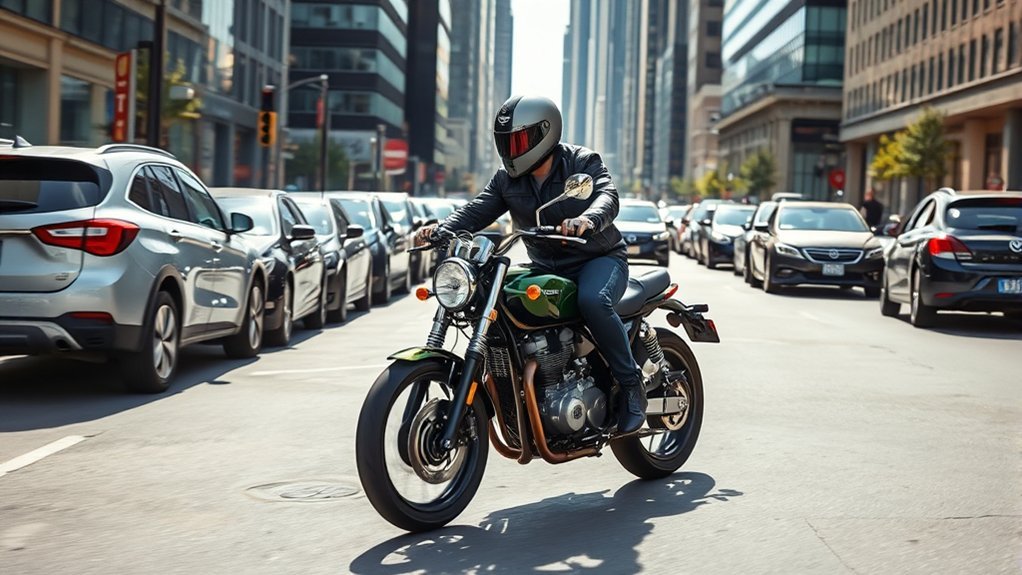
Lane filtering usually means a motorcycle moves between rows of vehicles that are stopped or traveling very slowly. It often occurs near a traffic signal or in heavy congestion. States that authorize filtering normally impose a low motorcycle-speed limit and require enough space for the maneuver to be completed safely.
Lane splitting is the broader practice of riding between rows of vehicles that may still be moving. California expressly recognizes lane splitting, while Minnesota permits a limited form of passing between traffic under statutory speed limits. Other states with authorization generally use narrower filtering rules.
Filtering is different from riding on a shoulder, using a bicycle lane, crossing into oncoming traffic, or weaving repeatedly between lanes. Those actions may remain illegal even where a state permits filtering.
Why Lane Filtering Matters for Motorcyclists
Riders often support filtering because it reduces the time a motorcycle spends stationary between larger vehicles. It may also shorten a rider’s exposure to exhaust, engine heat, and stop-and-go congestion. However, these practical advantages do not guarantee that a particular opening is safe.
| Potential Benefit | Practical Meaning | Important Limitation |
|---|---|---|
| Less time between stopped vehicles | A rider may move away from a position where a distracted driver could approach from behind. | Available research does not establish a universal percentage reduction in rear-end crashes. |
| Reduced delay | Motorcycles may move through congestion without occupying another full vehicle position. | The maneuver must still satisfy every state-specific speed, traffic, lane, and vehicle requirement. |
| Heat management | Moving air can improve rider comfort and may help motorcycles that become hot during long periods of idling. | Filtering is not a substitute for repairing a motorcycle with an overheating or cooling-system problem. |
States That Prohibit or Do Not Authorize Lane Splitting
No statewide authorization comparable to the rules in California, Arizona, Colorado, Minnesota, Montana, or Utah was verified for the following states as of July 19, 2026:
Alabama, Alaska, Arkansas, Connecticut, Delaware, Florida, Georgia, Hawaii, Idaho, Illinois, Indiana, Iowa, Kansas, Kentucky, Louisiana, Maine, Maryland, Massachusetts, Michigan, Mississippi, Missouri, Nebraska, Nevada, New Hampshire, New Jersey, New Mexico, New York, North Carolina, North Dakota, Ohio, Oklahoma, Oregon, Pennsylvania, Rhode Island, South Carolina, South Dakota, Tennessee, Texas, Vermont, Virginia, Washington, West Virginia, Wisconsin, and Wyoming.
This grouping does not mean every state uses identical statutory wording. One state may expressly prohibit operating between lanes, while another may enforce ordinary lane-use, passing, shoulder, or reckless-driving laws. The practical rule is the same: without clear statewide authorization, a rider should not assume lane filtering or splitting is permitted.
Legal Restrictions Overview
A motorcycle is generally entitled to use a full traffic lane. That does not automatically give the rider permission to share a lane with another vehicle, pass between rows, use the shoulder, or cross a lane boundary in an unsafe manner.
Local rules can also matter. A state statute may authorize a maneuver only on certain multilane roads, while cities, work zones, traffic-control devices, or other laws impose additional restrictions. Riders traveling across state lines should review each state separately instead of relying on a national map or social-media summary.
Consequences of Violating Lane-Use Laws
Possible consequences include a traffic citation, a fine, license points where the state’s point system applies, or allegations of improper passing, unsafe lane use, careless driving, or reckless driving. The exact offense and penalty depend on the state, the rider’s conduct, and the circumstances.
A violation can also affect a crash investigation. Even when filtering itself is legal, a rider may still share fault if the motorcycle was traveling too fast, passing in a prohibited location, or continuing through a gap that was not reasonably safe.
Exceptions for Law Enforcement
Some state laws provide exceptions for an on-duty peace officer performing official duties. Arizona’s statute, for example, contains an on-duty peace-officer exception. Such provisions do not give civilian riders permission to copy emergency or traffic-enforcement maneuvers.
Because exemptions vary, riders should not rely on the fact that they have seen a police motorcycle travel between lanes.
States With Statewide Lane Filtering or Splitting Authorization
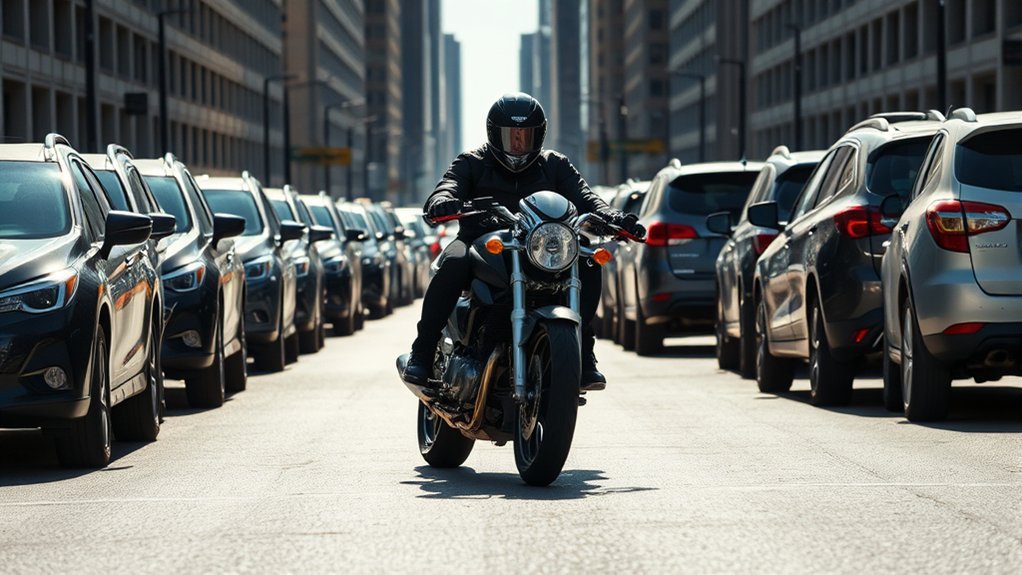
The table below summarizes the six verified statewide frameworks as of July 19, 2026. It is a starting point, not a substitute for reading the linked law.
| State | What Is Authorized | Main Conditions | Official Source |
|---|---|---|---|
| Arizona | A two-wheeled motorcycle may pass stopped same-direction traffic between adjacent lanes. | Road posted at 45 mph or less; at least two adjacent same-direction lanes; traffic stopped; motorcycle no faster than 15 mph; maneuver must be safe. | A.R.S. §28-903 |
| California | Lane splitting by a two-wheeled motorcycle between rows of stopped or moving vehicles is legally recognized. | No special statutory maximum speed is built into the definition, but unsafe speed, reckless operation, shoulder use, and other violations remain enforceable. | California Highway Patrol |
| Colorado | A two-wheeled motorcycle may overtake stopped traffic within the same lane when conditions allow. | Traffic must be stopped; motorcycle no faster than 15 mph; lanes must be wide enough; no passing on the right shoulder or in an opposing lane. Current authorization is scheduled to repeal September 1, 2027. | Colorado SB24-079 |
| Minnesota | A motorcycle may pass another vehicle traveling in the same direction under limited lane-sharing conditions. | Motorcycle no faster than 25 mph and no more than 15 mph faster than surrounding traffic. Prohibited around roundabout approaches or exits, in school zones, in single-lane work zones, and on queued freeway or expressway on-ramps. | Minn. Stat. §169.974 |
| Montana | A two-wheeled motorcycle may overtake between lanes when traffic is stopped or moving very slowly. | Motorcycle no faster than 20 mph; overtaken traffic stopped or moving at 10 mph or less; lanes must be wide enough; operation must be prudent. | MCA §61-8-392 |
| Utah | A qualifying motorcycle may filter between stopped vehicles on designated roads or qualifying off-ramps. | Generally requires two or more adjacent same-direction lanes, a road posted at 45 mph or less, stopped traffic, and a motorcycle speed of 15 mph or less. Filtering is not permitted on an on-ramp, and moving-traffic lane splitting remains prohibited. | Utah Code §41-6a-704 |
Warning: Legal permission is not permission to force a narrow gap. Do not filter beside a turning vehicle, through a space that is closing, on a shoulder unless a law expressly permits it, or at a speed that prevents you from stopping within the visible opening.
California: Broad Lane-Splitting Authorization
California has the broadest statewide framework. State law recognizes lane splitting as driving a two-wheeled motorcycle between rows of stopped or moving vehicles in the same lane, including on divided and undivided streets, roads, and highways.
That does not make every lane-splitting maneuver lawful or reasonable. The California Highway Patrol warns that danger increases as overall traffic speed and the motorcycle’s speed difference increase. Riders should also avoid lingering in blind spots, splitting near large vehicles, or treating the shoulder as another traffic lane.
California does not use a special statutory rule allowing a rider to travel any chosen speed “at their discretion.” Ordinary speed, reckless-driving, unsafe-lane-change, and other traffic laws still apply.
Key Differences Between Lane Splitting and Lane Filtering
| Feature | Lane Filtering | Lane Splitting |
|---|---|---|
| Traffic condition | Usually stopped or moving at a crawl. | May include traffic that is still moving. |
| Typical motorcycle speed | Often capped between 15 and 20 mph, depending on the state. | Depends on the state; California has no special numerical limit in the statutory definition, while Minnesota imposes limits. |
| Where commonly permitted | Qualifying multilane roads, stopped queues, or intersections. | Most broadly recognized in California; limited passing is also authorized in Minnesota. |
| Shoulder use | Normally separate from filtering and often prohibited. | Riding on the shoulder is not California lane splitting. |
The terminology used by riders, police, lawmakers, and driver manuals is not always identical. The controlling text is the state statute and any applicable official interpretation, not the label a rider uses for the maneuver.
Benefits of Lane Filtering: What the Safety Evidence Shows
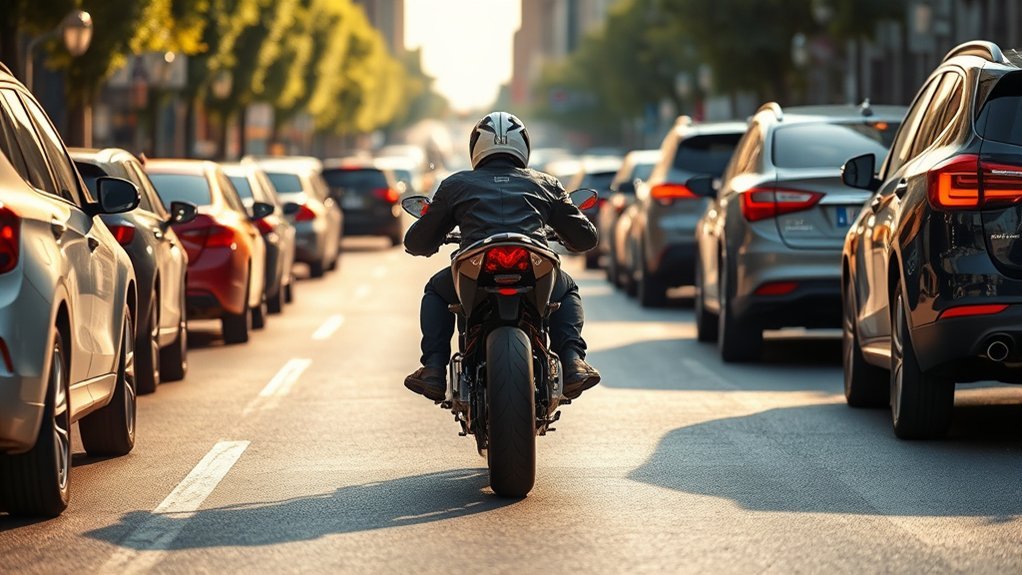
A frequently cited 2015 California collision study analyzed 5,969 motorcyclists who were involved in crashes, including 997 riders who had been lane splitting.
Within that crash sample, lane-splitting riders had lower observed percentages of head injury, torso injury, extremity injury, and fatal injury. The researchers also found that injury occurrence did not rise meaningfully at lower traffic speeds and moderate speed differences within the ranges they examined.
Among California riders who had already been involved in crashes, lane-splitting riders showed lower observed percentages of several serious injury outcomes. The study could not determine whether lane splitting changed the rider’s overall chance of crashing.
That limitation is important. The researchers did not know how many total miles or trips were ridden while splitting compared with not splitting. The study therefore does not support claims that lane splitting reduces rear-end crashes by 30%, 60%, or any other universal percentage.
Filtering may reduce the amount of time a rider remains stationary in a queue, but it introduces other hazards, including opening doors, sudden lane changes, mirrors, uneven lane markings, debris between lanes, and drivers who do not expect a motorcycle to pass.
Common Misconceptions About Lane Filtering Laws
“Lane Splitting Is Legal Everywhere”
It is not. Only six states currently have a verified statewide framework authorizing lane splitting, filtering, or limited passing between traffic. Even within those states, the conditions differ enough that a maneuver legal in Montana may violate Arizona or Utah law.
“Lane Filtering and Lane Splitting Are Identical”
The terms overlap, but filtering normally describes movement through stopped or nearly stopped traffic. Splitting is broader and can include passing between moving rows. State statutes may use different wording, so the legal definition matters more than informal rider terminology.
“Legal Means It Is Always Safe”
A state can authorize filtering while still requiring the rider to act prudently. A rider may be cited or held partly responsible after a crash when speed, space, visibility, road conditions, or another traffic violation made the maneuver unsafe.
“Every State Uses the Same Speed Limits”
The limits vary considerably:
- Arizona: motorcycle at 15 mph or less; surrounding traffic stopped.
- Colorado: motorcycle at 15 mph or less; surrounding traffic stopped.
- Montana: motorcycle at 20 mph or less; surrounding traffic at 10 mph or less.
- Utah: motorcycle at 15 mph or less; surrounding traffic stopped.
- Minnesota: motorcycle at 25 mph or less and no more than 15 mph faster than surrounding traffic.
- California: no separate numerical maximum in the statutory definition, though ordinary traffic laws and safe-riding duties still apply.
“The Shoulder Counts as Another Filtering Lane”
It generally does not. Colorado’s law expressly restricts passing on the right shoulder, and California’s definition concerns travel between rows of vehicles rather than shoulder riding. A former Hawaii shoulder-use provision is not a reliable current exception because the relevant statutory section has been repealed.
States With Pending Lane Filtering Legislation
Lane-filtering bills appear regularly, but introducing a bill does not change the law. A proposal must pass the legislature, receive any required executive approval, and reach its effective date before riders can rely on it.
Verified examples as of July 19, 2026, include:
- Michigan: Senate Bill 365 addresses motorcycle operation between lanes but should be treated as pending unless the official record shows enactment and an effective date.
- Ohio: House Bill 776 was introduced during the 136th General Assembly and should not be treated as current authorization unless enacted.
Note: News stories, advocacy pages, and bill summaries may continue circulating after a proposal has stalled or died. Confirm the bill’s latest action and then check whether the enacted language has reached its effective date.
Effective Riding Strategies in States Allowing Lane Filtering
- Read the official rule before riding. Confirm the motorcycle-speed limit, traffic-speed condition, required number of lanes, prohibited locations, and vehicle types covered.
- Check traffic before entering the gap. Look for turn signals, front-wheel movement, open spaces that invite sudden lane changes, and drivers looking at phones or mirrors.
- Keep the speed difference small. A low closing speed gives both the rider and driver more time to react.
- Avoid blind spots. Do not remain beside a vehicle longer than necessary, especially trucks, buses, trailers, and vehicles with limited rearward visibility.
- Cover the brakes and clutch. Be prepared to stop smoothly without locking a wheel or swerving into another vehicle.
- Do not use the shoulder as a shortcut. Filtering authorization normally concerns the space between traffic lanes, not the shoulder, bicycle lane, or opposing lane.
- Stop filtering when the gap becomes uncertain. Narrow lanes, construction barriers, poor pavement, rain, darkness, or erratic traffic can make a technically legal maneuver unreasonable.
- Remain predictable. Avoid revving aggressively, repeated lane-to-lane weaving, or entering a driver’s path without enough stopping distance.
Pro Tip: Before a multistate trip, save the official statute page for every state on your route. A screenshot or third-party map can become outdated, while the legislature or state transportation site shows the controlling language and effective dates.
Frequently Asked Questions
What penalties exist for violating lane filtering laws?
Penalties depend on the state and conduct involved. A rider may receive a citation for improper passing, unsafe lane use, shoulder driving, speeding, careless driving, or reckless driving. Fines, license points, and insurance effects vary, so check the cited offense and current state penalty schedule.
How do insurance policies address lane filtering incidents?
Legality does not automatically determine coverage or fault. An insurer will review the policy, state law, police report, vehicle positions, speed, witness evidence, and each road user’s actions. A lawful rider may still share fault, while an unlawful maneuver does not automatically cancel every policy benefit.
Are there age restrictions specifically for lane filtering?
The verified statewide filtering rules generally focus on the motorcycle, road, speed, and traffic conditions rather than creating a separate filtering age. However, ordinary license, endorsement, learner-permit, passenger, and under-18 restrictions still apply and may limit how or where a younger rider can operate.
Can lane filtering be practiced during all traffic conditions?
No. Arizona, Colorado, and Utah generally require surrounding traffic to be stopped. Montana allows it when traffic is stopped or moving at 10 mph or less. Minnesota uses motorcycle-speed and speed-difference limits and excludes several locations. California is broader, but unsafe conditions can still make the maneuver unlawful or unreasonable.
Do lane filtering laws apply to every motorcycle type?
Not always. Several statutes specifically refer to two-wheeled motorcycles, and some distinguish motorcycles from autocycles, trikes, or other three-wheeled vehicles. Confirm that the vehicle named in the statute matches the motorcycle you are operating.
Is lane filtering legal at a red light?
It can be legal in a state that permits filtering around stopped traffic, but every other condition must also be satisfied. Those conditions may include the road’s posted speed, number of same-direction lanes, motorcycle speed, available width, and whether the location is an intersection, on-ramp, school zone, work zone, or other excluded area.
Can a motorcyclist use the shoulder to pass stopped traffic?
Do not assume so. Shoulder riding is legally different from filtering between traffic lanes and is commonly prohibited except for emergencies or specifically authorized vehicles. California lane splitting does not turn the shoulder into a motorcycle lane, and Colorado expressly restricts passing on the right shoulder under its filtering law.
Conclusion
Motorcycle lane filtering laws are not uniform across the United States. California provides the broadest lane-splitting framework, while Arizona, Colorado, Minnesota, Montana, and Utah impose more specific limits involving traffic speed, motorcycle speed, road design, and location.
Legal authorization also does not prove that every maneuver is safe. Use a low speed difference, avoid blind spots and shoulders, stop when the opening narrows, and verify the current official statute before riding in an unfamiliar state. Pay particular attention to Colorado, where the current authorization is scheduled to repeal on September 1, 2027.
Sources
- California Highway Patrol Motorcycle Safety — California’s legal definition and current lane-splitting safety guidance.
- Arizona Revised Statutes §28-903 — Arizona’s traffic, road-speed, motorcycle-speed, lane, and vehicle conditions.
- Colorado Senate Bill 24-079 — Colorado’s filtering conditions, effective date, restrictions, and scheduled repeal.
- Minnesota Statutes §169.974 — Minnesota’s speed limits and prohibited filtering or passing locations.
- Montana Code Annotated §61-8-392 — Montana’s motorcycle and surrounding-traffic speed limits.
- Utah Code §41-6a-704 — Utah’s stopped-traffic, road, lane, motorcycle-speed, and ramp restrictions.






Leave a Reply