
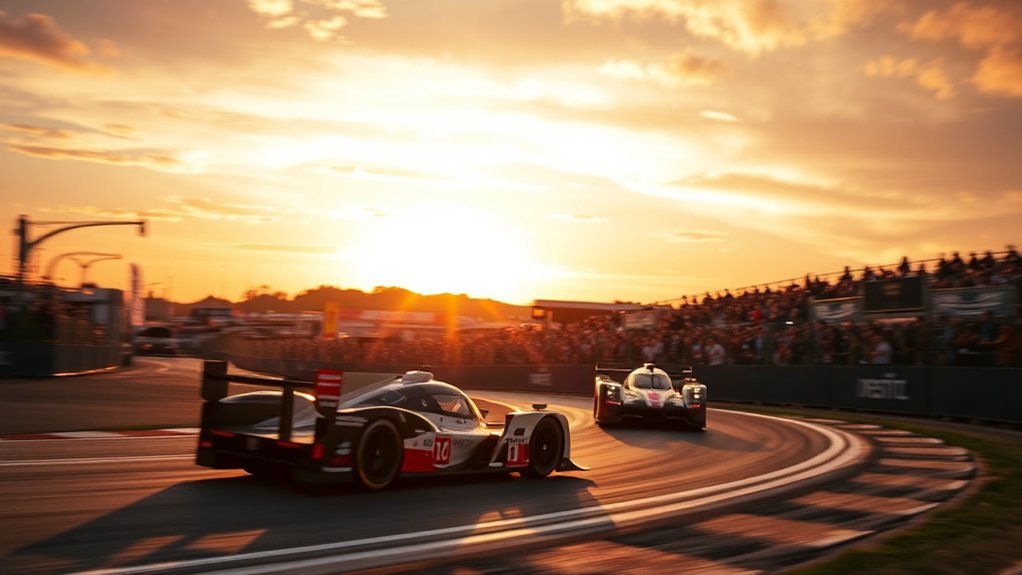
The 24 Hours of Le Mans is the world’s best-known endurance sports-car race. Drivers compete through daylight, darkness, changing weather, heavy traffic, pit stops, and mechanical strain on the 13.626-kilometre Circuit de la Sarthe. The event rewards outright speed, but reliability, teamwork, fuel use, tire care, and sound strategy often decide the result.
Quick Answer
The 24 Hours of Le Mans is a day-long endurance race held in France on a 13.626-kilometre circuit made from permanent track and public-road sections. Three-driver crews share each car, and the winner is the car that completes the greatest distance before the 24-hour limit expires.
Key Takeaways
- The race was first held in 1923 and remains one of motorsport’s most important endurance events.
- Hypercar, LMP2, and LMGT3 cars race together while competing for separate class wins.
- The 2026 race featured 62 cars and was won by the #7 Toyota TR010 Hybrid.
- Pit strategy, traffic, driver changes, tire life, repairs, and safety periods can be as important as raw lap speed.
- Visitors should plan for long walks, loud noise, changing weather, security checks, and separate bookings for parking or camping.
What Is the 24 Hours of Le Mans?
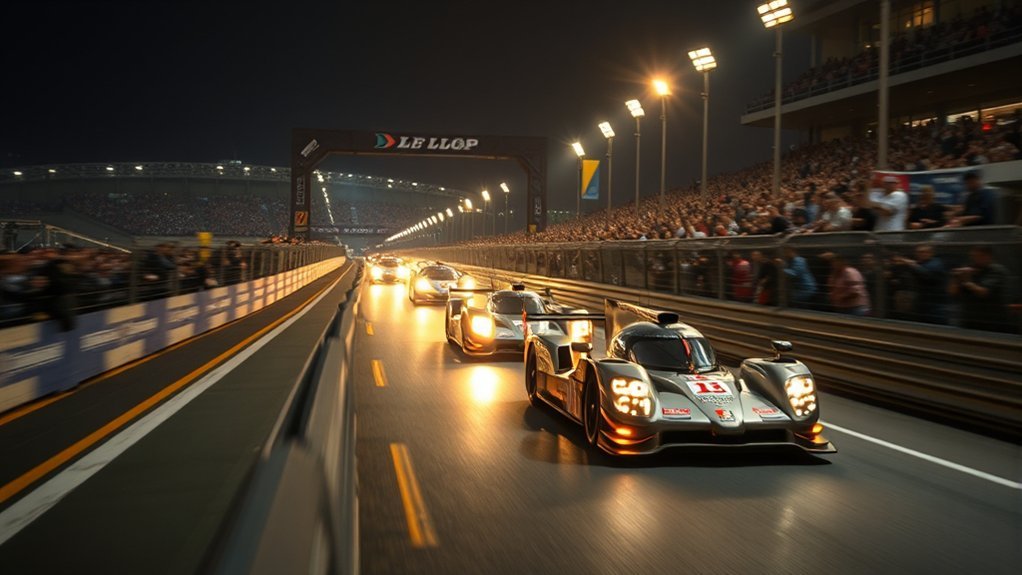
The 24 Hours of Le Mans was first held in 1923. It takes place near Le Mans, France, on the Circuit des 24 Heures du Mans, often called the Circuit de la Sarthe.
The current circuit measures 13.626 kilometres, or 8.467 miles. It combines permanent racing facilities with roads that normally carry public traffic.
Le Mans is not won by one fast lap. It is won by completing the greatest distance while keeping the car, crew, and strategy working for an entire day and night.
Each car is normally shared by three drivers. They rotate through scheduled stints while the rest of the crew handles fuel, tires, repairs, setup changes, and race strategy.
The overall winner is the car that covers the greatest distance before the 24-hour period ends. Cars also compete for separate victories within their classes, so several meaningful battles can continue at the same time.
In 2026, the race started with 62 cars and 186 drivers. Toyota Gazoo Racing won overall with the #7 Toyota TR010 Hybrid driven by Mike Conway, Kamui Kobayashi, and Nyck de Vries. The car completed 381 laps.
How the 24-Hour Race Works
A Le Mans entry must balance lap speed with the ability to survive thousands of kilometres. A car that is slightly slower but reliable can beat a faster rival that loses time to damage, penalties, repairs, or poor strategy.
| Race Element | Why It Matters |
|---|---|
| Driver rotation | Three drivers share the car. Teams must manage fatigue, mandatory drive-time rules, traffic experience, and each driver’s strongest conditions. |
| Pit stops | Stops may include fuel, tires, driver changes, cleaning, adjustments, damage checks, and repairs. |
| Multiclass traffic | Faster prototypes constantly catch slower GT cars. Safe passing without losing time is a major driver skill. |
| Tire strategy | Teams decide whether to change tires or extend their use over more than one fuel stint. Weather and track temperature can change that decision. |
| Neutralization | Safety cars, Full Course Yellows, and Slow Zones protect workers and drivers but can alter gaps and pit timing. |
| Repairs | A damaged car may return to the garage, be repaired, and rejoin. Fast, careful repair work can rescue a class result. |
Teams also prepare for temperature changes between afternoon, night, dawn, and the final hours. Grip, visibility, tire pressure, brake temperature, and driver alertness can all change during the race.
Key Facts and 2026 Le Mans Statistics
The 2026 edition provides a useful picture of the event’s scale. These figures apply to that race rather than every edition.
| Fact | Verified Detail |
|---|---|
| First race | 1923 |
| Current circuit length | 13.626 km (8.467 miles) |
| 2026 edition | 94th running |
| 2026 grid | 62 cars and 186 drivers |
| 2026 class split | 18 Hypercars, 19 LMP2 cars, and 25 LMGT3 cars |
| 2026 overall winner | #7 Toyota TR010 Hybrid, 381 laps |
| 2026 LMP2 winner | #43 Inter Europol Competition Oreca 07-Gibson, 361 laps |
| 2026 LMGT3 winner | #33 TF Sport Corvette Z06 LMGT3.R, 336 laps |
| Fastest 2026 race lap | 3:25.041 by Ryō Hirakawa in the #8 Toyota |
| 2026 pit stops | 1,849 across the field |
| Most driver victories | Tom Kristensen, nine |
| Most manufacturer victories | Porsche, 19 |
The 62 starters made 1,849 pit stops and completed 29,446 recorded overtakes during the 2026 race, showing how much activity takes place beyond the fight for the overall lead.
Dividing the pit-stop total by the number of starters gives nearly 30 stops per car, but that is not a fixed target. A car with damage may stop many extra times, while a retired car may complete far fewer.
History of the Circuit de la Sarthe
The Circuit de la Sarthe has changed many times since 1923. Safety improvements, road construction, faster cars, and new racing standards have shaped the layout while preserving its unusual mix of public roads and permanent track.
Circuit Evolution Over Time
The first race used a 17.262-kilometre route that reached farther into the outskirts of Le Mans. The modern circuit is shorter at 13.626 kilometres, but it remains one of the longest major racing circuits in regular competition.
One of the most important changes came in 1990, when two chicanes were installed on the Mulsanne Straight. The change divided the formerly uninterrupted high-speed section and reduced the extreme speeds reached there.
- The original 1923 course measured 17.262 km.
- The modern course measures 13.626 km.
- The circuit uses both permanent track and roads normally open to public traffic.
- The two Mulsanne chicanes were added in 1990.
- Runoff areas, barriers, resurfacing, and revised corners have continued to improve safety.
Historic Races and Milestones
| Year | Milestone | Key Result |
|---|---|---|
| 1923 | First 24 Hours of Le Mans | André Lagache and René Léonard won in a Chenard & Walcker. |
| 1953 | Disc-brake breakthrough | Tony Rolt and Duncan Hamilton won in a disc-brake-equipped Jaguar C-Type. |
| 1970 | Porsche’s first overall victory | Hans Herrmann and Richard Attwood won in a Porsche 917 K. |
| 2000 | Start of Audi’s dominant era | Frank Biela, Tom Kristensen, and Emanuele Pirro won in an Audi R8. |
| 2005 | Kristensen’s seventh victory | The result made Tom Kristensen the race’s sole record holder at the time. |
| 2012 | First hybrid-powered overall win | Audi won with the R18 e-tron quattro in the first season of the FIA WEC. |
| 2023 | Centenary race | Ferrari AF Corse’s #51 499P won, giving Ferrari its first overall victory since 1965. |
| 2026 | Toyota’s sixth overall win | The #7 Toyota TR010 Hybrid won a close race after completing 381 laps. |
Exploring the Iconic Track Layout
The Circuit de la Sarthe asks a car to perform well in very different conditions. Long, fast sections reward low drag and power, while braking zones and high-speed curves demand stability, grip, and driver confidence.
Key Track Features
- Dunlop Curve and Dunlop Chicane: The opening complex sends the field over the crest and toward the Forest Esses.
- Tertre Rouge: A crucial exit because it launches cars onto the first part of the Mulsanne Straight.
- Mulsanne Straight: The famous high-speed road is now split into three sections by two chicanes.
- Mulsanne Corner: A heavy-braking right-hander at the end of the straight.
- Indianapolis and Arnage: Two slower sections where braking, traction, and traffic management are vital.
- Porsche Curves: A fast sequence that places sustained loads on the car and rewards aerodynamic balance.
- Ford Chicanes: The final technical section before the pit straight and timing line.
Why the Major Corners Matter
Tertre Rouge can affect speed for much of the following straight, so a poor exit costs more than time in one corner.
The Mulsanne chicanes require cars to brake from high speed, change direction, and accelerate efficiently without damaging tires or striking the curbs too hard.
Mulsanne Corner and Arnage are among the circuit’s slowest points. Drivers must judge braking while watching for cars from other classes.
The Porsche Curves test downforce, commitment, and stability. Small mistakes can quickly become serious because of the speed carried through the sequence.
The Ford Chicanes reward a clean final sector. A strong exit helps a driver accelerate across the line and can also set up an overtaking attempt toward the Dunlop section.
Records, Innovations, and Famous Le Mans Achievements
Le Mans is part of the traditional Triple Crown of Motorsport alongside the Indianapolis 500 and Monaco Grand Prix. Graham Hill remains the only driver to have completed the driver version of that achievement.
- Porsche holds the manufacturer record with 19 overall victories.
- Tom Kristensen holds the driver record with nine wins.
- Jaguar’s 1953 success helped prove disc brakes in top-level endurance racing.
- Porsche earned the first Le Mans victory for a turbocharged engine in 1976.
- Audi achieved the first hybrid-powered overall victory in 2012.
- Ferrari returned to the overall winner’s circle in 2023, 58 years after its previous victory.
- Toyota earned its sixth overall victory in 2026.
Not every Le Mans innovation moved directly into road cars, but the race has repeatedly forced manufacturers to improve braking, lighting, aerodynamics, fuel efficiency, hybrid systems, tires, and reliability under extreme conditions.
What Are the Le Mans Race Categories?
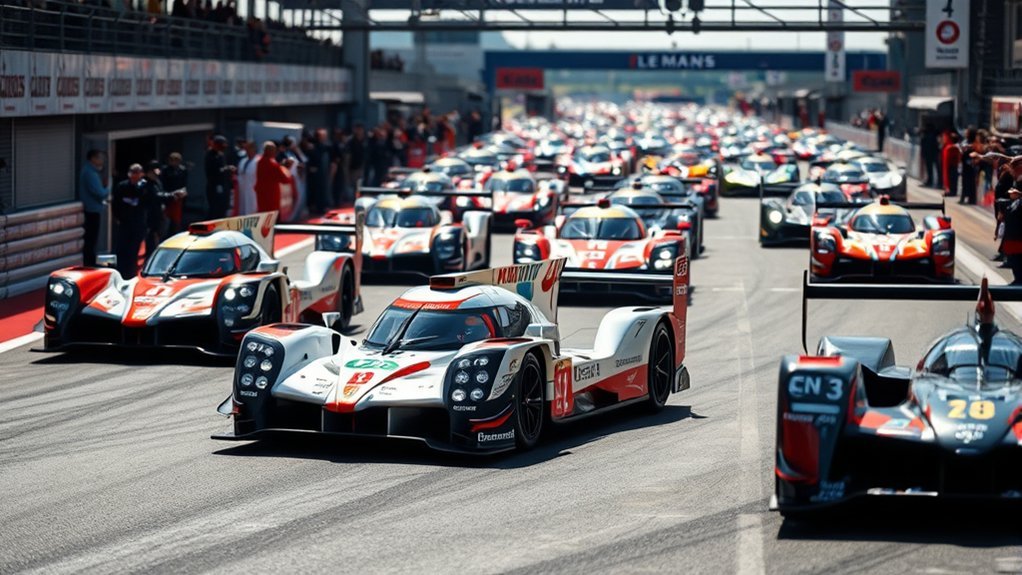
The 2026 race used three classes: Hypercar, LMP2, and LMGT3. Each class has its own technical rules, driver requirements, pace, and trophy.
| Class | 2026 Entries | What It Includes | Main Goal |
|---|---|---|---|
| Hypercar | 18 | LMH and LMDh prototypes, including hybrid and non-hybrid designs | Overall victory |
| LMP2 | 19 | Private-team racing prototypes; the 2026 field used Oreca 07-Gibson cars | LMP2 and LMP2 Pro/Am class honors |
| LMGT3 | 25 | GT3-based cars adapted for WEC and Le Mans competition | LMGT3 class victory |
Hypercar
Hypercar is the fastest class and normally supplies the overall winner. It combines two technical routes: Le Mans Hypercar and Le Mans Daytona h.
LMH rules allow manufacturers more freedom to design the complete car and may include a front-axle hybrid system. LMDh cars use a chassis base supplied by an approved constructor and a common hybrid system, while each manufacturer supplies its engine and body design.
LMP2
LMP2 cars are closed-cockpit prototypes intended for private teams. The category uses a controlled technical package to limit costs and keep competition close.
The 2026 Le Mans field consisted of Oreca 07 chassis powered by Gibson engines. Driver lineups must also satisfy FIA driver-rating requirements, and eligible crews can compete in the separate Pro/Am classification.
LMGT3
LMGT3 cars begin with production-based GT3 models from recognized manufacturers. They receive Le Mans and FIA WEC equipment such as leader lights, number panels, data systems, and class-specific technical adjustments.
These cars look more familiar to road-car fans, but they are fully prepared racing machines with competition suspension, brakes, safety structures, aerodynamics, and tires.
How Balance of Performance Works at Le Mans
Balance of Performance, commonly called BoP, is used in Hypercar and LMGT3. It is intended to let cars with different engineering designs compete within the same class.
The FIA WEC sporting regulations state that the FIA, ACO, and WEC Committee establish and adjust the system using technical data supplied by competitors and manufacturers.
Note: LMP2 is not balanced through the same Hypercar and LMGT3 BoP process. Its competition is controlled mainly through a common technical formula, standardized components, and sporting rules.
What BoP Can Adjust
Depending on the class and regulations, BoP decisions can affect factors such as minimum mass, maximum power, energy use, and other technical parameters. The exact table is issued for each competition.
BoP does not make every car identical. Designs may still differ in tire use, braking behavior, acceleration, aerodynamics, reliability, and the way they perform in traffic or changing weather.
How BoP Affects Strategy
A technical adjustment can influence stint length, tire stress, passing ability, and lap consistency. Teams study these effects when planning fuel windows, tire use, driver order, and responses to weather or safety periods.
At Le Mans, there is also no simple guarantee that the car with the strongest single-lap pace will win. Reliability, penalties, traffic, and execution remain decisive.
Who Controls the BoP Process?
Manufacturers and teams must provide accurate technical information, but they do not jointly choose the final adjustments. The FIA, ACO, and WEC Committee administer the system under the sporting regulations.
This distinction matters because BoP is a regulatory process, not an informal agreement among rival manufacturers.
Tips for Experiencing the 24 Hours of Le Mans
A good visit requires more planning than an ordinary two-hour race. The site is large, the event lasts through the night, and ticket access can differ between general admission, grandstands, parking areas, campsites, hospitality spaces, and special experiences.
Buy Tickets and Reservations Early
Use the official ticketing information rather than an unverified reseller. Admission, grandstand seating, parking, and camping may be separate products.
Popular grandstands, campsites, and parking areas can sell out. Always check the edition-specific terms before booking travel or accommodation.
Plan How You Will Move Around
The circuit covers a large area, so expect long walks. Study the official map, identify shuttle stops, and select a few priority viewing areas instead of trying to see every corner in one trip.
The official event app can provide a current program, map, live timing, and site information. Download it and save any tickets or maps before arriving in case the mobile network becomes busy.
Pro Tip: Watch one period in daylight, one after dark, and another near sunrise. The pace, light, temperature, brake glow, pit activity, and crowd atmosphere feel different during each part of the race.
Pack for a Full Day and Night
- Proper earplugs or earmuff-style hearing protection
- Comfortable, broken-in walking shoes
- Waterproof jacket and warm layer
- Hat, sunscreen, and sunglasses
- Portable phone charger
- Binoculars
- Compact seat or cushion where permitted
- Refillable water bottle if allowed under current security rules
- A small flashlight or headlamp for campsite and walking areas
Warning: Race cars can produce sound levels capable of damaging hearing. Use proper hearing protection, especially for children, and take quiet breaks. Remain behind spectator barriers, follow marshal instructions, and check the current prohibited-items and security rules before entering.
Choose Viewing Areas for Different Experiences
- Pit straight: Starts, finishes, pit strategy, and podium activity
- Dunlop area: Elevation changes and a recognizable Le Mans backdrop
- Tertre Rouge: Acceleration onto the Mulsanne section
- Mulsanne and Arnage: Heavy braking and night racing
- Porsche Curves: High-speed direction changes
- Fan Zones: Screens, food, rest areas, activities, and easier access to event information
Access can change by ticket type and edition. Confirm the current map before relying on an older spectator guide.
Visiting With Children
Le Mans provides family and children’s areas during the event, but parents should still plan for crowds, noise, changing weather, and long distances. Write a contact number on a child’s wristband, choose a clear meeting point, and give every child hearing protection.
Best Photography Spots at the Event
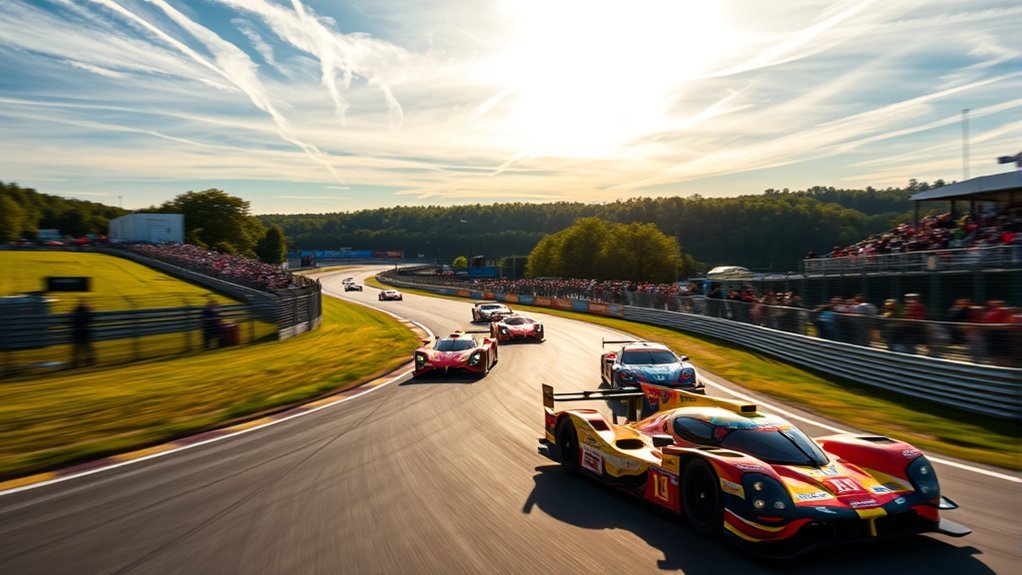
Good Le Mans photographs show more than a car by itself. The circuit’s bridges, crowds, grandstands, changing light, brake glow, pit lane, and wooded road sections help tell the story of the event.
- Main grandstands: Useful for the start, finish, pit stops, and cars passing in groups
- Dunlop Bridge area: A classic background with elevation and direction changes
- Tertre Rouge: Cars accelerating toward the Mulsanne section
- Arnage: Heavy braking, glowing brakes, and slower cornering speeds
- Porsche Curves: Fast panning shots and visible aerodynamic movement
- Evening and dawn: Softer light, headlights, brake glow, and more dramatic backgrounds
Useful Camera Settings
For a sharp image that freezes the car, begin around 1/1000 second or faster in good light. Raise the ISO as needed rather than accepting motion blur.
For a panning shot with a blurred background, try a shutter speed between roughly 1/60 and 1/250 second. Follow the car smoothly before, during, and after pressing the shutter.
A longer lens helps isolate cars behind safety fencing. A wider lens works better for pit-straight scenes, grandstands, sunrise, and the overall atmosphere.
Note: Do not block walkways with tripods or equipment. Stay behind all barriers, never lean through safety fencing, and do not use a drone unless you have specific authorization under the current event rules.
What Happened at Le Mans Classic Legend 2026?
Le Mans Classic Legend 2026 took place from July 2–5, 2026. It marked the event’s move to an annual format and focused on later periods of endurance-racing history.
The official event reported 159,853 spectators. Competition was organized around five main historic grids:
| Grid | Period Represented |
|---|---|
| Grid 6 | 1972–1984 |
| Grid 7 | 1982–1993 |
| Grid 8 | 1994–1999 |
| Grid 9 | 2000–2010 |
| Grid 10 | 2006–2015 |
The overlapping dates reflect different technical eras and vehicle types rather than one simple chronological sequence. Cars included prototypes and GT machinery from Group C through the LMP1, LMP2, and GTE periods.
The event returns from July 1–4, 2027 as Le Mans Classic Heritage, with a greater focus on the earlier history of the race. Check the official Le Mans Classic website for current grids, tickets, access, and program details.
Frequently Asked Questions
How can I purchase tickets for the 24 Hours of Le Mans?
Buy through the official 24 Hours of Le Mans ticketing site or an authorized agency identified by the organizer. Admission, grandstand seats, parking, campsites, and hospitality may require separate bookings. Check the edition and ticket dates carefully before paying.
What parking options are available at the event?
The organizer offers several official parking areas, but names, prices, access routes, and availability can change each year. Reserve the correct parking product in advance and follow the edition-specific route instructions rather than relying on an old map.
Are there family-friendly activities at the race?
Yes. Recent editions have included a Family Fan Zone, Kids Zone, games, road-safety activities, screens, and rest areas. The exact program changes each year, so check the current event schedule. Children should wear properly fitted hearing protection.
What should I bring for a comfortable viewing experience?
Bring hearing protection, comfortable shoes, waterproof clothing, a warm layer, sunscreen, a hat, a phone charger, and water where permitted. Binoculars and a compact seat can also help. Review the current prohibited-items list before packing.
Is camping permitted at the Circuit de la Sarthe?
Yes, the organizer sells access to designated reception and camping areas. A race-admission ticket does not automatically include a campsite. Your vehicle and equipment must fit within the booked pitch, and each area has its own access conditions.
When is the next 24 Hours of Le Mans?
The 95th 24 Hours of Le Mans is scheduled for June 9–13, 2027. The main 24-hour race normally takes place over Saturday and Sunday within the wider event week. Confirm the final timetable before making travel plans.
How long is the Circuit de la Sarthe?
The current Circuit des 24 Heures du Mans measures 13.626 kilometres, or 8.467 miles. Its exact configuration has changed many times since the original 17.262-kilometre layout used in 1923.
Can one driver complete the entire 24-hour race alone?
No. Modern Le Mans entries rotate three drivers through each car and must follow sporting rules covering maximum and minimum driving time. Driver changes are an essential part of race strategy and fatigue management.
Do spectators need hearing protection?
Yes. Proper earplugs or earmuff-style protectors are strongly recommended because prolonged motorsport noise can harm hearing. Children need correctly fitted protection and regular breaks in quieter areas.
Conclusion
The 24 Hours of Le Mans combines high-speed racing with a full day of strategy, traffic, changing conditions, fatigue, and mechanical risk. Its history reaches back to 1923, but the event continues to evolve through new cars, regulations, technology, and safety systems. Understanding the classes, circuit, pit strategy, and practical demands of attending makes the race easier to follow and far more rewarding to experience.
Sources
- Automobile Club de l’Ouest: Toyota Takes Its Sixth Victory at Le Mans — 2026 overall result, class winners, laps, and fastest race lap
- Automobile Club de l’Ouest: 2026 Post-Race Statistics — pit stops, overtakes, safety periods, and race-scale statistics
- Official 24 Hours of Le Mans Class Guide — Hypercar, LMP2, and LMGT3 descriptions and rules
- Automobile Club de l’Ouest: Circuit History — original and current circuit lengths and major layout changes
- 2026 FIA World Endurance Championship Sporting Regulations — Balance of Performance administration and category scope
- Official Le Mans Classic Website — 2026 attendance, historic grid periods, and 2027 event information







Leave a Reply