
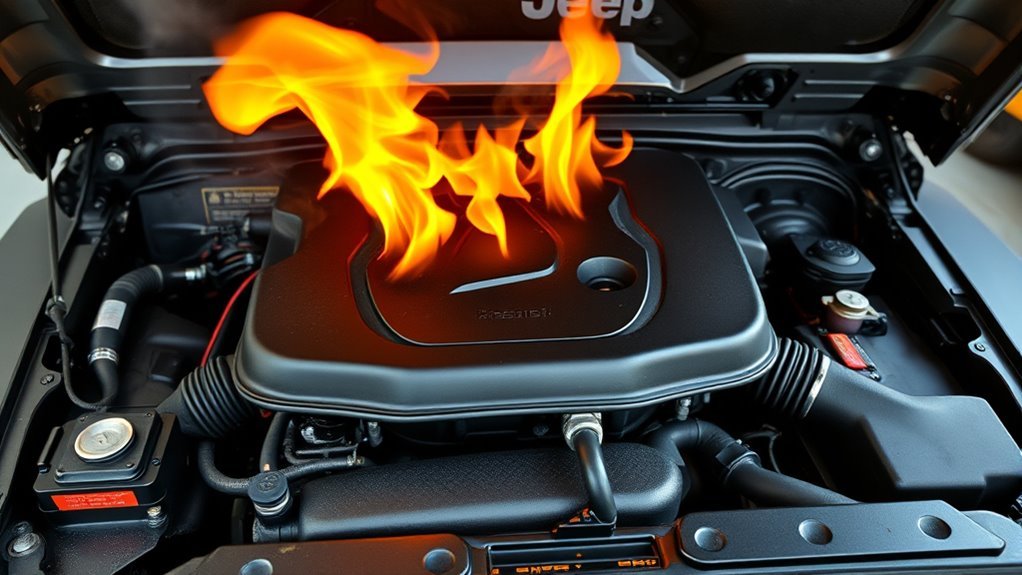
A burning smell, visible scorching, or melting around the engine cover of a 2016 Jeep Wrangler is not normal, even when the coolant-temperature gauge stays in its usual range. A normal gauge can coexist with a localized oil leak, damaged wiring, belt friction, foreign material on a hot component, or an engine malfunction that overheats the exhaust system.
Quick Answer
If your 2016 Jeep Wrangler’s engine cover looks or smells burned but the temperature gauge is normal, shut the engine off and look for localized causes such as leaking or spilled oil, damaged wiring, a rubbing belt, debris, missing heat shields, or a severe misfire. Do not keep driving if smoke, active melting, or warning lights are present.
Key Takeaways
- A normal coolant-temperature gauge does not rule out a localized fluid, electrical, belt, or exhaust-system heat problem.
- Visible smoke, flames, raw-fuel odor, or active melting requires an immediate stop, evacuation, and possible 911 call.
- On the 3.6L Pentastar, have the engine valley and oil filter adapter/cooler area checked for pooled oil instead of assuming the plastic cover itself is defective.
- Do not pour water over the engine, open a hot coolant cap, bypass a fuse, or use permanent engine-cover removal as a repair.
- Repair the heat source first, then replace the cover, retainers, wiring protection, or heat shields that were damaged.
At a Glance
| Time Required | 15–30 minutes for a cold-engine visual inspection; professional diagnosis may take longer |
| Difficulty | Basic for visual checks; advanced for leak, electrical, belt, or misfire diagnosis |
| Tools Needed | Flashlight, protective gloves, phone camera, clean white towel, and an OBD-II scan tool if available |
| Cost | No cost for a visual check; towing, diagnosis, and repairs vary with the actual cause |
Warning: If you see flames, heavy smoke, or active melting, pull over safely, turn off the engine, get everyone out, stay at least 100 feet from the Jeep and traffic, and call 911. Do not open the hood when an engine-compartment fire is suspected because the added air can make the fire grow.
Why Is My Jeep Wrangler’s Engine Cover Burning?
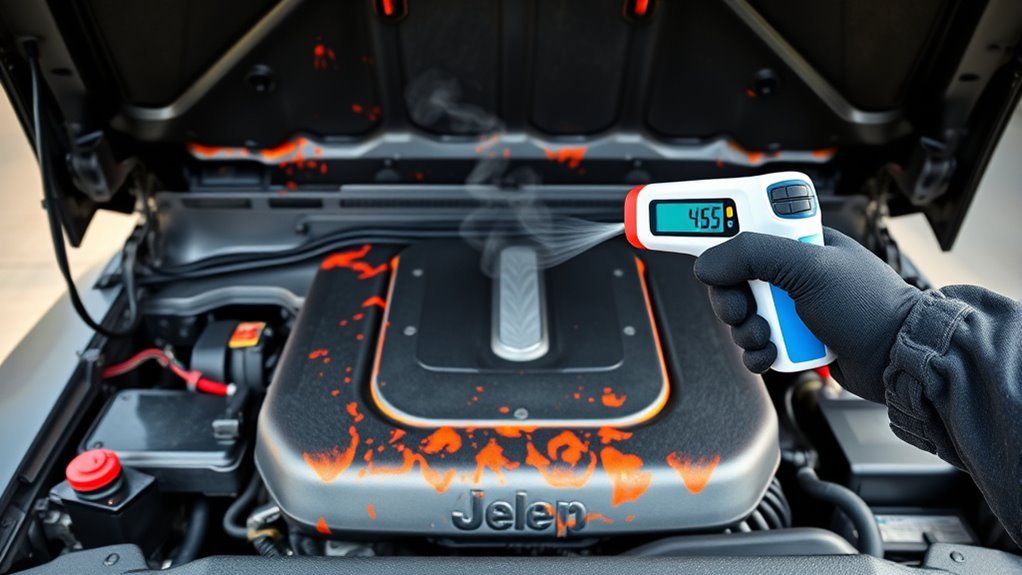
First, confirm what you mean by “engine cover.” It may refer to the removable plastic cover on top of the 3.6L engine, the insulation attached under the hood, a wiring-loom cover, or the painted hood itself. Each location points to different possible causes.
This guide assumes a North American 2016 Jeep Wrangler JK with the 3.6L gasoline engine shown in the 2016 Jeep Wrangler Owner’s Manual. Verify the VIN, engine, and market-specific manual before ordering replacement parts.
The plastic engine cover should not melt or scorch during normal operation. When damage appears, the important question is not simply whether the entire engine is overheating. The goal is to find the localized source of heat, smoke, or fluid residue.
Common Causes and Their Clues
| Possible Cause | Possible Clues | Recommended Action |
|---|---|---|
| Oil leak or spilled oil | Oily odor, dark wet residue, smoke after stopping, or oil collecting near the filter area or rear of the engine | Check the oil level and have the filter cap, valve-cover areas, engine valley, and oil filter adapter/cooler inspected |
| Coolant leak | Sweet odor, white vapor, wet hose connections, colored residue, or a falling reservoir level | Let the engine cool fully; never remove the pressure cap while hot; pressure-test the system if a leak is suspected |
| Electrical overheating | Sharp plastic odor, browned connector, melted loom, blown fuse, flickering equipment, or intermittent electrical failure | Do not touch damaged wiring or install a larger fuse; have the circuit inspected before driving |
| Belt, pulley, or hose contact | Burned-rubber odor, rubber dust, squealing, frayed belt edges, or fresh rubbing marks | Keep the engine off and have the belt routing, tensioner, idlers, pulleys, and nearby hoses checked |
| Misfire or overheated catalytic converter | Flashing check-engine light, rough running, loss of power, sulfur-like odor, or scorching heat under the Jeep | Stop driving and arrange a tow; continued operation can overheat and damage the converter |
| Debris, nesting material, or displaced heat protection | Leaves, grass, a shop rag, rodent material, loose insulation, or a missing shield near a hot component | Remove loose material only after the engine is fully cold and restore any factory shield or fastener |
A recently completed oil change is another important clue. Oil spilled around the filter cap or fill opening can produce an odor when the engine warms. However, a repeated smell, visible smoke, or a dropping oil level should not be dismissed as harmless residue.
How to Identify Non-Overheating Symptoms in Your Wrangler
The temperature gauge reports engine-coolant temperature. A reading in the normal range indicates that the measured coolant temperature is normal, but it does not monitor wiring connectors, belt friction, oil on a hot surface, the catalytic converter, or every point beneath the hood.
If the pointer reaches the upper limit or “H,” treat the condition as engine overheating. Pull over, turn off the air conditioner, and follow the owner’s-manual instructions. If the pointer remains at “H,” shut the engine off. Never loosen the coolant pressure cap while the system is hot or pressurized.
Note: A brief white vapor cloud after rain, snow, or a car wash can be moisture evaporating from the radiator. Jeep describes this as possible after driving when no radiator or hose leak is found. Persistent vapor, falling coolant, a sweet smell, or wet residue requires further inspection.
Use Odor and Appearance Only as Clues
- Hot-oil odor: Look for oil around the filter cap, fill opening, valve-cover areas, engine valley, and rear of the engine.
- Sweet odor or white vapor: Look for coolant residue, a damp hose connection, or a declining reservoir level after the engine has cooled.
- Sharp plastic or electrical odor: Look for discolored connectors, melted loom, or electrical equipment that stopped working.
- Burned-rubber odor: Check for belt dust, frayed edges, pulley noise, or a hose touching a moving component.
- Raw-fuel odor: Do not restart the engine. Move away from the Jeep and arrange professional help because fuel vapor can ignite.
- Scorching odor with rough running: A misfire or other engine malfunction may be overheating the catalytic converter even though the coolant gauge appears normal.
Do not lean over the engine or deliberately inhale fumes to identify them. If the odor is strong enough to irritate your eyes or throat, step away and have the vehicle towed.
Inspecting Your Burning Engine Cover: Key Steps for Diagnosis
Perform only a visual inspection unless you have the training and service information needed for electrical, fuel, cooling-system, or belt repairs. Keep hands, clothing, hair, tools, and jewelry away from belts, pulleys, and the cooling fan.
- Make the Jeep safe. Park on a level, noncombustible surface in an open area. Set the parking brake, turn the engine off, remove the key, and wait until the engine is fully cool. Do not open the hood if active fire or heavy underhood smoke is suspected.
- Identify the damaged part. Determine whether the marks are on the removable top cover, its underside, the hood insulation, wiring loom, hoses, or the hood itself. Photograph the damage before moving or cleaning anything.
- Look for a contact pattern. Shiny rub marks, one concentrated melted spot, a missing grommet, or a loose cover may show that the cover shifted against another component. Replace missing retainers rather than forcing the cover into place.
- Inspect for oil. Check around the oil fill opening and filter cap. Look down into visible areas of the engine valley and along the valve-cover edges. Check the dipstick before restarting. A low level, pooled oil, or oil running toward hot components requires diagnosis before driving.
- Inspect for coolant after the engine is cold. Check the reservoir level, hose connections, pressure-cap area, radiator face, and visible seams for wetness or dried residue. Do not remove the pressure cap while hot.
- Inspect wiring visually. Look for pinched loom, exposed copper, darkened terminals, melted connector bodies, or wiring resting against a hot or moving part. Do not probe a damaged circuit or replace a fuse with a higher rating.
- Check the belt area with the engine off. Look for cracking, missing ribs, frayed edges, rubber dust, or a belt that is no longer centered on a pulley. Do not run the engine with the cover removed while leaning over the belt drive.
- Check for debris and missing heat shields. Remove leaves, nesting material, or a forgotten shop towel only when every nearby component is cold. A loose or missing factory shield should be replaced correctly.
- Check warning lights and codes. Record any check-engine, oil-pressure, charging-system, or throttle-control warning. An OBD-II scan can preserve useful codes, but codes must be interpreted with physical inspection.
- Check the VIN for open recalls. Use the NHTSA VIN recall lookup. A general model-year listing does not confirm whether a specific Wrangler is included.
Pro Tip: Photograph wet areas and scorch patterns before cleaning them. FCA diagnostic guidance for Pentastar oil leaks warns that cleaning or degreasing too early can interfere with locating the source. A technician may use leak-detection dye to confirm the repair.
Have the Engine Valley Checked for Pooled Oil
On 3.6L Pentastar applications, the oil filter adapter/cooler is located in the upper engine area beneath the intake. FCA diagnostic guidance instructs technicians to inspect for oil puddling in the engine valley and to verify whether the adapter seals, filter cap, valve-cover area, or another source is responsible. See the official FCA STAR oil-leak diagnostic document.
Oil near this area does not automatically mean the complete adapter assembly must be replaced. Spillage during service, a damaged filter-cap seal, valve-cover leakage, adapter seals, or another leak path can produce similar evidence. Proper source verification prevents unnecessary parts replacement.
How to Fix and Prevent a Burning Engine Cover
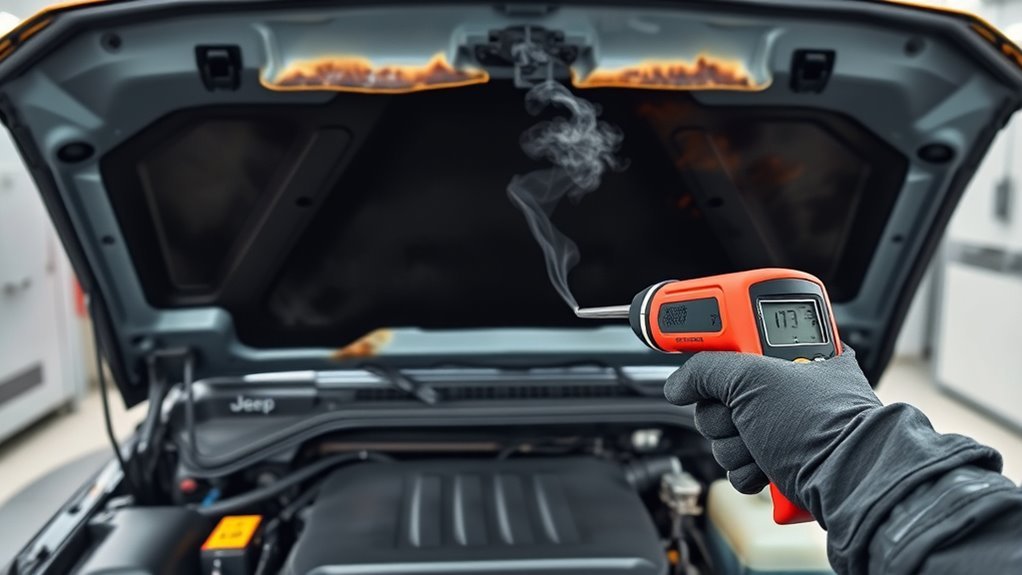
The correct repair depends on what produced the heat or smoke. Replacing the plastic cover alone is not enough if the leak, wiring fault, friction, or engine malfunction remains.
- Oil leak or service spill: Find and repair the exact source. Replace the correct seal, gasket, cap, adapter component, or damaged part as required. Remove pooled oil and residue only after the leak location has been documented and repaired.
- Coolant leak: Repair the hose, cap, radiator, reservoir connection, water-pump area, or other failed part. Use coolant meeting the Jeep specification in the owner’s manual, and do not mix incompatible coolant types.
- Electrical damage: Replace heat-damaged wiring, terminals, connectors, loom, and affected components. The technician must also find the short circuit, poor connection, overload, or routing problem that caused the heat.
- Belt or pulley problem: Replace the damaged belt and correct the seized, loose, misaligned, or worn pulley, tensioner, or accessory before starting the engine again.
- Misfire or engine-control fault: Diagnose the stored codes and mechanical cause. Do not keep driving with a flashing check-engine light, severe roughness, or power loss.
- Debris or missing shielding: Remove combustible material after the engine cools and reinstall the correct factory heat shield, clip, bracket, or fastener.
- Damaged cover: Install an exact-fit OEM or equivalent cover with the correct grommets and retainers after the root cause is fixed. Confirm that it does not touch wiring, hoses, or moving parts.
Should You Remove the Engine Cover for Better Airflow?
Do not use permanent cover removal as a substitute for diagnosis. The cover may be removed from a fully cooled, shut-down engine when required for inspection or service, but persistent heat means the underlying condition still needs repair. Do not add homemade foil, adhesive insulation, or other material that could loosen, trap residue, or contact a moving or hot component.
Preventing the Problem From Returning
- Check for spilled oil and confirm the oil filter cap is dry after each oil change.
- Inspect the cover grommets and mounting points whenever the cover is removed.
- Keep wiring secured in its original clips and away from sharp, hot, or moving parts.
- Remove leaf buildup and rodent nesting material before starting the engine.
- Investigate new odors, warning lights, rough running, or fluid loss promptly.
- Use the correct fluids, filters, seals, fuses, and replacement parts for the VIN and engine.
- After a repair, perform a controlled warm-up while watching for renewed leakage, smoke, unusual odor, warning lights, or abnormal temperature.
When to Seek Professional Help for Your Jeep Wrangler
A burning odor without visible smoke still deserves prompt attention. The following conditions call for professional diagnosis, towing, or emergency assistance.
| Sign | Action Required |
|---|---|
| Flames, heavy smoke, active melting, or strong raw-fuel odor | Stop immediately, evacuate, stay away, and call 911. |
| Oil or coolant dripping toward hot exhaust parts | Do not drive; arrange a tow. |
| Melted wiring, exposed copper, blown fuses, or electrical failure | Do not restart until the circuit is inspected. |
| Flashing check-engine light, severe rough running, or loss of power | Stop driving and tow the Jeep to prevent converter or engine damage. |
| Temperature gauge at “H,” steam, or coolant discharge | Shut the engine off and do not open the hot cooling system. |
| Repeated odor with no obvious source | Schedule diagnosis before returning to normal driving. |
A short drive to a repair facility should be considered only when the Jeep has fully cooled, there is no smoke, no active melting, no fluid dripping onto hot parts, no fuel or electrical odor, no warning light, no abnormal noise, and all fluid levels are correct. When the source is uncertain, towing is the safer choice.
Frequently Asked Questions
Does pouring water on an engine help cool it down?
No. Do not pour water over a hot engine. It can create steam, reach electrical equipment, and subject hot parts to rapid temperature change. Shut the engine off and let it cool naturally. Never remove the coolant pressure cap while the system is hot or pressurized.
Why does my Jeep smell like it is burning when it is not overheating?
The coolant gauge may remain normal while oil leaks onto a hot surface, wiring overheats, a belt rubs, debris smolders, or an engine misfire overheats the catalytic converter. The odor source should be found before the Jeep returns to normal use.
Can I drive my Jeep without the plastic engine cover?
The cover may be removed from a cold, shut-down engine for inspection or service, but removing it permanently is not a repair for abnormal heat. Correct the leak, wiring fault, contact point, belt issue, or other cause, then reinstall the proper cover and retainers.
Can the oil filter housing cause a burning smell on a 3.6L Wrangler?
It is one possible inspection area. FCA diagnostic guidance discusses oil pooling in the engine valley around the oil filter adapter/cooler. However, spilled oil, the filter-cap seal, valve-cover leakage, adapter seals, or another source can look similar, so the leak should be verified before parts are replaced.
How can I tell steam from smoke under the hood?
Steam is often white and may dissipate quickly, while oil or electrical smoke tends to linger and may have an oily or sharp odor. These are clues rather than a certain diagnosis. If heavy smoke or fire is possible, do not open the hood; evacuate and call 911.
Is a burning engine cover covered by a Jeep recall?
The symptom alone does not confirm a recall. Recall eligibility depends on the VIN and specific manufacturing information. Enter the 17-character VIN in the NHTSA or Mopar recall lookup and contact a Jeep dealer about any open campaign.
Sources
- 2016 Jeep Wrangler Owner’s Manual — coolant-gauge operation, hot-cooling-system warnings, engine-compartment layout, exhaust-system hazards, and fluid guidance
- FCA STAR Online Case S1809000007 Rev. C — Pentastar engine-valley and oil filter adapter/cooler leak diagnosis
- U.S. Fire Administration Vehicle Fire Safety — evacuation, hood, distance, and emergency-response guidance
- NHTSA Recall Lookup — VIN-based open-recall verification
Conclusion
A normal temperature gauge does not make a burning smell or melted engine cover safe to ignore. Shut the Wrangler down, separate active-fire conditions from a cold-engine inspection, and look for localized oil, coolant, electrical, belt, debris, or exhaust-related causes. Repair the source before replacing or reinstalling the cover, and tow the Jeep whenever smoke, active melting, fluid on hot parts, electrical damage, a flashing warning light, or severe power loss is present.



Leave a Reply