
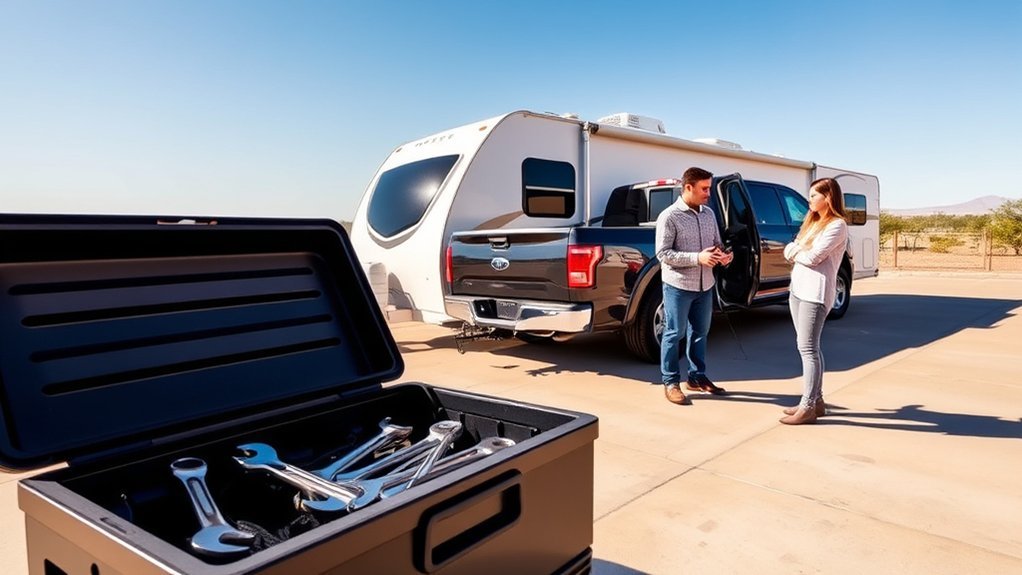
Towing a travel trailer safely starts long before you merge onto the highway. You must match the fully loaded trailer to the exact tow vehicle, stay within every weight rating, use compatible hitch and braking equipment, and complete the same walkaround before every trip. Careful loading and calm driving then help keep the vehicle and trailer stable.
Quick Answer
To tow a travel trailer safely, verify the vehicle, hitch, axle, payload, and combined-weight ratings; load the trailer for proper tongue weight; connect the coupler, crossed safety chains, wiring, brakes, and breakaway cable; then inspect the tires and lights. Drive slowly, leave extra space, and stop if sway begins.
Key Takeaways
- Use the exact tow vehicle’s owner’s manual, door-jamb labels, and trailering information. An advertised maximum tow rating is only one of several limits.
- Count passengers, cargo, hitch equipment, batteries, propane, water, and trailer supplies when calculating loaded weights.
- A conventional travel trailer commonly needs about 10%–15% of its loaded weight on the hitch, but the trailer and vehicle manufacturers’ limits control.
- Use a weight-distribution hitch, sway-control device, and brake controller only when they are compatible with and required for your specific combination.
- Inspect the hitch, chains, breakaway system, tires, wheels, brakes, lights, mirrors, doors, awnings, and cargo before every departure.
At a Glance
| Time Required | 30–60 minutes for the first complete setup; about 10–15 minutes for a routine pre-trip check |
| Difficulty | Intermediate; professional setup or instruction is wise for a first-time owner |
| Tools Needed | Rated hitch equipment, wheel chocks, tire gauge, torque wrench, tongue-weight scale or public scale, flashlight, gloves, and a helper when available |
| Cost | Pre-trip checks cost nothing when the combination is already equipped; hitch, brake-controller, mirror, scale, and professional-installation costs vary by vehicle and trailer |
Warning: General towing advice cannot establish whether a particular vehicle and trailer combination is safe or legal. Follow the exact tow vehicle, trailer, hitch, brake-controller, tire, and weight-distribution-hitch instructions. Never exceed any listed rating, even when another rating appears to leave extra capacity.
Confirm Your Vehicle Can Tow the Travel Trailer
Do not choose a trailer from the tow vehicle’s advertised maximum towing capacity alone. That number may assume a particular engine, axle ratio, drivetrain, wheelbase, cooling package, hitch, cab, bed, and lightly loaded vehicle. Passengers, luggage, accessories, and tongue weight reduce the capacity available for towing.
Check the exact vehicle’s owner’s manual, certification label, tire-and-loading label, hitch label, and any vehicle-specific trailering label. Current manufacturer guidance also recommends reviewing all relevant ratings and weighing the fully loaded combination rather than relying only on brochure figures. The 2026 Chevrolet Trailering Guide and Ford’s towing guidance provide useful examples, but your own manuals and labels control.
Know the Weight Ratings
- Maximum trailer weight rating: The greatest loaded trailer weight the specific vehicle is rated to pull when properly equipped.
- Payload: The weight the tow vehicle can carry, including occupants, cargo, accessories, hitch hardware, and the trailer’s tongue weight.
- GVWR: The maximum allowable weight of the loaded tow vehicle. A separate GVWR applies to the trailer.
- GAWR: The maximum allowable weight on each axle. Pay close attention to the tow vehicle’s rear GAWR and each trailer axle rating.
- GCWR: The maximum allowable combined weight of the loaded tow vehicle and loaded trailer.
- Tongue weight: The downward load placed on the hitch by a conventional trailer.
- Hitch and component ratings: The limits for the receiver, ball mount, hitch ball, coupler, weight-distribution system, and related hardware.
- Tire and wheel limits: The load and speed capabilities of the tires and wheels on both vehicles.
A maximum tow rating is not permission to ignore payload, tongue weight, axle ratings, hitch limits, tire limits, or GCWR. The first rating you reach is your limit.
Use Loaded Weights, Not Dry Weight Alone
A trailer’s unloaded or “dry” weight may exclude dealer-installed equipment, batteries, propane, water, food, camping supplies, and personal cargo. Load the tow vehicle and trailer as they will travel before making the final calculation.
For the most useful scale reading, place the loaded tow vehicle’s front axle, rear axle, and the trailer axles on separate scale platforms when possible. Confirm that:
- The tow vehicle’s total weight remains below its GVWR.
- Each tow-vehicle axle remains below its GAWR.
- The loaded trailer remains below its GVWR and axle ratings.
- The entire combination remains below the GCWR.
- The measured tongue weight remains within the vehicle, receiver, hitch, ball, coupler, and trailer limits.
A conventional travel trailer commonly performs best with approximately 10%–15% of its actual loaded weight on the hitch. That is a general range, not permission to exceed a manufacturer’s specified tongue-weight limit. Measure it with a suitable tongue-weight scale or obtain the required axle weights at a public scale.
Note: The informal “80% towing rule” can provide a planning buffer, but it is not an official capacity calculation. A combination at less than 80% of the maximum tow rating can still exceed payload, rear-axle, tongue-weight, hitch, tire, or GCWR limits.
Essential Tools for Towing a Travel Trailer
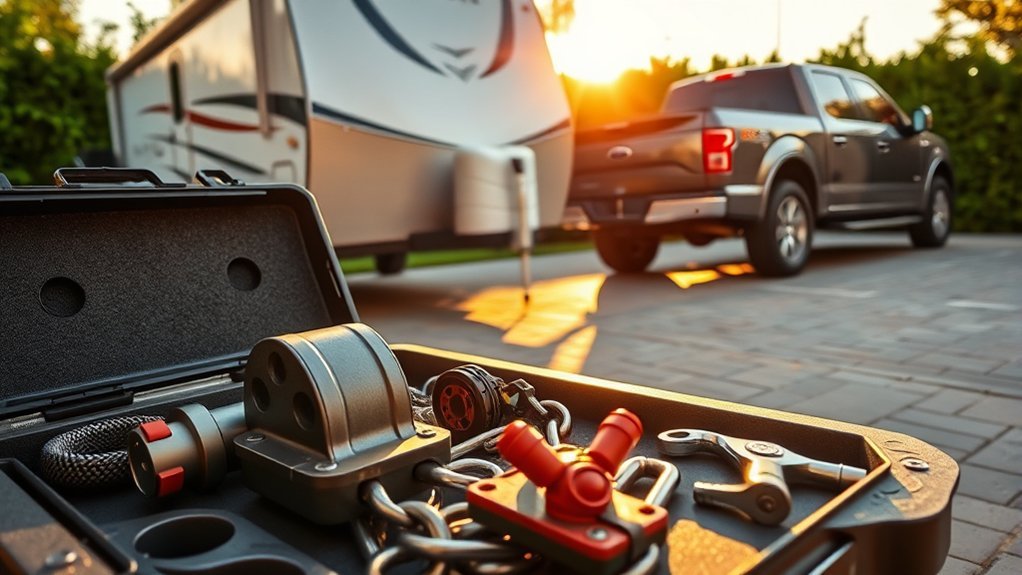
Every part between the tow vehicle and trailer must fit correctly and carry an adequate rating. A high-rated receiver does not make an underrated ball, ball mount, coupler, tire, or axle safe.
Rated Hitch, Ball, and Coupler
Match the hitch-ball diameter to the coupler and verify the ratings stamped or labeled on the receiver, ball mount, ball, and coupler. Install the correct hitch pin and retaining clip. The trailer should sit close to level when connected unless its manufacturer specifies otherwise.
Weight-Distribution and Sway-Control Equipment
A weight-distribution hitch uses spring bars to redistribute part of the hitch load among the tow vehicle and trailer axles. It can improve front-axle loading and handling when correctly selected and adjusted, but it does not increase the vehicle’s payload, GVWR, GAWR, GCWR, receiver rating, or maximum trailer rating.
Some combinations require a weight-distribution hitch or sway control above a stated trailer or tongue weight. Other vehicles or hitch systems restrict their use. Confirm compatibility in the tow vehicle, receiver, trailer, and hitch instructions before installation.
Safety Chains and Breakaway Equipment
For a conventional travel trailer, cross the safety chains beneath the trailer tongue unless the manufacturer or applicable law instructs otherwise. Leave enough slack for a full turn, but not enough for the chains to drag.
If the trailer has a breakaway braking system, inspect its switch, cable, and battery. Attach the cable to the tow vehicle at the point specified by the trailer manufacturer—normally a secure point independent of the safety chains and not a loose or easily removed hitch component. Route it with enough freedom for turning without allowing it to snag or drag.
Trailer Brakes and Controller
Electric trailer brakes and many electric-over-hydraulic systems require a compatible brake controller. A trailer with hydraulic surge brakes normally operates through movement at the coupler instead of an electric in-cab controller. Brake requirements depend on trailer weight and state law, so verify the rules for every state on your route through the USAGov state motor-vehicle directory.
Visibility and Inspection Tools
- Towing mirrors or extensions that provide the legally required view behind the trailer
- Wheel chocks sized for the trailer tires
- An accurate tire-pressure gauge and portable inflator
- A torque wrench and correct socket for the trailer wheels
- A rated jack, safe lifting points, and an inflated spare tire
- A flashlight, work gloves, reflective vest, and basic roadside kit
- A tongue-weight scale or access to a public vehicle scale
Pro Tip: Keep a printed checklist with the trailer instead of relying on memory. Have one person make each connection and a second person independently verify the hitch latch, chains, breakaway cable, wiring, jack, lights, doors, and cargo.
How to Hitch Your Travel Trailer Step by Step
- Park on firm, level ground. Set the tow vehicle’s parking brake, place it in Park, and chock the trailer wheels before working around the tongue.
- Inspect every connection point. Look for a damaged coupler, loose ball, cracked weld, bent receiver, missing pin, worn chain, damaged wiring, or leaking brake component.
- Confirm the ball and coupler match. Check the ball diameter and ratings before positioning the vehicle.
- Align the tow vehicle and trailer. Back slowly with a spotter or hitch camera. Stop immediately if you lose sight of the spotter. No one should stand between a moving tow vehicle and the trailer.
- Lower and lock the coupler. Lower the coupler fully onto the ball, close the latch, install its safety pin or lock, and confirm that the coupler has captured the ball.
- Install the weight-distribution equipment when applicable. Connect and adjust the spring bars and sway-control components exactly as their instructions require.
- Cross the safety chains. Attach each chain to a rated tow-vehicle point. Verify turning clearance and keep the chains off the pavement.
- Connect the breakaway cable. Use the specified independent attachment point and check the breakaway battery or indicator as directed by the trailer manufacturer.
- Connect the electrical plug. Leave enough cable for turns while keeping it clear of the road, hitch movement, and sharp edges.
- Raise and secure the tongue jack. Retract it completely and secure removable feet, handles, or pins. Fully retract all stabilizer jacks before travel.
- Test the lights and brakes. Check running lights, turn signals, brake lights, hazard lights, and reverse lights when fitted. In a safe open area, test the trailer brakes and controller at very low speed according to their instructions.
- Complete a final walkaround. Verify tires, lug nuts, doors, steps, vents, antennas, awnings, windows, storage compartments, propane equipment, cargo, and required clearance.
Warning: Never place any part of your body beneath an unsupported trailer, and never rely on a stabilizer jack for lifting. Use the trailer manufacturer’s approved lifting points and properly rated lifting and support equipment.
Travel Trailer Pre-Trip Checklist
Tow Vehicle and Hitch
- Vehicle and trailer are within every loaded weight rating.
- Receiver, ball mount, hitch ball, coupler, and hitch pins are correctly installed and rated.
- Coupler latch is fully closed and secured.
- Weight-distribution and sway-control equipment is installed and adjusted as instructed.
- Safety chains are attached, crossed when required, clear of the road, and free to turn.
- Breakaway cable is attached correctly and its battery is ready.
- Electrical connector is fully seated and safely routed.
- Tongue jack and stabilizer jacks are fully retracted.
Tires, Wheels, and Brakes
- Check tow-vehicle and trailer tire pressures when cold, using the pressure specified on the applicable vehicle or trailer label and manual.
- Inspect tread and sidewalls for cuts, bulges, punctures, cracking, uneven wear, and exposed material.
- Verify tire and wheel load ratings and observe the tire speed rating.
- Inspect the spare tire and make sure the jack and wheel tools fit.
- Tighten lug nuts to the trailer manufacturer’s specification and recheck them after wheel service as directed.
- Test the trailer brakes, brake controller, breakaway equipment, and parking brake when fitted.
The NHTSA TireWise guide recommends checking tires cold and using the vehicle manufacturer’s specified pressure rather than automatically treating the number molded on a tire as the operating pressure. For the trailer, follow its certification or tire placard, owner’s manual, and tire manufacturer’s instructions.
Trailer Body and Cargo
- All cargo is secured against forward, rearward, upward, and side-to-side movement.
- Cabinets, drawers, appliances, doors, windows, roof vents, and storage compartments are latched.
- Awnings, slideouts, entry steps, antennas, and leveling equipment are fully stowed.
- Propane cylinders and batteries are secured and their compartments are closed.
- Fresh, gray, and black tank levels have been considered in the loaded weight and balance.
- All lights and reflectors are clean and working.
- The trailer license plate and required registration are present.
NHTSA advises drivers to tie down cargo so it cannot drop, shift, leak, or escape during a sudden stop or impact. Review its secure-load guidance before carrying loose equipment.
Route and Legal Checks
- Know the combination’s total length, width, height, and loaded weight.
- Confirm bridge, tunnel, fuel-station, campground, and road clearances.
- Check weather, wind, grades, construction, and fuel stops before departure.
- Verify state requirements for trailer brakes, safety equipment, mirrors, lane use, dimensions, and towing speed.
- Check both the tow vehicle and trailer VINs for open recalls through the NHTSA recall lookup.
Load a Travel Trailer for Stability
Load heavy items low, near the trailer’s centerline, and where the trailer manufacturer recommends. Avoid placing a large concentration of weight at the far rear, where it can reduce tongue weight and increase sway.
When a conventional trailer has approximately centered axles, placing roughly 60% of the movable load in the front half and 40% in the rear half can be a useful starting point. It is not a substitute for measuring the final tongue weight. Fixed appliances, tanks, slideouts, batteries, and storage compartments can make the result very different from a simple visual estimate.
Distribute cargo evenly from side to side and secure it so it cannot move. Recheck the weights after adding major equipment, changing batteries, filling tanks, carrying bicycles, installing a rear rack, or moving heavy supplies.
Note: A weight-distribution hitch changes how the tongue load is shared among the axles, but it does not erase the tongue weight or create additional payload. Count the hitch hardware and tongue load when checking the tow vehicle’s loaded limits.
Safe Driving Tips for Towing a Travel Trailer
A trailer makes the combination longer, heavier, wider, and slower to respond. Practice starts, stops, turns, lane placement, and backing in an empty lot before entering busy traffic.
Speed and Following Distance
Drive at the lowest limit imposed by the posted towing law, tow vehicle manual, trailer manual, tire speed rating, traffic, weather, and road conditions. There is no nationwide rule that makes 65 mph safe for every travel trailer. Some jurisdictions set lower towing limits; California, for example, limits vehicles towing trailers to 55 mph.
Use a much longer following distance than you would without a trailer. Six seconds can be a practical starting point in good conditions, but increase the gap for rain, darkness, traffic, downhill grades, crosswinds, poor pavement, or a heavily loaded combination.
Acceleration, Braking, and Grades
- Accelerate gradually and allow extra room when merging.
- Look far ahead so you can slow early instead of braking abruptly.
- Use the transmission’s tow/haul mode when the vehicle manufacturer recommends it.
- Select a lower gear before a long descent and avoid riding the brakes.
- If braking performance changes, you smell hot brakes, or pedal travel increases, pull over safely and allow the system to cool before continuing.
- Do not coast downhill in Neutral.
Turns, Passing, and Lane Changes
- Make wider turns so the trailer tires clear curbs, signs, posts, and soft shoulders.
- Signal early and change lanes gradually.
- Use the mirrors frequently without staring at them for long periods.
- Allow the trailer to clear the passed vehicle before returning to the lane.
- Avoid passing on hills, curves, or when the available distance is marginal.
Wind and Passing Trucks
Crosswinds and the air displaced by large vehicles can move a travel trailer sideways. Reduce speed before the gust reaches you, keep both hands on the wheel, hold a steady course, and increase the space around the combination. If the wind makes lane control difficult, leave the road at a safe location and wait for conditions to improve.
What to Do If Your Travel Trailer Starts Swaying
Warning: Do not attempt to steer back and forth against trailer sway, accelerate through it, or make an abrupt lane change. Follow the tow vehicle, trailer, hitch, and brake-controller instructions because system behavior can differ.
- Hold the steering wheel steady. Keep the tow vehicle pointed straight ahead and avoid sudden corrections.
- Release the accelerator. Let the combination slow gradually.
- Apply the trailer brakes manually when equipped and instructed. Use the brake controller’s manual control smoothly to help pull the trailer into line.
- Avoid hard tow-vehicle braking while the sway is active. Abrupt braking can worsen instability or lead to a jackknife.
- Brake smoothly after the trailer settles. Move to a safe place and stop.
- Find the cause before continuing. Check for shifted cargo, low tongue weight, overload, tire problems, excessive speed, wind, loose hitch components, or worn suspension parts.
Current Chevrolet trailering guidance gives the same basic sequence: hold the wheel steady, release the accelerator, manually apply the electric trailer brakes when equipped, and stop to inspect the combination. Never continue at the same speed without correcting the cause.
Common Mistakes New Trailer Towing Drivers Make
- Shopping by dry weight or maximum tow rating alone: This overlooks payload, tongue load, passengers, cargo, axle limits, and GCWR.
- Assuming a weight-distribution hitch adds capacity: It can redistribute load but cannot raise a published rating.
- Guessing the tongue weight: Visual trailer level and tow-vehicle squat are not accurate scales.
- Loading heavy cargo behind the trailer axles: This can reduce tongue weight and promote sway.
- Using the wrong hitch ball or underrated component: Every connection must match and carry the load.
- Attaching the breakaway cable incorrectly: It must remain able to activate if the trailer separates.
- Allowing chains or electrical cables to drag: Road contact can weaken or sever them.
- Inflating tires without checking the correct placard: Use the specified cold pressure and inspect the tire’s load and speed limits.
- Skipping the brake and light test: A connected plug does not prove that every circuit and brake is working.
- Driving too fast: Speed reduces reaction time and can greatly worsen sway.
- Making abrupt steering or braking inputs: Smooth controls are essential with a long, heavy combination.
- Forgetting the trailer’s height and inside tracking: Roof equipment and trailer wheels may not follow the same path as the tow vehicle.
- Using stabilizers as lifting jacks: Stabilizers are normally designed to reduce movement after leveling, not to lift the trailer.
- Skipping repeat inspections: Recheck the combination after the first part of a trip and during fuel, meal, and rest stops.
Preparing for Arrival at Your Campsite When Towing
Before arriving, compare the trailer’s full travel dimensions with the campsite length, width, access-road restrictions, and overhead clearance. Include the tongue, tow vehicle, rear accessories, roof air conditioner, antennas, and any space required for slideouts or awnings.
Inspect the Site Before Backing
- Stop where you are not blocking traffic and walk the site first.
- Look for branches, posts, rocks, fire rings, utility pedestals, drop-offs, soft ground, and low wires.
- Choose the final wheel position and decide which side gives the driver the best view.
- Agree on simple hand signals with the spotter and keep the spotter visible at all times.
- Open the windows and turn off music so you can hear directions and warnings.
Back Slowly With Small Steering Inputs
Place one hand near the bottom of the steering wheel. Move that hand in the direction you want the rear of the trailer to travel. Back at walking speed, use small corrections, and pull forward to straighten whenever the angle becomes difficult.
Stop immediately if you lose sight of the spotter, another person enters the area, or you are unsure about clearance. Getting out to look is faster and safer than repairing a trailer, utility pedestal, or tree-damaged roof.
Secure the Trailer Before Unhitching
- Position and level the trailer side to side using approved leveling blocks.
- Set the tow vehicle’s parking brake and keep your foot on the service brake as needed.
- Chock the trailer wheels firmly in both directions before disconnecting the coupler.
- Disconnect weight-distribution and sway-control equipment according to its instructions.
- Disconnect the electrical plug, breakaway cable, and safety chains without allowing them to drag.
- Use the tongue jack to lift the coupler clear of the ball.
- Move the tow vehicle forward slowly and stop if the trailer shifts.
- Level the trailer front to back with the tongue jack.
- Lower the stabilizers as instructed, without using them to lift or force the trailer level.
- Check clearance before extending slideouts or awnings and before connecting utilities.
Arriving during daylight makes obstacles and clearances easier to judge, but a careful site walk, bright flashlight, and patient spotter remain necessary whenever visibility is limited.
Frequently Asked Questions
What is the 3-3-3 rule for RV travel?
The 3-3-3 rule is an informal trip-planning guideline, not a law or engineering standard. A common version suggests traveling no more than 300 miles in a day, arriving by about 3 p.m., and staying at least three nights. Some RVers replace the 300-mile limit with about three hours of driving. Adjust the plan for weather, traffic, fatigue, road conditions, and your experience.
What is the 80/20 rule for towing?
The informal 80/20 rule suggests selecting a fully loaded trailer that weighs no more than roughly 80% of the tow vehicle’s stated maximum trailer rating, leaving a planning buffer. It is not an official manufacturer rating and does not replace checks for payload, GVWR, GAWR, GCWR, tongue weight, hitch limits, tires, or actual scale weights.
What are common towing mistakes to avoid?
Avoid choosing a trailer by dry weight alone, exceeding payload or axle ratings, guessing tongue weight, loading too much weight behind the axles, using mismatched hitch parts, skipping the breakaway and brake tests, neglecting tire inspections, driving too fast, and making abrupt steering or braking movements.
What is the 60/40 rule for trailers?
The 60/40 rule is a general loading starting point that places about 60% of movable cargo in the front half of a conventional trailer and 40% in the rear half. It does not mean that the whole trailer must have a precise 60/40 weight split. Follow the trailer manual and measure the final tongue weight, which is commonly about 10%–15% of loaded travel-trailer weight.
Does every travel trailer need a weight-distribution hitch?
No. Some tow vehicles and receivers require one above a stated trailer or tongue weight, some make it optional, and others restrict its use. The trailer and hitch must also be compatible. Follow all manufacturer instructions and never use a weight-distribution hitch to justify exceeding a rating.
Do I need a trailer brake controller?
A compatible controller is generally needed for electric trailer brakes and many electric-over-hydraulic systems. Hydraulic surge brakes normally operate without an electric in-cab controller. Requirements vary by trailer, vehicle, brake type, and state law, so consult the manuals and every jurisdiction on your route.
What should I do if my travel trailer starts swaying?
Hold the steering wheel steady, release the accelerator, avoid abrupt steering and hard tow-vehicle braking, and smoothly apply the trailer brakes manually if the system and manufacturer instructions permit it. After the sway stops, slow down, pull over safely, and correct the cause before continuing.
Conclusion
Safe travel-trailer towing depends on verified weights, compatible equipment, careful hitching, a complete inspection, and calm driving. Check every rating rather than relying on maximum tow capacity alone, measure the loaded trailer and tongue weight, and correct any tire, brake, lighting, or sway problem before continuing. At the campsite, back slowly, use a visible spotter, chock the wheels, and secure the trailer before unhitching.
Sources
- 2026 Chevrolet Trailering Guide — weight ratings, tongue weight, safety chains, loading, pre-trip checks, driving, backing, and sway response
- Ford Towing Guidance — tongue-weight measurement, conventional-trailer ranges, axle ratings, and scale use
- NHTSA TireWise — cold tire-pressure checks, placard pressure, tire inspection, and maintenance
- NHTSA Secure Your Load — cargo restraint and unsecured-load safety
- USAGov State Motor Vehicle Services — official state-agency access for towing laws and equipment requirements
- NHTSA Recall Lookup — tow-vehicle and trailer VIN safety-recall searches







Leave a Reply