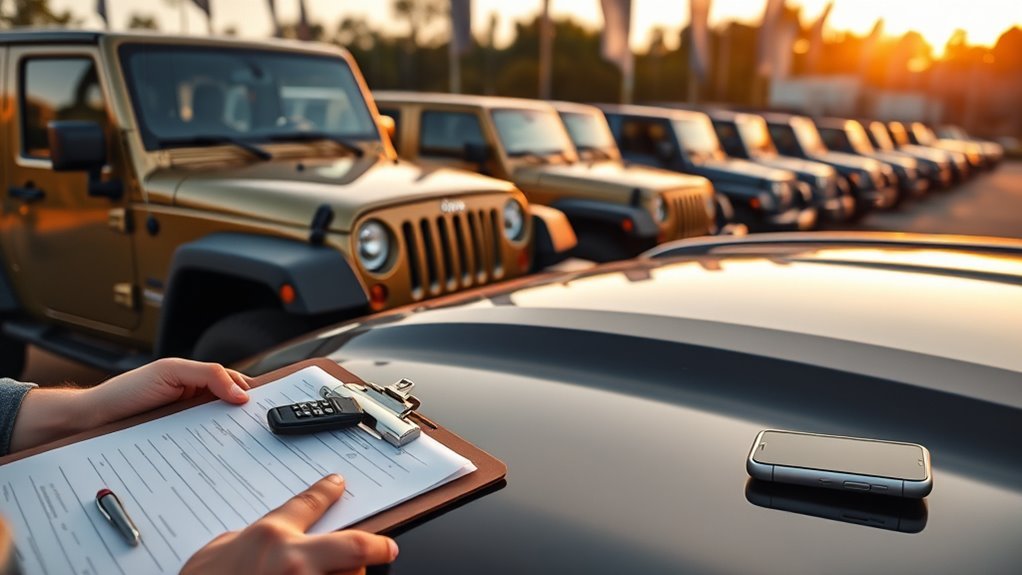
The cheapest way to buy a Jeep Wrangler depends on what you are trying to minimize. A lower sticker price, lower monthly payment, and lower lifetime cost are not the same thing. You will usually spend the least upfront on a carefully inspected used Wrangler, while the lowest-priced new route is normally a base Sport with few options. The best deal is the one with the lowest acceptable total cost after financing, fees, insurance, maintenance, and repairs.
Quick Answer
For the lowest total price, compare clean-title used Sport models and pay for an independent inspection. For a new Wrangler, choose the base Sport, skip dealer accessories, obtain financing quotes before shopping, and request written out-the-door prices from several dealers. Compare total cost—not just the payment or advertised discount.
Key Takeaways
- A used Sport can have the lowest purchase price, but only when its condition, title, modifications, and repair needs are verified.
- For a new Wrangler, compare written out-the-door totals for the same configuration instead of targeting a fixed percentage below invoice.
- A lease or long loan can lower the monthly payment without lowering the total amount you spend.
- Negotiate the Wrangler, trade-in, financing, and optional products as separate parts of the transaction.
- Check the VIN, open recalls, warranty documents, insurance cost, and final contract before signing.
At a Glance
| Time Required | Several hours for research and quotes, plus time for a test drive and used-vehicle inspection |
| Difficulty | Moderate |
| Tools Needed | Budget worksheet, loan quotes, insurance quote, written out-the-door offers, VIN, vehicle history report, and inspection checklist |
| Cost | Research and quotes are usually free; inspection, history-report, tax, title, registration, and financing costs vary |
Note: This article provides general buying and budgeting information, not personal financial or legal advice. Taxes, fees, warranty rights, trade-in credits, private-sale protections, and financing rules vary by state and transaction.
Start Here: Choose the Type of Savings You Want
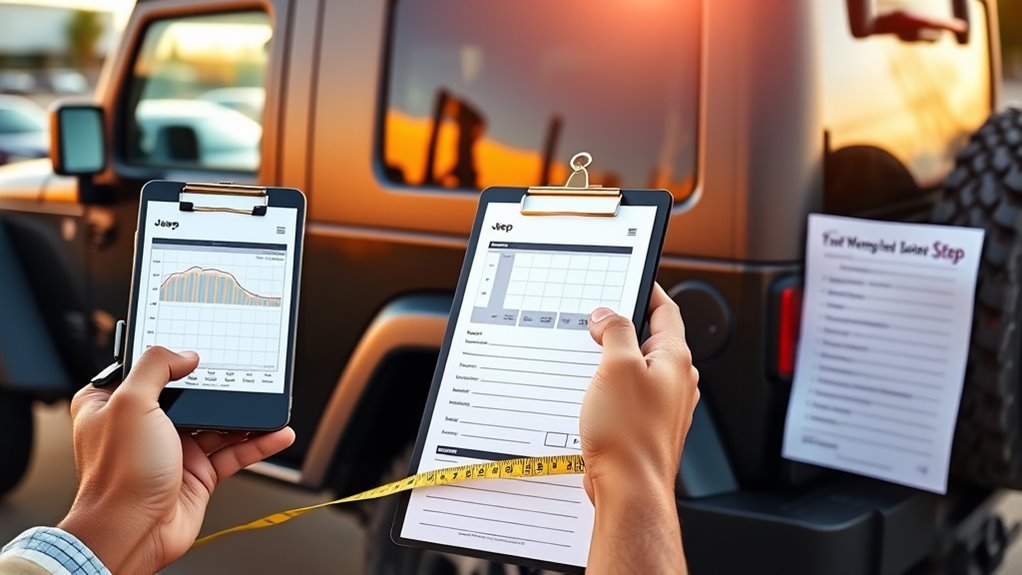
Before shopping, decide what “cheapest” means for your budget. The right route changes depending on whether you want the smallest purchase price, the smallest monthly payment, or the lowest total amount paid over several years.
| Your main goal | Route to investigate first | Main trade-off |
|---|---|---|
| Lowest upfront price | Older used Sport, often through a private seller | More repair risk and fewer dealer protections |
| Lowest new-vehicle price | Base Sport with few options | Fewer comfort, technology, and off-road upgrades |
| Lowest monthly payment | Lease, larger down payment, or longer loan | May increase risk or total cost and may not build ownership equity |
| Lower repair uncertainty | New or certified pre-owned Wrangler | Higher purchase price |
| Lowest financing cost | Less expensive vehicle, competitive APR, and shorter affordable term | Higher required payment than a long-term loan |
As of July 19, 2026, Jeep listed the base 2026 Wrangler Sport at a starting MSRP of $39,040. That price excludes destination, taxes, title, registration, optional colors, and equipment, and it can change without notice.
You can verify the latest base price and available configurations with Jeep’s official Wrangler Build & Price tool. A discounted higher trim is not automatically cheaper than a base Sport once options, fees, insurance, fuel, and financing are included.
Decide: New, Lease, Used, CPO, or Private-Party
Compare each route on the same timeline. For example, calculate what you would spend over three or five years instead of comparing one monthly payment with one cash price.
| Option | Why it may save money | What to check |
|---|---|---|
| New purchase | Full new-vehicle coverage, current incentives, and less immediate repair uncertainty | Destination charge, options, dealer accessories, APR, rebates, and depreciation |
| Lease | May provide a lower payment and shorter commitment | Total due at signing, total payments, mileage allowance, wear charges, acquisition fee, disposition fee, and purchase option |
| Used from a dealer | Lower price than a comparable new model and access to dealer financing | FTC Buyers Guide, warranty status, reconditioning fees, inspection, title, history, and recalls |
| Certified pre-owned | Can balance a lower used price with program-backed coverage | Exact program, deductible, exclusions, start date, mileage limit, and remaining factory coverage |
| Private-party used | May avoid dealer markup and dealer-added products | Seller identity, lien release, title rules, payment safety, inspection, history, and state-specific protections |
Leasing is not the same as buying at a discount. The Federal Trade Commission explains that a lease pays for the right to use a vehicle for an agreed period and mileage. Review the total lease obligation, not only the advertised payment. The FTC’s financing and leasing guide also warns that excess mileage and other end-of-lease charges may apply.
A cash purchase avoids loan interest, but it is not automatically the best choice if it empties your emergency fund or prevents you from paying higher-interest debt. Compare the cash price with any financing incentive and keep enough savings for registration, insurance, maintenance, tires, and repairs.
Warning: Do not make a large lease down payment only to create a lower advertised payment. If the leased Wrangler is stolen or totaled early, recovering that upfront money may be difficult. Compare the total due at signing and total lease cost.
Set a Realistic Total Budget
A Wrangler payment is only one part of the cost. Build your maximum vehicle budget before contacting a dealer.
- Purchase costs: selling price, destination charge, sales tax, title, registration, documentation fee, and required state charges.
- Financing costs: APR, loan term, interest, lender fees, and any prepayment penalty.
- Operating costs: insurance, fuel or charging, parking, routine maintenance, tires, and registration renewals.
- Risk costs: repair reserve, insurance deductible, and possible replacement transportation.
- Optional costs: service contracts, GAP products, wheel-and-tire plans, accessories, protection products, and modifications.
You may use 10%, 15%, or another share of take-home pay as a personal ceiling, but it is not a universal affordability rule. Add the payment, insurance, fuel, maintenance reserve, and parking before deciding whether the vehicle fits your budget. The Consumer Financial Protection Bureau recommends considering APR, taxes, fees, add-ons, insurance, and maintenance when estimating affordability.
Get an Insurance Quote Before Buying
Insurance can change the result of your comparison. Request quotes using the exact model year, trim, driver information, ZIP code, annual mileage, and intended coverage. A Rubicon, 4xe, or heavily modified Wrangler may not cost the same to insure as a base Sport.
Do Not Shop by Payment Alone
A dealer can lower a payment by extending the term, increasing the down payment, changing the annual mileage on a lease, or moving costs elsewhere in the agreement. Ask for these figures separately:
- Vehicle selling price.
- Out-the-door price.
- Down payment.
- Amount financed.
- APR.
- Number of payments.
- Total of payments.
- Total interest or finance charge.
A shorter affordable term generally reduces total interest. A long term may lower the payment but can leave you owing more than the Wrangler is worth for a longer period. The CFPB explains these trade-offs in its auto-loan negotiation guidance.
Research Wrangler Prices, Trims, and Inventory
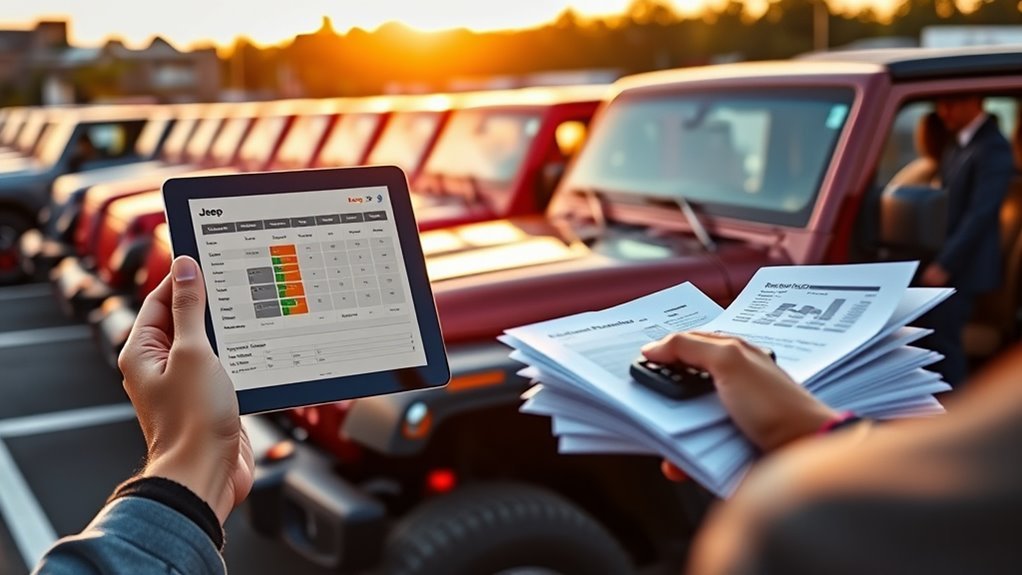
Start with the least expensive configuration that meets your real needs. A Sport can be the better value when you do not need factory locking differentials, larger tires, premium interior equipment, or appearance packages. A higher trim may still make sense when adding similar equipment later would cost more or affect reliability.
| What to check | Why it matters |
|---|---|
| Model year, trim, door count, engine, and drivetrain | Prevents comparisons between different configurations |
| MSRP and factory-installed options | Shows how the vehicle was configured before dealer products |
| Destination and dealer fees | Explains why the final total can be much higher than an advertised price |
| Inventory age and nearby availability | A dealer may be more flexible on an aging or overstocked configuration |
| Factory incentives | Offers can depend on ZIP code, model, purchase type, eligibility, and date |
| Written out-the-door total | Allows a true comparison after mandatory charges |
Check Jeep’s official Wrangler incentives page for current regional offers. Confirm the expiration date, eligible trim, required financing company, customer qualifications, and whether the offer can be combined with another discount.
Compare a Rebate With Promotional APR
A cash rebate and promotional interest rate may not be available together. Request two written calculations when a choice is offered:
- The out-the-door price after the rebate using your outside financing.
- The out-the-door price and total payments using the promotional APR without the rebate.
Choose the lower total cost after accounting for the down payment, interest, loan length, and any required fees. A zero-percent offer is not the cheapest choice when giving up a large rebate costs more than the interest saved.
Get Preapproved and Compare Loan Offers
Apply with a bank, credit union, or other lender before visiting the dealership. A preapproval gives you a rate and term to compare with dealer-arranged financing. It also helps keep the vehicle negotiation focused on price.
Compare each offer using the same amount financed and loan term. Review:
- APR rather than only the stated interest rate.
- Required down payment.
- Loan length.
- Total finance charge.
- Total of all payments.
- Late-payment terms.
- Prepayment penalty, if any.
- Whether optional products have been added to the amount financed.
Pro Tip: Let the dealer try to beat your preapproval, but compare the same loan amount and term. A lower payment caused by adding 12 or 24 months is not a better rate.
Negotiate the Wrangler’s Out-the-Door Price
Do not rely on a fixed target such as a percentage below invoice. Invoice data can be useful background, but it does not reveal every manufacturer allowance, dealer incentive, or internal cost. Competing written offers provide stronger evidence of the price available in your market.
Request Itemized Quotes Before Visiting
Contact several dealers that have the same VIN or a closely matched configuration. Ask each dealer to email an itemized out-the-door quote that identifies:
- VIN and stock number.
- MSRP.
- Selling price before incentives.
- Each incentive and eligibility requirement.
- Destination charge.
- Dealer documentation or processing fee.
- Dealer-installed accessories.
- Tax, title, and registration.
- Total out-the-door price before trade-in or financing.
The FTC recommends getting the out-the-door price in writing before leaving home because advertised prices may omit fees and unwanted add-ons. Review its car dealer advertising and pricing guidance before requesting quotes.
| Step | Action | Goal |
|---|---|---|
| 1 | Choose an exact trim and configuration | Create an equal comparison |
| 2 | Request itemized written out-the-door quotes | Expose fees and accessories |
| 3 | Ask dealers to beat the best valid quote | Use real market competition |
| 4 | Verify the VIN and vehicle availability | Avoid bait-and-switch pricing |
| 5 | Match the final contract to the quote | Prevent last-minute cost changes |
Remove Unwanted Add-Ons
Ask the dealer to remove products you did not request. Common items include paint protection, nitrogen-filled tires, VIN etching, theft products, wheel coverage, prepaid maintenance, rustproofing, service contracts, and dealer accessory packages.
Some accessories may already be installed, but that does not mean you must accept an unexplained charge. Ask whether the vehicle can be sold without the product or whether another Wrangler is available without it. Read the sales and financing agreements before signing.
Separate the Trade-In, Financing, and F&I Decisions
Calculate Trade Equity
Get several purchase or trade appraisals before visiting the selling dealer. Then subtract the payoff amount on your current loan from the trade allowance.
- Positive equity: The trade is worth more than its payoff.
- Break-even: The allowance and payoff are about equal.
- Negative equity: The payoff is higher than the allowance.
Negative equity does not disappear when rolled into the Wrangler loan. It increases the amount financed and can leave you owing more than the Wrangler is worth. Ask for the trade allowance, payoff, equity, and new amount financed as separate lines.
Negotiate the Wrangler’s price before applying the trade. State sales-tax treatment varies, so compare the after-tax result of trading with the result of selling separately.
Review the Finance and Insurance Office
The finance and insurance department may offer a service contract, GAP product, tire-and-wheel plan, maintenance package, credit insurance, or other protection. These products are generally optional unless a specific lender requirement is clearly disclosed.
For each product, ask for:
- Cash price.
- Financed price and added interest.
- Provider and administrator.
- Covered repairs or losses.
- Exclusions and deductible.
- Cancellation and refund rules.
- Whether similar coverage already exists through insurance or a factory warranty.
Warning: Never sign a contract with blank spaces, unexplained fees, a different APR, a longer term, or products you did not approve. Compare every final number with the written quote and loan offer.
Inspect a Used Wrangler Carefully
A low-priced used Wrangler is not a bargain when it needs major frame, suspension, axle, cooling, electrical, or drivetrain work. A vehicle history report is useful, but the FTC states that it is not a substitute for an independent inspection—even when the vehicle is certified or sold with a warranty. See the FTC’s used-car buying guide.
Verify the VIN, Model Year, Trim, and Title
- Match the dashboard VIN with the door label, title, registration paperwork, and sales contract.
- Decode or verify the VIN to confirm model year, engine, trim, and equipment.
- Check whether the title is clean, rebuilt, salvage, flood, lemon-law buyback, or otherwise branded.
- Confirm that any lien will be released correctly.
- Enter the VIN in the NHTSA recall lookup and arrange completion of open safety recalls.
Wrangler Inspection Checklist
- Frame and underbody: Look for severe rust, fresh undercoating hiding corrosion, bent brackets, damaged crossmembers, crushed skid plates, and signs of hard impacts.
- Suspension and steering: Check for loose joints, uneven ride height, poor alignment, vibration, wandering, tire rubbing, and low-quality lift components.
- Axles and drivetrain: Inspect for leaks, damaged housings, unusual noises, binding, and correct four-wheel-drive operation.
- Tires and wheels: Look for mismatched sizes, uneven wear, old date codes, oversized tires without supporting upgrades, and a missing matching spare.
- Engine and cooling: Check cold-start behavior, warning lights, fluid condition, leaks, overheating history, and maintenance records.
- Body and cabin: Look for water intrusion, mold odor, damaged top seals, poorly aligned doors, corrosion around hardware, and nonworking electronics.
- Modifications: Identify lifts, gearing changes, tuners, lighting, winches, bumpers, wiring, axle upgrades, and removed emissions equipment.
- Road test: Test at city and highway speeds, on turns, during braking, and through all available drivetrain modes.
Pay an independent mechanic who understands four-wheel-drive vehicles to inspect the Wrangler. Ask for a written report, repair estimate, and VIN on the report. Use needed repairs to renegotiate the price or reject the vehicle.
Pro Tip: A stock Wrangler with complete service records is often easier to evaluate than a heavily modified one. Do not pay extra for modifications unless their parts, installation quality, legality, and effect on reliability are documented.
Review Warranties and Service Contracts
For a new or used Wrangler, obtain the actual warranty documents instead of relying on a salesperson’s summary. Verify coverage by VIN, original in-service date, mileage, exclusions, deductible, transfer rules, and required maintenance.
For used vehicles sold by a dealer, review the FTC Buyers Guide. It should state whether the vehicle is sold as is or with a warranty. Spoken promises can be difficult to enforce, so place agreed repairs and coverage in writing.
Do not assume a service contract is an extension of the factory warranty. It is a separate product with its own terms. Compare the contract price with the vehicle’s remaining coverage, likely repair risk, deductible, exclusions, claim procedure, and cancellation policy.
Wrangler warranty information can be checked through the official Mopar warranty portal.
Use Timing as a Tiebreaker, Not a Guarantee
There is no guaranteed day or holiday when every Wrangler reaches its lowest price. Dealers may be more flexible when a vehicle has been in inventory for a long time, a new model year is arriving, a trim is overstocked, or a sales period is ending. However, a scarce Rubicon or specific configuration may remain expensive during the same period.
Black Friday, month-end, quarter-end, and year-end promotions can be worth checking, but compare the same written out-the-door total. A large advertised discount can be offset by mandatory accessories, lost financing incentives, or a higher APR.
Final Contract and Delivery Checklist
Before signing or accepting delivery, complete these checks:
- Match the VIN on the vehicle, quote, buyer’s order, title documents, loan, and insurance binder.
- Confirm the model year, trim, engine, drivetrain, color, packages, and included keys.
- Verify the selling price, incentives, trade allowance, payoff, taxes, fees, down payment, and out-the-door total.
- Confirm the APR, term, payment count, amount financed, finance charge, and total of payments.
- Remove unapproved products and accessories.
- Read warranty and service-contract documents.
- Confirm promised repairs, missing parts, or accessory installation in writing.
- Check for warning lights, body damage, tire damage, fluid leaks, and excessive mileage added since the quote.
- Keep copies of every signed document and the original written offer.
Walk away when the vehicle changes, the numbers do not match, an independent inspection is refused, or the dealer pressures you to sign before reviewing the documents.
Frequently Asked Questions
What is the cheapest way to buy a Jeep Wrangler?
The lowest purchase price is usually found on an older, lower-trim used Wrangler bought after a title check, VIN verification, history report, and independent inspection. For a new Wrangler, a base Sport with few options and no dealer add-ons is normally the least expensive configuration.
How do I get the biggest discount on a new Wrangler?
Choose an exact configuration, request written out-the-door quotes from several dealers, confirm all incentive requirements, and give dealers a chance to beat the best valid offer. Compare the complete total rather than relying on an advertised discount or a fixed percentage below invoice.
What is the best time of year to buy a Jeep Wrangler?
No date guarantees the lowest price. Model-year changes, aging inventory, month-end periods, and holiday promotions may create opportunities, but local supply and demand matter more. Compare itemized out-the-door quotes before deciding that a promotion is a bargain.
Is it cheaper to lease or buy a Wrangler?
A lease may have a lower monthly payment, but buying can cost less over a long ownership period. Compare the lease’s amount due at signing, total payments, mileage limit, fees, and purchase option with the loan’s down payment, interest, resale value, and remaining equity.
How much of my income should go toward a Wrangler payment?
There is no percentage that fits every household. Set a personal ceiling after adding the payment, insurance, fuel, maintenance, parking, taxes, and other debts. A payment that appears affordable can still create strain when the rest of the ownership costs are excluded.
Should I buy a modified used Wrangler?
Buy a modified Wrangler only after an experienced mechanic checks the installation, alignment, steering, suspension, axles, tires, gearing, wiring, emissions equipment, and underbody. Poor modifications can create repair, safety, insurance, inspection, and warranty problems that erase the lower purchase price.
Conclusion
The cheapest way to buy a Jeep Wrangler is to choose the least expensive route that still meets your reliability, safety, space, and capability needs. A carefully inspected used Sport may provide the lowest purchase price. A base new Sport may provide more warranty protection and fewer immediate repair concerns. A lease may lower the payment, but it should be judged by its full cost and restrictions.
Set a complete budget, obtain financing before shopping, compare exact configurations, request written out-the-door quotes, and keep the trade-in and optional products separate. For a used Wrangler, verify the VIN and title, check recalls, inspect modifications, and pay for an independent inspection. Sign only when the vehicle, price, financing, warranty, and paperwork match what you agreed to.
Sources
- Jeep Wrangler Build & Price — current model-year configurations, starting MSRP, and pricing exclusions.
- Jeep Wrangler Incentives and Offers — current regional purchase, lease, and financing offers.
- Consumer Financial Protection Bureau Auto-Loan Shopping Guidance — affordability, APR, taxes, fees, insurance, maintenance, and add-ons.
- Federal Trade Commission Car Dealer Pricing Guidance — written out-the-door prices, advertised offers, fees, add-ons, financing, and lease disclosures.
- Federal Trade Commission Used-Car Buying Guide — Buyers Guides, warranties, history reports, inspections, financing, and service contracts.
- National Highway Traffic Safety Administration Recall Lookup — VIN-based open safety recall checks.


Leave a Reply