
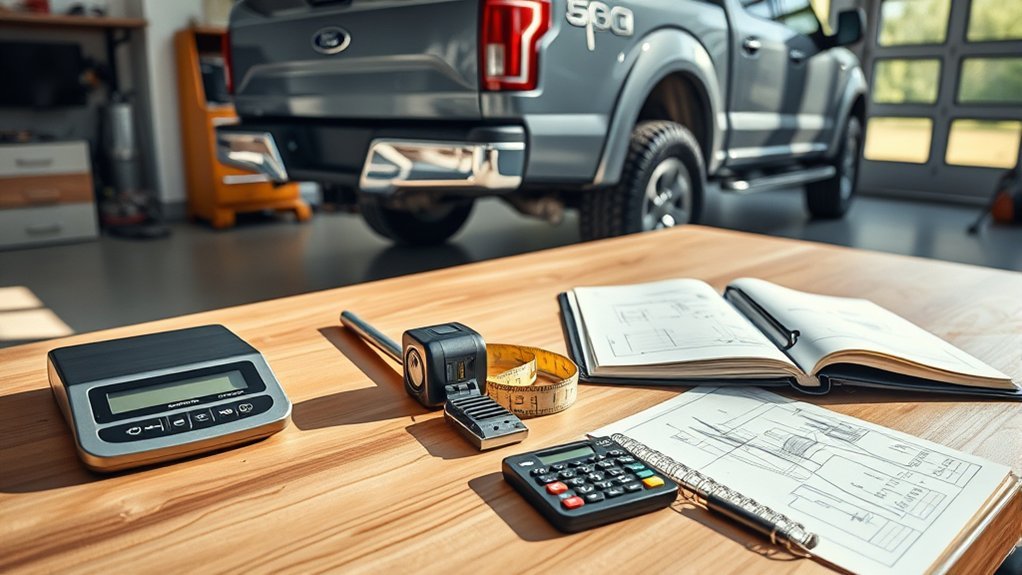
Calculating your vehicle’s towing capacity takes more than subtracting curb weight from the Gross Combined Weight Rating. You must verify the exact vehicle configuration, use its published trailer rating, account for everything loaded into the vehicle and trailer, and confirm that the combination stays within payload, axle, tongue-weight, hitch, tire, and braking limits.
Quick Answer
Find your vehicle-specific maximum trailer rating, then verify the loaded combination stays under GCWR, GVWR, GAWR, payload, tongue-weight, hitch, and tire limits. GCWR minus the actual loaded tow-vehicle weight gives combination-weight headroom, but it does not let you exceed any lower manufacturer rating.
Key Takeaways
- Use ratings for your exact model year, VIN, engine, drivetrain, axle ratio, body configuration, tow package, and installed equipment.
- GCWR minus actual loaded vehicle weight is only one limit; it is not the complete towing-capacity formula.
- Trailer tongue or kingpin weight counts against the tow vehicle’s payload, GVWR, and axle ratings.
- The safe loaded trailer weight is the lowest limit imposed by the vehicle, trailer, hitch system, axles, tires, and applicable equipment requirements.
At a Glance
| Time Required | 20–40 minutes for the paperwork and calculations, plus a trip to a vehicle scale |
| Difficulty | Moderate |
| Tools Needed | Owner’s manual, vehicle labels, VIN or build information, calculator, commercial vehicle scale, and a properly rated tongue-weight scale when appropriate |
| Cost | The calculation is free; commercial scale and tongue-scale costs vary |
Warning: Never rely on a brochure’s highest advertised towing number or a single GCWR subtraction. Exceeding any vehicle, axle, payload, receiver, hitch, ball, tire, wheel, or trailer rating can reduce steering, braking, stability, and component life. Follow the instructions for your exact vehicle and trailer.
How to Calculate Your Vehicle’s Towing Capacity

The goal is not to produce one large towing number. The goal is to prove that your fully loaded vehicle and trailer remain under every applicable limit. Follow these five steps.
1. Verify the Exact Tow Vehicle
Begin with the vehicle’s model year and VIN. Confirm its engine, transmission, drivetrain, axle ratio, cab and bed configuration, wheel and tire package, factory tow equipment, suspension, and any aftermarket equipment.
Vehicles that look alike may have different ratings. Optional equipment can increase the vehicle’s actual weight, reduce available payload, or change the published trailer rating. Use the current owner’s manual, the manufacturer’s towing selector or VIN tool when available, and the labels on the actual vehicle.
Note: The driver-door certification label commonly lists GVWR and front and rear GAWR. The tire-loading label states the combined occupant-and-cargo limit. Some newer vehicles also have a separate trailering label with curb weight, GCWR, maximum payload, maximum tongue weight, or other vehicle-specific figures.
2. Collect Every Relevant Rating
Record the following numbers before calculating anything:
- Maximum loaded trailer weight: The manufacturer’s maximum trailer rating for your exact configuration.
- GCWR: The maximum permitted combined weight of the loaded tow vehicle and loaded trailer.
- GVWR: The maximum permitted weight of the loaded tow vehicle, including passengers, cargo, hitch equipment, and trailer tongue or kingpin weight.
- Front and rear GAWR: The maximum weight permitted on each tow-vehicle axle.
- Payload or occupant-and-cargo limit: The weight available for people, cargo, accessories, hitch hardware, and tongue or kingpin load.
- Maximum tongue or kingpin load: The vehicle or hitch-system limit for downward trailer load.
- Receiver, ball mount, hitch ball, coupler, and weight-distributing-hitch ratings: Each component must be rated for the actual load and used in its approved mode.
- Tire and wheel ratings: The loaded axle and individual tire loads must remain within their limits.
- Trailer GVWR and GAWR: The trailer and its axles must remain within their own ratings.
Current manufacturer guides show why all these numbers matter. The 2026 Ford RV & Trailer Towing Guide separates GCWR, GVWR, GAWR, payload, maximum trailer weight, and tongue load instead of treating them as one interchangeable limit. Chevrolet provides similar guidance in its 2026 Trailering Guide.
3. Load the Vehicle and Trailer as They Will Travel
Do not use the trailer’s dry or empty weight as the final number. Load the fuel, water, batteries, propane, tools, food, luggage, motorcycles, camping equipment, cargo, and other items that will be carried during the trip.
Load the tow vehicle with the driver, passengers, pets, cargo, accessories, bed equipment, and hitch hardware. Removable equipment still counts if it will be aboard during towing.
Pro Tip: Keep a written weight worksheet in the glove box. Record each rating, each scale reading, and the calculated margin. Update it whenever you add passengers, cargo, water, batteries, racks, a topper, larger tires, or other equipment.
4. Weigh the Loaded Combination
A suitable commercial vehicle scale is the best way to check actual gross and axle weights. Position the tow vehicle’s front axle, rear axle, and trailer axle group on separate scale platforms when the facility permits it. The CAT Scale weighing instructions explain how multi-platform scales separate steer, drive, and trailer-axle weights.
At minimum, obtain these measurements:
- Loaded tow vehicle without the trailer: This gives the vehicle’s actual pre-hitch weight and front and rear axle weights.
- Loaded tow vehicle and trailer connected: This provides Gross Combination Weight and the loaded axle weights.
- Loaded trailer weight: Use an appropriate scale procedure or add the measured tongue load to the trailer-axle weight.
- Tongue or kingpin weight: Use a properly rated tongue scale or an approved commercial-scale method described by the vehicle, trailer, hitch, or scale provider.
If using a weight-distributing hitch, follow the tow vehicle and hitch manufacturers’ instructions for scale passes and adjustment. Do not assume the hitch is correctly adjusted merely because the combination appears level.
5. Calculate Each Limit and Use the Lowest Result
Start with the combination-weight calculation:
GCWR headroom = GCWR − actual loaded tow-vehicle weight before the trailer is attached.
This result is the maximum trailer weight allowed by the combination rating alone. It is not automatically the vehicle’s safe towing capacity.
Next, calculate the tow vehicle’s remaining payload before adding trailer tongue weight:
Remaining payload = GVWR − actual loaded tow-vehicle weight.
The remaining payload must accommodate the trailer’s tongue or kingpin load. If hitch hardware was not installed during the vehicle-only weighing, subtract its weight as well.
For a conventional trailer, the target tongue weight is often within 10%–15% of the loaded trailer weight, but the vehicle and trailer instructions control. Fifth-wheel and gooseneck kingpin loads are commonly higher. Chevrolet’s current guide gives a general 15%–25% range for those trailer types while still requiring the owner to follow the specific ratings and instructions.
Your final loaded trailer limit is the lowest amount allowed by all of these:
- The vehicle-specific maximum loaded trailer rating
- GCWR minus the actual loaded tow-vehicle weight
- Available payload after passengers, cargo, accessories, and hitch hardware
- GVWR and front and rear GAWR after the trailer is attached
- The vehicle’s maximum tongue or kingpin load
- The receiver, ball mount, hitch ball, coupler, and hitch-system ratings
- The tow vehicle’s tire and wheel ratings
- The trailer’s GVWR, axle, tire, wheel, and coupler ratings
- Any configuration-specific trailer-brake, hitch, or equipment requirement
The lowest limit wins. A higher GCWR or advertised trailer rating cannot override a lower payload, axle, tongue-load, receiver, tire, or trailer limit.
Worked Towing-Capacity Example
Assume a vehicle has the following verified ratings and loaded weights:
- GCWR: 15,000 pounds
- Vehicle-specific maximum loaded trailer rating: 8,500 pounds
- Actual loaded tow-vehicle weight before hitching: 6,000 pounds
- GCWR headroom: 15,000 − 6,000 = 9,000 pounds
- Payload remaining after passengers, cargo, accessories, and hitch hardware: 850 pounds
- Maximum permitted tongue weight: 900 pounds
- The trailer manufacturer calls for approximately 12% tongue weight
The GCWR calculation appears to allow 9,000 pounds, but the vehicle’s published trailer rating lowers that to 8,500 pounds. Payload is more restrictive:
850 ÷ 0.12 = approximately 7,083 pounds.
That combination is therefore limited to roughly 7,000 pounds of loaded trailer weight before checking the rear axle, receiver, tires, trailer ratings, and other limits. It cannot safely use the full 8,500-pound brochure rating with that passenger-and-cargo load.
Note: This example demonstrates the method only. Do not use its numbers for another vehicle. Your exact ratings, loading, equipment, and scale readings will be different.
Tools for Measuring Towing Capacity Accurately
You do not need specialized engineering equipment, but you do need reliable vehicle information and actual weights.
Owner’s Manual and Towing Guide
Use the manual and towing guide for the exact model year. Check all towing footnotes, equipment requirements, cooling requirements, break-in instructions, speed restrictions, frontal-area limits, and hitch limitations.
VIN, Build Information, and Vehicle Labels
Use an OEM VIN lookup, dealer build record, window sticker, or manufacturer towing calculator when available. Compare the result with the labels on the vehicle rather than using a rating from a different trim or internet listing.
Commercial Vehicle Scale
A multi-platform scale can provide the combination’s total weight and separate tow-vehicle and trailer axle weights. Scale readings reveal problems that a simple curb-weight calculation cannot, including overloaded rear axles or unexpectedly heavy cargo.
Tongue-Weight Scale
Use a properly rated tongue scale for trailers within the scale’s capacity. Large trailers may require a commercial-scale procedure. Keep the scale at the correct coupler height and follow its instructions.
Calculator or Weight Worksheet
A calculator helps with subtraction and percentages, but it does not establish a new manufacturer rating. SAE International’s current J2807 recommended practice describes manufacturer performance criteria and rating methodology. Vehicle owners should use the published rating produced for their configuration rather than attempting to recreate that engineering test.
Mistakes to Avoid in Towing Capacity Calculation
Most towing mistakes come from using the wrong vehicle specification, weighing only part of the load, or checking one rating while ignoring another.
| Mistake | Why It Is a Problem | Correct Approach |
|---|---|---|
| Using GCWR minus curb weight as the final answer | Ignores actual vehicle load and other lower ratings | Subtract actual loaded vehicle weight, then check every other limit |
| Confusing GVWR with GCWR | GVWR applies to the tow vehicle; GCWR applies to the combination | Check both independently |
| Using the trailer’s dry weight | Excludes cargo, fluids, batteries, propane, accessories, and equipment | Use the trailer’s actual trip-ready scale weight |
| Ignoring tongue or kingpin weight | Can overload payload, GVWR, the rear axle, tires, or receiver | Measure it and include it in the tow vehicle’s load |
| Using a maximum rating from a different configuration | Engine, axle ratio, drivetrain, body, and tow equipment can change the rating | Verify the exact model year and VIN |
| Assuming a weight-distributing hitch increases capacity | It redistributes load but does not raise published ratings | Use it only as permitted and required by the applicable instructions |
| Checking only total weight | An axle or tire can be overloaded while total weight remains below GCWR | Obtain separate front, rear, and trailer axle weights |
| Treating an 80% or 85% guideline as a guarantee | A percentage cannot detect an overloaded axle, payload, hitch, or tire | Use actual ratings and weights; treat optional margins only as extra conservatism |
Tips for Safe and Efficient Towing Practices
Correct weight calculations are only one part of safe towing. Complete a full inspection before every trip and again after the first few miles when using newly installed or adjusted equipment.
Complete a Pre-Trip Connection Check
- Confirm the hitch, ball, coupler, drawbar, pins, and clips are present, secured, and correctly rated.
- Cross conventional-trailer safety chains beneath the tongue when instructed, leave enough slack for turns, and prevent them from dragging.
- Attach the breakaway cable to an approved point that is separate from the safety chains and not merely looped around a removable ball mount.
- Test running lights, brake lights, turn signals, trailer brakes, and the brake controller.
- Raise and secure the tongue jack, stabilizers, steps, doors, awnings, ramps, and loose equipment.
- Verify mirrors provide the required rearward view.
Check Tires, Wheels, and Axles
Set tow-vehicle and trailer tire pressures when cold according to their labels and manufacturer instructions. Inspect tread, sidewalls, valve stems, wheel condition, lug-nut torque requirements, and tire age. Do not exceed an axle rating, tire rating, or wheel rating even when the total combination is below GCWR.
Load the Trailer for Stable Tongue Weight
Keep heavy cargo low, secure it against movement, and balance it from side to side. Position cargo so the measured tongue or kingpin load remains within the range and maximum specified by the vehicle, trailer, and hitch manufacturers.
Too little conventional-trailer tongue weight can encourage sway. Too much can overload the receiver, rear axle, suspension, tires, or payload and can reduce weight on the tow vehicle’s front axle.
Use a Weight-Distributing Hitch Only as Directed
There is no universal rule that every trailer over 5,000 pounds requires the same hitch. Some vehicles require a weight-distributing hitch above a stated trailer or tongue weight, some permit one only with specified equipment, and some do not approve one.
Follow the tow vehicle, receiver, hitch, and trailer instructions. A weight-distributing hitch can transfer some load among the tow vehicle’s front axle, rear axle, and trailer axles, but it does not increase GCWR, GVWR, GAWR, payload, maximum trailer weight, or component ratings.
Allow More Time and Space
A trailer increases overall length and can increase stopping distance. Accelerate gradually, leave more following distance, brake earlier, take wider turns, and avoid sudden steering or lane changes. Use tow/haul mode, transmission settings, speed limits, and downhill-braking procedures specified in the owner’s manual.
Trailer-brake and breakaway requirements vary by vehicle, trailer, and jurisdiction. Use the required equipment and verify that it functions before travel. This article provides general safety information and is not a substitute for the vehicle manual, trailer manual, equipment instructions, or applicable law.
What You Need to Know About Towing Capacity
The following terms describe different limits or actual weights. None should be used as a substitute for another.
| Term | Meaning |
|---|---|
| Curb Weight | The vehicle’s weight under the manufacturer’s stated standard-equipment and fluid conditions, without passengers or cargo. Definitions may vary slightly by manufacturer. |
| Payload | The combined allowable weight of occupants, cargo, accessories, hitch equipment, and trailer tongue or kingpin load carried by the tow vehicle. |
| GVW | The tow vehicle’s actual loaded weight. |
| GVWR | The maximum permitted loaded weight of the tow vehicle. |
| GAW | The actual weight carried by a specific axle. |
| GAWR | The maximum permitted weight on a specific axle. |
| GCW | The actual combined weight of the loaded tow vehicle and loaded trailer. |
| GCWR | The maximum permitted combined weight of the loaded tow vehicle and trailer. |
| Maximum Loaded Trailer Weight | The manufacturer’s trailer rating for the specified vehicle configuration and required equipment. |
| Trailer GVWR | The maximum permitted weight of the loaded trailer. |
| Tongue or Kingpin Weight | The portion of trailer weight pressing downward on the vehicle’s hitch or fifth-wheel/gooseneck connection. |
Which Towing Limit Controls?
The controlling towing limit can change when the load changes. A nearly empty tow vehicle may be limited by the published maximum trailer rating. The same vehicle carrying several passengers, tools, a bed cover, and cargo may become limited by payload, rear GAWR, or tongue weight.
Do not average the limits or choose the highest number. Reduce the trailer load, move permitted cargo without creating an unsafe balance, remove tow-vehicle cargo, or select a more capable tow vehicle if any rating is exceeded.
Frequently Asked Questions
What is the formula for calculating towing capacity?
There is no single final formula. GCWR minus the actual loaded tow-vehicle weight gives the trailer weight allowed by GCWR alone. You must then compare that result with the vehicle-specific maximum trailer rating, remaining payload, GVWR, GAWR, tongue-weight limit, hitch ratings, tire ratings, and trailer limits. The lowest limit controls.
What is the 80/20 rule for towing?
Some owners choose to keep a trailer at or below 80% of the vehicle’s published maximum as a personal operating margin. It is not a universal manufacturer rating, law, or guarantee of safety. An 80% trailer can still overload payload, an axle, the receiver, tongue weight, or a tire, so every actual weight and rating must still be checked.
What is the 85% rule for towing?
The 85% recommendation is mainly associated with UK caravan matching. It compares a caravan’s maximum laden mass with the tow car’s kerbweight, especially for newer drivers. It does not mean 85% of a U.S. vehicle’s advertised towing capacity and does not replace the vehicle’s published ratings or actual scale weights.
How do I determine my vehicle’s towing capacity?
Identify the exact vehicle configuration, obtain its manufacturer ratings, load the vehicle and trailer as they will travel, and weigh the combination. Calculate GCWR headroom and remaining payload, then confirm GVWR, GAWR, tongue weight, receiver, hitch, tire, wheel, and trailer ratings. The lowest permitted number is your practical loaded-trailer limit.
Does trailer tongue weight count against payload?
Yes. Tongue or kingpin weight is carried by the tow vehicle and counts toward its loaded weight, payload, GVWR, and axle loads. Passengers, cargo, accessories, and hitch hardware also use payload.
Can I use the trailer’s dry weight for the calculation?
No. Dry weight normally excludes at least some cargo, fluids, batteries, propane, dealer-installed equipment, and personal belongings. Use the trailer’s actual loaded, trip-ready weight and confirm that it remains below the trailer GVWR and axle ratings.
Do I need a weight-distributing hitch above 5,000 pounds?
Not necessarily. Requirements differ by tow vehicle, receiver, trailer, and hitch system. Follow all applicable manufacturer instructions. A weight-distributing hitch does not increase the vehicle’s GCWR, GVWR, GAWR, payload, maximum trailer rating, or component ratings.
Conclusion
To calculate towing capacity safely, verify your exact vehicle, use actual loaded scale weights, and check every applicable rating. GCWR subtraction is only one part of the process. Payload, GVWR, axle loads, tongue or kingpin weight, hitch components, tires, and trailer ratings may produce a lower limit.
Before hitching up, confirm that the vehicle, trailer, and equipment match the trip-ready load. When any number is exceeded or cannot be verified, reduce the load, use a lighter trailer, or choose a more capable tow vehicle.
Sources
- Ford Motor Company — 2026 RV & Trailer Towing Guide — definitions, weight limits, payload, axle ratings, trailer ratings, and tongue-load guidance
- Chevrolet — 2026 Trailering Guide — vehicle-specific ratings, tongue and kingpin load guidance, loading, and hitch requirements
- SAE International — J2807_202411 — performance requirements and methodology used to determine tow-vehicle combination and trailer weight ratings
- CAT Scale — How To Weigh — commercial multi-platform scale positioning and axle-weight measurements
- Ford Towing Resources — towing terminology, payload information, tongue-weight guidance, and vehicle towing tools







Leave a Reply