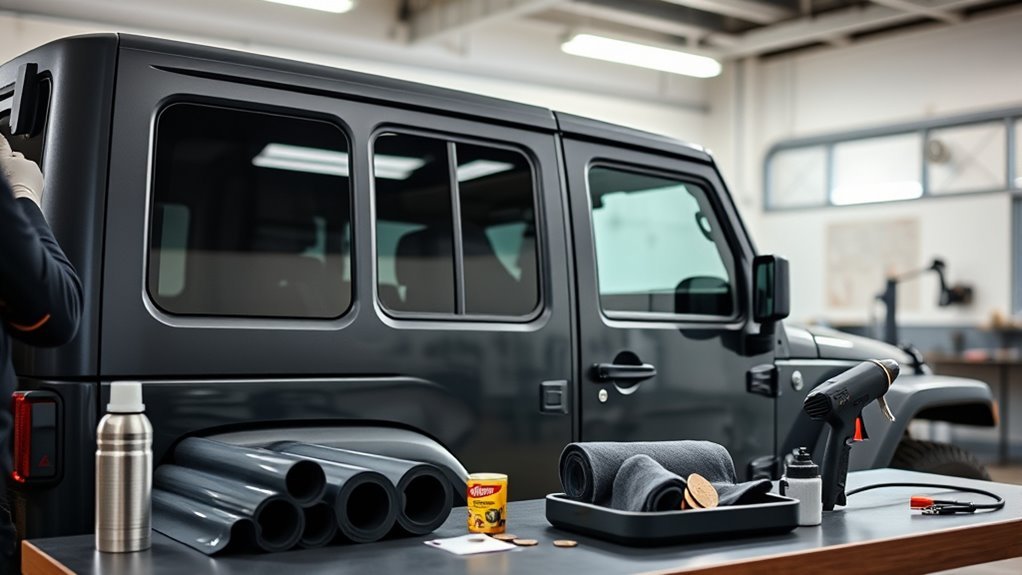
Jeep Wrangler window tint prices vary more than a single national average suggests. A two-window job may cost close to $100, while a four-door Wrangler with premium ceramic film, windshield coverage, or old-film removal can approach or exceed $900. Your body style, top configuration, film series, legal shade, and local labor market determine the final quote.
Quick Answer
Budget about $100–$250 to tint a Wrangler’s two front door windows, $200–$600 for a typical side-and-rear package, and $450–$900 for premium ceramic coverage. A windshield, visor strip, old-film removal, or a four-door body can increase the price. Always confirm which panes the quote includes.
Key Takeaways
- A two-door Wrangler generally costs less to tint than a four-door because it has fewer roll-down windows and less total glass.
- Dyed film is the budget choice, carbon or color-stable film is a useful middle tier, and ceramic film usually offers the strongest solar-heat control.
- A “full vehicle” quote may exclude the windshield, visor strip, roof glass, old-film removal, and sales tax.
- Standard automotive tint film is made for glass. Do not assume it can be installed on a Wrangler soft top’s pliable plastic windows.
- Tint laws regulate the completed glass-and-film combination, so have the installer verify final visible light transmission, or VLT.
At a Glance
| Time Required | About 1–2 hours for two front windows or 2–4 hours for a typical side-and-rear package; removal and windshield work can take longer |
| Difficulty | Moderate to difficult for DIY work; professional installation is recommended for clean edges, legal VLT, and warranty coverage |
| Tools Needed | For professional work: pattern-cutting equipment, slip solution, squeegees, edge tools, heat-shaping equipment, lighting, and a VLT meter |
| Cost | Approximately $100–$900 for most professional Wrangler jobs, depending on coverage and film; extensive removal or specialty work can cost more |
Jeep Wrangler Window Tint Price Snapshot
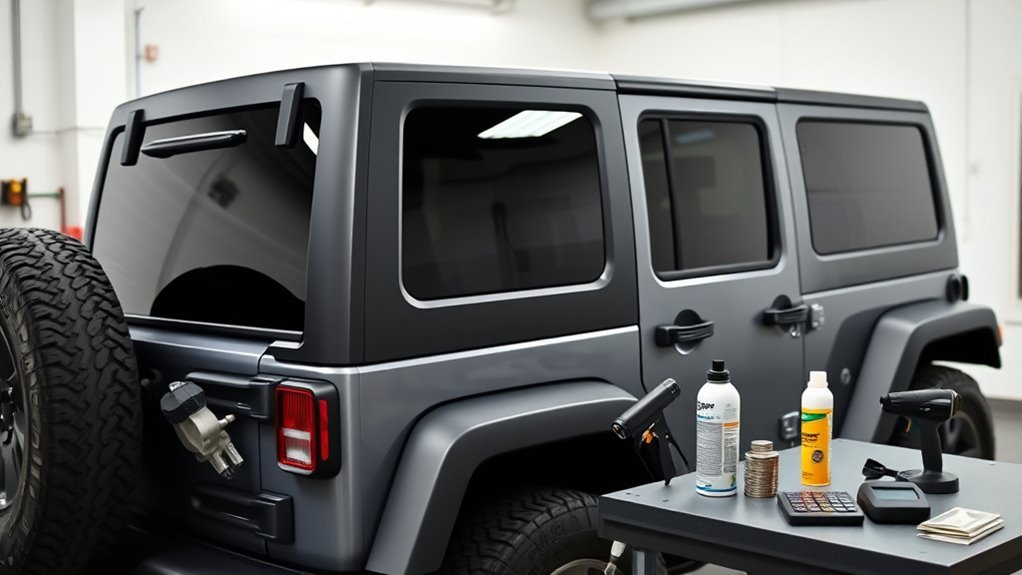
The following figures are broad 2026 budgeting ranges, not guaranteed national prices. Rates can be higher in expensive metro areas, for premium film lines, or when the installer includes windshield coverage and old-film removal.
| Coverage | Planning Range | What to Confirm |
|---|---|---|
| Two front door windows | $100–$250 | Film series, shade, edge finish, and whether it is matched to the rear privacy glass |
| Two-door side and rear glass | $200–$450 | Whether the rear hardtop quarter glass and liftgate glass are included |
| Four-door side and rear glass | $250–$600 | All four door windows, rear quarter glass, and rear liftgate glass |
| Premium ceramic side and rear package | $450–$900 | Exact manufacturer and film series—not merely the word “ceramic” |
| Full windshield film | $150–$350 | State legality, final VLT, optical clarity, and whether the film is clear or lightly tinted |
| Windshield visor strip | $50–$120 | Maximum permitted depth and the windshield’s AS-1 marking |
| Old-film removal | $75–$300+ | Number of panes, adhesive condition, and rear-defroster risk |
Ask the shop to identify every pane in writing. “Full tint” may mean only the side and rear glass at one shop, while another shop may include a visor strip or windshield. Sales tax and old-film removal may also be separate.
Pro Tip: Compare quotes only when they list the same Wrangler body style, glass coverage, film brand, film series, VLT shade, removal work, and warranty. A cheaper quote using an unnamed film is not directly comparable to an authorized premium-film installation.
Cost by Film Type: Dyed, Carbon, and Ceramic
Film labels are useful starting points, but they do not guarantee a specific performance level. Two ceramic films can have different visible-light transmission, total solar-energy rejection, infrared-energy rejection, color, and warranty coverage. Read the manufacturer’s data for the exact series and shade being installed.
| Film Type | Typical Wrangler Package Range | Best For | Main Tradeoff |
|---|---|---|---|
| Dyed | About $200–$400 | Appearance, privacy, glare reduction, and a lower upfront price | Usually less solar-heat control than higher-performance films |
| Carbon or color-stable | About $300–$600 | A balance of price, color stability, and heat control | Performance varies widely by brand and construction |
| Ceramic | About $450–$900 | Stronger solar-heat control, optical clarity, and non-metal construction | Highest initial price |
Infrared rejection is not the same as total solar-energy rejection. Compare identical measurements at the same VLT before deciding that one film is cooler than another.
Dyed Film: The Budget Option
Dyed film is usually the least expensive professional option. It can improve privacy, reduce visible glare, and change the Wrangler’s appearance without the premium price of a high-performance ceramic product.
Do not assume that every dyed film has the same UV protection or durability. Premium deep-dyed products can be more color-stable than low-cost surface-dyed films. Ask for the exact product name, data sheet, and written warranty rather than choosing only by price.
Dyed film makes the most sense when appearance and legal privacy are more important than maximum heat control. It may be less satisfying in very hot climates or on a Wrangler that spends long periods parked in direct sun.
Carbon or Color-Stable Film: The Middle Tier
Carbon and color-stable films commonly sit between entry-level dyed film and ceramic film. They may offer better color stability and solar performance than basic dyed products without reaching the highest ceramic price tier.
“Carbon” is not a single regulated performance grade. One manufacturer’s carbon film may perform differently from another product with the same label. Compare the film’s VLT, total solar-energy rejection, glare reduction, construction, and warranty rather than relying on the category name.
This tier is often a practical choice for owners who want more comfort than a basic appearance film but do not need the most expensive ceramic package.
Ceramic Film: Premium Heat Control
Ceramic automotive films use non-metal technology designed to reduce solar heat while maintaining clear visibility. For example, the 3M Ceramic IR Series advertises up to 95% infrared rejection and up to 66% total solar-energy rejection, depending on the shade and test method.
Those percentages cannot be applied to every ceramic film. A lightly tinted ceramic product may also have different results from a darker shade in the same line. Ask for a specification sheet that identifies:
- VLT: The percentage of visible light passing through the film-and-glass system.
- TSER: The percentage of total solar energy rejected across the broader solar spectrum.
- IRER or infrared rejection: Performance within a specified infrared wavelength range.
- UV rejection: The amount of ultraviolet radiation blocked within the manufacturer’s stated test range.
- Visible-light reflectance: How reflective the finished glass appears from inside and outside.
Ceramic film is usually worth considering in hot climates, for long daily commutes, or when you want high solar performance without a metallized film. It is not automatically the best value for a Wrangler used mainly in mild weather or driven with the top removed much of the year.
Coverage Costs: Front Windows, Rear Glass, and Windshield
The number of glass panes matters, but surface area and coverage definitions matter more. A four-door Wrangler has two additional roll-down door windows, while a hardtop adds fixed quarter glass and rear liftgate glass. The windshield is usually quoted separately.
- Front door windows: Often chosen to better match darker factory rear glass. The installer must still select a legal net VLT for your state.
- Side-and-rear package: May include the front and rear doors, hardtop quarter glass, and liftgate glass. Confirm each pane.
- Full windshield: Usually uses a clear or light high-performance film, but legality varies widely.
- Visor strip: A darker band near the top of the windshield. Permitted depth and position vary by jurisdiction.
- Roof glass: Only relevant when the specific vehicle has an actual glass roof panel. Many Wranglers do not have a conventional glass sunroof.
Warning: Windshield and front-side-window tint laws vary by state and may regulate VLT, reflectivity, tint color, visor-strip depth, stickers, and medical exemptions. Review your current state DMV or highway-patrol rules before authorizing the job. Federal glazing requirements do not replace state vehicle-use laws.
How VLT and Legal Tint Work
Visible light transmission, or VLT, is the percentage of visible light that passes through the completed window. A higher number means a lighter window. A 70% VLT window is much lighter than a 20% VLT window.
The shade printed on a film sample is not necessarily the final VLT after installation because the original glass already absorbs some light. As a rough illustration, installing nominal 50% film on glass that transmits 70% of visible light could produce a combined value near 35%:
0.50 × 0.70 = 0.35, or about 35% VLT.
This calculation is only an estimate. Glass specifications, film tolerances, and meter calibration affect the final reading. A qualified installer should meter the completed window when legal compliance is close to the limit.
The National Highway Traffic Safety Administration’s glazing guidance explains the federal framework for glazing installed by manufacturers, dealers, and repair businesses. State law remains the practical authority for how a registered vehicle may be used on public roads.
Factory Privacy Glass Versus Added Window Film
Many hardtop Wranglers have darker rear privacy glass from the factory. Privacy glass gets much of its dark appearance from color within the glass rather than an adhesive film layer. It may provide privacy and some solar control, but darkness alone does not prove strong heat rejection.
A nearly clear performance film can sometimes be installed over factory privacy glass to improve solar performance without making the rear windows dramatically darker. LLumar states that its clear automotive performance film is designed for glass that includes factory privacy glass.
Ask the installer to meter the existing rear glass before choosing film for the front windows. Matching the visible appearance may require a different nominal film shade than expected, and the finished front glass must remain legal.
Hardtop and Soft-Top Window Differences
A hardtop Wrangler uses automotive glass in its fixed rear quarter windows and liftgate. These panes can generally receive compatible automotive window film when the installer accounts for defroster lines, ceramic borders, seals, and the top’s removable design.
A factory soft top is different. Its rear and quarter windows are pliable plastic rather than ordinary automotive glass. The Jeep Wrangler owner’s manual warns that fabric-top plastic windows scratch easily and require special cleaning.
Note: Do not assume standard adhesive tint film can be applied to a Wrangler soft top’s plastic windows. It may adhere poorly, damage the plastic during removal, distort when the window flexes, or fall outside the film warranty. Use factory-tinted replacement panels or another solution approved by the top and film manufacturers.
Extra Charges: Removal, Windshield Work, and Special Preparation
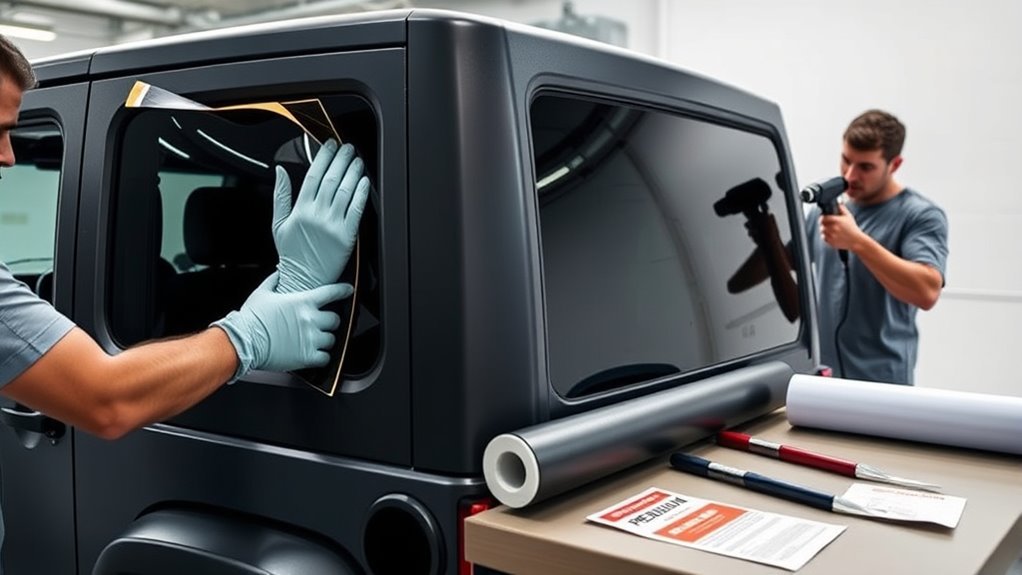
Old film is the most common extra charge. Removal becomes more expensive when the film is brittle, purple, bubbling, or covered with stubborn adhesive. Rear liftgate glass also requires care because aggressive scraping can damage defroster lines.
Other possible charges include:
- Full windshield film: More material, careful patterning, and strict optical-quality requirements.
- Visor strip: Usually a separate line item.
- Old adhesive cleanup: May take longer than peeling off the film itself.
- Small fixed panes: Some package prices exclude quarter glass or charge per pane.
- Premium film upgrade: Higher-performance film series cost more than the manufacturer’s entry-level line.
- Mobile installation: Travel or controlled-workspace fees may apply.
- Sales tax: Not every advertised price includes tax.
Wrangler glass is not unusually curved compared with many modern SUVs. The more relevant installation challenges are the removable top, tight seals, rear defroster, dot-matrix borders, existing contamination, and differences between glass and plastic top panels.
Do not assume a warranty is an optional $100–$200 add-on. Some manufacturers provide limited coverage when eligible film is installed and documented by an authorized dealer. Ask whether the quoted price includes both replacement film and installation labor for an approved claim.
Two-Door Versus Four-Door Wrangler Cost
A two-door Wrangler usually costs less because it has fewer roll-down door windows. A four-door Wrangler requires film and edge work on the rear doors as well as the front doors.
The price difference is not always dramatic. Fixed hardtop quarter glass and the rear liftgate still account for a meaningful part of the job on both body styles, and the selected film tier may have a greater effect on price than the extra two door windows.
Give the shop your Wrangler’s model year, body style, and top configuration before requesting a quote. A JK, JL, two-door, four-door, hardtop, soft top, and aftermarket top may require different patterns or coverage.
How Window Count and Glass Type Affect the Quote
Do not rely on a generic statement that a Wrangler has “five windows.” A quote may account for individual glass panels rather than openings, and the count changes with body style and top.
| Component | Pricing Effect |
|---|---|
| Two front door windows | Lowest common professional package |
| Four-door rear windows | Adds film, preparation, and edge-finishing time |
| Hardtop quarter glass | May be included in a full package or quoted separately |
| Rear liftgate glass | Larger pane with defroster lines; removal work can add cost |
| Windshield | Usually a separate premium add-on subject to legal limits |
| Soft-top plastic panels | Not ordinary tintable glass; requires a manufacturer-approved solution |
Choosing an Installer and Comparing Quotes
Installer workmanship affects contamination, edge quality, peeling, bubbles, scratches, and warranty support. Price matters, but the lowest quote can be expensive if the film must be removed and replaced.
Ask each shop these questions:
- What film will you install? Request the manufacturer, exact series, VLT shade, and performance data sheet.
- Which glass panels are included? List the front doors, rear doors, fixed quarter glass, liftgate, windshield, and visor strip separately.
- Is old-film removal included? Ask whether adhesive cleanup and rear-defroster care are part of the price.
- What will the finished VLT be? The shop should consider the original glass, not only the nominal film shade.
- Is the application legal here? Ask which current state rule applies to each pane.
- What does the warranty cover? Confirm bubbling, peeling, cracking, adhesive failure, discoloration, labor, transferability, exclusions, and required paperwork.
- Are you an authorized installer? Authorization may matter for manufacturer-backed claims.
- How should the tint be cared for? Obtain the drying period and cleaning instructions in writing.
Keep the final invoice, warranty card, film-series information, shade, installer details, and installation date. Some warranty claims require the original documentation. The 3M warranty resource, for example, directs customers to retain the applicable documentation and contact the installer for covered claims.
Installation Time and Aftercare
Two front windows may take about one to two hours. A typical side-and-rear package often takes two to four hours, while old-film removal, a full windshield, or difficult adhesive can turn the job into a longer appointment.
Freshly installed film may show temporary moisture pockets or haze while the mounting solution dries. Drying time depends on the product, weather, glass, and installation conditions. Follow the installer’s instructions instead of pressing on bubbles or trying to smooth the film yourself.
According to 3M’s automotive film care guidance, customers should avoid opening, closing, or cleaning newly tinted windows for at least 48 hours. After that period:
- Use a soft microfiber cloth.
- Use a nonabrasive cleaner approved for window film.
- Do not use razor blades, scrapers, hard brushes, or abrasive pads.
- Take care around the film edges when cleaning roll-down windows.
- Follow any product-specific instructions supplied by the installer.
Frequently Asked Questions
How much is window tinting for a Jeep Wrangler?
Expect roughly $100–$250 for the two front windows, $200–$600 for a common side-and-rear package, and $450–$900 for premium ceramic coverage. A windshield, old-film removal, a four-door body, or a high-cost local market can raise the total.
What is the best tint for a Jeep?
Ceramic film is often the best choice for strong solar-heat control and non-metal construction. Carbon or color-stable film can be a better value, while dyed film works for owners focused mainly on appearance and price. Compare the exact film series, data sheet, and warranty.
How much should a full tint job cost?
A Wrangler side-and-rear package commonly falls between $200 and $600. Premium ceramic work may cost $450–$900. Confirm whether “full” includes the windshield, quarter glass, rear liftgate, removal, tax, and warranty labor.
How long does it take to fully tint an SUV?
A standard professional job often takes two to four hours. Old-film removal, adhesive cleanup, windshield film, weather conditions, or complex preparation can extend the appointment.
Can you tint Jeep Wrangler soft-top windows?
Do not apply ordinary automotive glass film unless both the soft-top maker and film manufacturer approve it. Wrangler soft-top rear windows are pliable plastic, which can scratch, flex, distort, and be damaged during film removal. Factory-tinted replacement panels are usually the safer option.
Does factory privacy glass reject heat?
Factory privacy glass makes the rear windows darker, but darkness alone does not show how much total solar energy the glass rejects. A compatible clear or lightly tinted performance film may improve heat control while keeping a similar appearance.
Is full-windshield tint legal?
It depends on the state, the finished VLT, the film position, and any applicable exemption. Some states permit only a strip near the top, while others allow certain clear or light films. Check the current rule with your state DMV or highway-patrol authority before installation.
Conclusion
A realistic Jeep Wrangler tint budget starts near $100 for two front windows and can reach $900 or more for a four-door ceramic package with windshield work or film removal. Dyed film is the budget option, carbon or color-stable film offers a middle ground, and ceramic film generally provides the strongest solar performance.
Before booking, identify your model year, body style, and top type. Then compare itemized quotes for the same panes and exact film series. Confirm the completed VLT, current state law, manufacturer warranty, and whether the price includes removal and labor. Soft-top plastic windows require special care and should not be treated like hardtop glass.
Sources
- 3M Ceramic IR Series — ceramic-film infrared, solar-energy, UV, and non-metal performance information
- LLumar Clear Performance Film — performance film for factory privacy glass
- NHTSA Interpretation on Glazing and Aftermarket Tint — federal glazing and render-inoperative guidance
- 2024 Jeep Wrangler Owner’s Manual — soft-top plastic-window construction and care precautions
- 3M Automotive Film Product Care — post-installation window and cleaning guidance
- 3M Window Film Warranty Resources — warranty documentation and claim information

Leave a Reply