
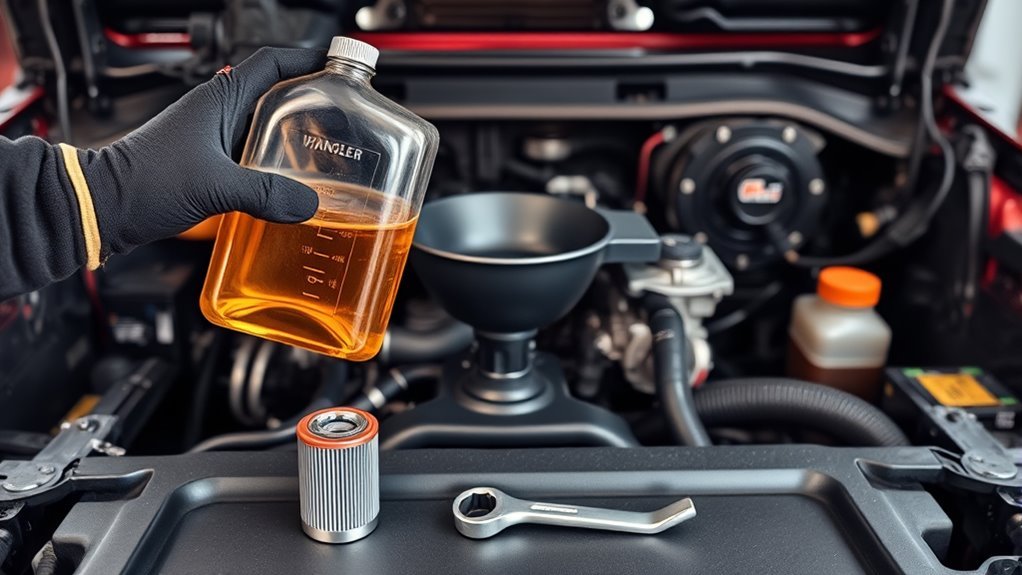
Jeep Wrangler oil capacity depends on the engine and generation, not simply the trim name. Common refill capacities range from 4 quarts in some older four-cylinder models to 9 quarts in the JL EcoDiesel. The biggest trap is the 2018 model year: a 2018 JK 3.6L takes 6 quarts with a filter, while a 2018 JL 3.6L takes 5 quarts.
Quick Answer
Most Jeep Wranglers take 4 to 6 quarts of engine oil, but the exact amount depends on the engine and generation. A 2018 JK 3.6L takes 6 quarts with a filter, while a 2018 JL 3.6L takes 5. The Wrangler 392 and JL EcoDiesel require 7.5 and 9 quarts.
Key Takeaways
- Identify the generation and engine first. JK, JL, TJ, and YJ Wranglers can use different capacities and viscosities.
- Do not treat every 2018 Wrangler alike. The 2018 JK 3.6L uses 6 quarts; the 2018 JL 3.6L uses 5 quarts.
- Use the viscosity on the oil cap and in the model-year manual. Meeting the correct material standard does not make every viscosity interchangeable.
- The published capacity is a starting refill amount. Finish by checking the dipstick on level ground after the engine has been shut off for the specified time.
- Replace the filter, check for leaks, and recycle the used oil.
At a Glance
| Time Required | About 30–60 minutes, plus time for safe setup and cleanup |
| Difficulty | Easy to intermediate |
| Tools Needed | Drain pan, correct wrench or socket, torque wrench, funnel, gloves, eye protection, wheel chocks, and approved ramps or jack stands if lifting is required |
| Cost | The cost of one filter and 4–9 quarts of the specified oil; shop labor is extra |
Jeep Wrangler Oil Capacity by Generation and Engine
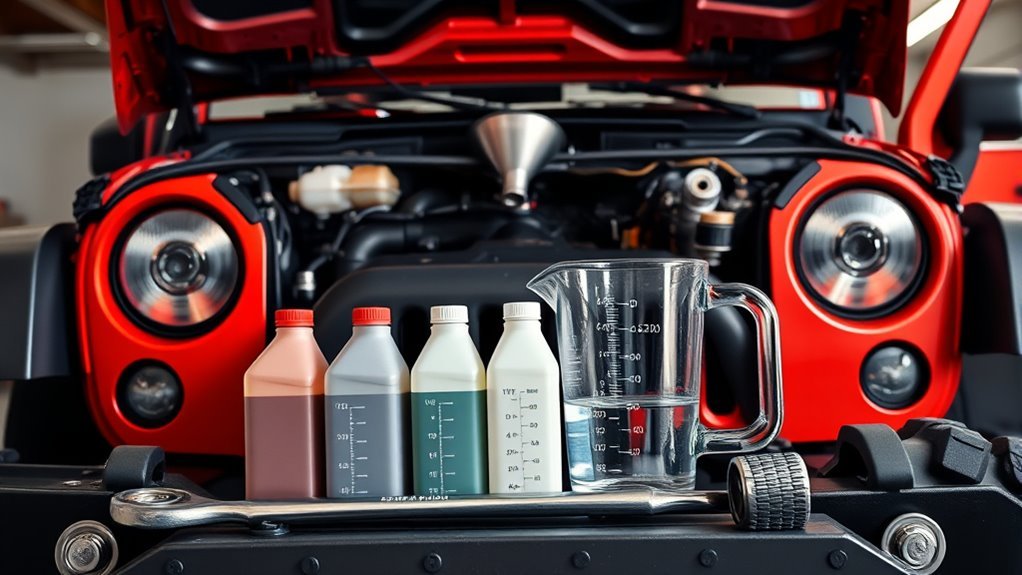
The following figures are common U.S.-market refill capacities with a new oil filter. Confirm the exact specification for your VIN and model year before servicing the vehicle. Current official Wrangler documentation lists 5 quarts for the 2.0L, 5 quarts for the 3.6L, and 7.5 quarts for the 6.4L. See the 2025 Jeep Wrangler Owner Handbook for the current manufacturer table.
| Generation and Years | Engine | Oil With Filter | Important Note |
|---|---|---|---|
| YJ, 1987–1995 | 2.5L four-cylinder | 4 quarts | Verify the year-specific viscosity because older recommendations vary by year and temperature. |
| YJ, 1987–1995 | 4.0L or 4.2L six-cylinder | 6 quarts | Confirm the engine before buying oil; displacement changed during the YJ generation. |
| TJ, 1997–2002 | 2.5L four-cylinder | 4 quarts | Check the dipstick after filling because retained oil can affect the final reading. |
| TJ, 1997–2006 | 4.0L six-cylinder | 6 quarts | This common six-quart specification is why “all older Wranglers take five quarts” is incorrect. |
| TJ, 2003–2006 | 2.4L four-cylinder | 5 quarts | Do not confuse this engine with the earlier 2.5L four-cylinder. |
| JK, 2007–2011 | 3.8L V6 | 6 quarts | The official 2011 guide specifies 6 quarts with a filter. |
| JK, 2012–2018 | 3.6L Pentastar V6 | 6 quarts | The 2018 JK still uses 6 quarts even though the all-new 2018 JL uses 5. |
| JL, 2018 and later | 2.0L turbo gasoline, including the 4xe engine-oil circuit | 5 quarts | The 4xe also has separate high-voltage cooling systems that are not part of an engine-oil change. |
| JL, 2018 and later | 3.6L Pentastar V6 | 5 quarts | Do not use the six-quart JK specification for a JL. |
| JL, 2020–2023 | 3.0L EcoDiesel V6 | 9 quarts | Use the diesel supplement and diesel-specific oil specification. |
| JL Wrangler 392, 2021 and later applications | 6.4L HEMI V8 | 7.5 quarts | Requires the specified 0W-40 full-synthetic oil, not the oil used in the 3.6L. |
Note: Capacities normally describe a refill with a new filter. Oil may remain in galleries or other engine passages, so the final dipstick reading—not an extra “rounding” quart—determines whether more oil is needed.
A 2018 Wrangler can be either a JK or a JL. The 3.6L JK takes 6 quarts with a filter; the 3.6L JL takes 5.
How to Confirm Your Wrangler’s Engine and Specification
Do not order oil from the trim name alone. Rubicon, Sahara, Sport, and Willys models can be equipped with different engines. Use the following checks before removing the drain plug:
- Confirm the model year and generation. The clearest visual distinction is usually JK versus JL, but 2018 requires extra care because both were sold.
- Identify the engine. Check the emissions label under the hood, the oil-filler cap, purchase records, or the engine information associated with the VIN.
- Open the exact owner’s manual or supplement. Use the fluid-capacity and engine-fluids sections rather than a generic parts listing.
- Check the oil cap. The cap normally shows the required SAE viscosity, but the manual also supplies the required manufacturer and API specification.
- Buy the correct filter. Filter design can change by engine and model year even when two Wranglers use the same number of quarts.
Jeep directs owners to its online owner-information resources for vehicle-specific manuals. The official Mopar vehicle-information site is the safest starting point when the paper manual is missing.
Correct Oil Type and Viscosity
Oil capacity and oil viscosity are separate specifications. An oil can meet Chrysler or Stellantis material standard MS-6395 and still have the wrong viscosity for a particular Wrangler. Follow the exact SAE grade printed on the oil cap and listed in the manual.
| Application | Common Manufacturer Specification |
|---|---|
| 2007–2011 JK 3.8L | SAE 5W-20 meeting MS-6395; verify the oil cap and year-specific manual. |
| 2012 JK 3.6L | SAE 5W-30 meeting MS-6395 in the official 2012 guide. |
| Later JK 3.6L, including 2018 | SAE 5W-20 meeting MS-6395 in the 2018 JK guide. |
| 2018 JL 3.6L | SAE 0W-20 meeting MS-6395. |
| JL 2.0L turbo and 4xe gasoline engine | SAE 5W-30 full synthetic meeting MS-13340 and the API category stated in the model-year manual. |
| JL 3.0L EcoDiesel | SAE 5W-40 synthetic meeting the diesel supplement’s required specifications. |
| JL 6.4L Wrangler 392 | SAE 0W-40 full synthetic meeting MS-A0921. |
The official 2018 Wrangler JL manual specifies 0W-20 for its 3.6L, while the separate 2018 Wrangler JK guide specifies 5W-20 for its 3.6L. This is another reason not to search by “2018 Wrangler 3.6L” without confirming the generation.
Pro Tip: Photograph the oil cap, emissions label, manual capacity page, and filter part number before shopping. That simple record prevents most year-and-engine mix-ups during future services.
How to Change Jeep Wrangler Engine Oil and Filter
Warning: Hot engine oil can cause serious burns. Let the exhaust and oil cool enough to handle safely. Chock the wheels, set the parking brake, and never work beneath a vehicle supported only by a jack. Use approved ramps or jack stands on firm, level ground.
- Verify the specification. Confirm the engine, refill capacity, viscosity, material standard, filter, drain-plug torque, and whether the plug uses a replaceable sealing washer.
- Warm the oil briefly. A short drive helps the oil drain, but do not begin while the oil or exhaust is dangerously hot.
- Park safely. Use level ground, apply the parking brake, chock the wheels, and lift the Wrangler only if access requires it.
- Position the drain pan. Wear gloves and eye protection. Remove the oil-filler cap, then carefully remove the drain plug.
- Let the oil drain fully. Inspect the plug and sealing surface. Replace a damaged plug or required sealing washer.
- Reinstall the drain plug. Tighten it to the exact specification for the model and oil-pan design. Do not guess or overtighten it.
- Replace the oil filter. Remove the old filter or cartridge, confirm the old gasket is not stuck in place, lubricate the new seal with clean oil when required, and install it according to the filter and vehicle instructions.
- Add most of the specified oil. Start about one-quarter to one-half quart below the published refill amount when practical. This leaves room for oil that may remain in the engine.
- Start the engine briefly. Confirm that the oil-pressure warning goes out normally. Shut the engine off and inspect the filter housing and drain plug for leaks.
- Check the level. Wait the time stated in the manual—commonly about five minutes after shutting off a warmed engine—then check the dipstick on level ground.
- Top up in small amounts. Add about one-quarter quart at a time and recheck. Stop when the level is within the safe or full range; do not pour in an extra quart merely because one remains in the bottle.
- Reset the oil-life indicator. Follow the model-year procedure only after the oil and filter have actually been changed.
- Recycle the oil and filter. Transfer used oil to a clean, leak-proof container with a secure lid and take it to an approved collection location.
Check and Correct High or Low Oil Safely
To obtain an accurate reading, park on level ground and follow the timing procedure in the owner’s manual. The 2018 JL manual directs owners to check about five minutes after a warmed engine has been shut off.
- Remove the dipstick and wipe it clean.
- Insert it fully, then remove it again without turning it upside down.
- Read both sides. Use the lower consistent reading if oil has smeared up one side of the stick.
- If low, add the exact approved oil in small increments and recheck.
- If high, do not keep driving without determining how far above the safe range it is and why.
If the engine is overfilled, let it cool and remove a measured amount with a suitable oil extractor or by carefully draining a small amount into a clean pan. Reinstall and torque the drain plug correctly before restarting the engine. A repair shop can correct the level when safe access or the proper equipment is unavailable.
The manufacturer warns that overfilling or underfilling can cause oil aeration or loss of oil pressure and may damage the engine. Do not assume an oil-pressure warning light is simply a low-level reminder. If the warning remains on while the engine is running, shut the engine off as soon as it is safe and investigate the cause.
2018 Jeep Wrangler JK Versus JL
The 2018 model year deserves its own check because Jeep sold the outgoing JK and the all-new JL at the same time.
- 2018 Wrangler JK 3.6L: 6 quarts with a filter and SAE 5W-20 meeting MS-6395.
- 2018 Wrangler JL 3.6L: 5 quarts with a filter and SAE 0W-20 meeting MS-6395.
- 2018 Wrangler JL 2.0L turbo: 5 quarts with a filter and the manual-specified 5W-30 full-synthetic oil.
Do not rely on the word “Rubicon” to choose between these specifications. Rubicon is a trim, and both generation and engine determine the oil requirement.
Older Wranglers: Oil Capacity and Trac-Lok Clarification
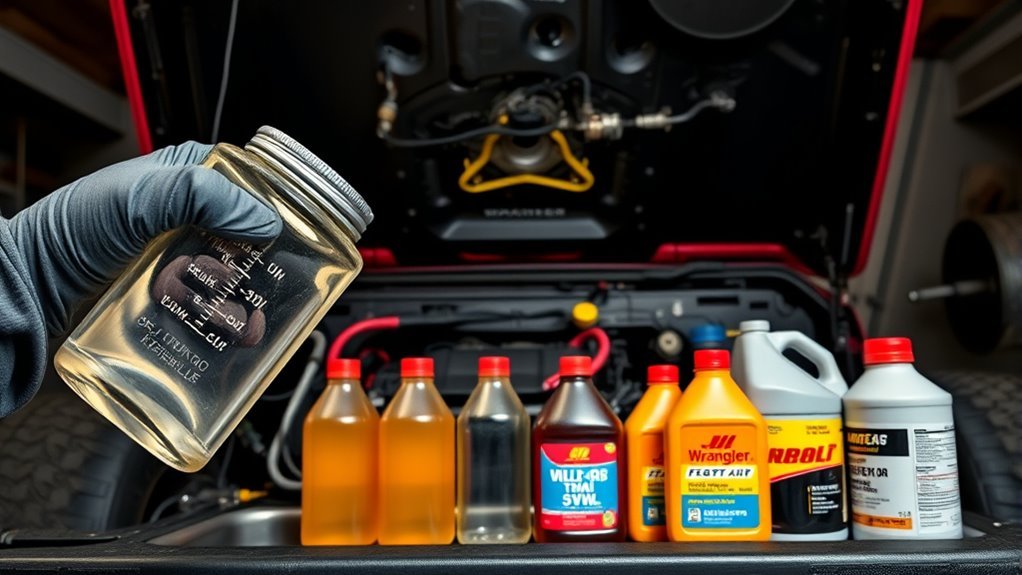
Older Wrangler capacities vary mainly by engine. Common YJ and TJ four-cylinder engines use 4 or 5 quarts, while the 4.0L and 4.2L six-cylinder engines commonly use 6 quarts. Oil-viscosity recommendations can vary with the model year and temperature range, so use the original manual rather than applying a modern JL specification to an older engine.
Trac-Lok is a limited-slip differential system, not part of the engine-lubrication system. Some Trac-Lok axles require friction-modifier additive in the differential gear oil. The required axle-fluid grade and additive amount depend on the axle, model year, and operating conditions. For example, the official 2011 Wrangler guide lists 80W-90 rear-axle lubricant for normal service and 75W-140 for trailer towing.
Warning: Never put limited-slip friction modifier, gear oil, transmission fluid, or another drivetrain additive into the engine crankcase. Engine oil and differential lubricant are separate fluids with different specifications.
Oil-Change Intervals and Severe Use
There is no single interval that applies to every Wrangler generation. Modern JL models use an automatic oil-change indicator that adjusts for operating conditions. The 2024 Wrangler Owner Handbook states that covered 2.0L and 3.6L oil-change intervals must not exceed 10,000 miles, 12 months, or 350 engine hours, whichever comes first.
The indicator may request service sooner when the Wrangler regularly experiences:
- Dusty trails or frequent off-road driving
- Extended idling or low-speed operation
- Frequent short trips
- Trailer towing or heavy loads
- Very hot or very cold temperatures
- Repeated water, mud, or sand exposure
Older JK, TJ, and YJ maintenance schedules differ. Follow the interval in the exact model-year manual rather than applying the current JL limit or an arbitrary 3,000-mile rule. Synthetic oil does not automatically extend the manufacturer’s required interval.
Dealer Versus DIY Oil Service
A dealer, independent shop, or owner can perform a correct oil change, and any of them can make a measuring or identification error. The best protection is documentation and verification rather than assuming a particular service provider is always right.
- Write the engine, capacity, viscosity, filter number, mileage, and date on the service record.
- Ask the shop to list the oil grade and quantity on the invoice.
- Check the dipstick after the vehicle has rested on level ground.
- Inspect the drain plug, filter area, and parking spot for leakage.
- Save receipts when maintenance records may affect warranty or resale documentation.
DIY service can reduce labor cost and lets you verify every step, but only when you have safe lifting equipment, the correct torque information, and an approved way to recycle the used oil.
Frequently Asked Questions
How many quarts does a Jeep Wrangler 3.6L take?
A 2012–2018 Wrangler JK 3.6L takes 6 quarts with a new filter. A 2018-and-later Wrangler JL 3.6L takes 5 quarts. Confirm whether a 2018 vehicle is a JK or JL before filling it.
Can I put 5W-30 in my Jeep Wrangler?
Use 5W-30 only when the oil cap and model-year manual specify it. A 2012 JK 3.6L used 5W-30, but a 2018 JK 3.6L specifies 5W-20 and a 2018 JL 3.6L specifies 0W-20. Meeting MS-6395 alone does not make the wrong viscosity appropriate.
How long should I wait before checking the oil?
Follow the exact manual. For the 2018 JL, Jeep instructs owners to check about five minutes after shutting off a warmed engine while the vehicle is on level ground. Wipe the dipstick, insert it fully, and read it again.
What happens if a Jeep Wrangler is overfilled with oil?
Too much oil can be aerated by moving engine parts and may cause an incorrect level, oil-pressure problems, leakage, or engine damage. Remove a measured amount safely and recheck the level instead of waiting for the engine to consume the excess.
How much engine oil does a Wrangler 4xe take?
The 2.0L gasoline engine in the Wrangler 4xe uses 5 quarts with a filter in current official capacity tables. The hybrid battery and power-electronics cooling circuits are separate systems and are not serviced as part of an engine-oil change.
Does a Jeep Wrangler need synthetic oil?
Use synthetic oil when the model-year manual requires it. JL 2.0L turbo, EcoDiesel, and 6.4L 392 applications specify synthetic oil. For other engines, the oil still must have the correct SAE viscosity, API approval, and manufacturer material standard.
Conclusion
Jeep Wrangler oil capacity cannot be reduced to one five- or six-quart answer. Common YJ and TJ engines use 4–6 quarts, JK V6 engines use 6 quarts, JL 2.0L and 3.6L engines use 5 quarts, the Wrangler 392 uses 7.5 quarts, and the JL EcoDiesel uses 9 quarts. Verify the engine and generation, use the exact viscosity and approval standard, replace the filter, and finish by checking the dipstick on level ground.
The 2018 split deserves special attention: the 3.6L JK uses 6 quarts and 5W-20, while the 3.6L JL uses 5 quarts and 0W-20. Correct identification is more reliable than guessing from the trim name or relying on a blanket Pentastar specification.
Sources
- 2025 Jeep Wrangler Owner Handbook — current 2.0L, 3.6L, and 6.4L oil capacities and lubricant specifications
- 2018 Jeep Wrangler JL Owner’s Manual — JL fluid capacities, 3.6L 0W-20 specification, level-check procedure, and overfill warning
- 2018 Jeep Wrangler JK User’s Guide — JK six-quart capacity and 5W-20 specification
- 2012 Jeep Wrangler User’s Guide — 3.6L JK six-quart capacity and 5W-30 specification
- 2020 Jeep Wrangler 3.0L Diesel Supplement — EcoDiesel nine-quart capacity and diesel-oil specification
- U.S. Environmental Protection Agency: Managing, Reusing, and Recycling Used Oil — safe collection and recycling of used oil and filters





Leave a Reply