

Car safety has changed from simple occupant restraints into a layered system that helps prevent crashes, protects people during impact, and supports drivers after danger is detected. The biggest gains have come from proven basics such as seat belts, airbags, stronger passenger compartments, better tires and brakes, electronic stability control, and carefully tested driver-assistance features.
Quick Answer
Car safety evolved through three layers: crash prevention, occupant protection, and post-crash response. Seat belts and airbags remain essential, while ESC, AEB, blind-spot warning, stronger crash structures, and better testing reduce specific risks. Newer automated and connected systems may add protection, but they do not replace an attentive driver.
Key Takeaways
- Three-point seat belts, airbags, controlled crumple zones, and strong occupant compartments form the core of crash protection.
- ESC, ABS, forward-collision warning, AEB, lane-departure warning, and blind-spot monitoring target different crash types; no single feature prevents every crash.
- Federal safety standards set minimum requirements, while NHTSA and IIHS tests help shoppers compare performance beyond those minimums.
- Most consumer vehicles still use driver-assistance systems, not fully autonomous driving. The driver must supervise the vehicle and understand each feature’s limits.
- For Nevada driving, prioritize proven crash-prevention features, good headlights, reliable tires, and systems that remain useful on long rural highways, in extreme heat, and during mountain winter weather.
Car Safety History and Major Milestones

Vehicle safety developed in stages. Early work focused on understanding what happened to a car and its occupants in a collision. Later advances added stronger structures, restraints, electronic controls, consumer crash ratings, and systems that can warn the driver or brake automatically.
- 1934: General Motors reports conducting the industry’s first barrier-impact and rollover tests to study crash injuries.
- 1959: Volvo engineer Nils Bohlin introduced the modern three-point safety belt as standard equipment in selected Volvo models. Volvo later made the design broadly available so other manufacturers could use it.
- 1966-1968: The U.S. National Traffic and Motor Vehicle Safety Act of 1966 created the framework for federal motor-vehicle safety regulation. New vehicles manufactured from 1968 onward had to comply with applicable Federal Motor Vehicle Safety Standards.
- 1978: NHTSA began its New Car Assessment Program, initially testing frontal-impact protection. The familiar 5-Star Safety Ratings system followed in 1993.
- Late 20th century: Airbags, anti-lock brakes, improved side-impact structures, head restraints, and child-restraint requirements became more common and more effective.
- Model year 2012: Electronic stability control became required on nearly all new U.S. light vehicles under FMVSS No. 126.
- 2020s: AEB, pedestrian detection, blind-spot intervention, lane support, improved crash dummies, software-based safety functions, and connected-vehicle research expanded the meaning of vehicle safety.
The result is a layered approach. Passive safety limits injury when a crash occurs. Active safety helps the driver avoid or reduce the severity of a crash. Post-crash safety includes fuel-system integrity, automatic emergency calling, door access, and safe shutdown of high-voltage systems in electrified vehicles.
How Seat Belts and Airbags Protect Passengers
Seat belts and airbags work together, but they do different jobs. A seat belt restrains the occupant, spreads crash forces across stronger parts of the body, and reduces the chance of ejection. An airbag is a supplemental restraint that cushions contact with the steering wheel, dashboard, door, or side structure in certain crashes.
- Seat belts keep occupants in the survival space: NHTSA reports that lap-and-shoulder belts reduce the risk of fatal injury to front-seat passenger-car occupants by about 45% and moderate-to-critical injury by about 50%.
- Airbags add protection: Frontal and side airbags are designed to deploy only in crashes that meet their sensing thresholds. They are most effective when occupants are properly belted and seated.
- Position matters: The belt should lie across the shoulder and chest, with the lap portion low across the hips. Sitting too close to an airbag or placing a child in the wrong seating position can increase injury risk.
- Modern systems are tailored: Vehicles may use frontal, side-torso, curtain, knee, center, and seat-mounted airbags, but the number and location vary by model and seating position.
A properly worn lap-and-shoulder belt cuts fatal-injury risk for front-seat passenger-car occupants by about 45%, making seat-belt use one of the most effective vehicle-safety actions available.
Warning: Never place a rear-facing child restraint in front of an active frontal airbag. NHTSA recommends that children younger than 13 ride properly restrained in the back seat. Always follow the child-seat and vehicle manuals.
Key Active Car Safety Features for Crash Prevention
Active safety systems address different hazards. Their benefits depend on road conditions, sensor performance, vehicle speed, system design, and whether the driver keeps the feature enabled.
- Electronic stability control (ESC): Detects when the vehicle is not following the driver’s intended path and selectively applies braking to help reduce skids and loss-of-control crashes.
- Anti-lock braking system (ABS): Prevents sustained wheel lock during hard braking so the driver can usually retain steering control. On ABS-equipped vehicles, press the brake firmly and hold it rather than pumping the pedal.
- Forward-collision warning (FCW): Alerts the driver when the system detects a likely frontal conflict.
- Automatic emergency braking (AEB): Applies braking when a frontal crash appears imminent and the driver has not responded enough. Some systems also detect pedestrians or cyclists.
- Lane-departure warning and lane-keeping assistance: Warn when the vehicle drifts over a detected lane marking and may provide steering support. These systems can struggle with faded lines, snow, glare, construction zones, or sharp curves.
- Blind-spot warning and intervention: Monitors adjacent lanes and warns of vehicles that may be difficult to see. Intervention systems may add steering or braking support, but drivers still need to check mirrors and look over the shoulder.
- Rear cross-traffic alert and rear automatic braking: Help detect crossing traffic or obstacles while backing. They supplement, rather than replace, direct observation and a slow backing speed.
- Adaptive headlights and automatic high beams: Improve visibility by changing beam direction or switching beam intensity when conditions allow.
Note: Feature names are not standardized. Two vehicles may use the same marketing term but behave differently. Read the owner’s manual and test the alerts, controls, and disengagement behavior before relying on any system.
Crash Testing and Vehicle Safety Standards
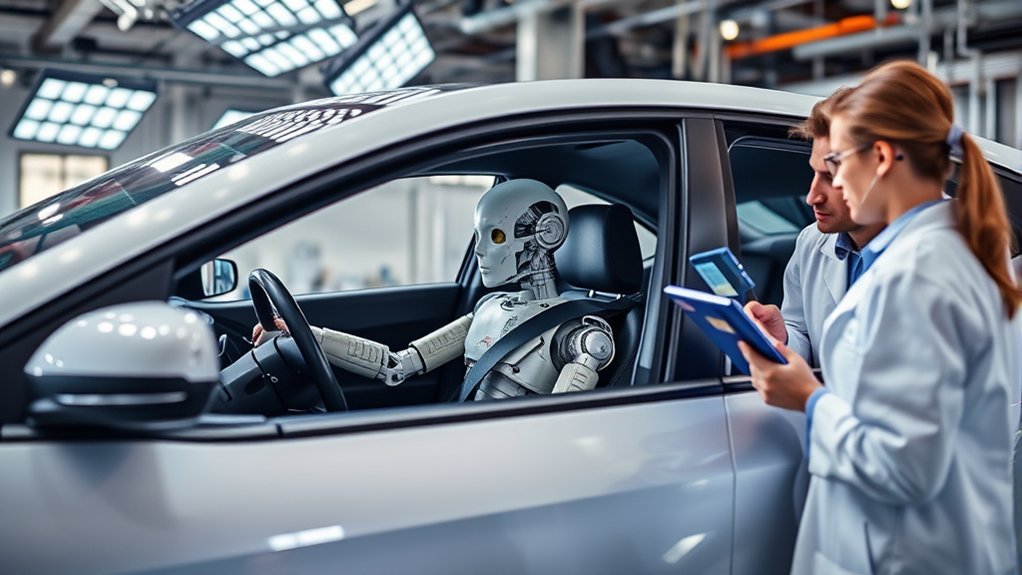
Crash tests serve two different purposes. Federal Motor Vehicle Safety Standards are legal requirements that new vehicles and equipment must meet. Consumer rating programs compare performance and encourage manufacturers to exceed minimum requirements.
- FMVSS compliance tests: NHTSA sets performance requirements for areas such as occupant protection, braking, lighting, roof strength, electronic stability control, and fuel-system integrity.
- NHTSA 5-Star Safety Ratings: The New Car Assessment Program evaluates frontal, side, and rollover performance and publishes consumer information for new vehicles.
- IIHS evaluations: The Insurance Institute for Highway Safety conducts additional crashworthiness, headlight, and crash-avoidance tests that do not duplicate every NHTSA procedure.
- Instrumented dummies and test devices: Sensors measure forces, movement, and injury criteria. Test tools continue to evolve to represent more occupants, seating positions, and crash modes.
- Real-world data: Police reports, insurance claims, naturalistic driving studies, and in-depth crash investigations help determine whether a feature works outside the laboratory.
What Safety Ratings Can and Cannot Tell You
A high rating is useful evidence, but it is not a guarantee that no one will be injured. Crash outcomes also depend on speed, impact angle, vehicle size and compatibility, occupant age and position, restraint use, road design, and emergency response.
Compare ratings for the exact model year, body style, drivetrain, and equipment package. A mid-cycle redesign or optional safety package can change a vehicle’s performance. Also check whether a rating applies to every trim or only to vehicles built after a certain date.
How ADAS Affects Real-World Road Safety
Well-designed driver-assistance systems reduce the crash types they are built to address, but broad claims about eliminating crashes are not supported. IIHS research has found that FCW with AEB reduces police-reported rear-end crashes by about 50%, while FCW alone reduces them by about 27%. Lane-departure warning has been associated with an 11% reduction in relevant single-vehicle, sideswipe, and head-on crashes, and blind-spot monitoring with a 14% reduction in lane-change crashes.
NHTSA’s FMVSS No. 127 rule calls for AEB, pedestrian AEB, and FCW on new light vehicles, with major compliance dates beginning in September 2029. NHTSA projects the standard could save at least 360 lives and prevent at least 24,000 injuries each year once the affected fleet is in service. Those figures are projected benefits of the rule, not a count of injuries already prevented each year.
Results vary by manufacturer, model year, target type, speed, lighting, weather, and driver use. A system that performs well against another passenger car may be less effective when approaching a motorcycle, large truck, pedestrian, or object at an unusual angle.
Pro Tip: During a test drive, check whether alerts are clear without being distracting, whether lane support feels predictable, and whether the vehicle lets you adjust warning timing. A feature that is regularly switched off provides little real-world benefit.
Driver-Assistance Limitations and Maintenance
Driver-assistance systems are not substitutes for safe speed, adequate following distance, good tires, clear visibility, or an attentive driver. Cameras can be blocked by dirt, snow, stickers, windshield damage, glare, darkness, or heavy rain. Radar and ultrasonic sensors can be affected by ice, bumper damage, accessories, or poor calibration.
- Keep camera areas, radar covers, lights, and sensors clean.
- Follow the manufacturer’s calibration procedures after windshield replacement, collision repair, wheel-alignment work, suspension changes, or bumper removal.
- Install safety-related software updates and complete recalls promptly.
- Do not assume lane-centering or adaptive cruise control can handle construction zones, emergency scenes, sharp curves, stopped vehicles, or every weather condition.
- Know how to cancel the system immediately with steering, braking, acceleration, or a dedicated control.
Warning: A warning light, camera error, recent collision, replacement windshield, or misaligned bumper can mean a safety system is unavailable or improperly calibrated. Have the vehicle inspected by a qualified repair facility rather than assuming the feature will work.
How Autonomous Vehicles May Transform Road Safety
Automated driving has the potential to reduce some crashes, but the outcome depends on system design, testing, operational limits, cybersecurity, maintenance, roadway conditions, and interactions with human road users. Most systems available to U.S. consumers today are driver-assistance systems that require continuous supervision, not vehicles that can drive anywhere without a human.
Enhanced Collision-Avoidance Systems
Highly automated vehicles may combine cameras, radar, lidar, maps, positioning, vehicle-motion sensors, and onboard computing. Safe designs also need redundancy, fault detection, a defined operational design domain, and a minimal-risk response when the system cannot continue.
- Automatic emergency braking: Can reduce speed or avoid certain frontal conflicts.
- Driver or occupant monitoring: Helps determine whether a supervising driver is attentive when supervision is required.
- Lane and path planning: Uses road geometry and surrounding-object data to select a safe path within system limits.
- Vehicle-to-everything communication: May provide information that onboard sensors cannot see, such as a signal phase or a vehicle hidden beyond an obstruction.
These functions can improve safety only when they are validated for the conditions in which they operate and fail safely when their limits are reached.
Reducing Driver-Related Crash Factors
The often-repeated claim that “94% of crashes are caused by human error” misstates an older NHTSA study. That study assigned the critical reason for the final event in a limited sample of crashes to the driver in 94% of cases; it did not determine that drivers were the sole cause of 94% of all crashes. Road design, vehicle condition, weather, visibility, system design, and other factors can also contribute.
Automation may reduce distraction, impairment, speeding, delayed reactions, and other driver-related risks in some situations. It can also introduce new risks, including sensor failure, software faults, poor handoffs between automation and drivers, unexpected behavior around vulnerable road users, and confusion about what the system can do.
In June 2026, UNECE’s World Forum for Harmonization of Vehicle Regulations adopted a global regulatory framework for fully autonomous driving systems based on safety management, testing, safety cases, and in-service monitoring. Adoption of a framework does not mean fully autonomous vehicles are suddenly available for unrestricted consumer use in every country.
Potential Traffic-Flow Benefits
Connected and automated vehicles may smooth acceleration, maintain steadier gaps, coordinate at intersections, and reduce some stop-and-go waves. Those benefits are not automatic. They depend on system behavior, the share of equipped vehicles, road design, traffic demand, communications coverage, and how automated vehicles interact with conventional vehicles, pedestrians, and cyclists.
Efficiency claims should therefore be treated as potential benefits rather than guaranteed fuel or travel-time savings.
Future Vehicle Safety With V2X Communication

Vehicle-to-Everything communication allows equipped road users and infrastructure to exchange safety messages. The main categories are vehicle-to-vehicle (V2V), vehicle-to-infrastructure (V2I), vehicle-to-pedestrian or vulnerable-road-user devices (V2P), and vehicle-to-network services (V2N).
Potential uses include warnings about a vehicle braking beyond the driver’s line of sight, an unsafe left turn, a red-light violation, a work zone, a wrong-way driver, poor road conditions, or a pedestrian obscured by another vehicle. V2X can extend awareness beyond the range and line of sight of onboard cameras and radar.
An older U.S. estimate suggested connected-vehicle applications could potentially address up to about 82% of crash scenarios involving unimpaired drivers. That estimate describes scenarios the technology might address; it is not evidence that current V2X deployments have already reduced total crashes by 80%.
Deployment still depends on broad equipment adoption, interoperable message standards, accurate positioning, privacy protection, cybersecurity, spectrum rules, infrastructure investment, and maintenance. The FCC finalized U.S. C-V2X spectrum rules in 2024, and the U.S. Department of Transportation continues to support staged deployment.
Choosing a Vehicle With the Right Safety Features
A safer purchase starts with verified test results and an exact equipment check, not a long list of marketing terms. Use this process for a new or used vehicle:
- Check the exact vehicle: Confirm model year, body style, drivetrain, build date, trim, and optional safety package.
- Review NHTSA and IIHS results: Look at crashworthiness, headlights, pedestrian protection, and crash-avoidance performance rather than relying on one overall score.
- Prioritize proven features: Seat belts with reminders, ESC, AEB with pedestrian detection, blind-spot warning, rear cross-traffic alert, lane-departure warning, and strong headlights are practical priorities.
- Check recalls by VIN: Use NHTSA’s recall lookup and confirm that open recalls have been completed.
- Test seating and visibility: Make sure the head restraint, belt fit, mirrors, controls, and child-restraint anchors work for the people who will use the vehicle.
- Ask about repair and calibration costs: Windshields, bumpers, mirrors, radar units, and cameras can make collision repairs more expensive and may require calibration.
- Read the manual: Confirm each system’s speed range, target limitations, weather limits, warning settings, and driver responsibilities.
Assessing Advanced Safety Technologies
Automatic emergency braking deserves special attention because performance can differ against vehicles, pedestrians, cyclists, motorcycles, and large trucks. Look for independent test results that include daytime and nighttime scenarios. For lane and blind-spot systems, confirm whether the feature only warns or can also intervene.
Do not overlook fundamentals. Good tires, predictable braking, clear headlights, a comfortable driving position, and direct outward visibility may matter every day, while a poorly understood automated feature may be used rarely or switched off.
Safety Features for Nevada Driving Conditions
Nevada drivers face long rural routes, high summer temperatures, dust and wind, sudden rain and flash flooding, urban pedestrian traffic, and winter ice or snow in mountain areas. ESC, AEB, lane-departure warning, blind-spot monitoring, strong headlights, tire-pressure monitoring, and dependable climate control can all be useful, but they cannot overcome worn tires or excessive speed.
For winter travel, the Nevada Department of Transportation advises checking road conditions through Nevada 511 or NV Roads, carrying appropriate emergency supplies, reducing speed, increasing following distance, and turning off cruise control on snow or ice. During heavy rain, avoid flooded roads and do not rely on driver-assistance sensors to judge water depth.
Safety for Children, Pedestrians, and Cyclists
Vehicle safety is not limited to adult occupants. Child restraints must match the child’s age, height, weight, and the seat manufacturer’s limits. A correct installation and proper harness fit matter more than the brand name. Children younger than 13 should generally ride in the rear seat.
For people outside the vehicle, look for pedestrian and cyclist AEB, a low-speed surround-view camera, rear automatic braking, good direct visibility, and headlights that provide strong illumination without excessive glare. These systems can reduce risk, but drivers must still scan crosswalks, drive slowly in parking areas, and check behind the vehicle before moving.
Recalls, Repairs, and Safety-System Upkeep
Safety equipment only works as designed when it is intact, correctly installed, calibrated, and free of recalls. Check the VIN before buying a used vehicle and again several times each year. Complete recall repairs at an authorized dealer; recall work is generally performed at no charge.
After a collision, verify that airbags, seat-belt pretensioners, crash sensors, steering components, brakes, cameras, radar units, and high-voltage safety systems were inspected and repaired according to manufacturer procedures. Avoid counterfeit, salvaged, or unknown replacement airbag components.
Warning: NHTSA has warned about dangerous substandard replacement airbag inflators found in previously repaired vehicles. When buying a used or rebuilt vehicle, review its crash history and have the restraint system inspected by a reputable professional.
Frequently Asked Questions
What are the historical origins of car safety regulations?
Early crash research and rising traffic deaths led governments to set minimum vehicle requirements. In the United States, the National Traffic and Motor Vehicle Safety Act of 1966 established the modern federal framework, and vehicles manufactured from 1968 had to comply with applicable Federal Motor Vehicle Safety Standards.
How do different countries compare in vehicle safety standards?
Countries use different legal frameworks, test speeds, crash configurations, equipment rules, and approval systems. U.S. FMVSS, UN vehicle regulations, and regional consumer programs such as NHTSA NCAP or Euro NCAP are not directly interchangeable. Compare vehicles within the same program and model year.
What role do insurance companies play in vehicle safety advancements?
Insurers and insurance research groups analyze claims to see whether technologies reduce crash frequency, injury claims, or repair costs. That evidence can influence ratings, premiums, fleet decisions, repair procedures, and manufacturer design priorities. A safety feature may reduce crashes while increasing the cost of repairs that still occur.
How can consumers influence car safety innovations?
Consumers influence the market by choosing vehicles with independently verified safety performance, completing recalls, reporting suspected defects to NHTSA, keeping effective features enabled, and asking manufacturers for clear system limits and repair information.
What are the environmental impacts of vehicle safety features?
Sensors, computers, wiring, stronger structures, and replacement parts require materials and energy, and damaged sensors can raise repair costs. On the other hand, preventing crashes can avoid vehicle repairs, replacement parts, congestion, emergency response, and premature vehicle disposal. The net effect depends on the technology and its real-world performance.
What is the difference between active and passive safety?
Active safety helps prevent or reduce a crash, such as ESC, AEB, or blind-spot warning. Passive safety reduces injury during a crash, such as seat belts, airbags, head restraints, crumple zones, and a strong occupant compartment.
Is automatic emergency braking the same as self-driving?
No. AEB is a targeted crash-avoidance feature that brakes in certain imminent-conflict situations. It does not steer through all traffic, understand every hazard, or remove the driver’s responsibility to watch the road and brake when needed.
Conclusion
Car safety improves when proven restraints, strong structures, reliable tires and brakes, active crash-prevention systems, responsible driving, and sound road design work together. Seat belts and airbags remain the foundation, while ESC, AEB, blind-spot monitoring, lane support, improved testing, automation, and V2X add targeted layers of protection. Treat every new feature as a tool with limits, verify independent test results, maintain the system correctly, and never let automation replace attention.
Sources
- NHTSA: Seat Belt Safety — seat-belt effectiveness and occupant-protection guidance.
- NHTSA: Vehicle Air Bags and Injury Prevention — airbag benefits, limitations, and safe occupant positioning.
- NHTSA: 5-Star Safety Ratings — NCAP history and consumer crash-test information.
- NHTSA: FMVSS No. 127 Automatic Emergency Braking Rule — AEB requirements and projected benefits.
- IIHS: Advanced Driver Assistance — real-world crash-reduction evidence and system limitations.
- U.S. DOT ITS: Vehicle-to-Everything Technology — V2X functions, deployment, interoperability, and safety uses.







Leave a Reply