
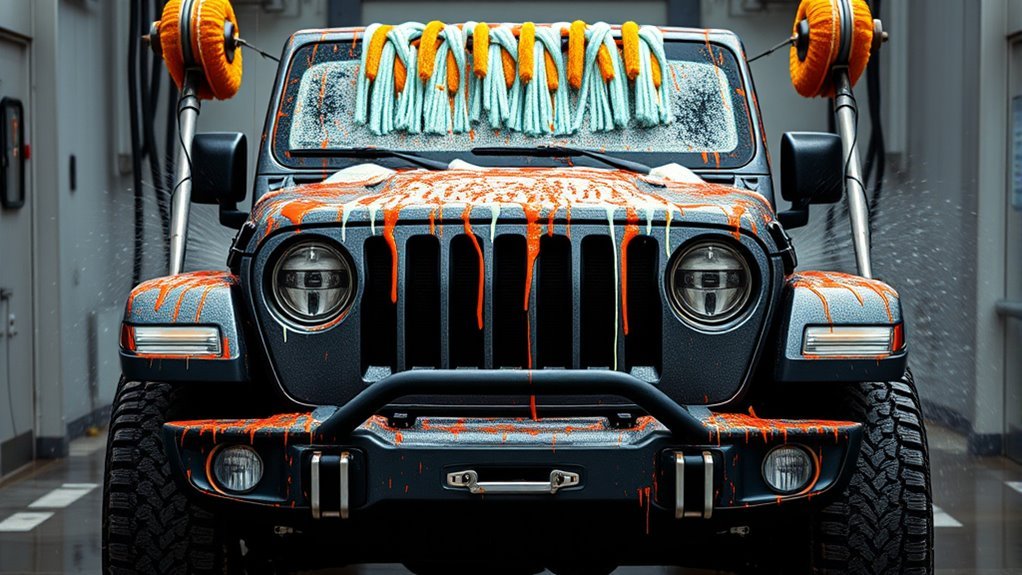
Yes, a Jeep Wrangler can be washed safely, but the correct method depends on its roof, model year, tires, and accessories. A fully installed hardtop can usually use an in-bay touchless wash if the Jeep fits the equipment limits. Jeep’s current guidance is stricter for a factory fabric soft top: do not run it through an automatic car wash. Hand washing remains the safest choice for every Wrangler.
Quick Answer
A hardtop Jeep Wrangler can usually use a touchless wash if it fits and every roof panel is secured. Do not put a factory fabric soft top through an automatic wash. Avoid brush systems, direct pressure at seals, and any wash when the roof, doors, windows, or accessories are loose.
Key Takeaways
- Hand washing is the lowest-risk option for every Jeep Wrangler roof style.
- Jeep says not to run a factory fabric top through an automatic car wash.
- An aftermarket soft top may have different rules; follow its manufacturer’s care instructions.
- Measure lifted or accessorized Wranglers instead of relying on stock dimensions.
- Keep strong water pressure away from roof seals, plastic windows, decals, cameras, and electrical connectors.
- Inspect the roof, cabin, paint, wheels, and accessories immediately after washing.
At a Glance
| Time Required | About 10–15 minutes for an in-bay wash or 30–60 minutes for a careful hand wash |
| Difficulty | Easy, provided the roof and accessories are installed correctly |
| Tools Needed | pH-neutral car-wash soap, hose, wash mitt, microfiber towels, wheel brush, and roof-specific cleaner when required |
| Cost | Nothing with supplies already on hand; otherwise local wash and cleaning-product prices vary |
Can You Take a Jeep Wrangler Through an Automatic Car Wash?
The safest answer depends on which top is installed:
- Removable hardtop: A stock Wrangler with a properly installed hardtop can generally use a touchless in-bay wash when it meets the wash’s height, width, tire, and accessory limits. Hand washing still offers more control.
- Factory fabric soft top: The 2026 Jeep Wrangler Owner’s Manual says not to run a fabric top through an automatic car wash because window scratches and wax buildup may result.
- Aftermarket soft top: Follow the top manufacturer rather than assuming the factory rule applies. For example, Bestop recommends a manual or touchless wash for its soft tops and advises against brush-style washes.
- Power sliding fabric roof: Keep the roof completely closed and use nonabrasive cleaning methods. Check the exact model-year manual before using an automatic wash.
- Top or doors removed: Do not enter any automatic or touchless wash.
Warning: Never enter a car wash with a roof panel, fabric section, window, tailgate, door, charge-port door, or accessory partly open or loosely attached. Water pressure and moving equipment can pull on the component or force water into the cabin.
How to Ensure Your Jeep Fits in the Car Wash
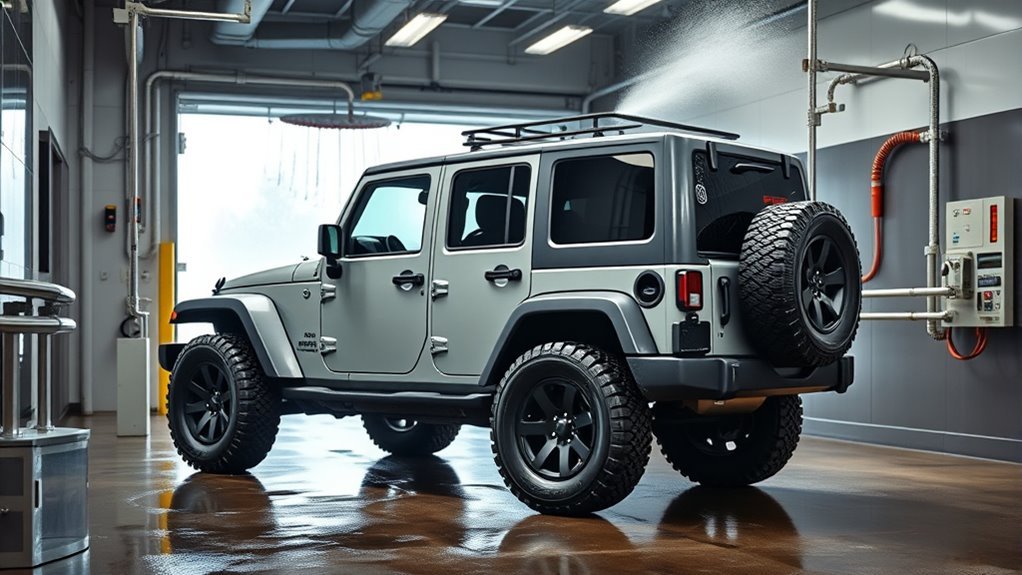
Measure the Wrangler as it sits today, not as it left the factory. A lift kit, larger tires, roof rack, rooftop tent, light bar, awning, snorkel, limb risers, aftermarket fenders, spare-tire carrier, or recovery equipment can change its clearance.
As one reference point, Jeep lists a stock 2026 Wrangler Sport configuration at 73.9 inches wide and 73.6 inches high. That does not establish the dimensions of every trim or modified Wrangler. Measure the highest, widest, and lowest points on your actual vehicle.
Before entering, compare these measurements with the wash operator’s limits:
- Total vehicle height, including antennas and roof accessories
- Body and tire width
- Tire diameter and tread width
- Ground clearance at conveyor rails
- Overall length, including the rear spare tire or carrier
- Maximum weight, when the operator publishes one
Ask the attendant about exposed tow hooks, steel bumpers, rock rails, winches, mud flaps, oversized tires, and rear-mounted accessories. A Jeep that physically fits through the entrance can still be incompatible with the guide rails, wheel track, or moving wash equipment.
Note: Jeep warns against taking a Wrangler through an automatic wash while a compact or limited-use temporary spare is installed because the reduced ground clearance can allow vehicle damage.
How to Prepare a Jeep Wrangler for a Car Wash
Complete this check before pulling into the wash bay:
- Identify the roof. Confirm whether it is a factory hardtop, factory fabric top, power sliding top, or aftermarket product.
- Check the exact manual. Use the model year and VIN-linked resources available through the official Mopar manual portal.
- Close and latch the roof. Check both Freedom Panels, front latches, rear fasteners, fabric retainers, zipper sections, and power-roof controls.
- Close every opening. Fully close the doors, tailgate, glass, windows, vents, and 4xe charge-port door.
- Secure or remove accessories. Remove loose flags, magnetic mounts, trail tools, recovery boards, antenna accessories, and removable rack parts.
- Check the antenna. Older and modified Wranglers may use a removable whip or aftermarket antenna. Remove or fold it only when the vehicle or antenna instructions permit.
- Turn off automatic wipers. A rain sensor can activate the wipers inside a wash and damage the blades or mechanism.
- Follow mirror instructions. Fold mirrors only when the wash operator and vehicle instructions call for it.
- Inspect the spare tire. Confirm that the rear spare, camera, carrier, and license-plate bracket are secure.
- Check for existing leaks or loose seals. An automatic wash should not be used to test a roof that is already misaligned or leaking.
Pro Tip: Take quick photos of the roof, paint, wheels, rear camera, and accessories before entering an automatic wash. The photos make it easier to distinguish new damage from an existing mark.
What to Know About Conveyor Car Washes and AutoPark
A conveyor wash moves the vehicle by one or more tires and normally requires the transmission to remain in Neutral. Procedures vary, so follow the attendant’s instructions rather than relying on a generic sequence.
On some automatic-transmission Wranglers, AutoPark can select Park when certain conditions occur, such as the driver leaving the seat, opening or removing the driver’s door, or changing the ignition state while the vehicle is stopped. To reduce the chance of an unexpected shift:
- Remain seated unless the wash specifically uses a safe, staffed procedure that says otherwise.
- Keep the driver’s door closed.
- Do not turn off the engine unless the exact vehicle and wash instructions require it.
- Shift to Neutral only when directed.
- Keep your feet off the pedals while the conveyor is moving the Jeep.
- Do not use a conveyor wash with the doors removed.
- Shift back into Drive only after the exit signal and when the path is clear.
If the procedure is unclear or the Jeep will not stay in Neutral as required, use a stationary touchless bay or hand wash instead.
Best Practices for Jeep Hard Top Washing
A properly installed hardtop is more suitable for washing than a removable fabric top, but its seams and removable panels still require care.
- Verify that the Freedom Panels sit flat and that every latch is fully locked.
- Inspect the door surrounds, windshield header, rear-glass seal, and panel seals for debris.
- Choose hand washing or a stationary touchless wash instead of equipment that strikes the body.
- Keep concentrated water pressure away from roof seams and weather strips.
- Use pH-neutral automotive soap rather than household detergent or abrasive cleaner.
- Rinse soap from panel edges, hinges, latches, and the rear-glass area.
- Dry around the roof gutters and panel joints so trapped water does not drip into the cabin later.
The owner’s manual warns that power washers exceeding 1,200 psi may damage or remove paint and decals. Even below that pressure, do not hold a nozzle close to seals, cameras, graphics, wiring, or damaged paint.
Best Practices for Factory and Aftermarket Soft Tops
Factory and aftermarket soft tops may look similar but can have different instructions. The factory Wrangler manual says not to run a fabric top through an automatic wash. Hand wash it with a mild cleaner, lukewarm water, and a soft-bristle brush, supporting the fabric from underneath when extra cleaning is needed.
For an aftermarket roof, follow its documentation. Bestop, for example, recommends hand washing for the best service life but permits a touchless wash for its products. That permission should not be transferred to an unrelated roof brand.
Use these soft-top practices:
- Remove loose dust and mud with cool or lukewarm water before scrubbing.
- Use only a cleaner approved for the top’s vinyl, sailcloth, twill, or other material.
- Brush fabric gently with a soft-bristle brush.
- Do not use the brush on clear plastic windows.
- Rinse until no cleaner remains.
- Let the top dry completely before folding or lowering it.
- Use only the protectant specified by the top manufacturer.
- Clean and lubricate zippers or plastic retainers with an approved product when required.
How to Clean Soft-Top Plastic Windows Without Scratching Them
Wrangler fabric-top windows are pliable plastic rather than ordinary automotive glass. Dirt can scratch them easily.
- Never wipe a dusty plastic window with a dry towel.
- Flood the surface with clean, cool or warm water first.
- Use a clean microfiber or soft cotton cloth and a mild soap or plastic-window cleaner.
- Wipe across the window rather than grinding dirt in circles.
- Do not use a brush, scraper, household glass cleaner, alcohol, harsh solvent, or abrasive polish.
- Rinse with clean water and dry with a soft, slightly damp cloth.
- Do not force, roll, or fold a cold, stiff plastic window.
Identifying Risks of Automatic Car Washes for Jeep Owners
Brush and cloth damage: Moving brushes or cloth strips can hold grit, leave fine paint marks, abrade a fabric roof, scratch plastic windows, catch loose trim, or pull at an accessory. The risk rises when the Jeep has external hardware that the wash was not designed to clear.
Water intrusion: Touchless systems eliminate brush contact but still direct pressurized water and detergent toward the vehicle. Water aimed at roof-panel seams, door seals, fabric retainers, or weather strips can enter a cabin when a seal is dirty, damaged, misaligned, or poorly installed.
Chemical exposure: Strong cleaners and spray waxes may be unsuitable for fabric tops, matte finishes, aftermarket coatings, vinyl windows, or decals.
Wheel and tire contact: Conveyor rails can contact wide tires, low components, specialty wheels, sidewalls, or suspension parts.
Accessory contact: Roof racks, rooftop tents, light bars, antennas, rear ladders, spare-tire accessories, and recovery equipment may snag or exceed the wash limits.
A “touchless” wash means nothing intentionally rubs the paint. It does not mean the wash is risk-free for roof seals, fabric, plastic windows, accessories, or oversized tires.
Benefits of Using Touchless Car Washes for Your Jeep
For a Wrangler with a securely installed hardtop and no incompatible modifications, a stationary touchless wash offers several advantages over a brush or cloth system:
- No rotating brush or cloth contacts the paint.
- It can remove loose dirt and winter grime quickly.
- There is less chance of wash media catching exposed hardware.
- The Jeep remains stationary rather than riding on a tire conveyor.
- Undercarriage rinsing may help remove road salt where available.
These benefits do not override the roof manufacturer’s instructions. A factory fabric soft top should still be hand washed, and an aftermarket top should only enter a touchless wash when its manufacturer permits it.
How to Hand Wash a Jeep Wrangler
Hand washing gives you control over water pressure, tools, cleaning products, and sensitive areas.
- Park in the shade. Let hot paint, wheels, and glass cool before applying soap.
- Inspect and secure the Jeep. Close the roof, windows, doors, tailgate, and charge-port door. Remove loose accessories.
- Rinse from top to bottom. Use moderate hose pressure to loosen sand and mud. Do not blast roof seals or electrical connectors.
- Wash the roof correctly. Use a wash mitt on a hardtop. Use a roof-approved cleaner and soft brush on fabric, while keeping the brush off plastic windows.
- Wash the painted body. Work in small sections with pH-neutral car-wash soap and a clean mitt.
- Clean wheels separately. Use separate tools so brake dust and grit do not reach the paint.
- Rinse thoroughly. Flush soap from hinges, fender edges, bumpers, roof channels, and the spare-tire area.
- Dry the Jeep. Use clean microfiber towels or filtered air. Blot plastic windows rather than rubbing them aggressively.
- Inspect the cabin and roof. Look for damp carpet, drips, displaced seals, loose latches, or water around the rear glass.
Key Maintenance Steps for Your Jeep Post-Car Wash
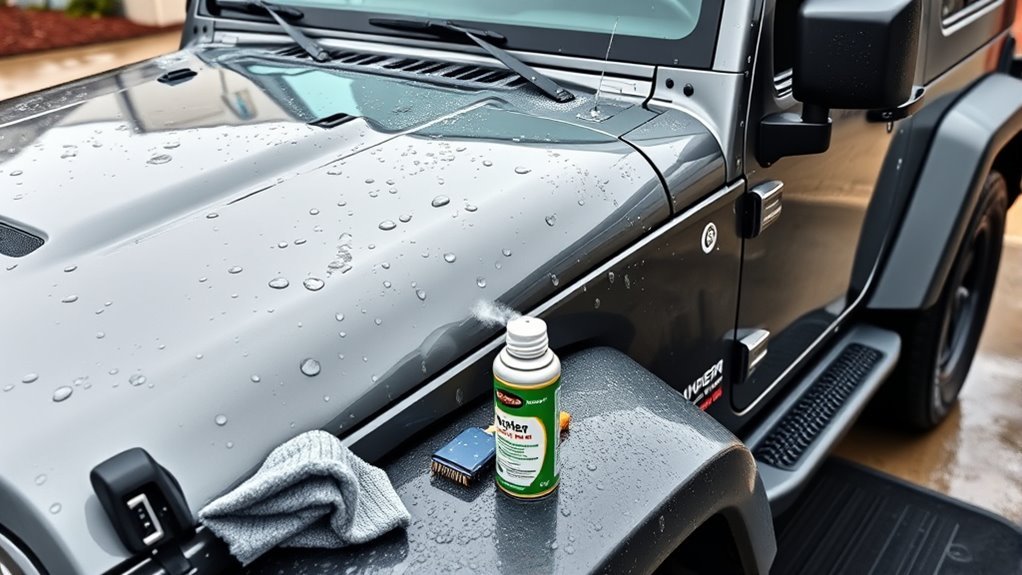
Inspect the Wrangler before driving away. Early detection can keep a small leak, loose part, or paint mark from becoming a larger problem.
- Open the doors and check the carpet, footwells, seat mounts, and cargo floor for moisture.
- Inspect the windshield header, Freedom Panel seams, door seals, rear-glass seal, and soft-top retainers.
- Check the roof rack, antenna, spare-tire carrier, camera, light bar, and other accessories for movement.
- Look for new scratches, cloudy plastic windows, lifted decals, or wheel damage.
- Dry pooled water around hinges, latches, bolts, and body seams.
- Remove mud and grime trapped behind wheels, bumpers, skid plates, and rock rails.
- Use only manufacturer-approved zipper lubricant, plastic-retainer lubricant, fabric protectant, or seal-care product.
If water entered the cabin, blot and extract it promptly. Lift removable floor mats, dry the carpet and insulation, and ventilate the Jeep. A repeated leak should be traced to debris, a folded seal, an incorrectly seated panel, damaged weather stripping, or a roof alignment problem. Persistent leakage warrants inspection by a qualified repair facility or Jeep dealer.
Winter Washing and Undercarriage Care
Road salt and other deicing chemicals can accelerate corrosion when they remain on exposed or damaged metal. The Iowa Department of Transportation explains that salt speeds the corrosion process when metal is exposed to air and water.
During winter:
- Rinse the underbody, wheel wells, suspension areas, bumpers, and rock rails after driving on heavily treated roads.
- Do not direct strong pressure into axle seals, electrical connectors, cameras, or damaged coatings.
- Wash only when temperatures allow the doors, locks, steps, and seals to dry without immediately freezing.
- Repair paint chips and exposed metal before corrosion spreads.
- Inspect drain holes and make sure they remain open.
Real-Life Tips From Jeep Owners on Car Washing
Use separate wash tools: Keep wheel brushes, underbody tools, and paint mitts separate. Grit from the wheels or trail mud can scratch paint when transferred to the body.
Clean trail debris first: Thick mud should be softened and rinsed away before touching the paint with a mitt. Do not grind dried sand or clay across the finish.
Be careful with antennas: A short aftermarket antenna may reduce clearance, but it is not a universal fix. Confirm compatibility, reception needs, installation torque, and car-wash instructions before replacing or removing the factory antenna.
Inspect seals instead of coating them blindly: Dirt, leaves, pine needles, or a folded seal can create a leak. Clean the seal and confirm panel alignment before applying any conditioner.
Do not ignore a new noise: Wind noise after washing can indicate that a panel, fabric retainer, door seal, or accessory shifted.
Why Hand Washing Is Often Preferred for Jeep Owners
Hand washing is slower, but it is the only method that lets you adjust the process around removable panels, exposed hinges, plastic windows, oversized tires, trail accessories, damaged paint, and roof seals.
- Better access: You can clean behind the spare tire, around hinges, under fender edges, and inside wheel wells.
- Controlled pressure: A hose can be redirected away from seals and sensitive components.
- Correct products: Different cleaners can be used for paint, fabric, plastic windows, wheels, and trim.
- Immediate inspection: Loose hardware, damaged seals, chips, scratches, and corrosion become easier to spot.
- Lower soft-top risk: Fabric and pliable windows are not exposed to automatic equipment or unsuitable spray wax.
Frequently Asked Questions
Can you run a Jeep Wrangler through a car wash?
A securely installed hardtop Wrangler can generally use a touchless wash when it meets the wash’s vehicle limits. Jeep says not to run a factory fabric top through an automatic car wash. Check aftermarket-top instructions separately and avoid automatic washing with the roof or doors removed.
Can a soft-top Jeep Wrangler use a touchless car wash?
Not every soft top has the same rule. Jeep’s factory guidance says not to run a fabric top through an automatic wash. Some aftermarket manufacturers, including Bestop, allow touchless washing for their products. Follow the instructions for the exact top installed on the Jeep.
How do you properly wash a Jeep Wrangler?
Secure the roof and accessories, rinse away loose dirt, wash with pH-neutral automotive soap, use roof-specific products where needed, clean wheels with separate tools, rinse thoroughly, dry with microfiber towels, and inspect the cabin and roof seals for leaks.
What happens if water gets inside a Jeep Wrangler?
A small amount of water should still be removed promptly. Blot or extract the moisture, lift wet mats, dry the carpet and insulation, ventilate the cabin, and inspect the nearby seal or roof panel. Persistent water intrusion can cause odor, stains, mildew, corrosion, or electrical problems.
Can you pressure-wash a Jeep Wrangler?
Use caution. Jeep warns that power washers exceeding 1,200 psi may damage paint or decals. Keep any nozzle well back and do not direct concentrated pressure at roof seals, fabric, plastic windows, cameras, electrical connectors, chipped paint, or decals.
Conclusion
You can wash a Jeep Wrangler without damaging it, but there is no single method that suits every roof and modification. A hardtop Wrangler that fits the wash limits can usually use a touchless bay, while Jeep’s factory fabric top should be hand washed. Secure every panel, avoid strong pressure at seals, follow the exact model-year manual, and inspect the Jeep afterward. When there is any doubt about clearance, roof material, accessories, or conveyor operation, wash it by hand.
Sources
- 2026 Jeep Wrangler Owner’s Manual — fabric-top care, plastic-window care, pressure-washer limit, leaks, AutoPark, and temporary-spare cautions
- Official Mopar Owner’s Manual Portal — model-year and vehicle-specific manual lookup
- 2026 Jeep Wrangler Sport Specifications — example stock exterior dimensions
- Bestop Care and Maintenance FAQ — aftermarket soft-top washing and plastic-window guidance
- Iowa Department of Transportation Winter Operations — road salt and accelerated metal corrosion

Leave a Reply