
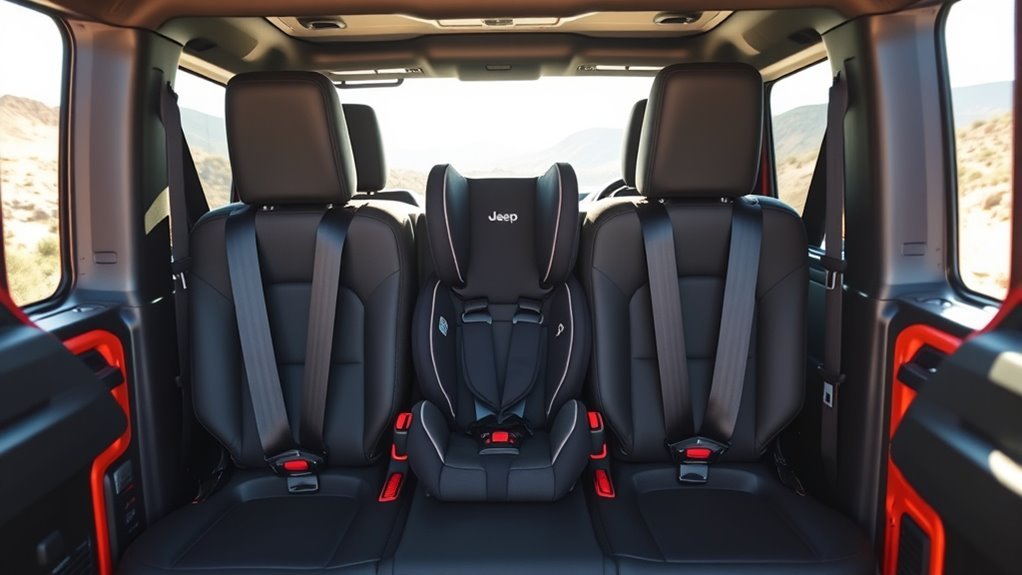
Fitting three child restraints in a Jeep Wrangler is not a simple yes-or-no question. A two-door Wrangler has only two rear seating positions, so three across is impossible. A four-door Wrangler has a center rear position, but the result depends on the exact model year, seat shapes, restraint models, child settings, buckle access, and installation method.
Quick Answer
A two-door Jeep Wrangler cannot hold three car seats across because it has only two rear seating positions. A four-door Wrangler may fit three narrow restraints, but no combination is guaranteed. Check both manuals, test every seat independently, use each forward-facing top tether, and have the final setup checked by a certified technician.
Key Takeaways
- Three across is possible only in a four-door Wrangler with three rear seating positions.
- A narrow advertised width does not prove that a restraint will fit the Wrangler’s seat contours, buckles, head restraints, or adjacent car seats.
- Seat-belt and lower-anchor installations can both be safe. A seat belt may create more side-to-side room, but it is not automatically safer.
- Never share one lower anchor between two restraints, and always use the approved top tether with a forward-facing harnessed seat.
- The final three-seat arrangement should be checked by a certified Child Passenger Safety Technician.
At a Glance
| Time Required | Allow 45–90 minutes for the first full test fit and safety check. |
| Difficulty | High. Three-across installations require careful manual checks and may need several seat combinations. |
| Tools Needed | The Wrangler manual, all three restraint manuals, a tape measure, a flashlight, and each child’s current height and weight. |
| Cost | No special installation tool is required. Restraint costs vary, and many certified inspection stations provide checks at no charge. |
Warning: This guide cannot approve a specific installation. The instructions and limits in your exact Jeep owner’s manual and each child-restraint manual control. Never place a rear-facing restraint in front of an active frontal airbag.
Can You Fit 3 Car Seats in a Jeep Wrangler?
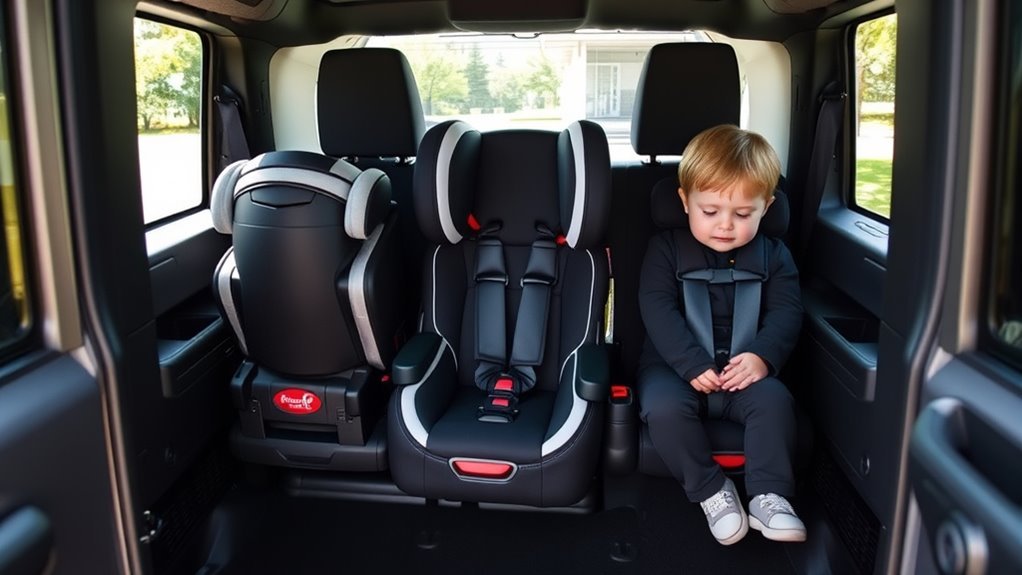
You cannot fit three child restraints across the rear of a two-door Jeep Wrangler. The current two-door Wrangler has four total seating positions, leaving only two positions in the back. Current four-door models have five total seating positions and a three-position rear bench, so a three-across setup may be possible there.
Check the official 2026 Wrangler specifications and the specifications for the relevant four-door trim before assuming that advice for one body style applies to another.
| Wrangler version | Rear seating positions | Three-across answer |
|---|---|---|
| Two-door Wrangler | Two | No. There is no center rear seating position. |
| Four-door Wrangler JK/JKU | Three | Possibly, with an exact model-year manual and a verified narrow-seat combination. |
| Four-door Wrangler JL or Wrangler 4xe | Three | Possibly, but seat shape, head restraints, buckles, and restraint modes can prevent a safe fit. |
The term JKU applies to the four-door JK generation, not every four-door Wrangler. Current Wrangler Unlimited models use the JL platform. Anchor locations and head-restraint instructions can change by year, so obtain the manual that matches the vehicle’s model year rather than relying on a forum post about a different Wrangler.
In the official 2025 four-door Wrangler child-restraint guide, Jeep shows two outboard lower-anchor sets and a top-tether anchor behind each rear seating position. The guide also contains special rules for using the inner outboard anchors for a center installation. Review the applicable section in the official Jeep child-restraint guide and compare it with your own model-year manual.
Note: A vehicle having three seat belts and three tether anchors does not prove that three particular child restraints will fit. Each restraint must fit the vehicle seat, meet its own installation rules, and remain usable without interference from the other two.
Car Seats to Test for a Three-Across Setup
Narrow restraints provide a better starting point, but there is no universally approved three-seat package for every four-door Wrangler. Published width is only one measurement. The base, shoulder wings, belt path, cup holders, recline angle, anti-rebound equipment, and vehicle-seat contours also affect the result.
Examples of Narrow Car Seats
| Restraint | Correct type | Published size information | Important limitation |
|---|---|---|---|
| Diono Radian 3R SafePlus | All-in-one harnessed restraint with multiple use modes | 17 inches wide | Its rear-facing installation can require substantial front-to-back space. Follow the current manual for the child’s setting and any required accessories. |
| Clek Fllo | Convertible rear-facing and forward-facing harnessed restraint | 13-inch base and 16.9-inch seating width | It is not a booster. Its rear-facing depth and required equipment must be checked in the current manual. |
| Chicco KeyFit 30 | Rear-facing-only infant restraint | Check the exact carrier and base specifications for the version being considered. | It is not a booster. The detachable base may interact with adjacent restraints differently from the carrier shell. |
Older names such as the Diono R100, Graco Nautilus, and Evenflo Tribute may appear in owner reports. Do not buy or reuse one solely because an older post says it fit. Confirm the exact model, date of manufacture, expiration date, recall status, crash history, labels, parts, and current manual first.
Seat Combinations Worth Test-Fitting
The children’s correct restraint stages must determine the combination. Never move a child into a booster or forward-facing mode early simply to make three seats fit.
| Child-restraint mix | Layout to test | Main concern |
|---|---|---|
| One rear-facing plus two forward-facing harnessed seats | Test the rear-facing restraint in the center and outboard positions. Install the most difficult restraint first. | Front-seat clearance, head-restraint contact, and access to all three top-tether anchors. |
| One infant seat, one forward-facing harnessed seat, and one booster | Place the booster where the child can reach the correct buckle and route the shoulder belt without interference. | A neighboring restraint may cover the buckle or stop the shoulder belt from retracting freely. |
| Two boosters plus one harnessed restraint | Test the harnessed restraint in the center, then verify both booster buckles with the children seated. | Two accessible buckle stalks can make this combination harder than three narrow harnessed restraints. |
| Three harnessed restraints | A center seat-belt installation may preserve the outboard lower anchors, but all three manuals must permit the final methods. | Independent tightness, lower-anchor sharing, tether routing, and shell overlap. |
Installation Tips for Success
- Install the hardest seat first. In many three-across arrangements, that is the center restraint because access becomes limited after the outboard seats are installed.
- Try more than one order. A rear-facing seat in the center may create useful overlap between shells, but an outboard position may provide a better installation or more front-seat space.
- Use only approved components. Do not add unapproved mats, buckle extenders, head supports, padding, or angle products.
- Remove optional accessories only when the restraint manual permits it. Cup holders and padding cannot be removed merely because they take up space.
- Test with the children’s real settings. Harness height, headrest height, recline angle, and booster mode can change the outer dimensions.
Pro Tip: Before ordering three new seats, ask a retailer whether you may test the display models in your Wrangler. Bring all three children’s measurements and photograph the vehicle’s loading label, buckles, lower anchors, and tether locations.
Step-by-Step Guide to Testing Three Car Seats in a Jeep Wrangler
- Confirm that the Wrangler has three rear seating positions. A two-door cannot support a rear three-across setup. Record the four-door’s model year, generation, trim, and whether it is a 4xe.
- Record each child’s age, height, weight, and correct restraint mode. Keep a child rear-facing until the child reaches the restraint’s rear-facing height or weight limit. Do not advance stages merely to save space.
- Read all four manuals. Review the Wrangler manual plus the manual for each restraint. Locate approved seating positions, belt paths, lower-anchor limits, tether routing, recline requirements, head-restraint rules, and contact restrictions.
- Inspect each restraint. Check expiration, recalls, crash history, labels, harness condition, buckle function, and required parts. Register current seats with their manufacturers for recall notices through the NHTSA child-seat safety portal.
- Choose a preliminary layout. Start with the restraint that has the greatest front-to-back or side-to-side demands. Test both center and outboard placements rather than assuming the rear-facing seat must go in the center.
- Select an approved installation method for each harnessed restraint. A seat belt may create more horizontal space than lower anchors, but either method can be safe. Do not use the seat belt and lower anchors together unless both the vehicle and restraint manuals expressly allow it.
- Follow the Wrangler’s center-anchor rules. In Jeep’s documented four-door setup, flexible lower attachments may use the inner outboard anchors in the center, which are 19 inches apart. Do not use rigid lower attachments there. The child-restraint manufacturer must also permit that anchor spacing.
- Never share a lower anchor. One lower anchor cannot secure attachments from two neighboring restraints. A center seat-belt installation is often used when the outboard restraints occupy their own lower anchors.
- Observe lower-anchor weight limits. Jeep’s verified 2025 guide gives a 65-pound combined child-plus-restraint threshold. The restraint may impose a lower child-weight limit, so follow the lower applicable limit.
- Attach every forward-facing top tether. Route the tether exactly as the Wrangler and restraint manuals direct, especially around folding or fixed head restraints.
- Check each harnessed restraint independently. Hold the restraint at its belt path and pull side to side and front to back. It should not move more than one inch. Remove the neighboring seats and confirm that the remaining restraint was not relying on pressure from them to seem tight.
- Check the booster positions with the children seated. The lap belt must lie low across the upper thighs, and the shoulder belt must cross the chest and shoulder. Each child must reach the correct buckle without routing the belt through or around an adjacent restraint.
- Verify normal vehicle use. Confirm that doors close without touching a restraint, front occupants can sit correctly, the shoulder belts retract freely, and no seat-folding or head-restraint mechanism is partly engaged.
- Schedule a professional check. Use the NHTSA inspection finder to locate a certified Child Passenger Safety Technician or virtual inspection service.
A three-across arrangement is successful only when all three children use the correct restraint stage and every restraint or seat belt works correctly on its own.
What Challenges Arise With Rear-Facing and Booster Seats?
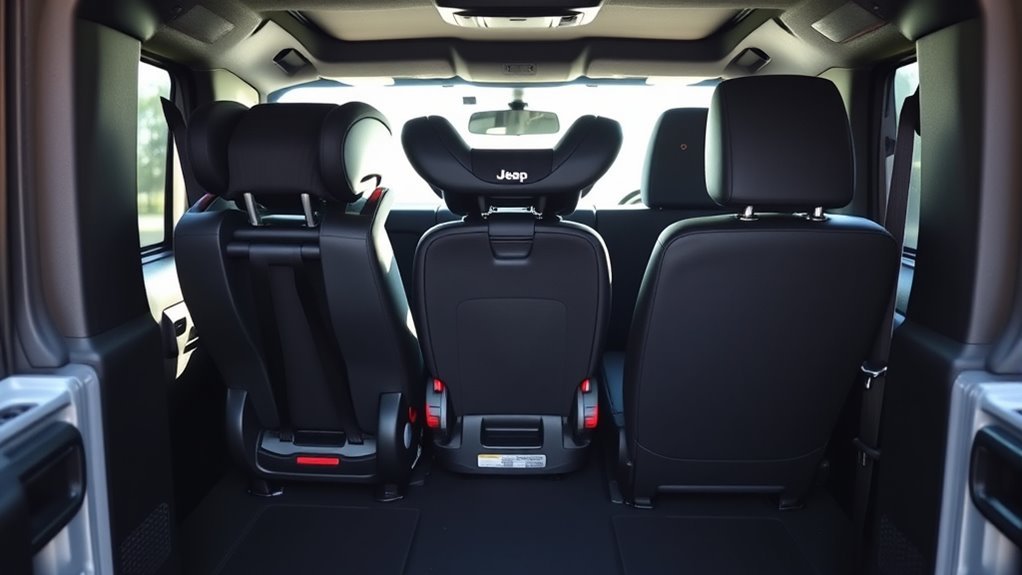
Rear-Facing Depth and Front-Seat Space
A narrow rear-facing restraint can still be too deep for the available space. The child’s required recline angle, headrest height, anti-rebound equipment, and vehicle-seat contour affect how far the restraint extends toward the front seat.
The verified Wrangler guide allows a rear-facing restraint to touch the back of the front passenger seat only when the child-restraint manufacturer also permits that contact. Do not force the restraint upright, brace it against a front seat, or use an unapproved angle adjuster to create room.
Head Restraints and Forward-Facing Seats
Wrangler head-restraint designs vary by model year and seating position. A raised, fixed, or folded head restraint may push a forward-facing child restraint or high-back booster away from the vehicle seatback. Follow both manuals before removing, folding, or routing a tether around a head restraint.
A restraint requiring full contact with the vehicle seatback is not compatible with a position where the Wrangler’s head restraint prevents that contact and neither manual provides an approved solution.
Booster Buckles and Seat Belts
Boosters can be harder to use in a tight row than their width suggests. The child must be able to buckle the correct lap-and-shoulder belt without accidentally releasing a neighboring restraint. The buckle cannot be buried under another seat, and the shoulder belt must move and retract freely through any belt guide.
After buckling, check that the lap belt lies low across the upper thighs rather than the stomach and that the shoulder belt crosses the middle of the chest and shoulder. Recheck the fit during every trip because a child can route the belt incorrectly while reaching into a narrow gap.
Warning: Do not add a seat-belt extender to make a booster buckle easier to reach unless the vehicle and booster manufacturers expressly approve that exact use. An easier buckle does not justify an unapproved belt configuration.
Is the Honda Pilot a Better Fit for Families?
A Honda Pilot is often easier for a family with three restrained children because it provides three rows and seating for seven or eight, depending on trim. That allows children to be divided between rows instead of forcing every restraint onto one narrow bench. It does not guarantee that every three-across combination will fit its second row.
Space and Comfort Comparison
| Family-use factor | Four-door Jeep Wrangler | 2026 Honda Pilot |
|---|---|---|
| Seating rows | Two | Three |
| Total seating capacity | Five | Seven or eight, depending on trim |
| Need for three across | Usually required when three restrained children ride together | Children may be divided between the second and third rows |
| Cargo and daily access | More limited when all rear positions are occupied | More cargo volume and seating flexibility, although third-row access must still be tested with installed restraints |
Honda lists the current Pilot’s seating and cargo specifications on its official 2026 Pilot specifications page. Families should still bring their actual restraints to any vehicle test drive.
Safety Features Overview
Do not reduce vehicle safety to a claim that one model is always “safer.” Crash-test results, headlights, driver-assistance equipment, seat-belt reminders, and structural changes differ by model year, trim, option package, and sometimes build date.
For example, IIHS reports structural changes for some 2026 Wranglers built after October 2025. Compare the exact vehicle using the current IIHS Wrangler ratings and IIHS Honda Pilot ratings. Also compare the child-restraint anchor locations, buckle access, and actual fit of your three seats.
Safety Tips for Fitting Multiple Car Seats
- Use the correct restraint stage. Keep a child rear-facing until the restraint’s rear-facing height or weight limit is reached.
- Follow both manuals. Vehicle approval does not override a child-restraint restriction, and a restraint feature does not override the vehicle manual.
- Use only one approved installation method. Do not combine lower anchors and the seat belt for a harnessed restraint unless both manufacturers permit it.
- Always use the forward-facing tether. Attach it to the tether anchor assigned to that seating position and tighten it as directed.
- Check lower-anchor limits. Move to a seat-belt installation when the applicable lower-anchor child-weight limit is reached.
- Confirm independent tightness. Each harnessed restraint should move less than one inch at its own belt path without support from a neighboring seat.
- Keep every buckle functional. No restraint may cover a buckle needed by another child.
- Check belt fit on boosters. The lap belt belongs low on the thighs, and the shoulder belt belongs across the chest and shoulder.
- Avoid unapproved accessories. Extra padding, protectors, buckle extenders, and positioning products can change restraint performance.
- Check recalls and expiration. Register each seat and follow the manufacturer’s instructions after any crash.
- Follow state law. Legal minimums vary, but a child may still need a more protective restraint stage after meeting the minimum legal requirement.
- Get a professional check. A certified technician can teach you how to repeat the installation correctly rather than merely installing it once.
What Parent Fit Reports Can and Cannot Tell You
Owner reports can help identify seats worth testing, but they cannot certify your installation. Two families may own the same Wrangler and get different results because their children use different harness heights, recline settings, headrest positions, restraint revisions, or booster modes.
| A fit report may help with | A fit report cannot prove |
|---|---|
| Finding narrow restraint models to test | That the current version has the same shell, base, or instructions |
| Learning which seat was installed first | That all three seats were independently tight |
| Spotting common buckle or head-restraint problems | That the tether, belt path, recline, and lower-anchor limits were correct |
| Estimating front-passenger space | That a taller or shorter front occupant can sit safely in your vehicle |
Treat “it fit perfectly” as a lead for further testing, not as an installation instruction. Ask for the vehicle year, exact restraint model and manufacture date, child’s mode and settings, installation method, tether use, and whether a certified technician inspected the finished setup.
Pro Tip: Photograph the finished installation from the front, each door, and the cargo area. Include close views of belt paths, buckles, lower attachments, and tether routing so a virtual technician can review the important details.
Frequently Asked Questions
What is the maximum weight limit for Jeep Wrangler back seats?
There is no universal 1,000-pound Wrangler back-seat limit. Use the Tire and Loading Information label on the driver-side door area and the owner’s manual to determine the maximum combined weight of occupants and cargo. For lower-anchor installation, the verified 2025 Wrangler guide uses a 65-pound combined child-plus-restraint threshold, subject to any lower limit in the child-restraint instructions.
Can I use a seat belt instead of LATCH for car-seat installation?
Yes. A correct seat-belt installation and a correct lower-anchor installation can both be safe. Seat belts often provide more positioning freedom in a three-across setup. Use the approved belt path, lock the belt as directed, attach the forward-facing tether, and do not combine the belt and lower anchors unless both manuals allow it.
Are specific Jeep Wrangler models better for car seats?
A four-door Wrangler is the only practical Wrangler body style for three rear restraints because it has a center rear seating position. Do not assume every JL is automatically better than every JK. Buckles, head restraints, seat contours, anchor rules, and front-seat space must be checked for the exact model year and configuration.
How do I determine whether three car seats fit safely together?
Install each harnessed restraint according to both manuals and confirm that it moves less than one inch at its belt path. Remove neighboring seats to make sure it stays tight independently. Then check shell contact rules, tether routing, front-seat clearance, door closure, buckle access, and correct lap-and-shoulder belt fit for every booster rider.
Can I install a car seat in the front passenger seat?
Children should ride in the rear seat, and NHTSA recommends that children under 13 remain in back. Never place a rear-facing restraint in front of an active frontal airbag. Any unusual front-seat use must be legal and expressly permitted by the vehicle and restraint manuals, with the airbag handled exactly as the vehicle manufacturer directs.
Can a two-door Jeep Wrangler hold three car seats?
No. A current two-door Wrangler has only two rear seating positions and no center rear position. Three child restraints cannot be installed across a two-position rear bench.
Is the center always the safest place for a rear-facing car seat?
Not automatically. The center can be a good position when it permits a correct installation, but the best rear position is the one allowed by both manuals that provides a secure fit without making the other restraints or front occupants unsafe. Test the center and outboard positions.
Conclusion
Three child restraints are impossible across the rear of a two-door Jeep Wrangler and only conditionally possible in a four-door. Narrow models such as the Diono Radian family or Clek Fllo can improve the odds, but their dimensions do not guarantee compatibility.
A safe result requires more than squeezing three shells onto the bench. Each child must use the correct restraint stage, each harnessed seat must remain independently tight, every forward-facing tether must be attached correctly, and booster riders must have accessible buckles and proper lap-and-shoulder belt fit. When those conditions cannot all be met, use a different restraint combination or a vehicle with more seating flexibility.
Sources
- Jeep 2026 Wrangler specifications and four-door Wrangler Sahara specifications — current seating-capacity information.
- Jeep 2025 Wrangler child-restraint guide — lower-anchor limits, center-anchor rules, top-tether locations, and installation checks.
- National Highway Traffic Safety Administration: Car Seats and Booster Seats — restraint stages, installation methods, lower-anchor limits, registration, and inspection guidance.
- National Highway Traffic Safety Administration: Air Bags — rear-facing restraint and front-airbag warning.
- NHTSA Right Seat and Inspection Finder — certified technician and inspection-station resources.
- Honda 2026 Pilot specifications, IIHS Wrangler ratings, and IIHS Pilot ratings — family-seating and model-year safety comparison.




Leave a Reply