
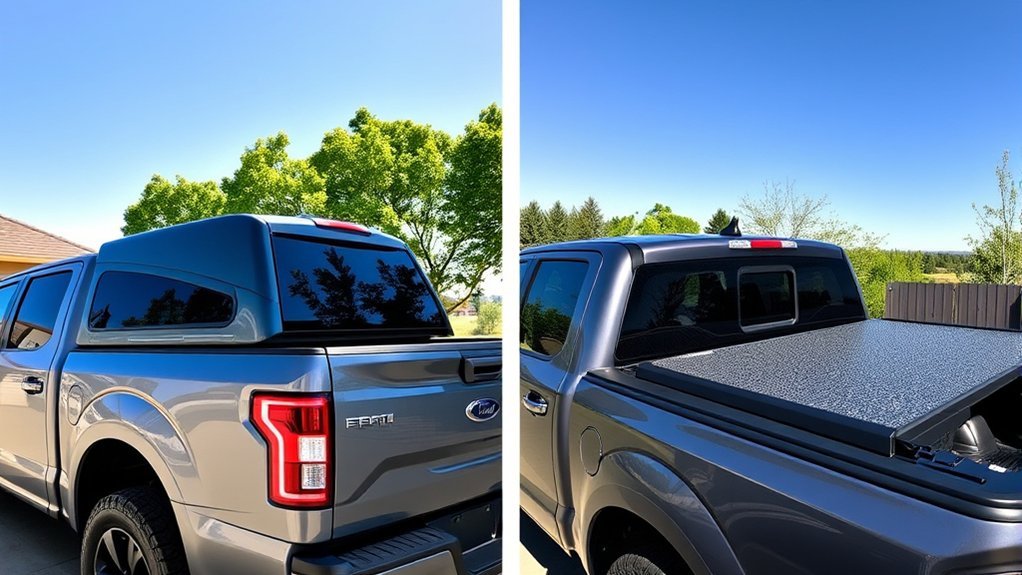
Choosing between a camper shell and a tonneau cover comes down to the cargo you carry, how often you need full bed access, and how much security and enclosed height you need. A camper shell creates a tall, enclosed cargo area, while a tonneau cover keeps a lower profile and is usually easier to open, remove, and buy on a smaller budget.
Quick Answer
For most daily drivers, a tonneau cover is the better choice because it costs less, weighs less, and opens quickly. Choose a camper shell when you need enclosed vertical space, stronger weather protection, or a sleep-ready cargo area. Hard tonneau covers narrow the security gap, so cargo type and access matter most.
Key Takeaways
- Choose a camper shell for tall enclosed cargo, work equipment, camping, side-window access, or long-term bed organization.
- Choose a tonneau cover for lower cost, quick bed access, easier removal, and a low-profile appearance.
- Hard tonneau covers offer much better forced-entry resistance than soft vinyl covers, although no truck-bed enclosure is theft-proof.
- Both products are normally weather-resistant rather than completely waterproof.
- Verify the truck’s exact year, model, bed length, rail system, tailgate, and accessories before ordering.
Understanding the Basics: What Are Camper Shells and Tonneau Covers?
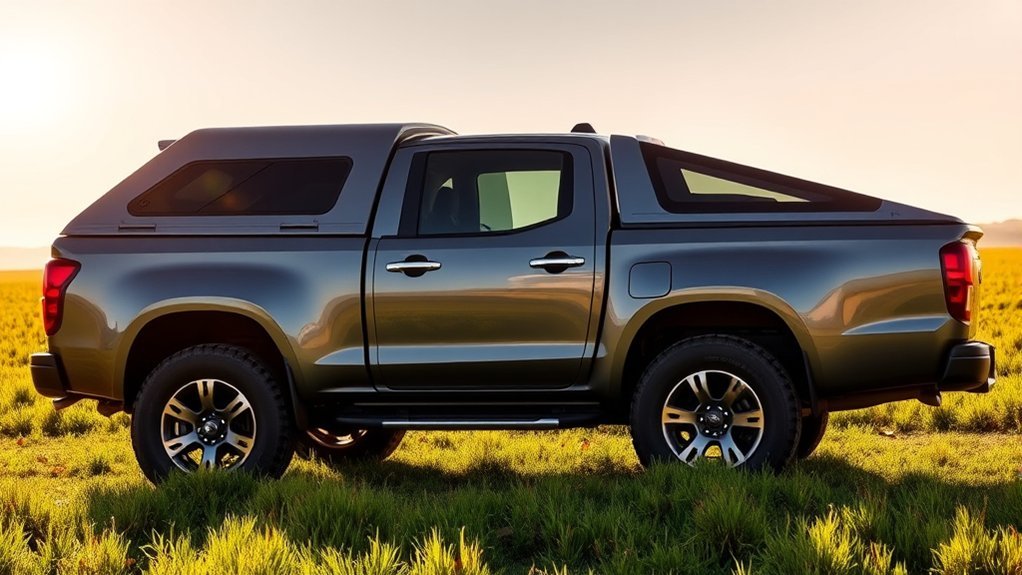
A camper shell, also called a truck cap, topper, or canopy, mounts on the bed rails and usually rises to cab height or higher. It creates an enclosed cargo compartment with a rear door and may include side windows, toolboxes, lighting, ventilation, roof racks, or a raised roof.
A tonneau cover spans the top of the bed near rail height. Depending on the design, it may roll, fold, retract into a canister, or lift as one solid panel. Soft covers focus on affordability and concealment, while hard covers provide more resistance to cutting and forced entry.
Both products can protect cargo from sun, rain, snow, dust, and casual observation, but manufacturers generally describe them as weather-resistant rather than waterproof. Water can enter around the tailgate, stake pockets, drain tubes, seals, or an uneven installation. SnugTop and Retrax both advise owners to take added steps to protect valuable or moisture-sensitive cargo.
Note: Keep cameras, power tools, electronics, documents, and bedding in sealed containers even when the truck has a cap or tonneau cover. A car wash, wind-driven rain, worn seal, or misaligned tailgate can still allow water inside.
| Factor | Camper Shell | Tonneau Cover |
| Enclosed cargo height | Best for stacked bins, bikes, tools, pets in parked use, and camping gear | Limited to cargo below the bed rails while closed |
| Security | Locking rear and side doors can provide strong enclosed protection | Soft covers deter viewing; hard locking covers provide stronger protection |
| Bed access | Usually through rear or side openings; removal takes planning and help | Often rolls, folds, or retracts quickly; access varies by design |
| Oversize loads | The fixed roof and rear opening can restrict very tall or bulky items | Usually easier because the cover can be opened or removed |
| Weight and removal | Heavier; may require several people, a hoist, and storage space | Usually lighter, although powered retractable and one-piece models can be heavy |
| Installation | Professional fitment is common, especially with wiring, paint, or warranty requirements | Many clamp-on models can be installed at home with basic tools |
| Typical best use | Contractors, camping, long trips, organized gear, and enclosed work storage | Daily driving, occasional hauling, quick access, and budget-conscious protection |
Why Choose a Camper Shell?
A camper shell is the stronger choice when you regularly need enclosed vertical storage. It lets you stack containers above the bed rails, organize tools on shelves, carry camping equipment out of sight, or build a simple sleeping platform.
Common camper-shell benefits include:
- Enclosed storage: The roof and sidewalls protect cargo that would sit above a closed tonneau cover.
- Multiple access points: Some models offer side windows, side tool doors, or commercial storage compartments.
- Better camping utility: A cap can create a sheltered sleeping and gear-storage area when the truck is safely parked.
- Rack options: Reinforced models may accept racks for kayaks, ladders, bikes, or other equipment.
- Customization: Lighting, screens, ventilation, carpet, headliners, roof height, and window layouts may be available.
A cap also has disadvantages. It adds weight, can reduce the truck’s remaining payload, limits loading through the top of the bed, and may require a hoist or several people for removal. A tall cap or roof load can also affect clearance and the vehicle’s center of gravity.
Warning: A camper shell is not a passenger compartment or roll bar. Do not carry people in the truck bed while driving, and do not occupy the enclosed bed while the engine is running. Exhaust gases can cause carbon-monoxide poisoning. Follow the cap manufacturer’s instructions and applicable state law.
If you plan to sleep in the bed while parked, use screened ventilation, keep the engine and fuel-burning equipment off, maintain an unobstructed exit, and plan for condensation. A cap creates shelter, but it does not provide the insulation, crash protection, or life-safety systems of a passenger cabin or recreational vehicle.
Why Tonneau Covers Are a Great Option
A tonneau cover is often the better match for everyday driving because it preserves a low profile and can provide fast access to the bed. Many clamp-on models are lighter and easier to remove than a full camper shell.
Advantages can include:
- Quick bed access: Roll-up, folding, and retractable designs open without removing a large enclosure.
- Lower initial cost: Soft roll-up and soft-folding covers are among the least expensive ways to conceal a truck bed.
- Easy removal: Many models can be removed and stored by one or two people.
- Low-profile appearance: The cover sits near the bed rails rather than changing the truck’s roofline.
- Security choices: Buyers can select anything from basic soft concealment to rigid locking panels and rails.
Soft vs. Hard Tonneau Covers
Soft roll-up and soft-folding covers are light, inexpensive, and easy to operate. They keep cargo out of sight but can often be cut with a knife, so they are best for low-risk storage rather than valuable tools left unattended.
Hard-folding and hard-roll-up covers use rigid panels or reinforced slats. Many latch along the rails and cannot be opened from outside when the tailgate is locked. They provide better forced-entry resistance while still offering broad bed access.
Retractable covers slide into a housing near the cab. They are convenient and may support rack systems, but the canister can reduce usable bed length and depth.
One-piece hinged covers can offer a clean appearance and strong security, but they are less convenient for tall cargo because the entire panel lifts from the rear.
Pro Tip: Do not compare a basic vinyl roll-up cover with a reinforced hard cover as though they offer the same protection. Choose the cover type first, then compare it with a camper shell.
Pricing Comparison: What to Expect for Each Option?
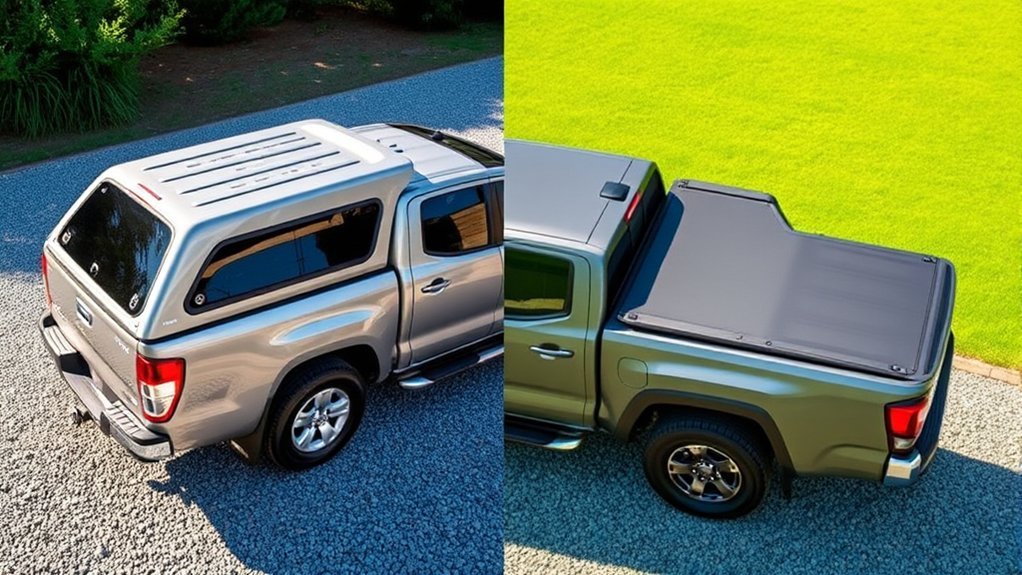
Prices vary by truck, bed length, material, finish, operation, accessories, shipping, tax, and installation. For that reason, one universal range can be misleading.
As of this July 2026 update, current listings show the general price ladder:
- Soft tonneau covers: Many starting prices fall between roughly $175 and $400.
- Hard-folding covers: Representative starting prices range from about $550 to $1,500.
- Retractable and powered covers: Entry models may start near $800, while premium powered systems can approach or exceed $3,000.
- Camper shells: Many custom fiberglass models require a dealer quote. LEER currently lists one modular cap with a starting price of $3,149 before vehicle-specific options or installation.
You can review current examples in the RealTruck tonneau-cover catalog and the LEER truck-accessory catalog. Prices and promotions can change, so compare the complete installed cost rather than the advertised base price.
For a camper shell, ask whether the quote includes paint matching, clamps, a front boot, interior lighting, wiring, a center high-mounted brake light, roof reinforcement, racks, screens, carpet, locks, delivery, installation, and tax. These options can change the final price substantially.
The least expensive option is not always the best value: pay for the access, security, fitment, and load capacity you will actually use.
Durability and Maintenance: Which Option Lasts Longer?
There is no universal lifespan winner. Durability depends on the product’s material, hardware, installation, climate, maintenance, and use.
Fiberglass and aluminum camper shells can provide many years of service, but their seals, locks, hinges, gas props, wiring, windows, and mounting clamps still require inspection. Painted fiberglass also needs finish care, and loose mounting hardware can allow movement or paint wear.
Soft tonneau covers can develop fabric shrinkage, fading, stitching wear, or hook-and-loop damage. Hard-folding models depend on seals, hinges, latches, and drain systems. Retractable covers add slats, bearings, tracks, a canister, and sometimes an electric motor.
Warranty length is a useful comparison point, but it is not a guaranteed service life. LEER’s current terms range from one-year coverage on some products to limited-lifetime coverage on others. Review exclusions for normal wear, improper installation, commercial use, cleaning products, and nontransferable coverage in the manufacturer’s warranty documentation.
Basic Maintenance Checklist
- Wash the product with the cleaner approved in its manual.
- Inspect mounting clamps and retention hardware after installation and at regular intervals.
- Check seals for gaps, tears, compression, or trapped debris.
- Clear tonneau drain tubes and camper-shell window channels.
- Test latches, locks, safety straps, gas props, lights, and wiring.
- Remove snow, ice, and loose material before opening or folding a cover.
- Repair water entry before storing tools, bedding, or electronics for long periods.
Fitment and Compatibility Checks Before You Buy
Truck-bed accessories are vehicle-specific. Verify the exact model year, make, model, cab configuration, bed length, and bed style. Use the VIN when a manufacturer or dealer needs it to identify a midyear change, factory package, or rail configuration.
Check compatibility with:
- Factory utility tracks or movable tie-down systems
- Plastic or spray-in bedliners
- Bed-rail caps and stake-pocket covers
- Multifunction, step, or powered tailgates
- Cross-bed toolboxes and bed slides
- Fifth-wheel and gooseneck hitches
- Bed racks, sport bars, and T-slot accessories
- Cab guards, headache racks, and ladder racks
- Factory cameras, lights, outlets, and remote tailgate controls
A retractable cover’s canister may interfere with a toolbox or hitch. A folding cover may block the rear window when raised against the cab. A camper shell may need a model-specific brake-light connection, wiring harness, clamp system, or tailgate seal.
Pro Tip: Measure the bed and confirm the manufacturer’s fitment listing before ordering, even when the seller says the product fits your truck generation. Bed lengths that sound similar can differ enough to require another part number.
Security, Weather, and Road Safety
A camper shell generally offers more enclosed volume and may use automotive-style locks, but its windows and doors can still be broken or forced. A hard tonneau cover paired with a locked tailgate may offer strong protection for cargo below the bed rails. A soft cover mainly conceals the load and discourages casual access.
Neither option replaces proper cargo restraints. The National Highway Traffic Safety Administration advises drivers to tie cargo down and prevent it from dropping, shifting, leaking, or escaping the vehicle. Secure heavy objects directly to rated anchor points, even when the bed is covered.
Warning: Before driving, close and latch every camper-shell door. Secure a tonneau cover in one of the driving positions approved by its manufacturer—normally fully closed and latched or fully opened and retained with its safety straps. Do not drive with a cover partly open unless the manual specifically permits that position.
For an example of safe operating positions, review the BAK Revolver installation and operating guide.
Added equipment also counts against the truck’s payload. Include the cap or cover, racks, drawers, tools, passengers, hitch equipment, and cargo when checking the payload label and owner’s manual. Never exceed the lowest applicable limit for the truck, cap, cover, rack, crossbars, or mounting system.
Will Either Option Improve Fuel Economy?
Do not buy a camper shell or tonneau cover based on a promised MPG increase. Aerodynamic results vary with the truck body, bed length, cover shape, speed, wind, accessory weight, tires, cargo, and driving conditions.
A 2007 SEMA wind-tunnel study of 13 tonneau covers found an average 5.73% reduction in drag coefficient across the tested combinations. However, the report also stated that fuel economy could not be calculated from drag coefficient alone because rolling resistance, drivetrain efficiency, and added weight also matter.
The practical conclusion is simple: a tonneau cover may improve airflow on some trucks, but a guaranteed gain of 1 or 2 mpg is not supported for every vehicle. Treat any fuel savings as a possible secondary benefit, not a reason to justify the purchase price.
Practical Use Cases: When to Choose Each Cover?
Choosing between a camper shell and a tonneau cover depends on what must fit inside, how often the bed needs to be fully open, and how long cargo will remain unattended.
- Choose a camper shell for contracting work when you need tall storage, shelves, side access, lighting, or commercial tool doors.
- Choose a hard tonneau for valuable everyday cargo when everything fits below the rails and you want a lower-profile enclosure.
- Choose a soft tonneau for basic concealment when cost and easy removal matter more than forced-entry resistance.
- Choose a camper shell for truck-bed camping when you want enclosed sitting room, ventilation options, and space for a sleep platform.
- Choose a folding or roll-up tonneau for frequent tall loads when you regularly need to uncover most or all of the bed.
- Choose a retractable cover for controlled access when you want to stop the cover at several positions and can accept the canister’s space requirement.
- Choose neither as permanent security for irreplaceable valuables when the truck will be left unattended in a high-risk area.
Making Your Decision: Key Factors for Your Truck Needs
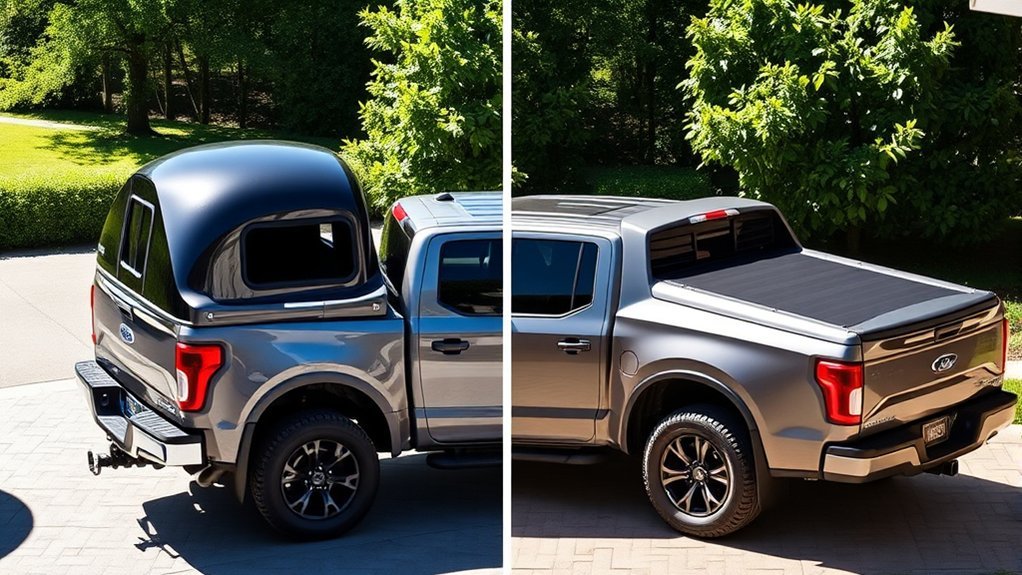
Start with the largest and most valuable items you carry. Then compare access, security, weather resistance, fitment, weight, removal, and installed cost.
Evaluate Your Cargo Needs
Ask these questions:
- Does the cargo fit below the bed rails?
- Do you frequently carry bikes, stacked bins, camping equipment, plants, appliances, or tall tools?
- Will you need side access, shelves, or interior lighting?
- How often must the full bed be uncovered?
- Will valuable gear remain in the truck overnight?
- Could a retractable canister, folded panel, or fixed cap roof interfere with the load?
If most cargo is flat and you need quick access, a tonneau cover is usually the more convenient choice. If you need tall enclosed space or a built-out cargo area, a camper shell is usually worth the extra cost and weight.
Assess Lifestyle Compatibility
A camper shell works well when the truck serves as a mobile workshop, travel vehicle, camping platform, or long-term storage system. A tonneau cover works well when the truck alternates between commuting, groceries, luggage, home projects, and occasional large loads.
Also consider removal. A tonneau cover may come off in minutes, depending on its design. A camper shell can require several people or a ceiling hoist, plus protected storage when it is not installed.
Check the Total Load and Installed Cost
Compare the weight of the enclosure and accessories with the truck’s remaining payload. A roof rack, cargo box, ladder, kayak, drawers, and tools can add more weight than expected.
Request an itemized quote that includes installation, wiring, paint, racks, taxes, replacement keys, warranty conditions, and removal charges. A lower advertised price may not include everything required for safe operation.
Use This Simple Decision Rule
Buy a camper shell when the cargo often extends above the rails, you need an enclosed workspace or sleeping area, or side-door organization is important.
Buy a hard tonneau cover when cargo fits below the rails and you want a balance of security, fast access, and easy removal.
Buy a soft tonneau cover when basic weather resistance and concealment matter more than high security.
Frequently Asked Questions
Does a camper shell add value to a truck?
A clean, well-fitted camper shell may make the truck more appealing to a buyer who wants secure work storage or camping capability. It does not guarantee a dollar-for-dollar increase in resale value, and a mismatched color, damaged shell, missing keys, leaks, or limited compatibility can reduce its appeal.
What are the disadvantages of a tonneau cover?
A closed tonneau limits cargo to bed-rail height. Soft covers offer limited forced-entry resistance, folding panels can block rear visibility, and retractable canisters use bed space. Seals can leak, and some covers interfere with racks, toolboxes, hitches, utility tracks, or specialty tailgates.
Do trucks get better gas mileage with a camper shell?
Not necessarily. A shell changes airflow but also adds weight and frontal or side area. The result depends on the truck, cap shape, speed, wind, cargo, tires, and driving style. Do not assume a camper shell will improve fuel economy without a vehicle-specific controlled test.
What are the disadvantages of truck toppers?
Truck toppers add cost and weight, reduce open-top loading, require storage and help for removal, and can create rear-visibility or clearance limits. Locks, seals, clamps, windows, paint, wiring, and gas props also require maintenance. Roof cargo must remain within every applicable load rating.
Are camper shells and tonneau covers waterproof?
They are normally weather-resistant, not completely waterproof. Water or dust can enter around seals, stake pockets, drain tubes, the bulkhead, or the tailgate. Keep valuable and moisture-sensitive items in sealed containers and correct leaks promptly.
Can you safely sleep under a camper shell?
A camper shell can provide parked shelter when it has adequate ventilation and a clear exit. Never sleep in the bed with the truck engine or a fuel-burning heater running, and never carry passengers under the shell while driving. Follow the manufacturer’s warnings and local laws.
Conclusion
A camper shell is the better choice when you need tall enclosed storage, camping space, side access, or a permanent work setup. A tonneau cover is usually better when cargo fits below the rails and you value quick access, lower weight, easier removal, and a lower starting cost.
Before buying, verify the exact truck and bed configuration, check accessory compatibility, compare the complete installed price, and read the product’s load, latching, maintenance, and warranty instructions. The best option is the one that fits your real cargo without creating access, safety, or storage problems.
Sources
- National Highway Traffic Safety Administration — Secure Your Load — cargo-securement duties and road-safety guidance.
- SnugTop Truck Cap Owner’s Manual — passenger restrictions, carbon-monoxide warning, weather resistance, mounting checks, rack limits, and maintenance.
- BAK Revolver Installation and Operating Guide — approved driving positions, latching, straps, snow and ice removal, and maintenance.
- SEMA Tonneau-Cover Wind-Tunnel Study — tested drag changes and limitations of converting aerodynamic results into fuel-economy claims.
- LEER Truck Cap vs. Tonneau Cover Guide — cargo, weather, access, budget, installation, and maintenance considerations.
- LEER Warranty Information — examples of product-specific warranty periods and installation conditions.





Leave a Reply