
Aftermarket headlights can be legal in the United States, but legality depends on what you replace, how the product was designed, and the laws where the vehicle is driven. A complete headlamp assembly made for your exact vehicle is very different from placing an LED or HID conversion bulb in a housing designed for a halogen bulb.
Quick Answer
Aftermarket headlights are legal when the complete lighting system complies with federal performance requirements and your state’s equipment laws. A correctly certified replacement assembly is usually the safest upgrade. Plug-in LED or HID bulbs installed in halogen headlamps are high-risk because the bulb and housing were not designed or tested as one system.
Key Takeaways
- The U.S. Department of Transportation does not pre-approve individual headlights. A DOT mark is the manufacturer’s certification of compliance.
- A complete LED headlamp assembly may be compliant, while an LED bulb placed in a replaceable-bulb halogen headlamp generally is not compliant replacement equipment under current NHTSA guidance.
- There is no universal federal street-legal limit of 3,000 or 4,000 lumens per bulb. Beam pattern, intensity at specific test points, color, construction, and aim all matter.
- Lower-beam headlamps must produce light within the federal white-color boundaries. Amber rules usually apply to signals, markers, or certain daytime running lamps.
- Check the exact model year, trim, build date, original headlamp type, state law, and inspection rules before purchasing an upgrade.
Note: This article provides general U.S. legal and safety information, not legal advice. Vehicle codes, inspection rules, and enforcement practices can change. Confirm the current requirements with your state legislature, DMV, state police inspection authority, or a qualified local attorney.
At a Glance
| Time Required | About 20–60 minutes to verify fitment, markings, documentation, and state rules; installation time varies by vehicle. |
| Difficulty | Moderate. Basic bulb replacement may be simple, while sealed LED, HID, adaptive, or auto-leveling systems may require professional service and calibration. |
| Tools Needed | Owner’s manual, OEM service information, VIN or build-date label, basic hand tools, gloves, a level parking surface, and the manufacturer’s aiming procedure. |
| Cost | Vehicle-specific. Complete certified assemblies, control modules, professional aiming, and calibration may cost much more than a replacement bulb. Price alone does not prove compliance. |
Key Federal Regulations Governing Headlight Modifications
The main federal lighting rule is Federal Motor Vehicle Safety Standard No. 108. It covers original and replacement lamps, reflective devices, light sources, markings, beam performance, color, durability, and aiming features.
FMVSS No. 108 applies to replacement equipment intended to replace regulated lighting equipment. A replacement headlamp must meet the requirements that apply to that type of headlamp; it is not enough for a product to fit the opening, illuminate the road, or carry an advertising claim that it is “street legal.”
Federal law also separates three situations:
- Manufacture, import, and sale: New motor vehicle equipment covered by a federal safety standard must comply with the applicable standard and be properly certified.
- Commercial installation: A manufacturer, distributor, dealer, rental company, or motor vehicle repair business generally may not knowingly make federally required safety equipment inoperative. This restriction appears in 49 U.S.C. §30122.
- Owner modification after purchase: NHTSA generally does not regulate every modification an individual makes to a personally owned vehicle. State equipment, inspection, and road-use laws may still prohibit the resulting setup.
A product being available online does not prove that it complies with FMVSS No. 108 or that the modified vehicle may legally be driven in your state.
Understanding Aftermarket Headlights: What’s Legal?
The word aftermarket covers several very different products. The most important legal question is whether you are installing the correct replacement light source or replacing the complete optical system.
| Upgrade Type | Compliance Risk | What to Verify |
|---|---|---|
| Correct replacement bulb of the original type | Lower risk | Use the exact bulb designation, wattage, connector, and application listed by the vehicle or bulb manufacturer. |
| OEM replacement assembly | Lower risk | Confirm the part number, side, model year, trim, original lighting package, and market specification. |
| Complete aftermarket headlamp assembly | Can be compliant | Look for the required lens markings, written FMVSS No. 108 compliance information, exact vehicle fitment, correct bulb or integral light source, and a usable aiming mechanism. |
| Complete integral LED headlamp | Can be compliant | The LEDs, optics, housing, driver, cooling system, and aiming features must be designed and certified as one complete headlamp. |
| Plug-in LED bulb in a halogen replaceable-bulb headlamp | High risk | Current NHTSA guidance says no LED replaceable light source may be used in a replaceable-bulb headlamp under FMVSS No. 108. State law controls much of the owner-use question. |
| HID conversion bulb and ballast in a halogen housing | High risk | A different light-source type, arc position, ballast, and output can prevent the headlamp from remaining compliant. |
| Light bar or auxiliary driving lamp | State-dependent | It cannot replace required headlamps. Check mounting, aiming, covers, switching, quantity, color, and public-road-use restrictions. |
LED Bulbs Versus Complete LED Assemblies
LED technology itself is not illegal. Many factory vehicles use legal integral LED headlamps. The problem is treating a replaceable LED bulb as though it were optically identical to the halogen filament for which a reflector or projector was designed.
In a February 13, 2024 interpretation, NHTSA explained that LEDs may be used in an integral-beam headlamp when the full headlamp meets FMVSS No. 108. It also stated that no LED replaceable light source was then permitted in a replaceable-bulb headlamp.
The location, size, orientation, and shape of a halogen filament are part of the optical design. An LED chip arrangement can place light in different locations, creating foreground glare, stray light above the cutoff, weak distance lighting, or an uneven beam even when the bulb appears brighter against a garage wall.
Adaptive and Auto-Leveling Headlamps
Modern vehicles may use adaptive driving beam, steering-responsive lighting, automatic leveling, ride-height sensors, cameras, control modules, or software coding. A headlamp that physically bolts into place may still be incompatible with these systems.
Do not convert an adaptive or auto-leveling vehicle to a simpler assembly unless the replacement manufacturer provides vehicle-specific compliance documentation and the conversion preserves every required function. Fault codes, disabled leveling, improper calibration, or a warning on the instrument panel can indicate that the installation is incomplete.
How to Choose a Potentially Compliant Aftermarket Headlight
No single logo or seller statement can prove legality. Use several checks together before buying an assembly.
- Identify the original system. Check the owner’s manual, bulb-access label, OEM parts catalog, or service information. Determine whether the vehicle uses halogen, HID, integral LED, adaptive LED, or another system.
- Match the exact vehicle. Verify the model year, trim, body style, left- or right-hand side, build date, lighting package, and VIN when the manufacturer provides VIN-based fitment.
- Read the product documentation. Look for a direct statement that the complete headlamp was designed to conform to FMVSS No. 108—not vague wording such as “DOT style,” “for off-road use,” or “meets SAE appearance.”
- Inspect the physical headlamp. Check for permanent lens markings, manufacturer identification, bulb type or light-source information, and aiming markings where applicable.
- Confirm all functions. High beam, low beam, turn signal, parking lamp, daytime running lamp, side marker, auto leveling, adaptive movement, and warning systems must work as designed.
- Check your state rules. Confirm color, height, number of lamps, auxiliary-light restrictions, inspection standards, and aiming requirements.
- Keep proof. Save the invoice, product page, instructions, compliance statement, and photographs of the markings in case an inspector or installer needs them.
Pro Tip: Search the part number together with the manufacturer’s name, “FMVSS 108,” and “recall.” A copied product description or marketplace badge is weaker evidence than documentation published by the actual headlamp manufacturer.
What DOT and SAE Markings Really Mean
DOT Is a Self-Certification, Not an Approval
The phrase “DOT-approved headlights” is common in advertising, but it is not technically correct. According to NHTSA’s certification guidance, the agency does not pre-approve individual motor vehicles or equipment items.
Under FMVSS No. 108, the lens of an original or replacement headlamp generally must carry the DOT symbol. That symbol represents the manufacturer’s certification that the headlamp conforms to the applicable federal requirements.
The marking is important, but it is not a government endorsement, a test report, or a guarantee that the assembly is correct for your vehicle. A manufacturer can apply a mark incorrectly or falsely, and counterfeit assemblies may copy legitimate-looking markings.
What an SAE Marking Tells You
SAE standards and identifying codes are used throughout automotive-lighting design and may describe a lamp’s function or the technical standard associated with it. However, “SAE certified” should not be treated as a replacement for the federal certification required for a regulated replacement headlamp.
Use SAE markings as one piece of evidence. Also verify the DOT mark where required, the actual manufacturer, the complete application list, the original light-source type, and the manufacturer’s written compliance statement.
“DOT” means the manufacturer is certifying the product. It does not mean a federal agency tested or approved that individual headlamp before sale.
State-Specific Headlight Laws You Should Know
FMVSS No. 108 provides a national standard for new and replacement lighting equipment, but states regulate vehicles operated on their roads. State laws may address subjects that include:
- Permitted headlamp and auxiliary-lamp colors
- Minimum and maximum mounting height
- Required number of headlamps
- Upper- and lower-beam operation
- Aim and glare
- Flashing or color-changing lights
- Light bars and auxiliary driving lamps
- Inspection and rejection criteria
- Restrictions for red, blue, green, or emergency-style lighting
Two Examples of State Rules
Florida: Florida Statutes §316.220 requires at least two headlamps showing white light and places them between 24 and 54 inches above the road. Florida law also addresses beam selection, aim, auxiliary lamps, and restrictions on altering a headlamp’s color.
Virginia: Virginia’s inspection rule for headlamps states that retrofitting an HID or LED bulb to a halogen headlamp system does not conform to FMVSS requirements and is grounds for rejection.
These examples do not create a nationwide rule. A setup that passes inspection in one state may be rejected in another, and a state without periodic inspections can still enforce its equipment code during a traffic stop or after a collision.
Note: Search the official state code and inspection manual rather than relying only on a retailer, forum post, social-media video, or general “50-state legal” claim.
Brightness Limits: Is There a Legal Lumen Number?
There is no single federal rule stating that every road-legal headlight bulb must remain below 3,000, 3,500, or 4,000 lumens. Those figures are often repeated in aftermarket marketing and unsourced legal guides, but they do not provide a reliable pass-or-fail test.
FMVSS No. 108 evaluates the headlamp system through requirements that include:
- Minimum and maximum luminous intensity at specified test points
- Light above, below, left, and right of the beam’s optical axis
- Lower- and upper-beam distribution
- White-light chromaticity
- Durability and environmental performance
- Replaceable light-source specifications
- Markings and aiming provisions
A high advertised lumen number may describe raw LED-chip output, theoretical output, output from both bulbs, or output measured before optical losses and heat reduction. It does not show where the light lands on the road.
Why Beam Pattern Matters More Than Box Lumens
A useful low beam places enough light on the roadway while limiting glare above the cutoff and toward approaching drivers. A bulb can produce more total light but create worse distance vision if too much light is scattered close to the vehicle or above the intended beam.
Headlamp aim also changes with vehicle load, suspension height, tire size, collision damage, worn mounting points, and an incorrectly seated bulb. A legal assembly can still create unsafe glare when it is damaged or badly aimed.
Warning: Do not select a headlight only because the listing promises an extreme lumen figure. Claims such as 20,000, 40,000, or 60,000 lumens do not establish legal compliance, beam quality, useful seeing distance, or safe glare control.
What Headlight Colors Are Legal?
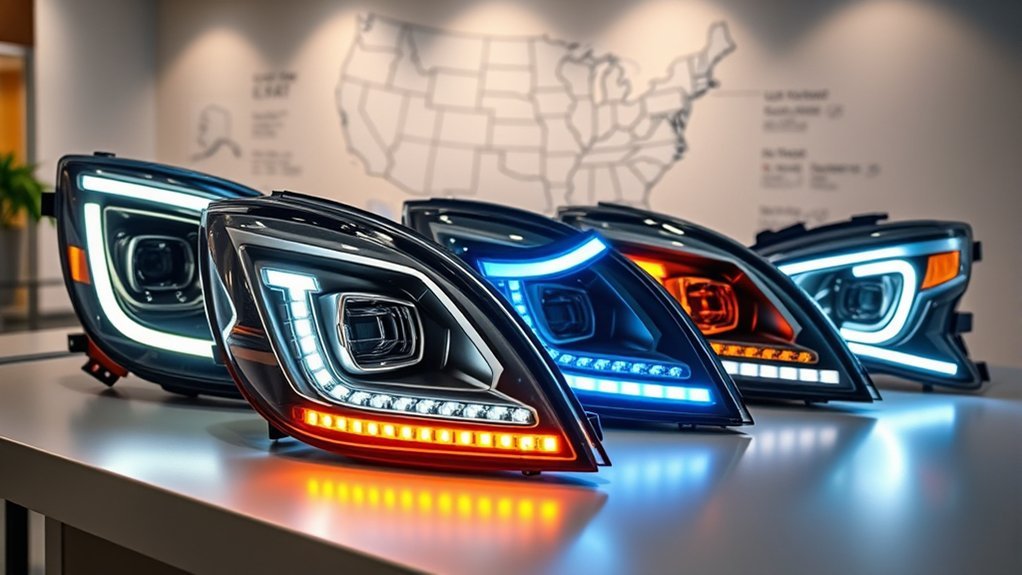
Under FMVSS No. 108, lower-beam headlamps are required to emit light within defined white chromaticity boundaries. The standard does not treat blue, purple, green, or red as normal lower-beam headlamp colors.
Amber is commonly permitted or required for other forward-facing functions, such as turn signals, side-marker lamps, or certain daytime running lamps. That does not make amber a universal replacement color for a required low beam.
Color temperature in kelvins is not the same thing as legal color compliance. A seller’s “5,000K” or “6,000K” label does not prove that the installed lamp falls within the required white boundaries. Coatings, optical design, production variation, and viewing angle can change the apparent color.
Avoid red, blue, green, purple, flashing, or color-changing headlamp modes on public roads unless an official state rule clearly authorizes that exact use.
Legal Mistakes to Avoid With Aftermarket Headlights
- Trusting the words “DOT approved.” NHTSA does not pre-approve individual headlamps. Verify the actual manufacturer’s certification and documentation.
- Assuming a DOT logo on a bulb legalizes a conversion. The complete headlamp system and approved light-source type matter.
- Installing an LED or HID bulb in a halogen housing. The new light source may not match the optics or federal replaceable-light-source requirements.
- Buying by lumen output alone. Raw output does not prove beam compliance or safe glare control.
- Using an assembly for the wrong trim. The same model year may have separate halogen, HID, LED, adaptive, or premium-lighting options.
- Ignoring the vehicle’s build date. Automakers sometimes change connectors, modules, and headlamps during a model year.
- Disabling auto leveling or adaptive functions. A warning-free low beam does not prove that every required function still works.
- Leaving the dust cap off. Moisture, dust, and altered ventilation can damage the reflector, lens, driver, or wiring.
- Using off-road lamps as low beams. A light bar or work lamp is not a substitute for a compliant headlamp.
- Skipping aim checks. New assemblies, suspension work, collision repairs, and cargo loads can change aim.
How to Install Aftermarket Headlights Safely and Legally
1. Verify the Vehicle and Product
Record the VIN, model year, build date, trim, body style, and original lighting package. Compare that information with the headlamp manufacturer’s application list and installation instructions.
Check both assemblies before taking the vehicle apart. Confirm the correct left and right units, connectors, bulb type, mounting points, vents, modules, adjusters, and lens markings.
2. Disconnect Power as Directed
Follow the vehicle manufacturer’s service procedure. Some vehicles require the ignition to remain off for a set period before connectors are removed. Others require 12-volt battery disconnection, window or steering initialization, or diagnostic steps after reconnection.
Warning: HID ballasts can generate dangerous ignition voltage. Do not open or energize a damaged ballast or lamp. On hybrids and electric vehicles, never probe, cut, or disturb orange high-voltage cables. Use the manufacturer’s shutdown procedure or a qualified technician when high-voltage equipment is near the repair area.
3. Remove the Old Headlamp Without Damaging the Mounts
Remove trim, fasteners, and connectors in the order stated by the service manual. Support the assembly while unplugging it. Do not pry against painted panels, break locating tabs, or force a connector with a secondary lock.
If the vehicle was recently in a collision, inspect the radiator support, brackets, adjusters, and mounting pockets. A new lamp cannot be aimed correctly when its mounting structure is bent or cracked.
4. Install the Correct Light Source and Seals
Use only the specified bulb or the integrated light source supplied with the certified assembly. Seat replaceable bulbs fully and lock them in the required orientation. A bulb installed at an angle can severely distort the beam.
Do not touch the glass of a halogen bulb with bare fingers. Restore every gasket, dust cap, vent, drain, and retaining clip. Do not drill the housing or leave the cap open to make room for an oversized fan or heat sink unless the headlamp manufacturer specifically designed and certified that configuration.
5. Reconnect and Test Every Function
Test the following before reinstalling all trim:
- Low beams
- High beams
- High-beam indicator
- Parking lamps
- Front turn signals and hazard lamps
- Daytime running lamps
- Side markers
- Automatic headlamp control
- Auto-leveling movement
- Adaptive or steering-responsive operation
- Instrument-panel warnings and diagnostic fault codes
Do not use resistors, capacitors, coding changes, or “CAN-bus cancellers” merely to hide a warning unless the headlamp manufacturer specifically requires the part and confirms compatibility. A hidden warning does not correct an unsafe beam or electrical fault.
6. Aim the Headlights Using the Correct Procedure
Park on a level surface, set tire pressures, remove unusual cargo, and place the vehicle in the condition specified by its service information. Measure and mark the headlamp centers as directed.
Do not rely on one universal “two-inch drop at 25 feet” rule. Headlamps may use VOL, VOR, visually aimable, mechanically aimable, auto-leveling, or manufacturer-specific procedures. Follow the vehicle and headlamp manufacturer’s instructions or use a professional optical aiming device.
Aim both lamps, then road-test the vehicle in a safe area. Look for an even low-beam pattern, useful distance lighting, correct high-beam position, and no sudden upward glare over bumps.
Pro Tip: Take clear before-and-after photographs of the low-beam pattern on the same wall, at the same distance, with the vehicle in the same position. Photos are not a compliance test, but they can reveal a crooked bulb, damaged mount, mismatched assemblies, or major aim error.
7. Complete Inspection or Calibration
If your state performs safety inspections, review its current headlamp rejection criteria before the appointment. Adaptive, matrix, or camera-controlled systems may require scan-tool initialization or calibration after a headlamp, sensor, windshield, suspension, or ride-height component is replaced.
Recheck the lamps after several drives for loose fasteners, condensation, flicker, overheating connectors, warning messages, or aim changes.
Aftermarket Headlight Compliance Checklist
| Check | Good Sign | Warning Sign |
|---|---|---|
| Fitment | Exact year, trim, build date, original headlamp type, and VIN application | “Universal,” “fits most,” or no distinction between halogen and factory LED trims |
| Compliance claim | Manufacturer identifies the applicable FMVSS and provides traceable documentation | “DOT style,” “DOT compatible,” “SAE look,” or an unexplained marketplace badge |
| Physical markings | Permanent, clear markings on the lens or assembly that match the documentation | Sticker only, removable print, misspelled marks, or markings shown online but absent on the product |
| Light source | Correct original bulb type or a complete integral-light-source assembly | LED or HID conversion bulb placed in a halogen replaceable-bulb headlamp |
| Road-use description | Clearly intended as compliant replacement road equipment | “Off-road use only,” “show use,” “fog use,” or “not for use on public highways” |
| Beam and aim | Defined cutoff, usable adjusters, correct aim procedure, and stable mounting | Scattered light, large bright areas above the cutoff, no adjustment, or broken mounts |
| State law | Color, height, inspection, auxiliary-light, and aiming rules have been checked | Seller claims “legal in all 50 states” without jurisdiction-specific support |
Final Thoughts on Upgrading Your Headlights Safely
The lowest-risk approach is to keep the original headlamp technology and use the correct replacement bulb or an OEM-equivalent complete assembly. A properly designed complete LED headlamp can also be compliant when it is certified for the exact vehicle and all required functions remain operational.
Avoid treating brightness, color temperature, a marketplace badge, or the words “DOT approved” as proof. Legal headlighting is an optical and vehicle-integration issue, not just a question of whether a bulb fits the socket.
The safest upgrade is the one that improves useful road visibility without changing the certified beam pattern, disabling vehicle functions, or adding glare for everyone else.
Frequently Asked Questions
Are LED headlights legal in all 50 states?
LED technology can be legal in every state when it is part of a compliant headlamp system, but there is no blanket rule making every LED installation legal. Complete integral LED assemblies, plug-in LED replacement bulbs, auxiliary LED lamps, colors, mounting positions, and inspection requirements are treated differently. Check the law in the state where the vehicle is operated.
Are aftermarket headlight assemblies legal?
They can be legal when the complete assembly is manufacturer-certified to comply with FMVSS No. 108, is designed for the exact vehicle application, uses the correct light source, retains required functions, is aimed correctly, and complies with state equipment laws. A DOT mark is important but is not a federal pre-approval.
Which types of aftermarket headlights are commonly noncompliant?
Common high-risk products include plug-in LED or HID bulbs installed in halogen replaceable-bulb headlamps, colored low beams, assemblies without required markings, lamps intended only for off-road use, products for the wrong vehicle trim, and installations that disable aiming, leveling, adaptive lighting, or other required functions.
Can I legally put LED bulbs in headlights that originally used halogen bulbs?
Current NHTSA guidance states that no LED replaceable light source may be used in a replaceable-bulb headlamp under FMVSS No. 108. NHTSA regulates the manufacture and sale of the replacement equipment, while state law generally controls whether an individual owner may operate the modified vehicle. Some state inspection rules expressly reject this conversion.
Does a DOT mark mean a headlight was approved by the government?
No. The DOT mark is the manufacturer’s certification that the headlamp complies with the applicable federal requirements. NHTSA does not normally test and approve each individual product before it is sold. Buyers should also verify the manufacturer, fitment, light-source type, instructions, and supporting compliance documentation.
Can aftermarket headlights cause a vehicle to fail inspection?
Yes. Depending on the state, a vehicle may fail for an incompatible light source, missing markings, incorrect color, poor aim, damaged lenses, missing high or low beams, disabled leveling, excessive glare, improper height, or nonworking required lamps. Review the current inspection manual for your state before installing the product.
Conclusion
Aftermarket headlights are not automatically legal or illegal. The result depends on the complete headlamp design, its certification, the original vehicle configuration, the quality of the installation, beam aim, and state law.
For the best chance of staying safe and compliant, use the correct original bulb type or a complete headlamp assembly documented for your exact vehicle. Verify more than a logo, preserve every lighting function, follow the proper aiming procedure, and check your state’s current equipment and inspection rules before driving on public roads.
Sources
- 49 CFR §571.108 — Federal Motor Vehicle Safety Standard No. 108 — federal requirements for original and replacement lighting equipment, markings, color, photometry, and aiming.
- NHTSA Interpretation: LED Headlights, February 13, 2024 — integral LED headlamps, replaceable LED light sources, and the role of state law.
- NHTSA Importation and Certification FAQs — explains that DOT does not pre-approve vehicles or equipment and that manufacturers are responsible for certification.
- 49 U.S.C. §30122 — Making Safety Devices and Elements Inoperative — restrictions applying to manufacturers, distributors, dealers, rental companies, and motor vehicle repair businesses.
- Florida Statutes, Chapter 316 — state requirements covering headlamp color, mounting, beam operation, aim, and auxiliary lamps.
- Virginia Administrative Code 19VAC30-70-510 — state inspection requirements for headlamps, including LED or HID bulbs retrofitted into halogen systems.







Leave a Reply