
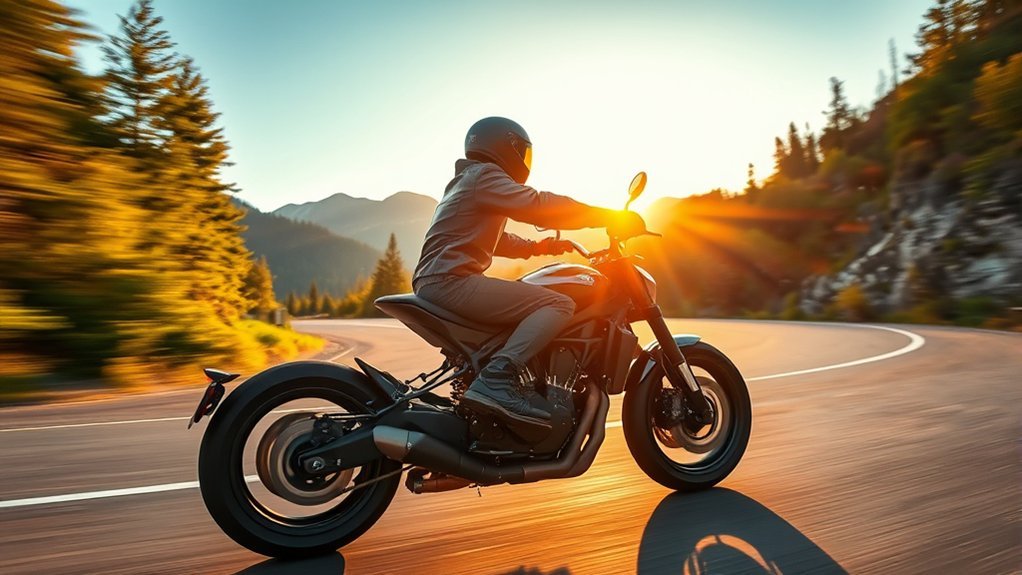
Motorcycle defensive riding means managing space, visibility, speed, traction, and escape routes before a hazard becomes an emergency. It combines proper protective gear, active scanning, flexible lane positioning, smooth motorcycle control, and sound judgment. These habits cannot remove every risk, but they can give you more time and room to respond.
Quick Answer
Ride defensively by wearing complete protective gear, checking your motorcycle before each ride, scanning well ahead, maintaining an escape route, and adjusting your lane position to changing hazards. Keep at least a two-second following gap in good conditions, allow more space when risk increases, and practice braking and swerving in a controlled training area.
Key Takeaways
- Wear a properly fitted, DOT-compliant helmet, eye protection, gloves, riding jacket and pants, and over-the-ankle boots.
- Use the SEE strategy—Search, Evaluate, Execute—to identify threats early instead of relying on last-second reactions.
- Choose the lane position that provides the best sight line, traction, space cushion, and escape route; no single lane third is always safest.
- Treat two seconds as a minimum following interval in favorable conditions and increase it in rain, darkness, traffic, poor visibility, or reduced traction.
- Practice emergency braking, swerving, and cornering only in a legal, traffic-free practice area or under qualified instruction.
At a Glance
| Time Required | 5–10 minutes for a pre-ride check; 30–60 minutes for a focused practice session |
| Difficulty | Beginner fundamentals with skills that require lifelong practice |
| Tools Needed | Roadworthy motorcycle, complete riding gear, owner’s manual, tire-pressure gauge, and cones or flat markers for closed-area practice |
| Cost | Routine practice may be free; professional course fees and protective-gear costs vary |
According to NHTSA’s 2024 data, 6,228 motorcyclists were killed in U.S. traffic crashes, accounting for 16% of all traffic fatalities.
Note: Defensive riding reduces exposure to hazards but cannot guarantee that another road user will see you or that every crash can be avoided. Follow your state’s licensing, helmet, equipment, lane-use, and insurance laws, and treat this guide as a supplement to professional rider training.
Essential Gear for Defensive Riding
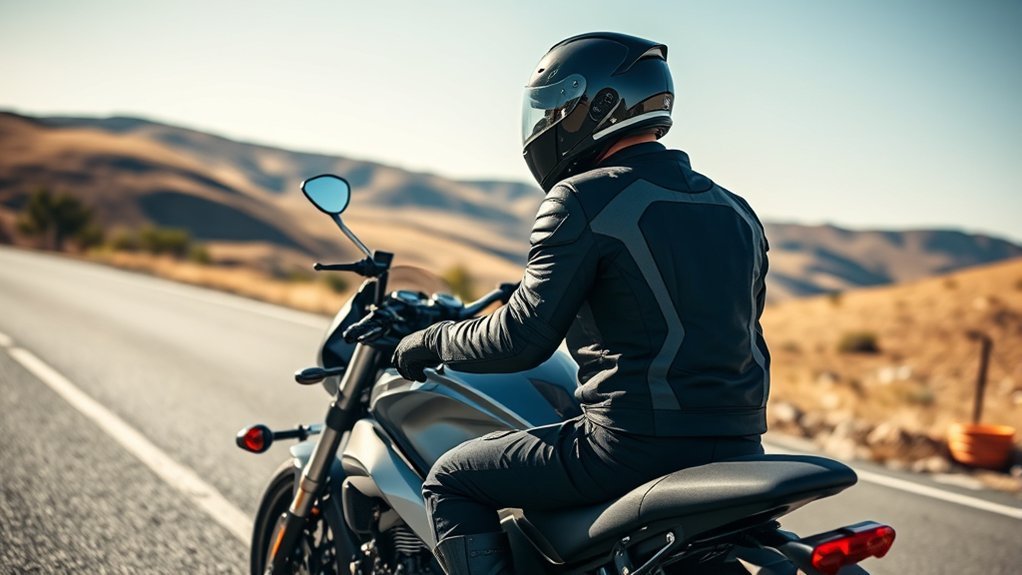
Protective gear is your final layer of defense when prevention fails. It should fit closely enough to stay in place during a crash while still allowing you to turn your head, operate every control, and move comfortably.
Choose a DOT-Compliant Helmet
Wear a helmet manufactured to comply with Federal Motor Vehicle Safety Standard No. 218. Check for the DOT certification label on the rear and inspect the permanent interior label for the manufacturer, model, size, and other required information. NHTSA does not pre-approve individual helmets, so “DOT-compliant” is more accurate than “DOT-approved.”
NHTSA estimates that motorcycle helmets are about 37% effective in preventing fatal injuries to operators and 41% effective for passengers. A full-face helmet also provides coverage for the face and chin, along with protection from wind, insects, and road debris.
The helmet should feel evenly snug without painful pressure points. Replace it after a significant impact and follow the helmet manufacturer’s inspection and replacement instructions. Do not buy a used helmet unless its history and condition can be verified with confidence.
Cover the Rest of Your Body
The Motorcycle Safety Foundation’s protective-gear guidance recommends equipment designed for both comfort and crash protection:
- Eye protection: Use a clean, impact-resistant face shield or goggles. Ordinary eyeglasses may not block wind or debris.
- Jacket and pants: Choose abrasion-resistant motorcycle clothing with impact protectors at areas such as the shoulders, elbows, back, hips, and knees.
- Gloves: Wear full-finger gloves that protect the palms and knuckles while allowing precise control operation.
- Boots: Use sturdy, over-the-ankle footwear with secure closures and slip-resistant soles. Avoid loose laces that could catch on controls.
- Weather layers: Carry waterproof, insulating, or ventilated layers as conditions require. Discomfort, cold, and heat can reduce concentration.
Improve Conspicuity Without Depending on It
Bright clothing, a light-colored helmet, and retroreflective material can make a rider easier to notice, especially in low light. NHTSA identifies brightly colored and reflective equipment as useful motorcycle-conspicuity measures.
However, visible does not mean seen. Drivers may look toward a motorcycle without recognizing its speed or presence. Continue to manage speed, lane position, following distance, and escape space even when wearing high-visibility gear.
Check the Motorcycle and Yourself Before Riding
Use the T-CLOCS Pre-Ride Inspection
A defensive ride begins before the motorcycle moves. The MSF T-CLOCS checklist provides a practical inspection sequence:
- T — Tires and wheels: Check cold tire pressure against the motorcycle or tire manufacturer’s instructions. Look for damage, embedded objects, uneven wear, loose spokes, and wheel problems.
- C — Controls: Confirm that the throttle, clutch, levers, pedals, cables, hoses, and handlebars operate freely.
- L — Lights and electrics: Test the headlight, brake-light switches, turn signals, horn, and instrument indicators.
- O — Oil and other fluids: Check levels and look for leaks. Use the owner’s manual for the correct procedures and specifications.
- C — Chassis: Inspect the frame, suspension, chain or belt, fasteners, and visible components for looseness, damage, or improper adjustment.
- S — Stands: Verify that the side and center stands retract correctly and that springs and safety cutoffs work as designed.
Do not ride when a tire, brake, steering, control, wheel, or structural problem could affect safe operation. Have uncertain defects inspected by a qualified technician.
Assess Your Own Readiness
Do not ride after drinking alcohol or using an impairing drug. Read medication warnings carefully, and ask a pharmacist or clinician when you are unsure whether a medicine affects alertness, coordination, judgment, or vision.
Also reconsider the ride when you are severely tired, ill, emotionally overwhelmed, overheated, dehydrated, or too cold to operate the controls normally. Defensive riding depends on accurate perception and calm decisions; it cannot compensate for major impairment.
Essential Techniques for Defensive Riding
The goal of defensive riding is to recognize developing conflicts while you still have several safe choices. Waiting until a vehicle enters your path leaves fewer options and requires more abrupt control inputs.
Use the SEE Strategy
The Motorcycle Safety Foundation teaches Search, Evaluate, Execute—or SEE:
- Search: Scan far enough ahead to identify traffic lights, curves, stopped traffic, surface changes, driveways, pedestrians, animals, and vehicles that may cross your path. Continue checking mirrors and nearby blind spots.
- Evaluate: Decide which hazards could affect you, how quickly the conflict may develop, and where your open space is located.
- Execute: Communicate, change speed, adjust lane position, or change direction early and smoothly. Avoid waiting until emergency action is your only choice.
Move your eyes instead of staring at one object. Check the road surface, traffic path, mirrors, and escape space repeatedly. Looking farther ahead generally allows smoother decisions than focusing only on the vehicle directly in front.
Maintain a Space Cushion
Use a fixed roadside point to measure following time. When the vehicle ahead passes it, count until your motorcycle reaches the same point. Allow at least two seconds in favorable conditions and increase the interval when:
- The pavement is wet, dirty, uneven, or covered with loose material.
- You cannot see through or around the vehicle ahead.
- Traffic is dense or repeatedly stopping.
- You are riding at night or into glare.
- You are carrying a passenger or luggage.
- Your tires, brakes, or reaction time may be affected by conditions.
- A vehicle is following you too closely.
A longer gap improves your view and gives you more time to brake, change lanes, or steer around a hazard. Avoid filling every gap merely because another driver may enter it; restoring space is usually safer than defending a position.
Use Flexible Lane Positioning
A motorcycle may use the left, center, or right portion of its lane. Choose the position that gives you the best combination of:
- Visibility to and from other road users
- A clear view through traffic and around curves
- Distance from oncoming or merging vehicles
- Good pavement and traction
- Protection from wind blast and roadside hazards
- At least one usable escape route
The left third may be useful when you need to see past traffic, but it can place you closer to oncoming vehicles or a centerline hazard. The right third may improve space from opposing traffic but place you near driveways, parked cars, debris, or merging traffic. The center may be appropriate at times, but it is not automatically safest either.
Change position deliberately as conditions change. Do not weave continually, and avoid remaining beside another vehicle where the driver may not see you or may move into your lane.
Pro Tip: Before entering an intersection, curve, or cluster of traffic, identify the open area you could use if your main path becomes blocked. An escape route is most useful when you select it before the conflict develops.
Manage Intersections, Blind Spots, and Traffic Conflicts
Approach Intersections With a Plan
Intersections include traffic lights, stop signs, driveways, parking-lot exits, side streets, and any location where another road user may cross your path. Reduce speed enough to preserve stopping and steering options.
Watch the front wheels of waiting vehicles because wheel movement may reveal a vehicle starting to turn before its body position changes noticeably. Also look for a driver’s head movement, gaps in traffic, turn signals, and changes in vehicle speed—but never depend on one clue.
When an oncoming vehicle may turn left across your path:
- Cover the controls without applying them abruptly.
- Adjust your lane position to improve visibility and escape space.
- Reduce speed when the threat is credible.
- Check the space beside and behind you before the conflict becomes immediate.
- Do not assume eye contact means the driver has judged your speed correctly.
Avoid Extended Blind-Spot Exposure
Pass through another vehicle’s blind spot promptly when legal and safe. Avoid riding beside cars, buses, or trucks when you could instead move ahead or drop back and restore space.
Large trucks create additional hazards. Their blind spots are larger, they may need extra room to turn, and their tires can throw debris. Do not remain beside a truck or follow so closely that the truck blocks your view of traffic, signals, and road hazards.
Communicate Early
Use turn signals for every turn and lane change, even when traffic appears light. Check mirrors and the relevant blind spot before changing position. Cancel the signal afterward if your motorcycle does not do so automatically.
Your brake light may not illuminate when you slow by closing the throttle or downshifting. When appropriate, a light application of the brake can alert following traffic while you maintain control. Do not flash or apply the brake in a way that destabilizes the motorcycle.
Emergency Braking, Swerving, and Cornering
Warning: Do not attempt first-time emergency braking, swerving, or maximum-lean drills on a public road. Practice in a legal, level, traffic-free area with good pavement, or take a certified rider course. Begin at low speed and increase difficulty only after you can perform each skill consistently.
Practice Straight-Line Emergency Braking
For a straight-line stop, keep your head and eyes up, square the handlebars, and apply both brakes with smooth, increasing pressure. As weight transfers forward, the front tire can accept more braking force, but grabbing the front brake abruptly can overwhelm available traction.
Keep the motorcycle upright and avoid staring at the obstacle. If your motorcycle has an antilock braking system, continue firm brake pressure when ABS activates. ABS can help prevent wheel lock, but it cannot create traction or eliminate stopping distance.
Braking in a curve requires additional judgment because traction is already being used for cornering. When space permits, reduce lean and straighten the motorcycle before applying maximum braking. Qualified instruction is the safest way to practice the alternatives needed when straightening is not possible.
Separate Swerving From Abrupt Braking
A swerve is a quick change of direction used when stopping is not the best available option. Look toward the open path and press the handlebar in the direction you need the motorcycle to lean. Clear the obstacle, then return to your original path only when it is safe.
Avoid hard braking during the swerve because braking and turning compete for available traction. Complete heavy braking before steering sharply, or straighten the motorcycle before resuming strong braking.
Set Up Curves Before Entering
Choose an entry speed that allows you to see through the curve and make adjustments. Look where you want to go, apply smooth steering input, and avoid abrupt throttle, brake, or body movements.
Do not fixate on the shoulder, centerline, guardrail, or obstacle. Your visual attention strongly influences your path. If you enter faster than intended, keep looking through the turn, reduce speed smoothly, and avoid sudden inputs that use more traction than the tires can provide.
Identifying and Managing Road Hazards
Surface hazards can affect a motorcycle more than a four-wheeled vehicle because the motorcycle has a smaller contact area and depends on lean angle for turning. Scan the road early enough to reduce speed and choose a smoother line before reaching the hazard.
Loose, Wet, and Uneven Surfaces
Watch for gravel, sand, mud, wet leaves, fuel or oil, potholes, broken pavement, construction plates, painted markings, manhole covers, and pooled water. When crossing a low-traction area:
- Reduce speed before reaching it.
- Keep the motorcycle as upright as practical.
- Avoid abrupt braking, acceleration, or steering.
- Use smooth control inputs and allow the motorcycle to move slightly beneath you.
- Restore normal speed and lean only after traction improves.
Cross railroad tracks, pavement seams, and grooves at a safe angle rather than following them closely. Change direction only after checking surrounding traffic and confirming that the maneuver will not place you in a greater hazard.
Debris, Animals, and Opening Doors
Leave extra space beside parked cars so you have time to respond to an opening door, a pedestrian stepping out, or a vehicle pulling away. Scan beneath and between parked vehicles for feet, wheels, lights, and movement.
Where animals are common, reduce speed and widen your search area. One animal may be followed by another. Avoid relying on the horn to make an animal move in a predictable direction.
Riding in Rain, Wind, Heat, Cold, and Darkness
Rain and Reduced Traction
Slow down, increase following distance, and make steering, braking, and throttle changes gradually. Painted lines, metal covers, leaves, and other smooth surfaces may become especially slippery when wet.
Use waterproof gear that preserves movement and visibility. Keep the face shield clean and use its ventilation or anti-fog features. Avoid riding through standing water when you cannot judge its depth or see the pavement beneath it.
Wind
Crosswinds and turbulent air from large vehicles can move a motorcycle within its lane. Maintain a secure but relaxed grip, reduce speed when needed, and leave more lateral space. Expect the wind force to change as you pass buildings, barriers, trucks, or open areas.
Heat and Cold
Heat can contribute to dehydration, fatigue, and poor concentration. Wear ventilated protective gear, drink water, and take breaks before your attention declines.
Cold can reduce dexterity and slow control operation. Use windproof and insulated layers without adding so much bulk that you cannot move your head, hands, or feet normally. Stop and warm up if shivering, numbness, or confusion develops.
Night Riding
Ride only as fast as your usable sight distance allows. Clean the headlight, face shield, glasses, and mirrors before departure. Use high beams when legal and when they will not blind another road user.
Allow more space because hazards are harder to identify and speed is more difficult to judge at night. Watch for animals, unlit vehicles, pedestrians, glare, and road edges that disappear beyond the headlight beam.
Why Training and Skill Development Matter
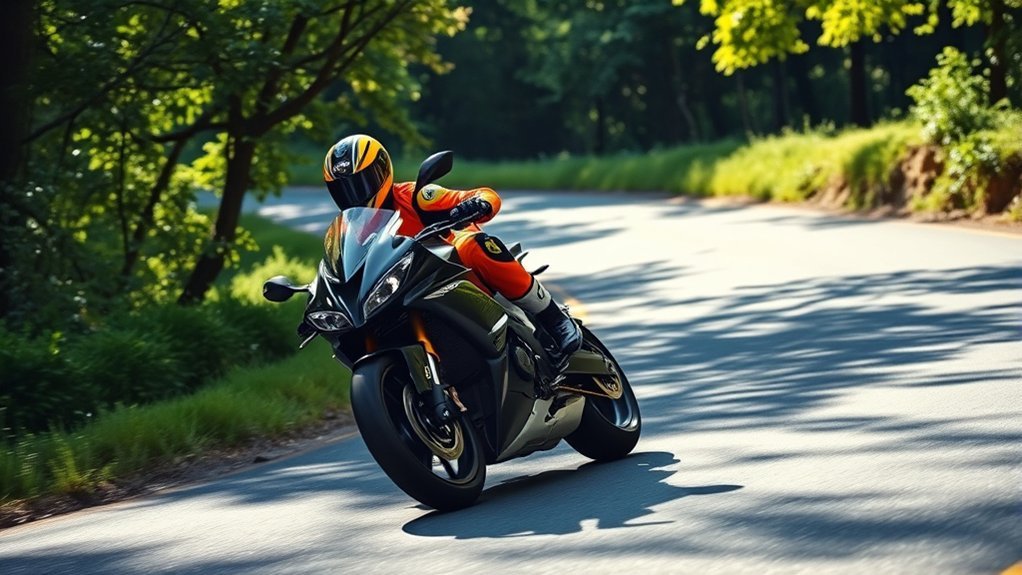
Formal instruction gives new riders a structured way to learn controls, balance, braking, turning, shifting, hazard awareness, and safety-oriented decision-making. It also gives experienced riders an opportunity to correct habits and practice skills that are difficult to evaluate alone.
The MSF Basic RiderCourse is designed for beginning riders and includes motorcycle familiarization, low-speed control, stopping, shifting, turning, and other core exercises. Experienced riders can use advanced courses to refine braking, cornering, perception, and crash-avoidance skills.
Training does not guarantee that a rider will avoid a crash. Its value is in building repeatable control habits, improving hazard recognition, and providing supervised practice before those skills are needed in traffic.
Build a Safe Practice Routine
Use a legal practice range with level pavement, good visibility, and no traffic. Wear full protective gear and inspect the surface before beginning.
- Warm up: Practice smooth starts, stops, shifting, and wide turns at low speed.
- Braking: Mark a braking point and practice smooth use of both brakes while upright. Increase speed gradually only after your stops remain controlled.
- Swerving: Use soft cones or flat markers to create a clear obstacle and escape lane. Practice looking through the open path.
- Cornering: Work on entry speed, head and eye position, steering input, and smooth throttle control.
- Review: Stop when fatigue develops. Record what felt inconsistent and seek qualified coaching for skills you cannot perform reliably.
Practice on the motorcycle you normally ride because control effort, weight, braking response, turning behavior, and rider aids vary between models.
Tips for Riding Safely in Groups
Group riding requires individual responsibility. No rider should exceed a safe speed, run a red light, make an unsafe pass, or follow too closely merely to remain with the group.
Plan Before Departure
- Discuss the route, planned stops, fuel range, pace, hand signals, and what to do if the group separates.
- Place an experienced rider at the front and another experienced rider at the rear.
- Keep groups manageable. MSF recommends dividing groups larger than about five motorcycles into smaller units.
- Confirm that each rider knows the destination instead of depending entirely on the motorcycle ahead.
- Do not pressure an inexperienced rider to maintain a pace beyond that rider’s comfort or skill.
Use the Right Formation
On a straight road with good visibility and pavement, a staggered formation can preserve space and sight lines. The lead rider normally uses the left portion of the lane, with the next rider at least one second behind in the right portion. Each rider should remain at least two seconds behind the motorcycle directly ahead.
Move to single file when riding through curves, entering or leaving a highway, passing, traveling on narrow roads, or encountering poor visibility, construction, rough pavement, or other hazards. Never ride side by side while moving because it removes maneuvering space.
At a stop, riders may wait in pairs when the lane is wide enough and conditions allow. Reform the staggered pattern only after moving through the intersection safely. Do not compress the moving group merely to prevent another vehicle from entering a gap.
Pass Individually
Each rider must make an independent passing decision based on personal sight distance, motorcycle performance, and traffic conditions. Do not assume it is safe to pass because the leader passed. Return to the lane with enough room for the next rider, but never accelerate beyond a safe speed to create or close a gap.
Frequently Asked Questions
What is the best type of motorcycle for defensive riding?
The best motorcycle is one that fits your body, experience, and intended use. You should be able to reach every control, support the motorcycle at a stop, steer it at low speed, and manage its weight and power confidently. Condition, tires, brakes, visibility, predictable power delivery, and familiarity matter more than whether the motorcycle is labeled a sport bike, cruiser, touring bike, or standard.
How do weather conditions change defensive-riding strategy?
Rain, wind, cold, heat, glare, and fog can reduce traction, visibility, comfort, and concentration. Slow down, increase following distance, reduce lean and abrupt inputs, and use suitable protective layers. Postpone the ride when visibility, wind, flooding, ice, heat, or your physical condition makes safe control doubtful.
Are there specific defensive-riding techniques for urban traffic?
Yes. Reduce speed near intersections and driveways, stay out of blind spots, leave space beside parked cars, watch vehicle wheels for early movement, and expect pedestrians, cyclists, delivery vehicles, and opening doors. Choose a lane position that improves your view and keep an escape route available instead of riding beside another vehicle.
How can I improve my reaction time while riding?
Improve the time available to react rather than depending only on faster reflexes. Scan farther ahead, maintain a larger space cushion, identify escape routes, stay rested and sober, and practice braking and swerving in a controlled area. Early hazard recognition usually creates more safety margin than a last-second physical reaction.
What should I do if I encounter an aggressive driver?
Do not gesture, argue, brake-check, race, or try to teach the driver a lesson. Create distance by changing lanes, turning off, or allowing the vehicle to pass. Ride to a busy public location or police or fire station if you are being followed, and call 911 when there is an immediate threat. Do not lead a threatening driver to your home.
Is a two-second following distance always enough?
No. Two seconds is a minimum starting point in favorable conditions. Increase the gap in rain, darkness, heavy traffic, poor pavement, limited visibility, strong wind, or when carrying a passenger or luggage. You also need enough distance to see around the vehicle ahead and maintain an escape path.
How often should I practice emergency riding skills?
Practice often enough that braking, swerving, and low-speed control remain familiar, especially after a long break or when changing motorcycles. Use short, focused sessions in a traffic-free area and stop before fatigue reduces accuracy. Periodic professional instruction can identify errors that are difficult to notice on your own.
Conclusion
Effective motorcycle defensive riding begins with a roadworthy motorcycle, complete protective gear, and a rider who is rested, sober, and focused. On the road, use SEE, preserve space, adjust your lane position, and identify escape routes before conflicts become urgent.
Continue practicing braking, swerving, cornering, and low-speed control under safe conditions. No technique can remove every hazard, but disciplined scanning, smooth control, sound judgment, and ongoing training can leave you with more time and better options when traffic changes unexpectedly.
Sources
- National Highway Traffic Safety Administration — Motorcycle Safety — current fatality data, helmet use, impairment, visibility, and general riding guidance.
- NHTSA — Choose the Right Motorcycle Helmet — DOT certification, FMVSS No. 218, helmet fit, labeling, and novelty-helmet warnings.
- Motorcycle Safety Foundation — If You Ride a Motorcycle — SEE strategy, visibility, lane positioning, protective gear, and space management.
- Motorcycle Safety Foundation — T-CLOCS Pre-Ride Inspection Checklist — tires, controls, lights, fluids, chassis, and stands.
- Motorcycle Safety Foundation — Basic RiderCourse — formal beginner training and hands-on riding exercises.
- Motorcycle Safety Foundation — Group Riding — staggered formation, spacing, communication, passing, and group planning.






Leave a Reply