
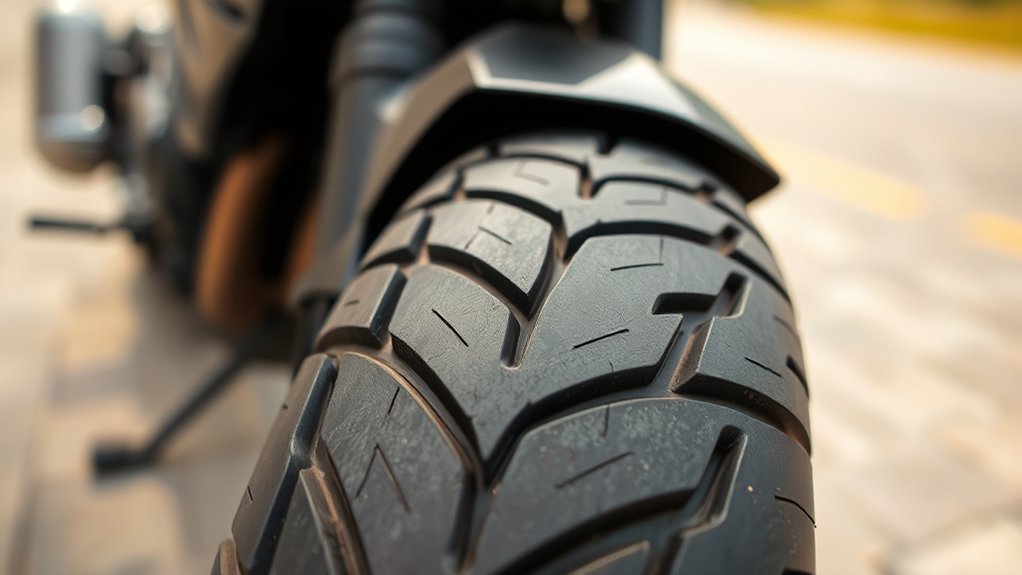
Motorcycle tire wear can reveal pressure problems, suspension faults, wheel issues, riding habits, or simple end-of-life wear. A healthy street tire normally wears gradually and predictably. Cupping, deep cracks, bulges, exposed cords, rapid air loss, severe flat spots, or sudden handling changes require prompt attention because tire condition directly affects grip, braking, and stability.
Quick Answer
Motorcycle tire wear is normal only when it is even and gradual. Replace a tire when it reaches its wear bars, violates local tread-depth rules, has structural damage, or develops handling-changing wear. Check pressure cold, inspect before rides, and have bulges, cracks, punctures, cupping, or one-sided wear professionally assessed.
Key Takeaways
- Measure tread at several points and use the shallowest reading, not an average.
- Check pressure when the tires are cold and use the motorcycle manufacturer’s specification, not the maximum pressure molded on the tire.
- Do not rotate motorcycle tires from front to rear; investigate pressure, balance, alignment, suspension, bearings, or fitment instead.
- Chicken strips are not proof of tire damage or poor riding skill.
- Do not ride on a flat tire, bulge, exposed cord, bead damage, serious deformation, or rapidly leaking tire.
At a Glance
| Time Required | 10–15 minutes |
| Difficulty | Easy visual inspection; professional diagnosis may be needed |
| Tools Needed | Accurate pressure gauge, tread-depth gauge, flashlight, owner’s manual, and an optional motorcycle stand |
| Cost | $0 with existing tools; approximately $10–$30 for basic gauges |
Warning: This guide provides general inspection information. Your motorcycle owner’s manual, tire manufacturer’s instructions, approved fitment information, and applicable law take priority. Do not ride on a visibly damaged, flat, deformed, or rapidly leaking tire.
Understanding Motorcycle Tire Wear Patterns
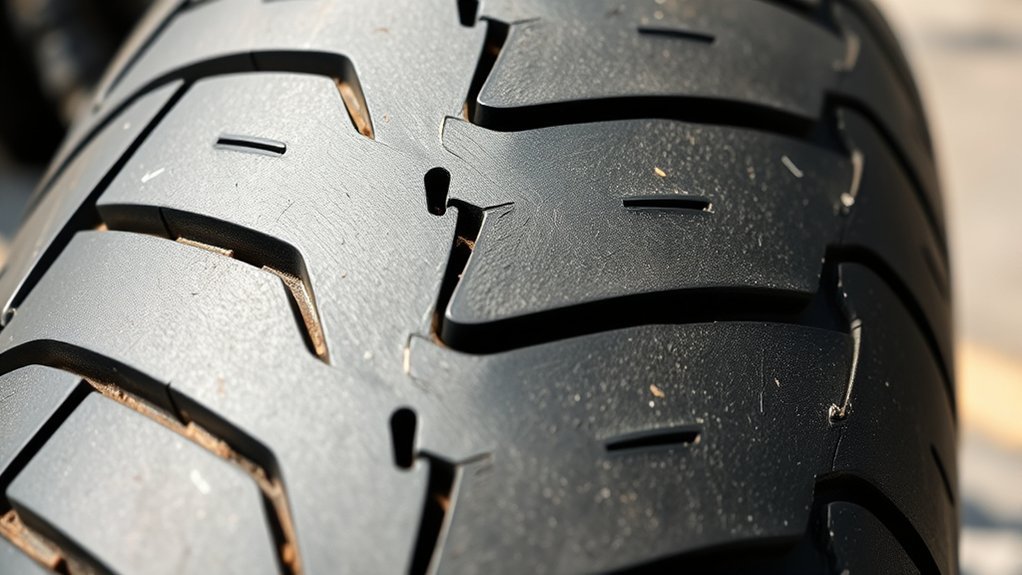
Understanding motorcycle tire wear patterns can help you detect a developing pressure, wheel, suspension, or fitment problem. A wear pattern is a clue, however, not a complete diagnosis. The same appearance may have more than one cause, so pressure history, mileage, load, road conditions, motorcycle setup, and handling symptoms must also be considered.
Normal Street Wear Versus a Problem
Normal street wear is usually smooth, gradual, and reasonably even around the tire. A rear tire used for commuting or highway travel may wear more quickly through the center because it spends more time upright and transfers engine power to the road. The front tire may wear differently because it handles steering and much of the braking load.
Wear deserves closer attention when it develops rapidly, appears in isolated patches, creates raised and lowered tread blocks, exposes cords, reaches the wear bars at one point, or changes the motorcycle’s handling.
Common Motorcycle Tire Wear Patterns
- Flattened or squared-off center: Common after extended upright highway riding. Excessive pressure may contribute to center wear, but the appearance alone does not prove overinflation.
- Heavy shoulder wear: May reflect frequent cornering, low pressure, excessive load, or a tire that is unsuitable for the motorcycle or use.
- Cupping or scalloping: Alternating high and low tread areas may be associated with pressure, balance, braking loads, worn suspension, loose bearings, or normal characteristics of a particular tire design.
- One-sided wear: Road crown and repeated routes can have an effect, but strong or rapidly developing one-sided wear may indicate alignment, wheel, fork, swingarm, or suspension problems.
- Flat spot in one area: May result from a skid, locked wheel, impact, or long-term storage with the motorcycle’s weight resting on one section of the tire.
- Cracks or crazing: Can indicate aging, ozone or UV exposure, storage damage, or chemical contamination. Cracks require professional evaluation even when tread remains.
- Blue or purple discoloration: Can appear after repeated heat cycles, especially during demanding use. Color alone does not determine whether the tire is unsafe, but it should be considered with grip changes, surface condition, and the tire maker’s guidance.
So-called chicken strips are areas of unused tread near the tire’s shoulders. They mainly reflect how far that portion of the tire has been used at lean. They are not, by themselves, evidence of tire damage, incorrect pressure, or poor riding ability. Riders should never increase lean on public roads merely to remove them.
Street Wear Versus Track Tearing
Terms such as cold tear, hot tear, and graining are most useful in track settings. Track wear can be influenced by cold and hot pressures, carcass construction, compound, tire warmers, track temperature, pavement, pace, suspension, and throttle application.
A deep or shallow torn surface should not be diagnosed from appearance alone. Track riders should begin with the tire manufacturer’s published operating range and consult an experienced tire technician or suspension specialist. Street pressures should not be replaced with track pressures.
Note: Online wear-pattern photos can suggest where to look, but they cannot confirm the cause without pressure, temperature, load, fitment, and motorcycle-setup information.
A tire that reaches its wear limit in one groove or one section is worn out, even when other areas still appear usable.
Recognizing the Signs of Deteriorating Tires
Inspect both tires before riding and perform a closer check regularly. The Motorcycle Safety Foundation T-CLOCS checklist includes tread depth, wear, weathering, bulges, embedded objects, cold pressure, rims, bearings, and wheel condition.
Look for the following warning signs:
- Bulges, bubbles, blisters, or localized swelling.
- Exposed cord, fabric, belt material, or separated tread.
- Deep cuts, tears, open cracks, or serious surface deformation.
- Damage around the bead or the area where the tire meets the rim.
- A bent, cracked, or badly dented wheel.
- A puncture, embedded object, or unexplained pressure loss.
- Tread worn level with a wear indicator at any measured point.
- Strong cupping, one-sided wear, or a skid flat spot that affects handling.
- New vibration, wobble, pulling, steering resistance, or instability.
- Rubber damaged by petroleum products, solvents, or corrosive chemicals.
Warning: Stop riding if you find a bulge, exposed reinforcement, serious bead damage, tread separation, a flat tire, or a fast leak. Do not attempt to “ride it to the shop.” Arrange professional transport or roadside assistance.
Small surface lines are not always a sign of immediate failure, but cracks and crazing should never be dismissed solely because the tread is deep. A tire professional may need to inspect the inner liner, bead, and carcass for damage that cannot be seen while the tire is mounted.
Identifying Common Causes of Tire Degradation
Motorcycle tire degradation can result from incorrect pressure, excessive load, wheel or suspension faults, aggressive use, impacts, aging, poor storage, contamination, or an unsuitable tire combination. Finding the cause matters because replacing a tire without correcting the underlying problem may damage the new tire in the same way.
Tire Pressure Management
Correct motorcycle tire pressure supports the motorcycle’s weight, maintains the intended tire profile, controls heat, and affects steering, grip, stability, and tread life.
Use the cold pressures specified by the motorcycle manufacturer in the owner’s manual, on the motorcycle placard, or in official fitment information. Do not treat the maximum pressure molded into the tire sidewall as the motorcycle’s normal setting.
Michelin’s current motorcycle pressure guidance recommends checking cold pressure every two weeks and before long journeys. A tire is generally considered cold when it has been parked long enough to return to ambient temperature.
- Underinflation increases carcass flex and heat and may cause sluggish steering, shoulder wear, instability, or tire damage.
- Overinflation can make the ride harsh, reduce the tire’s ability to absorb irregularities, and contribute to center wear or reduced compliance.
- Incorrect load pressure may overload the tire when carrying a passenger, luggage, or accessories.
- A leaking valve or damaged valve cap can cause gradual pressure loss.
Never bleed pressure from a hot street tire simply because the reading has risen during a ride. Pressure normally increases as the tire warms. Recheck and adjust it when cold unless the manufacturer provides a specific hot-pressure procedure.
Suspension Setup Issues
Incorrect spring preload, damping, ride height, or worn suspension components can contribute to uneven tire wear. A leaking fork, worn shock, sticking linkage, or setup that is too stiff or too soft may prevent the tire from following the road consistently.
Suspension is not the only possible cause of cupping or irregular wear. A technician should also consider:
- Wheel balance.
- Front and rear wheel alignment.
- Steering-head, wheel, and swingarm bearings.
- Bent wheels or damaged rims.
- Loose spokes or incorrect spoke tension.
- Brake drag or a previously locked wheel.
- Incorrect tire size, construction, direction, or rim width.
Set preload and pressure for the actual load, including the rider, passenger, luggage, and accessories. Use the owner’s manual rather than copying another rider’s settings.
Load, Riding Style, Road Conditions, and Storage
Hard acceleration can wear a rear tire quickly, while repeated heavy braking places more demand on the front. Burnouts, wheelspin, skids, abrupt throttle use, and prolonged high-speed operation can produce rapid or localized wear.
Rough pavement, potholes, curbs, debris, and sharp objects may damage the tread, sidewall, carcass, or wheel. An impact can cause internal damage even when the outer surface appears mostly intact.
Long periods of storage may create flat spots, especially when pressure is low. Use an approved stand where practical, maintain the recommended storage pressure, and follow the motorcycle and tire manufacturers’ storage instructions. If the motorcycle remains on its tires, move it periodically so the same section does not support the load continuously.
How to Inspect for Common Tire Wear Patterns
Park the motorcycle on firm, level ground with the engine off. Allow the tires to cool before checking pressure. Use a stand only when you know how to secure the motorcycle safely.
- Confirm the specifications. Find the approved tire size, construction, load and speed ratings, and cold pressure in the owner’s manual or official manufacturer information.
- Check cold pressure. Use an accurate gauge on both tires and reinstall the valve caps when finished.
- Rotate each wheel for inspection. Examine the full tread circumference, sidewalls, valve area, bead, and rim.
- Remove loose surface debris carefully. Do not pull out a nail or screw if the tire is holding air and you need a professional to assess it; removing it may cause immediate deflation.
- Measure tread depth. Check several main grooves across and around the tire. Record the shallowest valid measurement.
- Find the wear indicators. Look for “TWI,” a triangle, a manufacturer symbol, or another sidewall marker showing where the raised bars cross the main grooves.
- Compare both sides and the full circumference. Look for center flattening, cupping, isolated low spots, one-sided wear, cracks, and deformation.
- Check the wheel and surrounding components. Look for rim damage, loose spokes, bearing play, fork leaks, shock leaks, and brake drag.
- Arrange an inspection when uncertain. A tire may need to be removed from the wheel to inspect its inner surface and carcass.
Common Wear Indicators
Motorcycle tires have raised tread-wear indicators in selected grooves. When the surrounding tread becomes level with an indicator, the tire has reached that indicator’s depth at that location.
U.S. federal motorcycle tire wear indicators are associated with 1/32 inch, or 0.8 mm, of tread. Some states require more tread, including 2/32 inch, or about 1.6 mm. Michelin explains this jurisdictional difference in its updated motorcycle tread-depth guide.
Do not assume that one measurement represents the entire tire. If a groove or section reaches the applicable wear limit, the tire needs replacement even when another section measures deeper.
Visual Inspection Techniques
Use a flashlight and view the tire from several angles. Run a gloved hand lightly over the tread to feel high and low areas, but keep your fingers away from sharp objects and do not place your hands near a wheel that can move unexpectedly.
A dedicated tread-depth gauge is more reliable than a coin test because it gives a numerical reading and can be used at multiple points. Coin tests also vary by coin, placement, groove shape, and jurisdiction.
Pro Tip: Write down both cold pressures and the shallowest tread measurement once a month. A simple record can reveal a slow leak or unusually rapid wear before it becomes obvious during a ride.
Key Tire Maintenance Practices for Extended Longevity
Proper tire maintenance cannot prevent normal wear, but it can reduce avoidable damage and help the tire perform as designed.
- Perform a quick tire-and-wheel check before each ride.
- Measure cold pressure at least every two weeks and before long trips.
- Adjust pressure and suspension preload for passengers and luggage as directed by the motorcycle manufacturer.
- Use an approved front and rear tire combination in the specified sizes and constructions.
- Have the wheel balanced whenever a tire is installed, removed, or remounted.
- Investigate vibration, pulling, wobble, cupping, or rapid pressure loss promptly.
- Keep petroleum products, solvents, fuel, oil, and cosmetic tire dressings off the tread.
- Clean tires with water and mild soap when needed, then inspect them again.
- Protect stored tires from excessive heat, sunlight, ozone sources, moisture, and chemical contamination.
- Replace damaged valve components when recommended during tire service.
Do not rotate motorcycle tires from front to rear. Front and rear tires may differ in profile, size, construction, direction, and load requirements. Tires marked for front use must remain on the front, and tires marked for rear use must remain on the rear.
Uneven motorcycle tire wear is a reason to find the cause—not a reason to swap the front and rear tires.
Maintaining Proper Tire Pressure for Safety
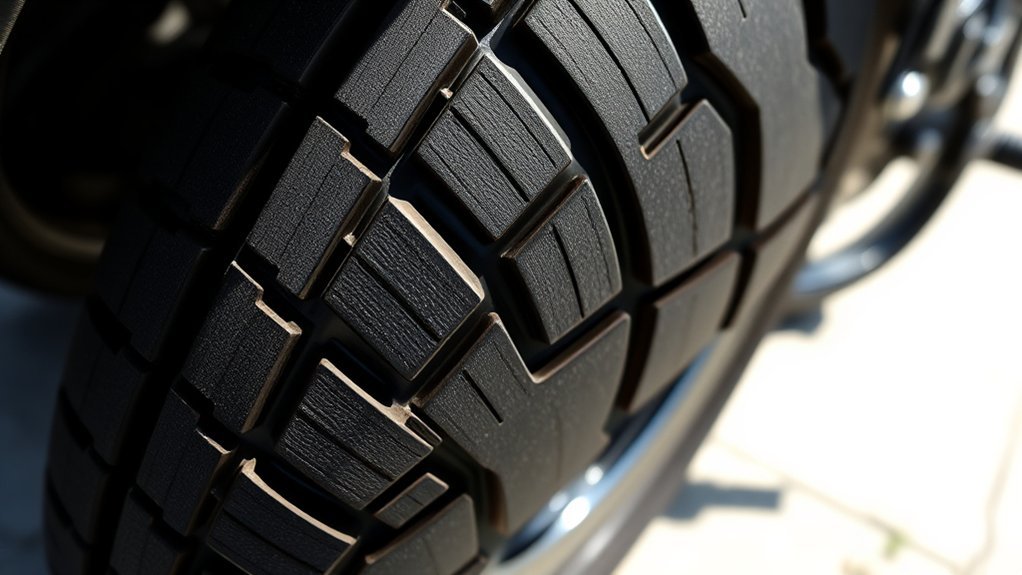
Maintaining proper tire pressure supports predictable handling, load capacity, heat control, and tire life. A tire can look adequately inflated while still being several pounds low, so always use a gauge.
- Park the motorcycle and allow the tires to cool to ambient temperature.
- Find the motorcycle manufacturer’s cold-pressure specification for the current load.
- Remove the valve cap, press the gauge squarely onto the valve, and take a second reading if the first seems unusual.
- Add air in small amounts when pressure is low. If pressure is high while the tire is genuinely cold, release small amounts and recheck.
- Inspect the valve stem for cracks, movement, leakage, or damage.
- Reinstall the valve cap and repeat the process on the other tire.
A tire-pressure monitoring system is helpful but does not replace a gauge or physical inspection. TPMS alerts may occur only after pressure has already fallen significantly, and the system cannot detect tread wear, cracks, embedded objects, or wheel damage.
Note: Track, off-road, and competition pressures may differ from street specifications. Use only the pressure range supplied for the exact tire, motorcycle, load, speed, and riding environment.
When to Replace Your Motorcycle Tires
Replace a motorcycle tire when any condition below applies:
- The wear limit is reached: The tread is level with a wear indicator at any point or has reached the applicable legal or technical limit.
- Structural material is visible: Cord, fabric, breaker, or other reinforcement can be seen.
- A bulge or separation appears: Localized swelling, tread lifting, or layer separation requires immediate removal from service.
- Damage is beyond an approved repair: Sidewall or shoulder damage, bead deformation, large punctures, run-flat damage, or serious internal abrasion normally requires replacement.
- The tire loses air repeatedly: A slow or fast leak must be diagnosed before further riding.
- Wear affects handling: Severe cupping, flat spotting, one-sided wear, vibration, wobble, or instability may make replacement necessary even when some tread remains.
- The tire is contaminated: Oil, fuel, solvents, or corrosive chemicals can damage rubber and internal components.
- The tire is too old: Age, storage, heat, sunlight, and service history matter even when tread remains.
- The tire is incompatible: The size, construction, direction, rim fit, load rating, speed rating, or front/rear designation is not approved for the motorcycle.
There is no single mileage at which every motorcycle tire expires. A soft sport tire on a powerful motorcycle may wear much faster than a touring tire on a lighter, gently ridden motorcycle. Condition, age, pressure history, use, and the manufacturer’s instructions are more dependable than a blanket mileage estimate.
Motorcycle Tire Age and the DOT Date Code
The last four digits in a modern DOT tire identification code show the week and year of manufacture. For example, “2324” means the tire was manufactured during the 23rd week of 2024.
Michelin’s current motorcycle replacement guidance recommends annual professional inspection after five years of use and precautionary replacement by ten years, even when a tire appears usable. A motorcycle or tire manufacturer may specify an earlier limit.
Can a Punctured Motorcycle Tire Be Repaired?
Do not continue riding on a flat or visibly damaged tire. A qualified technician must determine whether the tire maker permits repair and whether the damage meets its requirements.
The Bridgestone Motorcycle Tire Safety and Maintenance Manual states that an eligible repair requires the tire to be removed from the rim and inspected internally. It prohibits plug-only repairs, damage outside the tread area, repairs at the wear limit, and punctures larger than 1/4 inch, or 6.4 mm.
Repair policies vary by tire type and manufacturer. A repaired tire may also have reduced speed restrictions or lose its original speed rating. Follow the tire maker’s instructions exactly.
Breaking In New Motorcycle Tires
New tires can feel different because their profile, tread depth, and response differ from the worn tires they replaced. Begin with gentle acceleration, braking, and lean angles while learning the new handling.
Michelin’s June 2026 new-tire break-in guidance recommends at least 100 km, or about 62 miles, of progressive road use for its motorcycle and scooter tires. Follow the instructions supplied by the manufacturer of your exact tires.
Choosing the Right Replacement Motorcycle Tire
Select replacement tires by motorcycle model and approved fitment, not by diameter alone. Confirm all of the following:
- Front or rear designation.
- Tire width, aspect ratio, and rim diameter.
- Radial, bias, or bias-belted construction.
- Load index and speed rating.
- Tube-type or tubeless requirements.
- Approved rim width.
- Direction-of-rotation arrow.
- Street, touring, sport, adventure, off-road, or competition use.
- Original-equipment or manufacturer-approved pairing.
For best predictability, use the approved matched front and rear pair. Do not mix radial and bias or bias-belted tires unless the motorcycle manufacturer explicitly approves that combination. Bridgestone also warns that installing a new front tire while leaving a heavily worn rear tire may cause instability.
When replacing only one tire, confirm that it is compatible with the remaining tire and motorcycle. Ask the motorcycle manufacturer, tire manufacturer, or a qualified dealer when the approved combination is unclear.
Frequently Asked Questions
How can I choose the right motorcycle tire for my bike?
Use the motorcycle manufacturer’s approved size and fitment information. Match the front or rear designation, construction, rim requirements, load index, speed rating, tube or tubeless specification, and intended use. A tire that physically fits the wheel is not automatically an approved or safe fitment.
What is the average lifespan of motorcycle tires?
There is no dependable universal mileage. Tire category, motorcycle power and weight, pressure, load, road surface, climate, storage, maintenance, and riding style can change tire life substantially. Replace tires according to condition, wear indicators, age, handling, and manufacturer guidance rather than relying on a 5,000- or 10,000-mile rule.
Can I mix different tire brands on my motorcycle?
A matched, manufacturer-approved front and rear pair is the safest default. Different brands or product families can have different profiles, carcasses, compounds, and handling characteristics. Never mix radial and bias or bias-belted construction unless the motorcycle manufacturer specifically approves the combination.
How does riding style affect tire wear?
Hard acceleration increases rear-tire wear, repeated heavy braking loads the front tire, and long upright highway travel can flatten the center. Skids, burnouts, wheelspin, abrupt inputs, overloading, and sustained high speeds can accelerate or localize wear.
Are there specific motorcycle tires for different weather conditions?
Yes. Tire compounds, tread patterns, temperature ranges, water evacuation, and intended surfaces differ. Choose a street-legal tire approved for your motorcycle and expected conditions. Competition rain tires, off-road tires, and tires marked not for highway service should not be treated as ordinary road replacements.
Can a nail puncture in a motorcycle tire be repaired?
Possibly, but only when the tire manufacturer permits it and a qualified technician removes the tire for internal inspection. Sidewall or shoulder punctures, large holes, run-flat damage, low remaining tread, bead damage, and plug-only repairs generally do not qualify.
How do I determine the age of a motorcycle tire?
Find the final four digits of the DOT tire identification code. The first two digits are the manufacturing week and the final two are the year. A code ending in 2324 means the 23rd week of 2024. Age does not replace a condition inspection, but older tires require closer professional evaluation.
Conclusion
Motorcycle tire wear should be judged by the entire tire, not one isolated mark or a fixed mileage estimate. Check cold pressure, measure the shallowest tread, inspect the tread and sidewalls, and respond promptly to leaks, bulges, cracks, punctures, cupping, vibration, or instability.
Use the motorcycle manufacturer’s approved pressures and fitments, keep front and rear tires in their designated positions, and seek a professional inspection whenever damage or irregular wear is difficult to explain. Replacing a questionable tire early is less costly than risking a loss of grip or tire failure.
Sources
- National Highway Traffic Safety Administration — Motorcycle Tire Tread-Wear Indicators — federal motorcycle tread-wear indicator requirement.
- Motorcycle Safety Foundation — T-CLOCS Pre-Ride Inspection Checklist — tire, wheel, pressure, bearing, rim, and suspension inspection points.
- Michelin — Motorcycle Tire Tread Depth and Legal Limits — tread measurement, wear indicators, and U.S. jurisdictional differences.
- Michelin — How to Check Motorcycle Tire Pressure — cold-pressure procedure, frequency, and hot-tire precautions.
- Michelin — When to Change Motorcycle Tires — damage, unusual wear, tire age, and replacement guidance.
- Bridgestone — Motorcycle Tire Safety and Maintenance Manual — fitment, front/rear matching, tread limits, balancing, and puncture-repair restrictions.







Leave a Reply