
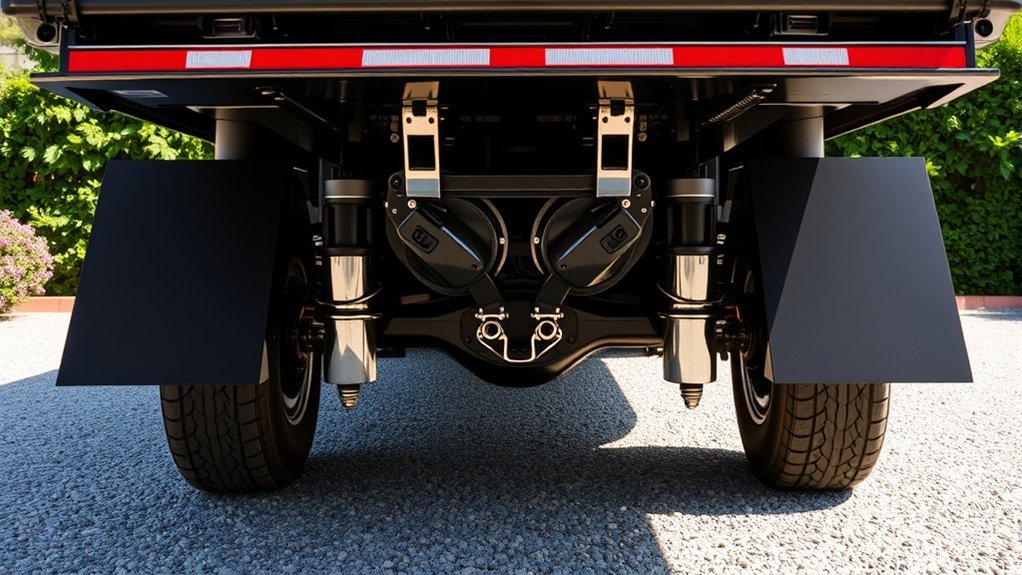
Airbags for towing—more accurately called air helper springs—can reduce rear squat, restore ride height, and improve control when a truck or SUV carries trailer tongue weight or heavy cargo. They are useful load-support tools, but they do not raise the vehicle’s payload, axle, hitch, or towing ratings. Safe results depend on correct fitment, measured weights, proper installation, and kit-specific air pressure.
Quick Answer
Towing airbags are worth considering when a correctly loaded, within-rating vehicle still squats or bottoms out. Choose a vehicle-specific kit, use only enough pressure to restore normal ride height, and follow its manual. Air springs cannot increase towing capacity, correct unsafe tongue weight, or replace a required weight-distribution or sway-control system.
Key Takeaways
- Air helper springs support the existing suspension and reduce squat; they do not change GVWR, GAWR, GCWR, payload, hitch limits, or maximum trailer weight.
- There is no universal towing-airbag PSI. The correct minimum, maximum, and loaded pressure come from the exact kit manual.
- Verify fitment by year, make, model, drivetrain, axle, suspension, bed length, lift height, and in-bed hitch hardware before buying.
- Weigh the loaded tow vehicle and trailer. Airbags can hide visible squat even when a rear axle, tire, hitch, or payload rating is exceeded.
- Airbags are not the same as a weight-distribution hitch, anti-sway device, upgraded shock, or higher-capacity tire.
At a Glance
| Time Required | About 1–2 hours for some no-drill manual-fill kits; 4–6 hours or more for systems with compressor controls, wiring, or difficult fitment |
| Difficulty | Moderate for a bolt-on kit; advanced when drilling, exhaust clearance, frame-mounted hitches, height sensors, or electrical work are involved |
| Tools Needed | Vehicle-specific manual, jack and rated stands or lift, sockets, torque wrench, air-line cutter, pressure gauge, leak-test solution, and any kit-listed drill or electrical tools |
| Cost | Roughly $150–$800 for many manual-fill kits and about $700–$1,400+ for premium compressor/control packages; vehicle-specific parts and labor vary |
What Towing Airbags Do—and What They Do Not Do

In this article, “airbags” means suspension air springs, not the crash-protection airbags inside the cab. A typical towing kit mounts between the vehicle’s frame and axle or fits inside a coil spring. Adding air pressure lets the springs share part of the load carried by the factory suspension.
When the vehicle is within all of its ratings, the extra support can:
- Reduce rear-end squat and suspension bottoming.
- Return the vehicle closer to its normal ride height.
- Improve headlight aim, steering feel, and braking response that were affected by excessive squat.
- Let the driver tune support for changing cargo or trailer tongue weight.
- Reduce repeated contact with factory bump stops on rough roads.
Air springs do not change the limits printed by the vehicle, tire, axle, hitch, or trailer manufacturers. The 2026 Ford towing guide, for example, explains that actual vehicle weight must remain below GVWR, each axle must remain below GAWR, and the combined vehicle-and-trailer weight must remain below GCWR.
Warning: A level-looking truck can still be overloaded. Airbags may remove visible squat without reducing the weight carried by the rear axle, tires, wheels, hitch, or vehicle. Confirm actual loaded weights on a scale before towing.
How Air Helper Springs Affect Stability and Control
Trailer tongue weight pushes down behind or near the rear axle. That load can compress the rear suspension and reduce weight on the front axle. Excessive squat can change steering response, headlight aim, suspension travel, and braking feel.
Properly adjusted air springs resist some of that suspension compression. Their main job is load leveling, not changing where the trailer’s weight comes from. A well-matched system can make a within-rating combination feel more settled, but it cannot fix poor trailer loading, an undersized tow vehicle, worn shocks, weak brakes, low tire capacity, or excessive speed.
| Potential Benefit | Important Limit |
|---|---|
| Reduces rear squat | Does not increase payload, GAWR, or tire capacity |
| Restores suspension travel and ride height | Too much pressure can create a harsh ride and reduce useful suspension movement |
| Can improve control when squat was the cause of poor handling | Does not correct bad tongue weight, trailer sway, worn components, or excessive speed |
| Adjusts for changing loads | Pressure must stay within the exact kit’s limits |
Airbags vs. Weight Distribution and Sway Control
Airbags and a weight-distribution hitch solve different problems. Air springs support the tow vehicle’s rear suspension. A properly set weight-distribution hitch uses spring bars to restore part of the load to the tow vehicle’s front axle and the trailer axles. Some vehicles or hitch receivers require weight distribution above a stated trailer or tongue weight.
Likewise, air pressure is not a safe cure for trailer sway. Sway calls for a full check of trailer loading, tongue weight, tire condition and pressure, hitch setup, speed, wheel alignment, suspension condition, and any required sway-control equipment.
Use air springs to restore ride height—not to disguise an overloaded axle or compensate for an unsafe trailer setup.
How to Choose the Right Towing Airbag Kit
1. Verify Exact Vehicle Fitment
Do not choose a kit by truck series alone. Confirm the exact model year, make, model, cab and bed configuration, two- or four-wheel drive, single- or dual-rear-wheel axle, factory suspension type, and any special chassis package. For vehicles with an official VIN-based towing tool, use the VIN to confirm the factory configuration and ratings.
Also check for parts that can occupy the same frame space as air-spring brackets:
- Fifth-wheel or gooseneck hitch brackets
- Aftermarket sway bars or traction devices
- Lift, lowering, or leveling kits
- Exhaust routing and heat shields
- Oversize tires or modified bump-stop spacing
- Factory ride-height sensors or electronic suspension
2. Calculate the Real Load
Start with the door-jamb certification label, tire-and-loading label, owner’s manual, hitch label, and trailer data plate. Then account for passengers, cargo, accessories, the hitch itself, and loaded trailer tongue or pin weight.
For a conventional trailer, tongue weight is commonly near 10% of loaded trailer weight, but the correct range and maximum must come from the tow-vehicle, hitch, and trailer manufacturers. The 2026 Ford guide uses 10% for conventional trailers over 2,000 pounds and 15% for fifth-wheel pin weight in its general guidance. Other manufacturers or trailer types may specify different limits.
Note: Brochure “maximum towing” numbers often assume a lightly equipped tow vehicle. Real passengers, cargo, options, accessories, and tongue weight reduce the available payload and may reduce the trailer weight you can safely tow.
3. Match the System to How You Tow
A simple manual-fill kit may be enough when the load changes only a few times each season. Frequent towers may benefit from an onboard compressor. Dual-path controls let the left and right springs use different pressures when the manufacturer permits it, which can help with a persistent side-to-side load difference.
Choose support capacity as a product feature—not as permission to add that much cargo. A kit advertised with 5,000 pounds of load-leveling capacity still cannot raise the vehicle’s certified limits.
4. Choose the Appropriate Spring Style
- Double-convoluted or bellows-style springs: Common on pickups and vans with leaf springs; suitable for heavier load-leveling work when a vehicle-specific kit is available.
- Sleeve-style springs: Used in some applications where space and suspension travel favor a narrower spring.
- Coil-spring inserts: Fit inside certain factory coil springs and usually provide less leveling support than heavy-duty frame-to-axle systems.
- Internal-jounce air springs: Some premium systems include an internal bumper that provides added support if pressure is lost or the suspension compresses deeply.
Air Spring Systems and Non-Air Alternatives to Compare
There is no single “best” towing airbag for every vehicle. Fitment, suspension design, loaded weight, ride goals, hitch hardware, and service access matter more than brand alone. The products below are examples of different system types, not a universal ranking.
| System | Type | Best Fit | Key Check |
|---|---|---|---|
| Firestone Ride-Rite | Adjustable air helper spring | Vehicle-specific truck, van, and RV load leveling | Confirm the exact kit’s capacity, pressure range, hitch compatibility, and drilling requirements |
| Air Lift LoadLifter 5000, including fitment-specific kits such as 57275 | Adjustable bellows air spring | Leaf-spring pickups and vans needing up to 5,000 pounds of load-leveling support | “5,000 pounds” is leveling capacity, not added payload or towing capacity |
| Hellwig Big Wig | Large-diameter adjustable air spring | Heavy pickup and motorhome applications with a listed fitment | Capacity and minimum pressure vary by part number; use the matching installation manual |
| SumoSprings Solo Series | Microcellular urethane helper spring; not an airbag | Drivers who want progressive, maintenance-free support without air lines | Less adjustable than air springs; unloaded contact and ride effect depend on fitment |
| RoadActive Suspension | Mechanical tension-coil system for leaf springs; not an airbag | Leaf-spring vehicles needing always-active support without pressure adjustment | Does not increase payload; confirm compatibility with the exact spring pack and other suspension parts |
Should You Install Towing Airbags Yourself?
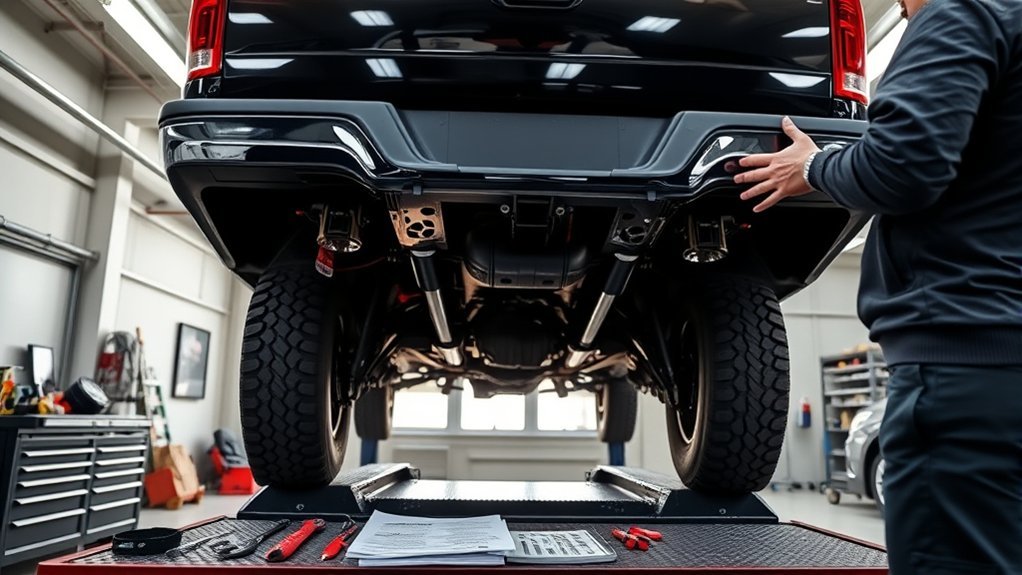
A careful DIY installation is realistic when the kit is a confirmed fit, uses bolt-on brackets, includes clear instructions, and does not interfere with a hitch, exhaust, brake lines, wiring, or suspension modifications. You should also be comfortable supporting the vehicle safely, tightening fasteners to specification, routing nylon air line, and checking for leaks.
Professional installation is the safer choice when the job requires drilling, welding, exhaust changes, frame-hitch coordination, electrical compressor wiring, ride-height sensors, or custom spacers for a lifted vehicle. It is also wise when corrosion, previous repairs, or unknown modifications make the frame or suspension hard to assess.
Installation Overview
- Read the entire kit manual first. Confirm every part, tool, torque value, clearance requirement, and lifting instruction.
- Record baseline ride height. Measure from a repeatable body or frame point with the vehicle unloaded and then loaded as it will be used.
- Support the vehicle safely. Use the lift points and support method specified by the vehicle and air-spring manufacturers. Never work under a vehicle supported only by a jack.
- Install the brackets and springs. Keep brake hoses, wiring, fuel lines, and moving suspension parts clear. Tighten all fasteners to the manual’s torque values.
- Route the air lines. Make clean, square cuts. Avoid exhaust heat, sharp edges, pinch points, and moving parts. Install heat shields where required.
- Install inflation valves or compressor controls. Protect valves from road debris and route electrical wiring through fused, approved circuits as directed.
- Inflate and leak-test. Use the manual’s test pressure and apply a soap-and-water leak solution to fittings and valve cores. Repair bubbling connections before driving.
- Set loaded pressure. Add air in small steps until the vehicle returns near its normal loaded ride height without exceeding the kit maximum.
- Recheck after the first trips. Inspect clearances, air lines, brackets, and fastener torque at the interval listed in the manual.
Pro Tip: Photograph air-line routing, bracket positions, and valve locations before lowering the vehicle. Those photos make later leak checks and service much faster.
How to Set Airbag Pressure for Towing
There is no universal towing pressure. Depending on the design, one kit may operate from 5 to 35 PSI while another may allow 5 to 100 PSI. Some systems with an internal jounce bumper may permit zero PSI when unloaded; many standard air springs require a minimum pressure at all times.
Use this safe adjustment process:
- Load the vehicle and trailer exactly as they will travel.
- Confirm that all vehicle, axle, tire, hitch, and trailer ratings are within limits.
- Start at the kit’s required minimum pressure.
- Add equal pressure to both sides in small steps unless the manual allows independent side-to-side adjustment.
- Stop when the vehicle returns close to its normal ride height and handling feels controlled.
- Do not keep adding pressure after the vehicle is level. Excess pressure can make the rear suspension harsh and may reduce traction on rough roads.
- Record the final cold pressure for that exact load and recheck it before future trips.
Air Lift’s current pressure guide advises adjusting pressure for the load, avoiding overinflation as a false fix for sway, and never exceeding the vehicle’s ratings.
Warning: Do not use a generic 5/10/20 rule or a blanket 30–80 PSI range. Minimum and maximum pressure vary by spring design and part number. The installation manual for the exact kit is the controlling source.
Single-Path vs. Dual-Path Inflation
A single-path system connects both rear springs so they receive the same pressure. It is simple and works well for evenly distributed loads. A dual-path system controls each side separately and can correct a consistent side-to-side difference when the kit permits it.
Independent pressure should not be used to mask badly placed cargo. First move the load so the trailer and vehicle are balanced side to side. Then use only the small pressure difference needed for final leveling.
Airbag Maintenance and Troubleshooting

Air springs need regular pressure and clearance checks. The exact schedule comes from the kit manual, but a pre-trip inspection is smart whenever you tow.
- Check cold pressure before loading and again after the vehicle is loaded.
- Inspect bellows for cracking, abrasion, distortion, oil contamination, or contact with nearby parts.
- Check air lines for chafing, melted areas, tight bends, and loose routing clips.
- Look for bracket movement, missing hardware, corrosion, and contact at full suspension travel.
- Test suspected leaks with soap-and-water solution at fittings and valve cores.
- Keep the springs clean with mild soap and water; avoid petroleum solvents unless the manufacturer approves them.
- Follow the kit’s procedure before lifting the vehicle by the frame or allowing the axle to hang.
| Symptom | Likely Causes | What to Do |
|---|---|---|
| Pressure drops while parked | Loose fitting, damaged line, leaking valve core, or damaged spring | Leak-test every connection; recut damaged line squarely; replace damaged parts rather than patching the spring |
| Ride is harsh or skips over bumps | Too much pressure, incorrect spacer height, or suspension binding | Reduce pressure without going below minimum; inspect installation geometry and clearances |
| Truck still sags at maximum allowed pressure | Overload, wrong kit, poor fitment, damaged suspension, or incorrect installation | Stop adding load; weigh the combination and have the suspension and installation inspected |
| One side needs much more pressure | Uneven cargo, leak, bent or worn suspension part, or bracket misalignment | Rebalance cargo, leak-test, and inspect the suspension before using pressure to level it |
| Compressor cycles often | System leak, faulty pressure sensor, weak electrical connection, or incorrect control setting | Check for leaks and follow the compressor controller’s diagnostic procedure |
Safety Limits Airbags Cannot Change
Airbags are supplementary suspension parts. They cannot compensate for:
- Exceeding GVWR, front or rear GAWR, GCWR, payload, tire load, wheel load, hitch, or trailer ratings
- Insufficient trailer brakes or an incorrectly adjusted brake controller
- Unsafe tongue or pin weight
- A missing or incorrectly set weight-distribution hitch when one is required
- Worn shocks, bushings, ball joints, wheel bearings, brakes, or tires
- Engine or transmission overheating while towing
- Excessive speed, crosswind exposure, or abrupt steering
Do not assume that stronger rear support makes the rest of the vehicle stronger. The frame, axles, brakes, cooling system, tires, wheels, hitch, and powertrain still have their original limits.
Pre-Tow Safety Checklist After Installing Airbags
- Confirm vehicle, trailer, hitch, and tire ratings.
- Weigh the loaded tow vehicle and trailer, including axle weights.
- Verify tongue or pin weight is within the manufacturers’ specified range.
- Set air-spring pressure to restore ride height without exceeding the kit maximum.
- Check tire pressures cold using the vehicle and trailer placards, not the tire sidewall maximum as a default target.
- Inspect hitch pins, coupler, safety chains, breakaway cable, wiring, lights, and trailer brakes.
- Confirm the trailer is level or set to the manufacturer’s recommended attitude.
- Check air-line and spring clearance through normal suspension movement.
- Test steering, braking, and trailer behavior at low speed before entering traffic.
Are Supplemental Air Suspension Systems Worth It?
They can be worthwhile when the vehicle is properly rated and loaded but still needs adjustable rear-suspension support. The strongest use cases are frequent towing, slide-in campers, variable bed cargo, uneven work loads, and vehicles that regularly reach the factory bump stops without exceeding their ratings.
They may be poor value when the real problem is an overloaded vehicle, too much trailer for the tow rating, bad weight distribution, worn suspension parts, or a hitch setup that needs correction. Occasional light loads may be handled adequately by the stock suspension, while drivers who do not want to monitor pressure may prefer a maintenance-free helper spring.
Current Air-Suspension Technology and What Is Next
Wireless compressor controls, smartphone apps, dual-path pressure control, preset pressures, low-pressure protection, and automatic self-leveling are already available. Firestone’s current Air Command systems and Air Lift’s WirelessAir systems can adjust pressure from a remote or phone, while selected self-leveling systems use height sensors to maintain a set stance.
The practical trend is toward easier installation, sealed electronics, automatic height control, and better diagnostics. Claims about regenerative suspension or fully adaptive aftermarket towing systems should be treated as emerging concepts unless a production manufacturer provides a tested, vehicle-specific product and installation standard.
Frequently Asked Questions
What is the 5/10/20 rule for towing airbags?
There is no recognized universal 5/10/20 rule. Some kits require at least 5 PSI, but 10 and 20 PSI are not standard settings for light and heavy loads. Follow the exact kit manual and use only enough pressure to restore ride height within its stated range.
What is the 80/20 rule for towing?
There is no official towing-capacity rule saying you should use only 20% of capacity for 80% of trips. Safe towing depends on actual loaded weights, payload, axle ratings, GCWR, hitch limits, tire capacity, tongue or pin weight, road conditions, and the vehicle manufacturer’s instructions.
Are airbags worth it for towing?
They are often worth it when a correctly loaded, within-rating vehicle needs adjustable support to reduce squat or bottoming. They are not a solution for excess weight, unsafe tongue weight, worn parts, inadequate brakes, or a missing weight-distribution system.
What PSI should air bags be for towing?
Use the pressure that restores normal ride height for the actual load while staying between the exact kit’s minimum and maximum. Depending on the product, that may be a range such as 5–35 PSI or 5–100 PSI. A blanket 30–80 PSI recommendation is not safe for every system.
Do towing airbags increase payload or towing capacity?
No. They add suspension support but do not change GVWR, GAWR, GCWR, payload, hitch ratings, tire ratings, or maximum trailer weight. Those limits remain set by the vehicle and component manufacturers.
Can airbags replace a weight-distribution hitch?
No. Airbags support the rear suspension, while a weight-distribution hitch is designed to restore load toward the tow vehicle’s front axle and trailer axles. Use the hitch type and setup required by the tow-vehicle and hitch manufacturers.
Should airbags be inflated when the truck is unloaded?
Most standard systems require a minimum pressure even when unloaded, often 5 PSI, but some internal-jounce designs permit zero PSI. Follow the exact manual; too little pressure can damage some springs, while too much can make the unloaded ride harsh.
Conclusion
Towing airbags can be a smart upgrade when they are used for the job they were designed to do: support the existing suspension and restore ride height on a vehicle that already remains within every weight rating. The safest setup starts with exact fitment, scale weights, proper trailer loading, and the correct hitch. Install the kit as directed, use kit-specific pressure, inspect it before towing, and never treat a level stance as proof that the combination is within its limits.
Sources
- 2026 Ford RV & Trailer Towing Guide — GVWR, GAWR, GCWR, tongue weight, weighing, braking, and weight-distribution guidance
- Air Lift: Finding the Correct Air Pressure for Your Air Suspension — pressure adjustment, overinflation, and vehicle-rating limits
- Air Lift LoadLifter 5000 — load-leveling capacity, fitment, and minimum-pressure information
- Firestone Airide Automotive Aftermarket — Ride-Rite air helper springs and current compressor-control options
- SuperSprings International: SumoSprings — non-air microcellular urethane helper-spring design
- RoadActive Suspension: How RAS Works — mechanical leaf-spring support and system limitations







Leave a Reply