
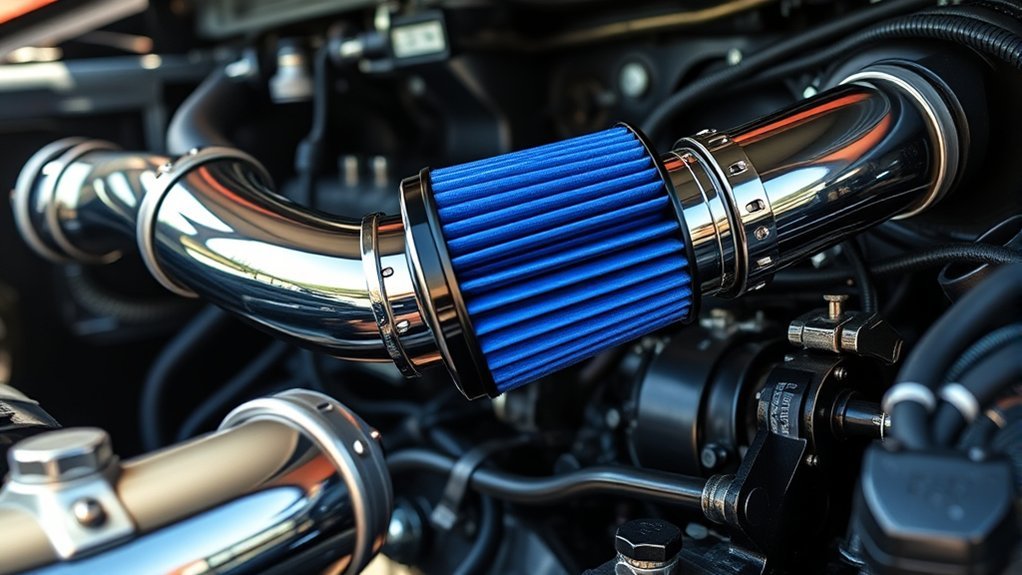
A cold air intake can change how your truck sounds and responds, but it is not a guaranteed shortcut to a large horsepower increase or better fuel economy. The best results come from a vehicle-specific system that fits the exact engine, preserves correct sensor readings, draws air away from engine-bay heat, and complies with applicable emissions rules.
Quick Answer
A well-designed cold air intake may reduce airflow restriction, sharpen throttle feel, increase induction sound, and add measurable power on some trucks. Gains are specific to the kit and engine, not a universal 5–20%. Verify the exact fitment, dyno sheet, emissions status, tuning requirement, and filter instructions before buying.
Key Takeaways
- Horsepower gains vary by truck, engine, intake part number, calibration, test method, and other modifications.
- A sealed airbox usually manages engine-bay heat and water exposure better than a fully exposed filter.
- Check the exact model year, engine, sensor configuration, emissions application, and part number before ordering.
- Many vehicle-specific kits work with the factory tune, but that is not true of every intake or modified MAF housing.
- Filter service intervals range widely. Follow the instructions for the exact dry or oiled filter instead of using a universal mileage rule.
At a Glance
| Time Required | About 45–90 minutes for many bolt-on kits; complex diesel or tightly packaged applications may take longer. |
| Difficulty | Beginner to intermediate, depending on sensor access, battery procedures, and engine-bay space. |
| Tools Needed | Socket set, screwdrivers or nut drivers, pliers, manufacturer-specified Torx bits, clean towels, and an optional OBD-II scan tool. |
| Cost | Varies by truck, engine, filter type, airbox design, emissions certification, and whether tuning is required. |
What Is a Cold Air Intake and How Does It Improve Truck Performance?
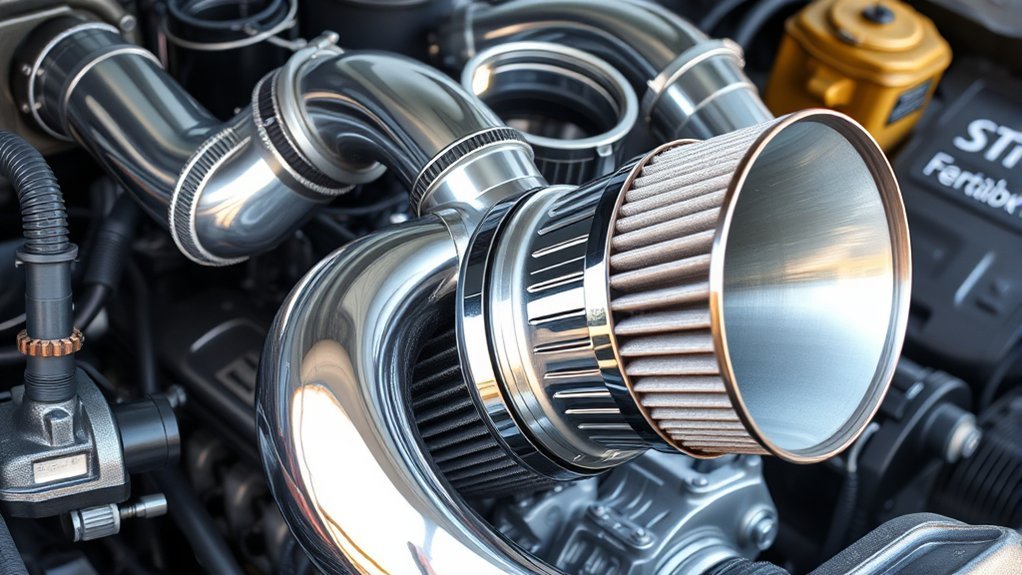
A cold air intake replaces some or all of the factory airbox, filter, ducting, and intake tube between the outside-air inlet and the engine. Most kits aim to reduce restriction, smooth the airflow path, increase filter area, isolate the inlet from engine-bay heat, or combine several of those changes.
The basic temperature principle is sound. At the same pressure, cooler air is denser than warmer air, as shown by the ideal-gas relationship explained by NASA Glenn Research Center. Denser air contains more oxygen in a given volume.
That does not mean every aftermarket intake always delivers colder air. A fully exposed filter can draw heated engine-bay air while the truck is idling or moving slowly. A sealed box with an effective outside-air duct may control heat better, while the factory intake may already draw cool air with little restriction.
The engine control module also matters. Modern engines use sensors and programmed fuel, ignition, throttle, and boost strategies to maintain safe operation. Increasing available airflow does not force the engine to produce a fixed amount of additional power.
Treat every horsepower number as part-number-specific. The truck, engine, tune, test method, weather, fuel, tires, drivetrain, and dyno can all change the result.
Cold Air Intake Benefits and Realistic Expectations
Horsepower and Torque
A properly engineered intake can add measurable horsepower when the original system is restrictive and the replacement maintains correct sensor readings. The amount must be evaluated on the exact application.
For example, K&N reported an estimated 8.91-horsepower gain on an otherwise stock 2012 Toyota Tacoma 4.0-liter V6 using one specific intake. The same manufacturer reported an estimated 12.05-horsepower gain on an otherwise stock 2011 Ford F-150 5.0-liter V8 using a different intake.
Those are manufacturer test results for two part numbers and two trucks. They do not prove that another intake will add the same amount, and they do not support a universal 5–20% claim.
Throttle Response
Less restrictive tubing may make the engine feel more responsive during larger throttle openings. The stronger induction sound can also make acceleration feel more dramatic even when the measured performance change is modest.
Throttle response is influenced by electronic throttle programming, transmission behavior, turbocharger response, vehicle weight, gearing, and traction. An intake is only one part of that system.
Engine and Turbo Sound
Sound is often the most noticeable change. An open filter can make intake roar, turbo spool, compressor bypass, or supercharger noise easier to hear. A closed airbox is usually quieter, although it may still sound deeper than the factory system.
More sound does not automatically mean more airflow or power. Choose the design based on your noise preference as well as its test data and heat management.
Fuel Economy
A cold air intake should not be purchased with the expectation that it will pay for itself through fuel savings. Fuel economy may stay the same, improve slightly under limited conditions, or decline if the added sound encourages harder acceleration.
Payload, towing, tire pressure, axle ratio, speed, wind, temperature, terrain, idle time, fuel formulation, and driving style usually have a greater effect on real-world truck fuel economy.
Possible Drawbacks
- Heat soak: An exposed filter may draw warmer air in slow traffic or after the truck has been parked with a hot engine.
- More noise: The louder intake sound can become tiring during towing or long highway trips.
- Water exposure: A low-mounted filter can be vulnerable if it becomes submerged.
- Maintenance errors: Washing a non-washable filter, oiling a dry filter, or reinstalling a wet filter can cause problems.
- Sensor faults: Incorrect MAF or IAT installation, air leaks, and disconnected breather lines can trigger a check-engine light.
- Emissions issues: A kit that is not legal for the exact application may cause inspection, registration, or enforcement problems.
- Limited gains: A well-designed factory intake may leave little room for improvement on an otherwise stock truck.
Comparing Cold Air Intake Designs
Brand alone does not determine performance. Compare the complete design, exact part number, filter media, sensor provisions, test data, emissions status, replacement-filter availability, and installation instructions.
| Design | Advantages | Tradeoffs | Best Fit |
|---|---|---|---|
| Sealed airbox | Better isolation from engine-bay heat, dirt, and splashed water; usually quieter. | May cost more and make filter inspection less convenient. | Towing, daily driving, dusty roads, and owners who prefer controlled noise. |
| Open filter with heat shield | Strong induction sound, simple filter access, and less enclosure around the filter. | Can be more affected by engine-bay heat, dust, noise, and water exposure. | Drivers who prioritize sound and easy access and understand the heat-management tradeoff. |
| Dry synthetic filter | No filter oil, straightforward servicing, and a good choice near sensitive airflow sensors. | Some dry filters are replace-only; others allow limited cleaning. Instructions vary. | Owners who want simpler maintenance or do not want to apply filter oil. |
| Oiled cotton filter | Washable and reusable when serviced correctly with the approved cleaner and oil. | Requires complete drying and the correct amount of oil; over-service and under-service should be avoided. | Owners willing to follow a detailed cleaning and re-oiling process. |
Check the Exact Fitment
Do not order from a photo or a broad description such as “fits F-150” or “fits Silverado.” Confirm all of the following:
- Model year
- Make and model
- Engine displacement and engine code where listed
- Gasoline or diesel application
- Turbocharged, supercharged, or naturally aspirated configuration
- Two-wheel-drive or four-wheel-drive restriction where applicable
- Factory sensor type and MAF housing arrangement
- Emissions package and CARB application
- Intake manufacturer’s exact part number
- Required tune, optional tune, or factory-calibration compatibility
Use the VIN to confirm the truck’s engine and factory configuration when there is any uncertainty. A part that fits the engine bay may still be wrong for the sensor calibration or emissions family.
Pro Tip: Download the installation instructions before buying. They reveal the required tools, sensor-transfer steps, battery procedure, emissions notes, filter type, replacement-filter number, and whether permanent cutting or drilling is required.
Emissions Legality and Warranty Considerations
Federal law prohibits removing, bypassing, or rendering emissions controls ineffective. The U.S. Environmental Protection Agency explains that the Clean Air Act prohibits emissions tampering and aftermarket defeat devices.
California and states that follow California emissions requirements may require a valid CARB Executive Order for an intake installed on a pollution-controlled vehicle. Use the CARB aftermarket-parts database to verify the exact manufacturer, part number, model year, engine, and listed application.
An EO number is not a blanket approval for every product sold by that brand. It applies only to the configurations named in the order. Keep the EO label or documentation with the truck if the kit includes one.
Warning: Do not install an intake that deletes required emissions equipment, changes sensor placement outside the approved design, or is labeled for racing use only on a street-driven truck. Confirm federal, state, and local requirements before installation.
Using an aftermarket part does not automatically cancel the entire vehicle warranty. The Federal Trade Commission states that an auto warranty remains in effect when aftermarket parts are used. However, a manufacturer or dealer may deny coverage for damage it can show was caused by a defective part or incorrect installation.
Protect yourself by keeping the purchase receipt, part number, instructions, photos of the completed installation, filter-service records, and the original factory intake.
How to Install a Cold Air Intake on a Truck
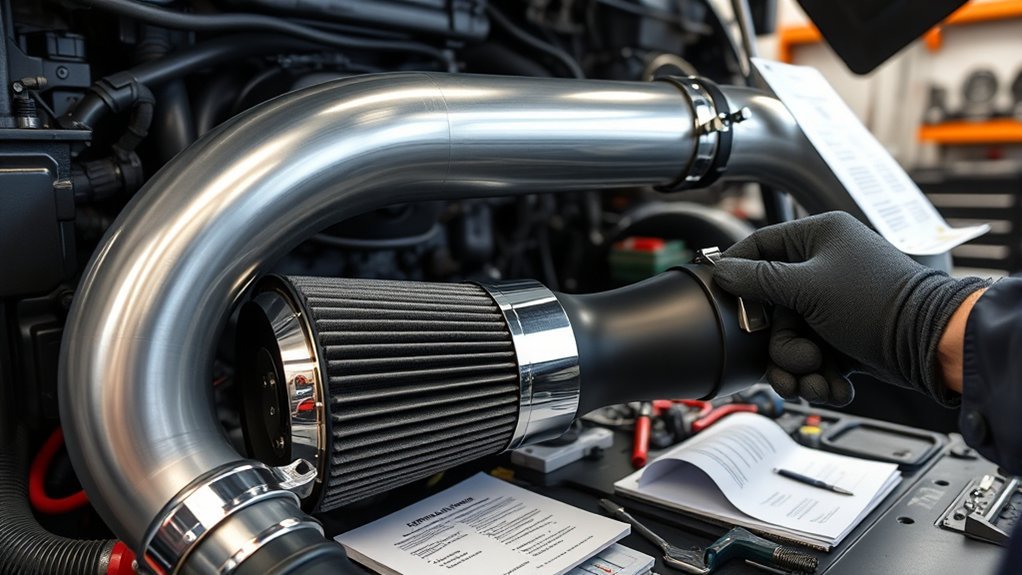
The following process covers common bolt-on systems. The instructions supplied with the exact kit and the truck’s service information always take priority.
- Confirm the part: Match the intake part number to the truck’s model year, engine, sensor configuration, and emissions application.
- Park safely: Work on a level surface, set the parking brake, switch off the ignition, remove the key, and let hot engine parts cool.
- Review the battery procedure: Disconnect the negative battery terminal only as directed by the intake and vehicle instructions. Some trucks have battery-monitoring, memory, or dual-battery procedures that must be followed.
- Inventory the kit: Lay out the tube, filter, airbox or heat shield, couplers, clamps, brackets, seals, grommets, fasteners, and sensor hardware. Do not begin if anything is missing.
- Protect the intake opening: Once the factory tube is removed, keep dirt, tools, screws, and loose hardware away from the throttle body or turbo inlet.
- Remove the factory system: Unplug the MAF or IAT sensor by releasing its lock rather than pulling on the wires. Disconnect breather and PCV hoses carefully. Save every factory part and fastener.
- Transfer sensors correctly: Install each sensor in the specified direction with the supplied seal or O-ring. Do not force the sensor, touch delicate sensing elements, or enlarge the housing.
- Install the airbox or heat shield: Seat all edge seals and fresh-air ducts so the system can draw outside air as designed.
- Fit the tube and couplers: Align the assembly before tightening it. Prevent contact with the fan, belts, pulleys, hood, wiring, brake lines, air-conditioning lines, exhaust components, and sharp body edges.
- Reconnect all hoses and wiring: Confirm that every PCV, crankcase breather, vacuum, MAF, IAT, and support connection is secure and routed without kinks.
- Tighten the system: Tighten clamps and fasteners evenly to the manufacturer’s specification. Excessive clamp force can distort a plastic tube, coupler, or sensor housing.
- Perform a hand inspection: Tug gently on the filter, tube, sensor, and hoses. Check that no tool or cloth remains in the engine bay.
- Reconnect the battery: Follow the kit and vehicle procedure, then start the engine without immediately revving it.
- Inspect at idle: Listen for hissing, whistling, rubbing, or surging. Check for warning lights and verify that the tube remains clear of moving parts.
- Test-drive gradually: Begin with light throttle, recheck the installation, and only then perform normal acceleration.
Note: A tune is not automatically required. Some vehicle-specific intakes are designed for the factory calibration, while other systems alter airflow-metering characteristics or are intended for tuned vehicles. Follow the exact intake manufacturer’s requirement.
Warning: Avoid deep standing water with a low-mounted intake filter. If a filter becomes submerged, the engine may ingest water and suffer hydrolock or internal damage. AEM’s air-bypass guidance specifically addresses this risk for compatible applications, but no accessory makes deep-water driving universally safe.
Post-Installation Checklist
- The filter is fully seated and cannot contact the hood or body.
- Every clamp is positioned behind the tube or coupler bead where specified.
- The MAF or IAT sensor points in the required direction.
- All electrical connectors are locked.
- All PCV, crankcase, vacuum, and breather hoses are connected.
- No wire or hose is stretched, pinched, or touching a hot or moving part.
- The airbox seal and outside-air duct are seated correctly.
- The engine idles smoothly.
- No warning light appears.
- The installation remains tight after the first heat cycle and test drive.
Cold Air Intake Troubleshooting
| Symptom | Likely Checks | What to Do |
|---|---|---|
| Check-engine light | Loose clamp, unplugged sensor, incorrect MAF orientation, missing breather hose, air leak, wrong intake part, or calibration mismatch. | Read the diagnostic code, inspect the entire installation, and correct the cause before clearing the code. Reinstall the factory intake if the cause cannot be found. |
| Rough idle or stalling | Unmetered air leak, disconnected PCV or vacuum line, poorly seated sensor seal, or incompatible MAF housing. | Switch off the engine and inspect every connection between the filter and engine. Do not continue driving if the truck stalls unpredictably. |
| Whistle or hiss | Air leak, loose coupler, open resonator port, or normal intake resonance. | Confirm that every intended port is connected or capped and that the tube is not cracked or distorted. |
| Power feels worse when hot | Engine-bay heat soak, missing airbox seal, blocked fresh-air duct, or filter positioned near a heat source. | Inspect the heat shield, lid, weather seal, and outside-air path. Compare intake-air temperature under repeatable conditions if scan data is available. |
| Rubbing or vibration | Misaligned bracket, insufficient engine-movement clearance, loose mount, or contact with the hood or fan shroud. | Realign the system and restore the specified supports before the tube, wiring, or nearby components are damaged. |
| Flashing check-engine light | A serious misfire or condition that can damage the catalytic converter. | Reduce load, stop safely, switch off the engine, and diagnose the problem before driving farther. |
Cold Air Intake Maintenance
There is no correct universal cleaning interval. Use the instructions for the exact filter part number and inspect the system more often after off-road driving, dust storms, construction-zone travel, farm use, or prolonged gravel-road driving.
K&N states that some oversized conical filters supplied with its intake systems can go up to 100,000 miles between services under normal highway conditions. S&B advises inspecting some dry filters every 5,000 miles and replacing them around 15,000–30,000 miles depending on dust exposure. These examples show why an 8,000-mile rule cannot be applied to every filter.
Maintaining an Oiled Filter
- Remove the filter without allowing dirt to enter the open intake tube.
- Tap off loose debris gently.
- Apply only the cleaner approved by the filter manufacturer.
- Rinse in the specified direction with low-pressure water.
- Let the filter dry naturally and completely.
- Apply the specified filter oil evenly and in the correct amount.
- Allow the oil to wick through the media before touching up light areas.
- Reinstall the filter only after confirming that it is evenly treated and properly seated.
Follow the filter manufacturer’s cleaning procedure. Do not use gasoline, harsh solvent, high-pressure water, a heat gun, oven, or compressed air unless the filter maker specifically permits that method.
Maintaining a Dry Filter
Never apply filter oil to dry synthetic media. Some dry filters may be cleaned with an approved solution, some may be blown out carefully, and others must be replaced. The S&B service guidance, for example, specifies inspection and replacement practices for its filter types.
Inspect the Complete System
Filter maintenance is only part of the job. Check the couplers, clamps, airbox seals, sensor wiring, support brackets, breather hoses, and fresh-air duct at every service. Replace a cracked coupler, damaged filter, missing seal, or worn grommet before it allows unfiltered air into the engine.
Common Myths and Maintenance Answers
| Question or Claim | Accurate Answer |
|---|---|
| Do cold air intakes really improve power? | Some do on specific trucks. Use the exact kit’s dyno chart and test conditions rather than a universal horsepower range. |
| Should every reusable filter be cleaned at 8,000 miles? | No. Service intervals vary by media, manufacturer, filter size, restriction, and driving environment. |
| Are all cold air intakes basically the same? | No. Airbox sealing, tube diameter, sensor location, filter media, fresh-air routing, emissions status, and calibration compatibility differ. |
| Will an intake improve fuel economy? | Not necessarily. MPG may remain unchanged, and harder acceleration can erase any small theoretical benefit. |
Frequently Asked Questions
Are cold air intakes good for trucks?
They can be worthwhile when you want more induction sound, a reusable filter, improved service access, or a documented performance gain from a vehicle-specific kit. They are less compelling when the factory intake already flows well or when the replacement exposes the filter to excessive heat, dust, or water.
How much horsepower does a cold air intake add to a truck?
There is no universal number. Some exact applications show measurable single-digit or low-double-digit manufacturer dyno gains, while others may show little change. Check the dyno sheet for the exact part number, engine, test truck, and calibration.
Do you need to tune your truck after installing a cold air intake?
Not always. Many vehicle-specific kits are engineered for the factory calibration. A tune may be required when the manufacturer specifies one, the MAF housing dimensions change outside the stock calibration range, or the intake is combined with major boost, fueling, exhaust, or engine modifications.
How do you set up a cold air intake correctly?
Use the exact kit instructions, transfer sensors in the correct direction, connect every breather and vacuum line, seat the airbox seals, align the tube away from heat and moving parts, tighten all clamps, inspect for leaks, and perform a gradual test drive.
Can a cold air intake improve gas mileage?
It is possible for fuel economy to change slightly, but an improvement is not guaranteed. Most owners should buy an intake for its documented airflow, sound, filtration, serviceability, or performance characteristics rather than expected fuel savings.
Will a cold air intake void the truck’s warranty?
Installing an aftermarket intake does not automatically cancel the entire warranty. However, coverage may be denied for a failure that the manufacturer or dealer can show was caused by the intake, a defective component, poor maintenance, or incorrect installation.
Can a cold air intake cause a check-engine light?
Yes. Common causes include an unplugged or reversed sensor, loose clamp, unmetered air leak, disconnected breather hose, wrong part number, or an intake that requires different calibration. Read the diagnostic code and inspect the installation instead of clearing the light repeatedly.
Is an open or closed cold air intake better?
A closed airbox usually offers better heat, dirt, noise, and water management. An open system may provide more induction sound and easier filter access. The better choice depends on the complete design, test data, and how you use the truck.
How often should a cold air intake filter be cleaned?
Follow the interval and inspection method for the exact filter. Dusty, sandy, agricultural, construction, and off-road use require more frequent inspection. Never wash or oil a filter unless its manufacturer permits that service method.
Conclusion
A cold air intake can be a useful truck upgrade when you choose it for the right reasons. A quality, vehicle-specific kit may add induction sound, improve serviceability, reduce restriction, sharpen throttle feel, and produce a documented power gain on the application for which it was tested.
Do not rely on universal horsepower percentages, promised fuel savings, or a one-size-fits-all maintenance schedule. Verify the exact fitment and emissions status, follow the installation instructions, protect the filter from heat and water, inspect for air leaks, and service the filter according to its manufacturer. Those checks matter more than the brand name printed on the tube.
Sources
- NASA Glenn Research Center: Equation of State — relationship between air pressure, temperature, and density.
- K&N Cold Air Intakes — part-specific dyno testing, factory-tune compatibility, and typical installation information for its intake line.
- K&N Filter Cleaning Instructions — approved cleaning, drying, and re-oiling procedures.
- S&B Filter Service Guidance — inspection, cleaning, and replacement guidance for different filter types.
- California Air Resources Board: Aftermarket Performance Parts — Executive Order and application-specific emissions requirements.
- U.S. Environmental Protection Agency: Aftermarket Defeat Devices — federal emissions-tampering requirements.







Leave a Reply