
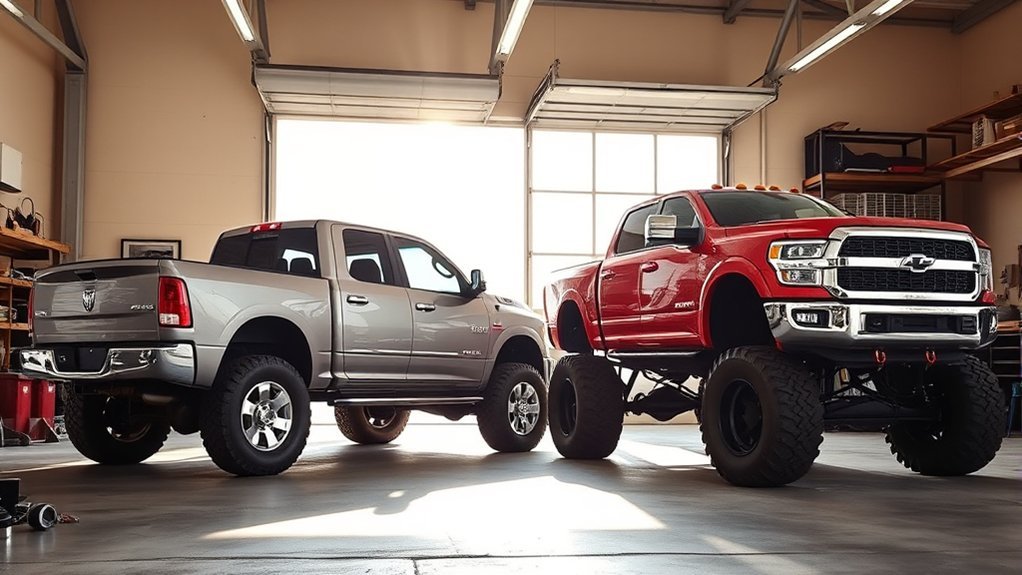
A leveling kit and a lift kit can both change a truck’s stance, tire clearance, and driving feel, but they solve different problems. A leveling kit mainly corrects the factory nose-down rake. A lift kit raises more of the vehicle for added clearance and off-road use. The right choice depends on your exact truck, tire plan, towing needs, budget, and tolerance for changes in handling.
Quick Answer
Choose a leveling kit for a mild front lift, a flatter stance, and modest tire clearance at a lower total cost. Choose a suspension lift when you need more height, suspension travel, or off-road clearance. Either option must match your exact year, model, trim, drivetrain, suspension, and tire setup.
Key Takeaways
- Leveling kits usually raise the front about 1 to 2.5 inches, though vehicle-specific products can fall outside that range.
- Suspension lifts commonly raise both ends about 2 to 6 inches; body lifts raise the body without adding suspension travel.
- Neither modification automatically preserves factory ride quality, increases payload, or raises the manufacturer’s tow rating.
- Plan for an alignment, tire-clearance check, headlight check, and possible driver-assistance or speedometer calibration.
- Verify fitment by year, make, model, trim, 2WD/4WD system, cab, engine, suspension package, and VIN before ordering.
At a Glance
| Time Required | Often 2–4 hours for a basic leveling kit; a full suspension lift may require a full day or weekend for an experienced installer. |
| Difficulty | Intermediate for many leveling kits; advanced for most suspension lifts. Rust, air suspension, adaptive dampers, and ADAS can add complexity. |
| Tools Needed | Vehicle-rated jack and stands or a lift, wheel chocks, hand tools, breaker bar, torque wrench, measuring tape, and any specialty tools named by the kit manufacturer. |
| Cost | Parts range from inexpensive spacers to multi-thousand-dollar suspension systems. Add labor, alignment, tires, wheels, calibration, and any worn-part repairs. |
What Are Leveling Kits and How Do They Work?
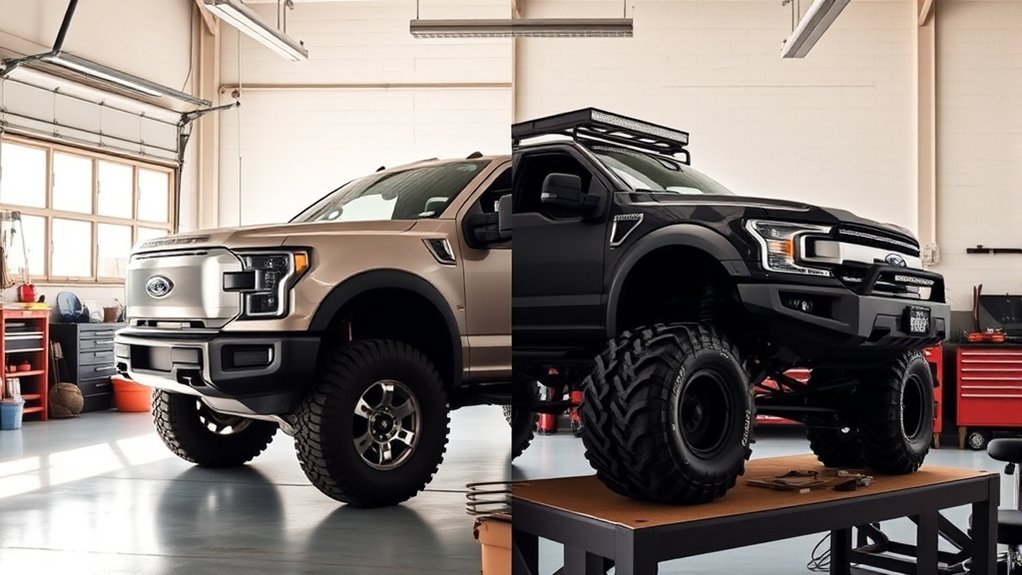
Most pickups sit slightly higher in the rear when unloaded. This factory rake helps the truck stay closer to level after cargo or trailer tongue weight compresses the rear suspension. A leveling kit reduces that rake, usually by raising the front.
Common designs include strut spacers, coil-spring spacers, replacement or adjustable struts, torsion keys, and model-specific control-arm systems. The correct design depends on the truck’s suspension. A part that fits one trim or drivetrain may not fit another, even within the same model year.
A small front lift can create more room around the front fenders and may allow a modestly larger tire. Tire fitment is never guaranteed by lift height alone. Wheel width, offset, backspacing, alignment, fender shape, mud flaps, and suspension travel all affect rubbing.
A leveling kit changes stance first. Any gain in tire clearance, ride quality, or off-road ability depends on the kit design and the exact vehicle.
What Are Lift Kits and How Do They Compare to Leveling Kits?
A lift kit raises more of the vehicle than a basic front leveling kit. The term can describe a suspension lift, a body lift, or a combination system. These designs do not produce the same results.
Key Differences Explained
Suspension lifts change springs, struts, shocks, control arms, crossmembers, knuckles, track bars, blocks, or related parts to raise the chassis and body. A complete system may correct steering and suspension geometry for the new height and can add room for larger tires.
Body lifts use spacers between a body-on-frame vehicle’s body and frame. They raise the body and can create tire or fender clearance, but they do not add suspension travel. Bumpers, steering shafts, fan shrouds, fuel fillers, wiring, and shifters may require vehicle-specific provisions.
Current manufacturer listings show that the labels overlap: some products called “lift kits” add as little as 1.5 to 2 inches, while many leveling kits add 1 to 2.5 inches. Treat the product name as a starting point, not a complete description.
Benefits of Each Option
A leveling kit works well when your goal is a flatter unloaded stance, a little more front clearance, or room for a carefully chosen tire size. It usually keeps the project smaller because fewer parts are changed.
A suspension lift is better suited to drivers who need more overall height, improved approach or breakover clearance, additional suspension travel, or clearance for substantially larger tires. It also creates more chances for changes in steering feel, braking, driveline angles, fuel use, and component wear.
Installation Complexity Compared
A simple spacer or torsion-key kit can be straightforward on a clean, compatible truck, but it still involves supporting the vehicle safely, unloading suspension components, tightening fasteners to specification, and completing an alignment.
A full suspension lift can require cutting, drilling, differential relocation, brake-line brackets, steering corrections, longer shocks, new control arms, driveshaft work, or electronic calibration. A recent manufacturer installation guide estimates about 2–4 hours for a leveling kit and a full day or weekend for a suspension lift in experienced hands. Rough Country’s lift-install preparation guide also recommends planning the alignment and repairing worn steering or suspension parts first.
Comparing Leveling Kits and Lift Kits: Key Similarities
Both modifications change the vehicle’s ride height or body position, so both require exact fitment and a complete post-install inspection. Each can alter tire clearance, headlight aim, entry height, aerodynamics, and the way the truck responds to steering and braking inputs.
- Both may create room for larger tires, but the allowed size remains vehicle- and wheel-specific.
- Both can change alignment angles and tire wear.
- Both may affect camera-, radar-, or steering-based driver-assistance features.
- Both can add weight and maintenance points.
- Both may be subject to state equipment, bumper-height, headlight-height, and inspection rules.
Neither option increases the axle, tire, payload, gross vehicle weight, or trailer ratings printed by the vehicle manufacturer.
Major Differences Between Leveling and Lift Kits
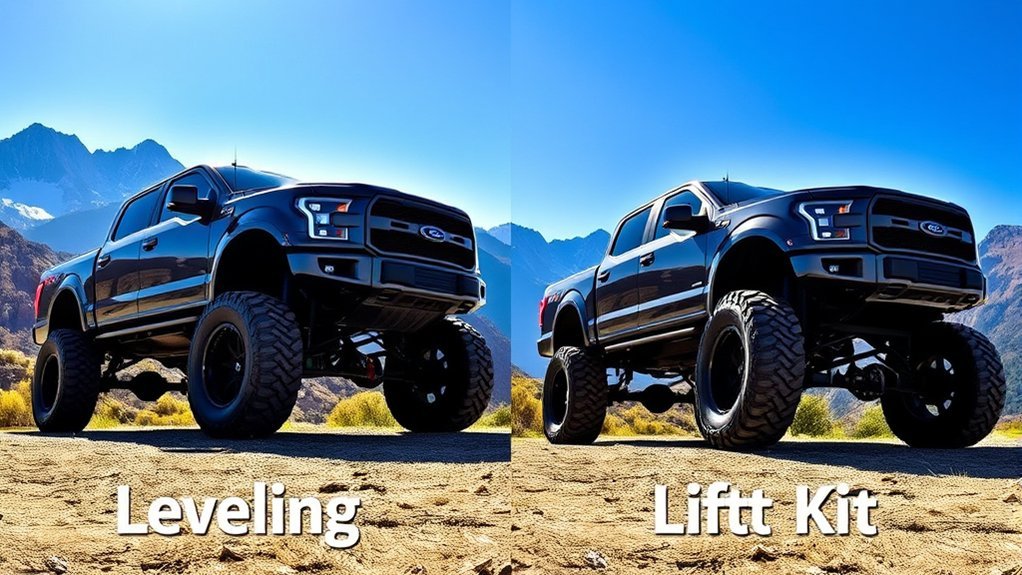
| Feature | Leveling Kit | Lift Kit |
|---|---|---|
| Main goal | Reduce front-to-rear rake | Raise more of the vehicle for clearance, travel, or tire fitment |
| Common height | About 1–2.5 inches at the front | About 2–6 inches for many suspension systems; body lifts are often smaller |
| Suspension travel | Usually little or no increase; design-dependent | May increase with a well-designed suspension system; body lifts do not add travel |
| Installation | Usually fewer parts and less labor | Often more parts, measurements, corrections, and labor |
| Best fit | Daily use, mild tire change, appearance | Off-road use, larger tire plan, more overall height |
The largest practical difference is scope. A leveling kit is normally a focused front-end change. A lift kit is a system change that may involve the front suspension, rear suspension, steering, driveline, brakes, electronics, and body clearances.
How Ride Quality, Handling, and Ground Clearance Change
No lift or leveling kit can guarantee factory ride quality. A spacer that increases strut preload may make the front feel firmer. A replacement strut or coilover can feel better or worse depending on spring rate, damping, travel, and setup. Larger, heavier tires can add steering effort and unsprung weight even when the suspension kit itself is well designed.
Raising a vehicle also raises its center of gravity. That can increase body motion and reduce the margin for abrupt steering inputs. Drive conservatively until you understand the new response, and allow extra room for braking when larger tires or heavier wheels are installed.
Ground clearance needs a precise definition. Raising the body or chassis can improve approach, departure, and breakover clearance. The lowest differential or axle clearance usually increases only when tire radius increases. A two-inch lift does not automatically create two inches of clearance under every component.
Warning: Do not rely on lift height as proof that the tires will clear. Check full steering lock, suspension compression, brake hoses, ABS wiring, sway-bar links, CV angles, driveshafts, and fender clearance before normal driving.
Tire Fitment, Load Rating, and Speedometer Calibration
Start with the vehicle’s door-jamb Tire and Loading Information label and owner’s manual. The National Highway Traffic Safety Administration’s TireWise guidance explains that the vehicle manufacturer’s recommended cold pressure—not the maximum pressure molded into the tire sidewall—is the correct starting point.
Any replacement tire and wheel combination must have suitable load capacity, clearance, diameter, width, offset, and speed rating for the vehicle and its use. Confirm that the tire does not contact the frame, control arms, body, liners, or wiring at full lock and through the usable suspension travel.
A larger overall tire diameter changes the relationship between wheel speed and road speed. Depending on the vehicle, this can affect the speedometer, odometer, shift behavior, cruise control, and driver-assistance calculations. Vehicle-specific calibration tools, such as Ford Performance’s ProCal tool, are designed to correct supported tire or gearing changes within approved parameters.
Pro Tip: Measure the actual mounted tire diameter and verify clearance on your exact wheel. The size printed on the sidewall is nominal, and two tires with the same labeled size can have different measured dimensions.
Towing, Payload, and Loaded Stance
A leveling or lift kit does not increase the manufacturer’s tow rating, payload rating, gross vehicle weight rating, or axle ratings. Added wheels, tires, bumpers, steps, skid plates, and suspension parts count as vehicle weight and can reduce the payload available for people, cargo, hitch equipment, and trailer tongue weight.
Factory rake also serves a purpose. A truck that sits perfectly level when empty may look nose-high or place more load on the rear suspension when towing or hauling. Drivers who regularly carry heavy loads may be better served by preserving some rake and choosing load-management equipment approved for the application.
After the modification, weigh the loaded truck and trailer when practical, then compare the measured axle and total weights with the labels and owner’s manual. Do not use appearance as a substitute for weight compliance.
Safety Systems, Headlights, and Alignment
Changing ride height can change toe, camber, caster, steering-wheel position, headlight aim, and the viewing angle of cameras or radar sensors. A professional alignment should follow installation unless the kit manufacturer gives a different procedure.
Modern trucks may also need a steering-angle reset, ride-height calibration, radar aiming, or camera calibration. Ford, for example, warns in its owner-manual guidance for lane-keeping systems that an unapproved suspension kit may prevent the system from operating correctly. Use the instructions for your exact vehicle rather than assuming every model needs the same service.
Check low- and high-beam aim after the truck is sitting at its final ride height with the correct tire pressure. Also confirm that brake hoses, parking-brake cables, ABS wiring, and sensor harnesses have enough slack through steering and suspension travel.
Advantages and Disadvantages of Leveling Kits
Leveling kits appeal to daily drivers because they can provide a noticeable stance change without the scope of a full lift. Their benefits and limitations depend on the design.
- Advantages: lower parts cost in many applications, shorter installation, reduced factory rake, modest front tire clearance, and fewer changed components.
- Disadvantages: possible loss of droop travel, firmer ride with some spacer designs, altered ball-joint or CV angles, less rear-high stance for towing, and limited off-road improvement.
A leveling kit is not automatically harmless. Pushing a suspension to the upper end of its adjustment range can accelerate wear or make alignment harder. A quality, vehicle-specific kit with suitable control arms or struts may cost more but can address geometry that a basic spacer does not.
Benefits and Drawbacks of Lift Kits
A suspension lift can add useful clearance and capability when the complete vehicle is built around it.
| Benefits | Drawbacks | Plan For |
|---|---|---|
| More chassis and body clearance | Higher center of gravity and entry height | Alignment and cautious road testing |
| Room for larger tires | Possible rubbing, gearing, braking, and fuel-economy changes | Fitment check and possible calibration |
| Potential for more suspension travel | More components and maintenance points | Steering, driveline, hose, and sensor corrections |
| Stronger off-road stance and capability | Higher parts, labor, tire, and wheel costs | A complete project budget |
A body lift is usually less complex than a large suspension lift, but it brings its own fitment concerns and does not provide the same suspension benefits. Choose the design based on the clearance you need, not the advertised height alone.
Choosing Between Leveling Kits and Lift Kits
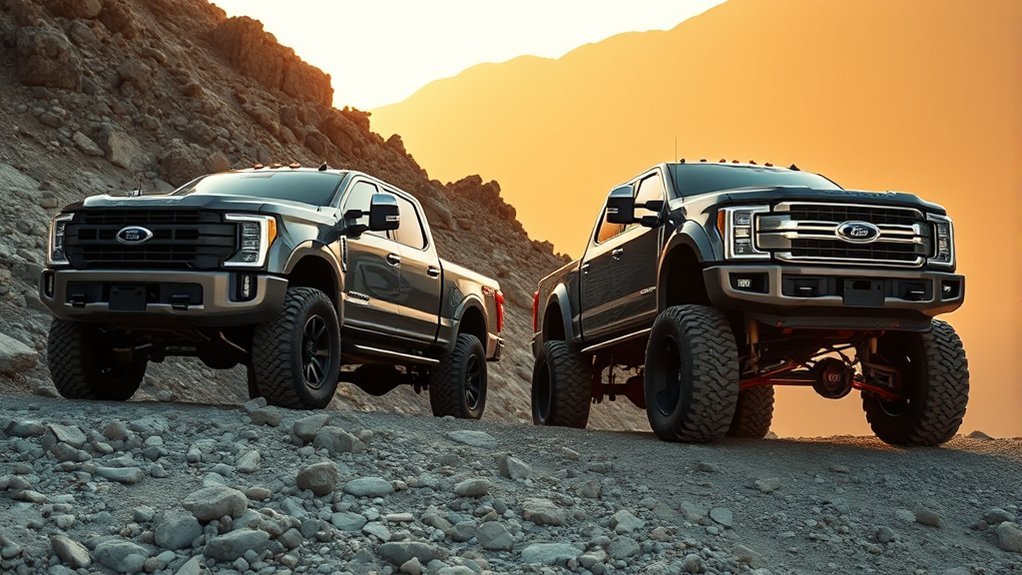
Use your real driving needs to make the choice:
- Choose a leveling kit when the truck is mainly a daily driver, you want less rake, and your tire increase is modest.
- Choose a suspension lift when you need more overall height, trail clearance, suspension travel, or room for a larger tire package.
- Consider a body lift only on compatible body-on-frame vehicles when you mainly need body or fender clearance and understand the bumper, steering, shifter, and wiring requirements.
- Keep the truck stock when towing stability, factory driver-assistance performance, easy entry, low operating cost, or warranty simplicity matters more than added height.
Before buying, identify the truck by VIN and confirm the exact model year, trim, cab, bed, engine, 2WD/4WD system, axle, suspension package, adaptive dampers or air suspension, and factory off-road package. Then compare the kit instructions with your planned wheel and tire specifications.
What to Budget for Leveling and Lift Kits
There is no reliable universal price for either modification. Current manufacturer lift and leveling listings include basic spacers below $100, loaded strut systems in the hundreds, and complete lift systems that start above $1,000. Premium shocks, control arms, and long-travel parts can push the parts total much higher.
Average Costs Comparison
| Project Type | Typical Cost Pattern | Common Extras |
|---|---|---|
| Basic spacer or torsion-key leveling kit | Usually the lowest parts cost | Alignment, installation, worn front-end parts |
| Replacement strut, coilover, or control-arm leveling system | Several hundred dollars to well over $1,000 | Rear shocks, control arms, calibration |
| Small suspension lift | Hundreds to low thousands for parts | Labor, alignment, tires, wheels, speedometer correction |
| Large or premium suspension lift | Often several thousand dollars before tires and labor | Driveline, steering, brake-line, gearing, and ADAS work |
Installation Expense Considerations
Labor depends on the vehicle, rust level, kit design, local shop rate, and whether the installer finds worn ball joints, bushings, tie rods, wheel bearings, shocks, or CV components. Ask for a written estimate that separates parts, labor, alignment, calibration, tires, wheels, and taxes.
Budget for the entire build rather than the kit box. Larger tires may require different wheels, trimming, recalibration, or axle gearing. A cheap kit can become an expensive project when those costs are ignored.
Installation Tips for Leveling and Lift Kits
Use the kit instructions and the factory service information for your exact truck. Do not substitute a generic online torque value for the value specified by the vehicle or kit manufacturer.
- Inspect first: repair worn steering, suspension, wheel-bearing, brake, and tire components before adding height or heavier tires.
- Measure the stock truck: record hub-to-fender height at all four corners, tire clearance, headlight aim, and steering-wheel position.
- Confirm every part: compare the kit contents and part numbers with the instructions before disassembly.
- Support the vehicle correctly: use wheel chocks and vehicle-rated stands or a professional lift on a stable surface. Never work under a vehicle supported only by a jack.
- Protect hoses and wiring: verify brake-line, ABS, parking-brake, and sensor-harness routing through full steering and suspension travel.
- Torque at ride height when required: bonded rubber bushings can be damaged if tightened in the wrong suspension position. Follow the service procedure.
- Complete the alignment and checks: verify tire clearance, steering centering, headlights, warning lights, and driver-assistance operation.
- Reinspect after driving: follow the kit maker’s stated re-torque interval instead of using a universal mileage rule.
Note: A coil spring or strut can store enough energy to cause severe injury. Use only the removal method and specialty tools specified for the vehicle. When a spring compressor is required, professional installation is the safer choice for anyone without the correct equipment and training.
Common Questions on Leveling and Lift Kits
Three misconceptions cause many poor builds. First, advertised lift height does not guarantee a tire size. Second, a suspension modification does not raise the truck’s certified load or tow ratings. Third, aftermarket parts do not automatically erase the entire factory warranty, but damage caused by a modification may be excluded.
Also confirm insurance and legal requirements before installation. State rules for bumper height, lamps, fenders, tire coverage, inspections, and overall vehicle height can differ. Tell your insurer about material modifications when required by the policy so the vehicle and added equipment are properly documented.
The Federal Trade Commission’s auto-warranty guidance states that a manufacturer cannot deny warranty coverage merely because an aftermarket part is present; it may deny coverage for repairs when the aftermarket equipment caused the damage.
Frequently Asked Questions
Should I get a leveling kit or a lift kit?
Choose a leveling kit for a mild front lift, reduced factory rake, and a modest tire change. Choose a suspension lift when you need more overall height, trail clearance, suspension travel, or room for a substantially larger tire package. Keep the truck stock when towing stability, factory electronics, entry height, or low ownership cost is the priority.
What are the negatives of leveling kits?
Possible drawbacks include reduced droop travel, a firmer ride with some spacer designs, steeper CV or ball-joint angles, alignment difficulty, faster component wear, and less rear-high stance for towing. The effect depends on the truck, lift amount, and kit design.
Does a lift kit affect resale value?
It can help with buyers who want the same setup, but it can reduce the buyer pool when the modification is extreme, poorly documented, or hard to return to stock. Professional installation records, alignment reports, calibration records, and the original parts can make the truck easier to evaluate.
Why do trucks not come level from the factory?
The rear-high rake allows the rear suspension to settle under passengers, cargo, or trailer tongue weight without making the truck immediately sit nose-high. It also reflects the manufacturer’s targets for handling, aerodynamics, headlight aim, suspension travel, and load capacity.
Do I need an alignment after installing a leveling or lift kit?
Usually, yes. Changing ride height can alter toe, camber, caster, and steering-wheel position. Follow the kit instructions, then obtain a professional alignment and keep the printout. Some solid-axle or rear-only changes may have different requirements.
Will a lift or leveling kit void my warranty?
Not automatically. Warranty coverage may still apply to unrelated failures. A manufacturer can deny coverage for a repair when it can show that the aftermarket part or installation caused the problem. Read the vehicle and kit warranties and keep all installation and service records.
Can I tow normally after leveling my truck?
The factory tow and payload ratings do not increase. Because leveling reduces unloaded rake, the truck may sit nose-high sooner when loaded. Check axle weights, tire capacity, headlight aim, hitch setup, and loaded suspension position before towing.
Conclusion
A leveling kit is the practical choice for a mild stance correction and a modest tire plan. A suspension lift makes more sense when the truck truly needs added height, clearance, or travel. Either build can work well when the parts match the exact vehicle and the project includes alignment, tire and load checks, electronics, headlights, and post-install inspection. Choose the smallest modification that safely meets your real driving needs.
Sources
- Rough Country lift-kit listings — current examples of leveling, body-lift, and suspension-lift heights and parts prices.
- Rough Country: How to Prep for a Lift Kit Install — installation time, worn-part inspection, shock selection, and alignment planning.
- NHTSA TireWise — tire pressure, load-label, inspection, and tire-safety guidance.
- Ford owner-manual guidance: Lane Keeping System — manufacturer warning about unapproved suspension kits and driver-assistance operation.
- Federal Trade Commission: Auto Warranty Tips — warranty treatment of aftermarket parts.
- Ford Performance ProCal 4 — example of vehicle-supported speedometer correction for tire or gear changes.







Leave a Reply