
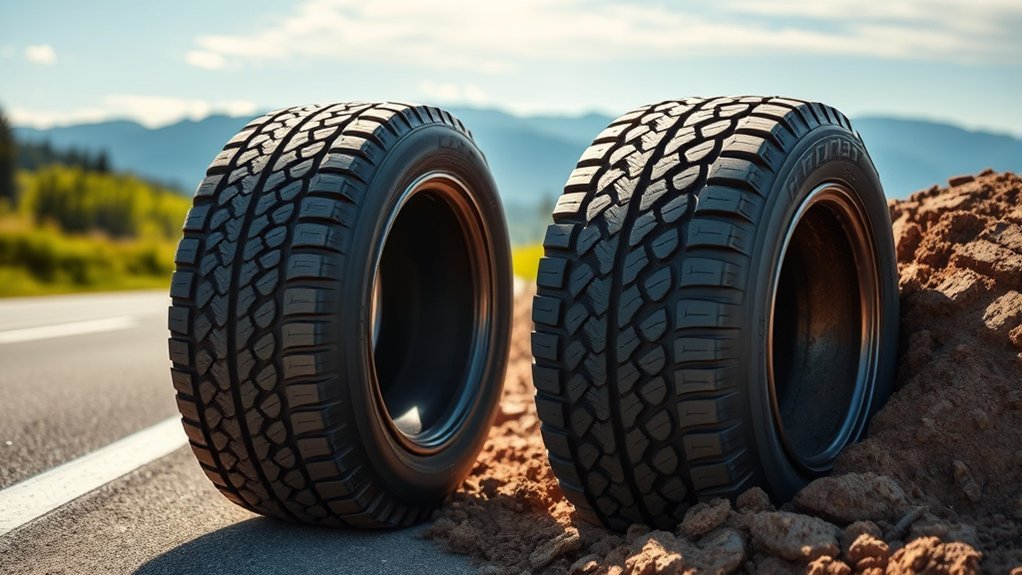
Choosing between all-terrain and mud-terrain tires comes down to where you drive, how often you leave pavement, and what trade-offs you can accept. All-terrain tires usually suit daily-driven trucks and SUVs, while mud-terrain tires make more sense for vehicles that regularly face deep mud, loose soil, rocks, and difficult trails. Tire model, size, load rating, weather rating, and vehicle fitment matter as much as the category name.
Quick Answer
For most drivers, all-terrain tires are the better choice because they are quieter and more comfortable on pavement while still handling dirt, gravel, and light mud. Choose mud-terrain tires when deep mud, loose soil, rocks, or repeated hard off-road use matters more than road noise, ride comfort, treadwear, and fuel use.
Key Takeaways
- Choose all-terrain tires for commuting, highway travel, towing, gravel roads, and occasional trail use.
- Choose mud-terrain tires for frequent deep mud, loose soil, sharp rocks, and demanding low-speed trails.
- Do not rely on a universal mileage or MPG estimate. Treadwear, rolling resistance, and wet grip vary by model and size.
- For winter use, check for the Three-Peak Mountain Snowflake symbol instead of assuming an aggressive tread is snow rated.
- Always match the vehicle’s required tire size, load capacity, speed rating, wheel specifications, and recommended cold pressure.
Understanding All-Terrain and Mud-Terrain Tires
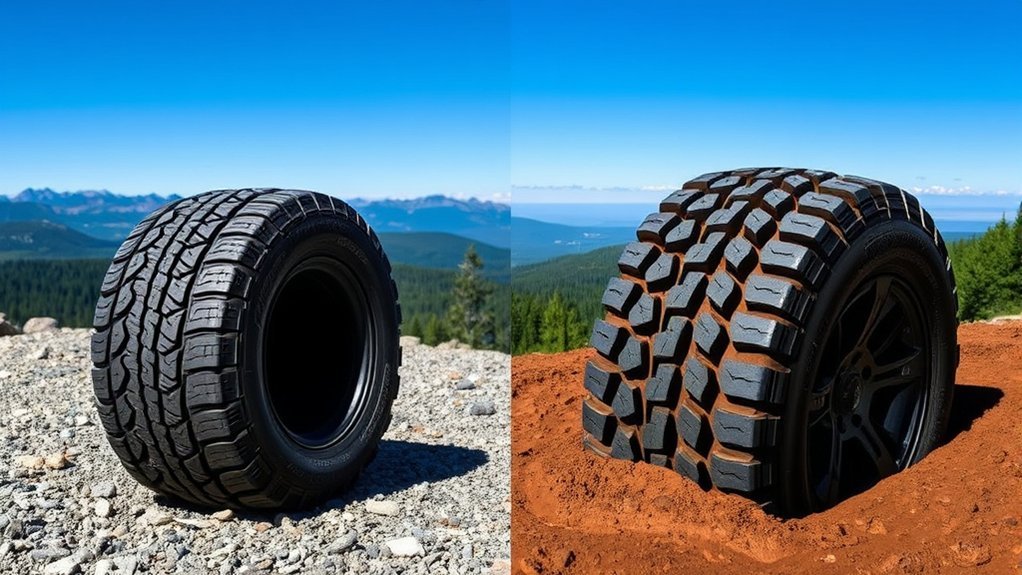
All-terrain tires use a balanced tread pattern intended for both paved roads and moderate off-road driving. Their tread blocks are usually smaller and closer together than those on mud-terrain tires. Many models also use more siping, which means small cuts in the tread blocks that can help create biting edges in rain or snow.
Mud-terrain tires use larger tread blocks, wider spaces between those blocks, and more aggressive shoulder features. These open spaces help the tire release mud and loose material instead of becoming packed. Reinforced sidewall features are also common because mud-terrain tires are often used around rocks, ruts, and trail hazards.
Neither label guarantees performance in every condition. One all-terrain model may have better wet braking, winter qualification, noise control, or treadwear coverage than another. The same is true of mud-terrain tires. Compare the specifications for the exact size you plan to buy.
| Factor | All-Terrain Tires | Mud-Terrain Tires |
|---|---|---|
| Best use | Daily driving with occasional off-road travel | Frequent difficult off-road travel |
| Pavement comfort | Usually smoother and quieter | Usually firmer with more pattern noise |
| Deep mud | Moderate capability; tread may pack sooner | Stronger self-cleaning and loose-surface traction |
| Wet pavement | Often easier to optimize for road use, but results vary by model | Large blocks and voids may reduce refinement; model-specific testing matters |
| Treadwear coverage | Mileage warranties are available on many models and sizes | Mileage warranties are less common on aggressive models |
| Fuel use | Often lower rolling resistance than a comparable aggressive tire | May increase rolling resistance, weight, and aerodynamic drag |
Note: Some manufacturers sell rugged-terrain or hybrid-terrain tires that sit between these categories. They may offer more open tread and sidewall protection than a typical all-terrain tire without being as loud or specialized as a full mud-terrain design.
How Comfortable Are All-Terrain Tires on the Road?
All-terrain tires are generally more comfortable on pavement because their tread blocks are smaller, more closely spaced, and designed to make steadier contact with the road. This usually reduces vibration and the rhythmic humming associated with large, widely spaced tread blocks.
There is no universal noise score that applies to the entire category. Road noise changes with the tire model, tread depth, vehicle insulation, wheel size, inflation, road surface, speed, alignment, and wear pattern. A quiet all-terrain tire can also become louder as its tread wears unevenly.
Mud-terrain tires usually produce more noticeable tread noise, especially at highway speeds. Their heavier construction and large tread blocks can also make steering feel slower and the ride firmer. These effects may be mild in a well-insulated full-size truck but more obvious in a lighter SUV or pickup.
Drivers who spend most of their time on pavement should place road comfort, wet braking, steering response, and noise near the top of the shopping list. An aggressive appearance is not worth sacrificing the qualities used on every trip.
Tread Design: Comparing All-Terrain and Mud-Terrain Features
The main design difference is the amount of rubber touching the road and the amount of open space available to move loose material. All-terrain tires keep more tread in contact with pavement. Mud-terrain tires use larger voids to dig into soft ground and release packed mud.
| Feature | All-Terrain | Mud-Terrain |
|---|---|---|
| Tread blocks | Moderate size and closer spacing | Large blocks with wide spacing |
| Siping | Often more extensive for wet or snow traction | Varies; some models prioritize block strength |
| Shoulders | Moderately open for mixed use | Aggressive lugs for ruts and loose surfaces |
| Mud clearing | Suitable for light or moderate mud, depending on model | Designed to eject mud and maintain open voids |
| Sidewall tread | May include mild traction and protection features | Often more aggressive for ruts, rocks, and aired-down use |
How They Perform in Mud, Rocks, Sand, Rain, and Snow
Mud and Loose Soil
Mud-terrain tires have the clearest advantage in deep mud and soft soil. Wide tread voids give the tire room to bite into the surface and release material as the tire rotates. A packed all-terrain tread can begin acting like a smooth tire when the mud is deep and sticky.
All-terrain tires remain suitable for maintained dirt roads, shallow mud, campsites, farms, and moderate trails. Drivers who only encounter mud a few times each year may be better served by carrying recovery boards and choosing a more road-friendly tire.
Rocks and Gravel
Both categories can work on gravel and rocky trails, but construction matters. Look at sidewall design, tread-chip resistance, load range, and the manufacturer’s intended use. A strong all-terrain tire may be a better match for high-mileage gravel roads, while a mud-terrain tire may offer stronger shoulder grip in ruts and on uneven rocks.
No tire is puncture-proof. Slow down around sharp rocks, inspect the sidewalls after difficult trails, and avoid assuming that an aggressive tread permits higher speeds.
Sand
Deep sand rewards flotation more than digging. An overly aggressive tire can bury the vehicle if the driver uses too much throttle. Tire width, vehicle weight, pressure, momentum, and driving technique may matter more than whether the sidewall says all-terrain or mud-terrain.
Pro Tip: When off-road conditions call for reduced pressure, use an accurate gauge, stay within the wheel and tire manufacturer’s limits, drive slowly, and reinflate to the correct road pressure before returning to normal-speed pavement.
Rain and Standing Water
Do not assume that every all-terrain tire has excellent wet braking or that every mud-terrain tire performs poorly. Wet traction depends on tread compound, groove design, tread depth, temperature, pressure, and the exact tire size.
NHTSA treats wet traction, rolling resistance, and treadwear as separate performance characteristics in its replacement-tire information work. That means a tire with low rolling resistance or long treadwear coverage is not automatically the best wet-braking tire. Review model-specific testing and replace worn tires before they lose the water-clearing depth you depend on.
Snow and Ice
An aggressive tread can work well in loose, deep snow, but large tread blocks alone do not guarantee strong packed-snow or ice performance. For winter use, look for the Three-Peak Mountain Snowflake symbol, commonly shortened to 3PMSF. This symbol shows that the tire meets a defined severe-snow traction requirement.
The M+S marking means mud and snow, but it is not a substitute for 3PMSF qualification. Michelin’s tire-marking guidance also distinguishes the two. In areas with frequent ice, hard-packed snow, or long periods below freezing, a dedicated winter tire may still provide better braking and control than either a typical all-terrain or mud-terrain tire.
Warning: Do not choose a tire for winter driving based only on an aggressive appearance or an M+S marking. Verify the exact tire and size for 3PMSF qualification, and follow local chain or traction-device laws.
Tire Longevity: Which Lasts Longer?
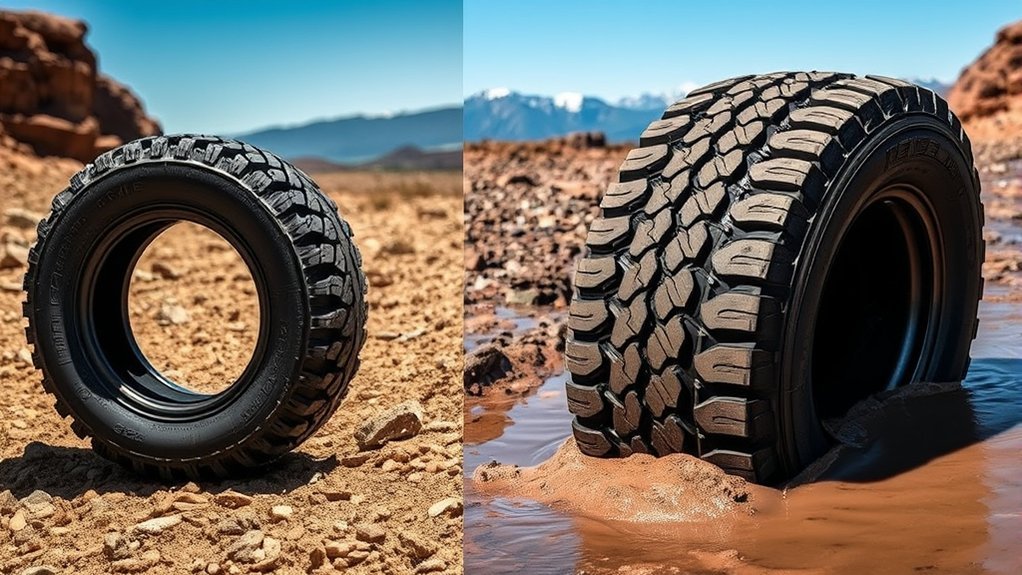
All-terrain tires often last longer during pavement-heavy use, but there is no reliable mileage range for every tire in either category. Actual life depends on the model, size, compound, vehicle weight, alignment, pressure, rotation, towing load, road temperature, driving style, and percentage of pavement use.
A limited mileage warranty is not a promise that every buyer will reach that distance. Warranty eligibility usually depends on documentation, rotation, even wear, correct inflation, vehicle condition, and other terms. Some sizes within one tire line may also have different coverage.
All-Terrain Tire Lifespan
Current manufacturer examples show why model-specific information is more useful than a universal range. The BFGoodrich All-Terrain T/A KO3 lists a 50,000-mile limited mileage warranty, while the Michelin LTX A/T2 lists a 60,000-mile warranty. Coverage may depend on size and warranty terms.
These examples do not prove that either tire will reach the stated mileage on every truck. Heavy towing, high torque, poor alignment, underinflation, and long periods on abrasive pavement can shorten service life.
Mud-Terrain Tire Durability
Mud-terrain tires are built to resist many off-road hazards, but off-road toughness is not the same as long pavement tread life. Large tread blocks can move and scrub on asphalt, while frequent hard acceleration or incorrect pressure can create irregular wear.
The BFGoodrich Mud-Terrain T/A KM3, for example, is covered by a standard limited warranty for workmanship and materials, but its product page does not advertise the type of mileage warranty shown for the KO3. Always distinguish a standard defect warranty from a treadwear mileage warranty.
Maintenance Impact on Longevity
Follow the vehicle and tire manufacturers’ rotation schedule, check cold pressure at least monthly, and have alignment inspected when the vehicle pulls, the steering wheel sits off-center, or the tread wears unevenly. Use the pressure on the vehicle placard, not the maximum pressure molded on the tire sidewall, as the normal starting point for road use.
NHTSA advises replacing tires when tread reaches 2/32 inch and checking tread and pressure regularly. It also notes that some vehicle and tire manufacturers recommend replacing tires that are six to ten years old regardless of remaining tread. The last four digits of the DOT Tire Identification Number show the week and year of manufacture.
A mileage warranty is a coverage limit with conditions—not a guaranteed prediction of how long a tire will last on your vehicle.
Fuel Efficiency: A Comparison of MPG
All-terrain tires often have a fuel-use advantage over equally sized mud-terrain tires, but there is no fixed one- or two-MPG rule. Rolling resistance differs among individual tires, and changing tire diameter, width, weight, pressure, or wheel weight can affect the result.
NHTSA identifies rolling resistance as a tire characteristic related to fuel efficiency. It does not establish a universal MPG difference between all-terrain and mud-terrain categories.
All-Terrain Tire Efficiency
A road-focused all-terrain tire may use a lighter construction, smaller tread blocks, or a compound designed to reduce rolling resistance. Staying close to the original tire diameter and keeping pressure correct can help preserve the vehicle’s expected fuel economy.
Do not assume that every all-terrain tire is efficient. An oversized LT tire with a high load range may be heavier and harder to accelerate than the original equipment tire, even when it is marketed as all-terrain.
Mud-Terrain Tire Impact
Mud-terrain tires may increase fuel use because of their mass, tread movement, open pattern, and rolling resistance. Larger replacements can add another penalty by increasing rotational mass and changing effective gearing.
The effect may be small on one vehicle and noticeable on another. A diesel pickup, gasoline SUV, hybrid, and electric truck will not respond identically to the same tire change.
How to Estimate Long-Term Fuel Cost
Use your own annual mileage, measured fuel economy, and local fuel price instead of a generic savings number:
Annual fuel cost = annual miles ÷ measured MPG × fuel price per gallon.
Record several tanks before changing tires and several tanks afterward. Compare similar routes, temperatures, loads, and driving speeds. Also remember that a taller tire can make the odometer under-report distance unless the vehicle is recalibrated, which can distort hand-calculated MPG.
Cost Analysis: Price and Total Ownership Cost
Tire prices cannot be reduced to one dependable range for each category. A 17-inch standard-load tire and a 22-inch heavy-duty LT tire may differ dramatically even when both carry the same all-terrain label.
| Cost | Why It Matters |
|---|---|
| Tire price | Changes with size, load range, brand, construction, and availability |
| Mounting and balancing | Large or heavy off-road tires may cost more to install and balance |
| Alignment | Helps prevent rapid or uneven wear |
| TPMS service | Sensors, seals, stems, or programming may require service |
| Fuel or energy use | Heavier and higher-resistance tires may increase operating cost |
| Suspension or fitment changes | Oversized tires may require wheels, trimming, lifts, recalibration, or gearing changes |
| Replacement interval | A cheaper tire may cost more per mile if it wears quickly |
To compare value, divide the installed set price by the realistic number of miles you expect from that set. Use your own maintenance history and driving conditions rather than treating the mileage warranty as guaranteed life.
Fitment, Load Capacity, and Safety Checks
Start with the tire-information placard on the driver’s door frame and the vehicle owner’s manual. These sources identify the original tire size, recommended cold pressure, and vehicle load information. Replacement tires should meet the vehicle manufacturer’s requirements unless a qualified tire professional has approved an alternative fitment.
Size, Load Index, and Speed Rating
Verify the full tire size, load index, and speed rating. Do not install a tire with less load capacity than the vehicle requires. A higher-looking load range is not automatically better if the tire, wheel, pressure, and vehicle application are mismatched.
The tire’s maximum sidewall pressure is not the normal inflation target for the vehicle. Use the vehicle placard for the original fitment. When changing construction or size, obtain a documented pressure recommendation from the vehicle manufacturer, tire manufacturer, or qualified installer.
P-Metric Versus LT Tires
Passenger-type and LT tires may use different construction, load calculations, weight, and pressure requirements. An LT tire can offer stronger construction for demanding truck use, but it may also add weight and ride firmness. Do not switch categories based only on appearance.
Towing and Payload
A tire does not raise the truck’s tow rating, payload rating, gross vehicle weight rating, or axle rating. The vehicle, hitch, wheels, tires, and axles must all remain within their separate limits. Confirm the loaded axle weights when towing or carrying heavy gear.
Oversized Tires
Larger tires can rub the body or suspension, reduce braking response, change steering feel, alter effective gearing, affect stability-control behavior, and make the speedometer or odometer inaccurate. They may also interfere with spare-tire storage or TPMS operation.
Warning: Never exceed the vehicle, axle, wheel, or tire load limits. Have non-original tire sizes and load ranges reviewed by a qualified tire professional before installation, especially on a vehicle used for towing, commercial work, or heavy payloads.
Choosing Between All-Terrain and Mud-Terrain Tires: Key Use Cases
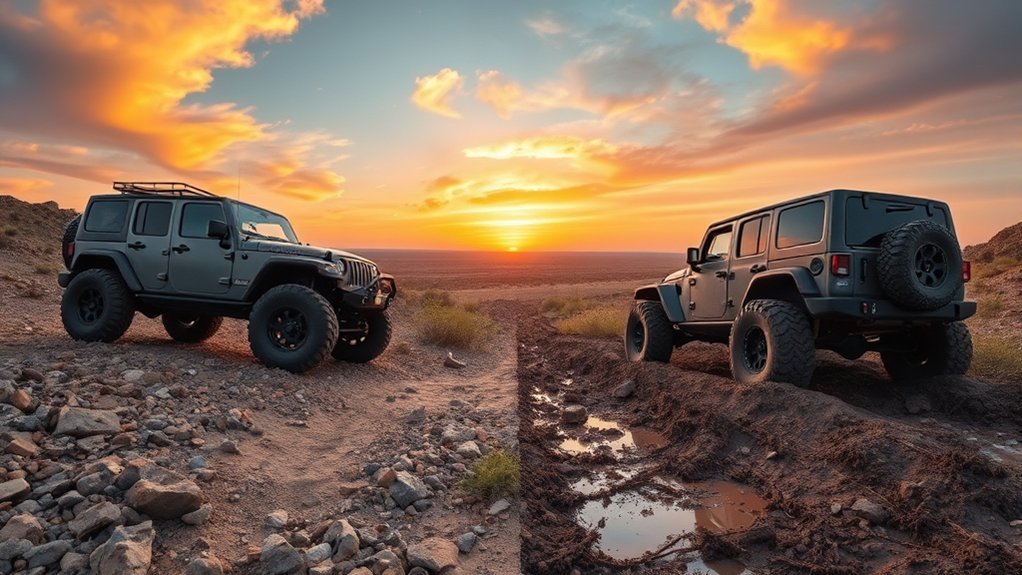
Your pavement-to-trail ratio is the fastest way to narrow the choice. Be honest about the terrain the vehicle encounters regularly, not the most difficult trail you may drive once.
| Driving Pattern | Best Starting Point |
|---|---|
| Daily commuting with occasional gravel roads | All-terrain |
| Highway travel, towing, and maintained campsites | Road-focused all-terrain |
| Regular dirt, gravel, moderate rocks, and shallow mud | All-terrain or rugged-terrain |
| Frequent deep mud, ruts, loose soil, and hard trails | Mud-terrain |
| Severe winter roads | 3PMSF-qualified all-terrain or dedicated winter tire, depending on conditions |
| Dedicated trail vehicle with limited highway mileage | Mud-terrain |
Choose All-Terrain Tires When
- Most mileage is on paved roads.
- You need a quieter ride for commuting or road trips.
- You tow or carry loads and want stable highway manners.
- Your off-road use is mostly gravel, dirt, campsites, forest roads, or moderate trails.
- You want access to more models with limited mileage warranties.
- You need 3PMSF-qualified options for snow but do not require a dedicated mud tire.
Choose Mud-Terrain Tires When
- You regularly drive through deep mud or loose soil.
- Your trails contain ruts, rocks, and surfaces that require aggressive shoulder grip.
- The vehicle is a trail-focused rig rather than a high-mileage commuter.
- You accept more road noise, firmer ride quality, and potentially faster pavement wear.
- You are prepared to inspect, rotate, balance, and reinflate the tires as needed.
Consider a Rugged-Terrain Tire When
A rugged-terrain or hybrid-terrain tire may suit drivers who find a normal all-terrain tread too mild but do not need a full mud-terrain tire. Compare it with both categories for wet braking, noise, winter qualification, weight, treadwear coverage, and available load ratings.
Pros and Cons of All-Terrain and Mud-Terrain Tires
| Tire Type | Advantages | Drawbacks |
|---|---|---|
| All-terrain |
|
|
| Mud-terrain |
|
|
What Do Owners Say About All-Terrain vs. Mud-Terrain Tires?
Owner reports commonly follow the same broad pattern: drivers praise all-terrain tires for daily comfort and versatility, while mud-terrain users value traction in difficult off-road conditions. These reports are useful for spotting noise, balancing, wear, or ride-quality trends, but they are not controlled tests.
Read reviews for the exact tire size and vehicle type you use. A tire can behave differently on a lightweight midsize SUV than on a heavy diesel pickup. Give more weight to reviews that identify the vehicle, tire size, mileage, pressure, rotation history, road type, and percentage of off-road use.
Also separate product complaints from installation or vehicle problems. Vibration can come from balance, wheel damage, runout, alignment, suspension wear, mud inside the wheel, or incorrect centering—not only from the tire design.
All-Terrain vs. Mud-Terrain Buying Checklist
- Calculate your real pavement use. Include commuting, highway travel, errands, and towing miles.
- List the difficult surfaces you face regularly. Separate deep mud from gravel, rocks, sand, packed snow, and ice.
- Check the vehicle placard. Record the original size, recommended cold pressure, and load information.
- Verify fitment. Confirm load index, speed rating, wheel width, diameter, clearance, TPMS compatibility, and spare-tire fit.
- Check winter markings. Look for 3PMSF qualification when severe-snow traction matters.
- Compare wet-road evidence. Do not judge rain performance from tread appearance alone.
- Review the exact warranty. Confirm whether it is a mileage warranty, standard defect warranty, road-hazard plan, or a combination.
- Price the complete installation. Include mounting, balancing, alignment, TPMS service, disposal fees, and any required vehicle changes.
- Consider weight and diameter. Larger, heavier tires can affect braking, acceleration, fuel use, steering, and speedometer accuracy.
- Choose for normal use. Buy the tire that fits the conditions you face most often, not the most extreme trip you can imagine.
Frequently Asked Questions
Should I get mud-terrain or all-terrain tires?
Choose all-terrain tires when most driving is on pavement with occasional dirt, gravel, or moderate trails. Choose mud-terrain tires when the vehicle regularly faces deep mud, loose soil, ruts, rocks, or demanding trails and you accept more road noise and less refinement.
Do all-terrain tires last longer than mud tires?
They often last longer when most miles are on pavement, but no universal mileage difference applies. Compare the exact models and sizes, read the warranty terms, and account for pressure, rotation, alignment, vehicle weight, towing, and driving style.
Is there a downside to all-terrain tires?
Yes. They are usually noisier, heavier, and less fuel-efficient than comparable highway tires. They may also clog sooner than mud-terrain tires in deep mud and provide less aggressive shoulder grip in ruts or on difficult rocks.
What is the longest-lasting all-terrain tire?
There is no single longest-lasting tire for every vehicle and size. Compare the limited mileage warranty for the exact size, required rotation schedule, load rating, road-use focus, and owner reports from similar vehicles. A warranty is not guaranteed service life.
Are mud-terrain tires better in snow?
They can work well in deep, loose snow, but they are not automatically better on packed snow or ice. Check whether the exact tire and size carry the 3PMSF symbol. In severe icy conditions, a dedicated winter tire may offer better braking and control.
Can I tow with all-terrain or mud-terrain tires?
Yes, when the tires meet the vehicle’s size, load, pressure, and speed requirements. The tire does not increase the truck’s tow or payload rating. Verify loaded axle weights and keep the vehicle, hitch, wheels, axles, and tires within their individual limits.
Can I mix all-terrain and mud-terrain tires?
Avoid mixing tread categories, sizes, constructions, or substantially different tread depths unless the vehicle and tire manufacturers specifically permit it. Mixed tires can change braking, steering, stability-control response, and four-wheel-drive system behavior.
Should I air down all-terrain or mud-terrain tires off-road?
Reduced pressure can improve flotation and ride quality on some trails, but the safe amount depends on the tire, wheel, vehicle weight, speed, and terrain. Excessive reduction can unseat the bead, damage the sidewall, or create excess heat. Reinstate the correct road pressure before normal-speed pavement driving.
Conclusion
All-terrain tires are the practical choice for most daily-driven trucks and SUVs because they balance pavement comfort with useful dirt, gravel, and moderate-trail capability. Mud-terrain tires earn their compromises when deep mud, loose soil, ruts, rocks, and hard off-road use are a regular part of the vehicle’s job.
Make the final decision by comparing the exact tire models and sizes for wet grip, 3PMSF qualification, load capacity, warranty terms, weight, road noise, and installed cost. Above all, keep the replacement within the vehicle’s fitment and load requirements rather than choosing by tread appearance alone.
Sources
- NHTSA TireWise — tire pressure, placard information, tread depth, inspections, and tire aging.
- NHTSA Consumer Tire Information Program Final Rule — rolling resistance, wet traction, treadwear, and tire fuel-efficiency information.
- BFGoodrich All-Terrain T/A KO3 — current all-terrain features, severe-snow qualification, and limited mileage warranty.
- BFGoodrich Mud-Terrain T/A KM3 — mud-terrain design and standard limited warranty information.
- Michelin LTX A/T2 — current all-terrain warranty, comfort, and intended-use information.
- Michelin Seasonal Tire and Marking Guide — M+S, 3PMSF, and winter-tire distinctions.







Leave a Reply