

Driving on sand can be a great way to reach remote beaches, fishing spots, and campsites, but soft sand can trap a poorly prepared vehicle in minutes. Safe beach driving starts before the tires touch the sand: confirm the route is open, use a suitable vehicle, carry recovery gear, lower tire pressure only as local guidance and your vehicle allow, and plan around tides, weather, wildlife, and pedestrians.
Quick Answer
Use a capable 4WD vehicle, check permits and closures, air down gradually to the range recommended for that beach and vehicle, maintain smooth momentum, and avoid sharp steering or wheelspin. Stay out of salt water, give people and wildlife plenty of room, and reinflate the tires before returning to normal road speeds.
Key Takeaways
- Beach rules vary. Check permits, route maps, closures, tide forecasts, and posted speed limits before entering the sand.
- True 4WD with adequate clearance is the safest choice for deep, soft sand; AWD crossovers may not be allowed or may bog more easily.
- There is no universal beach tire pressure. Many official routes recommend a starting range between about 15 and 25 PSI, depending on the beach, vehicle, load, tire, and sand.
- Smooth throttle, gradual steering, steady momentum, and early decisions prevent most stuck-vehicle situations.
- Use only properly rated recovery equipment and approved recovery points, and keep everyone clear of loaded straps, ropes, and winch lines.
At a Glance
| Time Required | About 20–30 minutes for checks, airing down, and staging gear, plus the drive |
| Difficulty | Moderate; conditions can change quickly |
| Tools Needed | Low-pressure gauge, air compressor, shovel, traction boards, suitable jack base, full-size spare, first-aid kit, water, and rated recovery equipment |
| Cost | Permit and equipment costs vary by location and what you already own |
Essential Vehicle Preparation for Beach Driving
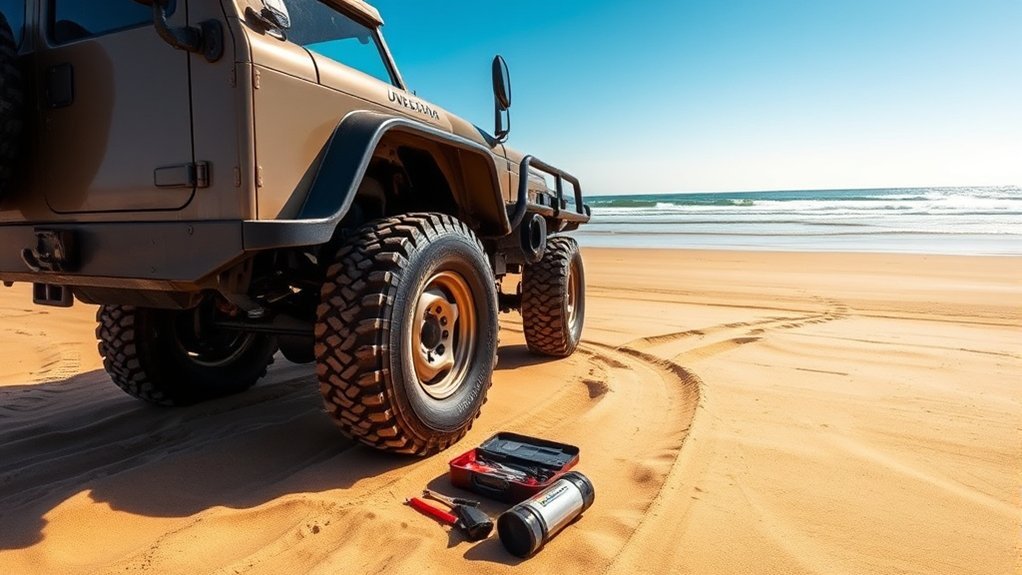
Start by confirming that vehicles are allowed on the beach. Many public beaches limit driving to marked over-sand vehicle routes, require a permit, set vehicle and equipment rules, or close sections to protect nesting birds and sea turtles. Check the managing agency’s current map and alerts on the day of your trip; a permit does not always guarantee access when a route reaches capacity or closes because of overwash, storms, or wildlife.
A true four-wheel-drive vehicle with adequate ground clearance is the most dependable choice for deep, loose sand. Some beaches allow two-wheel-drive or AWD vehicles, but others discourage or prohibit them. The National Park Service notes that AWD vehicles can become stuck more easily than true 4WD vehicles on soft beach sand. Review the exact rules for your destination rather than assuming any SUV is suitable.
Note: Check the owner’s manual for your exact VIN, model year, tire size, drivetrain, and trim. It should explain approved 4WD modes, traction-control settings, tire-pressure limits, jacking points, and recovery points. Controls and restrictions can differ even between vehicles with the same model name.
Complete a Pretrip Vehicle Check
- Check engine oil, coolant, battery condition, belts, hoses, and visible fluid leaks.
- Inspect all tires for cuts, bulges, exposed cords, uneven wear, and adequate tread.
- Confirm that the spare is full-size if the beach requires one, properly inflated, and usable with your vehicle.
- Test the air compressor and verify that the low-pressure tire gauge reads accurately.
- Secure loose cargo and keep heavy items low so they do not shift on rutted sand.
- Start with enough fuel for delays, detours, idling, and a longer return route.
Check Weather, Tides, and Route Status
Review the weather forecast and NOAA tide predictions for the nearest station. High tide, storm surge, overwash, and rough surf can narrow or block a route that was open earlier. Leave a generous safety margin and follow the local agency’s instructions; there is no universal safe distance from the water or high-tide line.
Warning: Never drive through salt water or park where a rising tide can surround the vehicle. Salt water can damage brakes, wheel bearings, wiring, and drivetrain parts, and moving water can undermine the sand beneath the tires.
Choosing Tires and Tire Pressure for Sand
Most drivers do not need a dedicated sand tire for an occasional beach trip. A sound highway-terrain or all-terrain tire in the correct load rating and size can work well when it is aired down appropriately and driven smoothly. Very aggressive mud-terrain tread can dig quickly if the driver uses too much throttle, so technique matters as much as the tread pattern.
Tire Types to Consider
- Highway-terrain tires: Often suitable for firm beach sand when they have enough sidewall and are in good condition.
- All-terrain tires: A practical choice for mixed paved and off-road use, with stronger tread and sidewall designs than many road tires.
- Mud-terrain tires: Capable off-road, but aggressive lugs can dig holes quickly when wheelspin begins.
- Dedicated sand tires: Useful for specialized dune vehicles, but usually unnecessary for a street-driven beach vehicle.
Use the tire size and load range approved by the vehicle manufacturer. The pressure molded into a tire sidewall is a maximum rating, not the normal road pressure for your vehicle. For paved driving, follow the cold pressure on the driver-door placard or in the owner’s manual, as explained by NHTSA tire-safety guidance.
How Far Should You Air Down?
There is no single PSI that is safe for every beach, tire, wheel, load, and vehicle. Official National Park Service guidance varies by location: Assateague recommends 15–20 PSI, while Cape Lookout lists 20–25 PSI in its beach-driving tips. Other routes may post different limits or require a gauge capable of reading a certain low pressure.
Treat 15–25 PSI as a location-dependent range, not a universal target. Start with the beach’s posted guidance, then adjust cautiously for your vehicle, tire, load, and sand.
- Stop on a safe, level staging area before entering deep sand.
- Measure all four tires with a low-pressure gauge.
- Lower pressure in small, even steps, keeping the front and rear relationship recommended for your vehicle when applicable.
- Inspect the sidewalls. Excessive bulging raises heat, sidewall, and bead-unseating risk.
- Drive slowly and avoid hard turns, sudden braking, and high-speed travel while aired down.
- Recheck pressure if the sand changes, the vehicle feels unstable, or the tires become hot.
- Reinflate to the vehicle’s road-pressure specification before normal pavement speeds.
Pro Tip: Air down before the soft entrance ramp, not after you are already bogged. Label the compressor hose and valve tools so you can find them quickly when wind or blowing sand reduces visibility.
Beach Driving Techniques for Acceleration, Braking, and Steering

Select the drivetrain mode recommended by your owner’s manual before the sand becomes deep. For many part-time 4WD vehicles, 4H is appropriate for normal beach travel, while 4L is reserved for very soft sand, steep access ramps, or slow recovery work. Do not engage 4WD, lock a differential, or disable stability systems unless the vehicle manual allows it for the current surface and speed.
Maintain Smooth Momentum
Use gentle throttle and enough momentum to keep the tires floating over the sand. Momentum does not mean speed. Follow the posted limit and slow well below it around people, wildlife, parked vehicles, blind crests, ruts, and narrow sections. One beach may post 15 mph, while another may allow a higher maximum with lower limits near pedestrians or wildlife.
- Accelerate gradually to avoid wheelspin.
- Make wide, smooth steering inputs instead of sharp turns.
- Keep extra space from the vehicle ahead because sand increases rolling resistance and stopping distances can vary.
- Use existing tracks when they lead through an open, legal route and the tracks are not deeply rutted.
- Avoid stopping in the softest section. When possible, stop on firmer sand with the vehicle facing an easy exit.
Start, Stop, and Turn Without Digging In
If the tires begin to spin, ease off the accelerator immediately. More throttle usually digs the tires deeper and can lower the frame onto the sand. When stopping in soft sand, roll to a gentle halt without a hard brake application. Before moving forward again, backing a few feet may give the vehicle a firmer track for the launch.
| Situation | Best Response |
|---|---|
| Tires start spinning | Ease off, straighten the wheels, and regain traction before adding gentle throttle. |
| Vehicle loses momentum | Do not floor it. Stop early on top of the sand and begin a controlled self-recovery. |
| Deep ruts pull the steering | Hold the wheel firmly, reduce speed, and make small corrections rather than fighting the rut. |
| Approaching people or wildlife | Slow to the posted reduced speed, yield, and give a wide berth without entering closed habitat. |
Rules, Tides, Wildlife, and Other Beach Hazards
Beach driving is transportation through a sensitive public space, not an invitation to cut circles, climb dunes, or leave the marked corridor. Stay on open routes and designated crossings. Never drive on vegetation, nesting areas, signed closures, or dunes unless a marked route expressly allows the crossing.
Share the Beach Safely
- Yield to pedestrians, anglers, horses, cyclists, wildlife, and emergency vehicles.
- Use seat belts and proper child restraints. Never carry passengers on the hood, roof, tailgate, fenders, or outside a moving vehicle.
- Expect children, pets, fishing lines, tent stakes, driftwood, holes, and soft washouts near parked groups.
- Keep noise and speed low near birds and turtles, and obey temporary wildlife closures.
- Pack out trash and avoid fluid leaks that can contaminate the beach.
Read the Sand Before Committing
Firm, damp sand can provide better support, but the dark strip close to the water is not automatically safe. A rising tide can remove your escape route, and wet sand may hide washouts or soft channels. Walk a questionable section first when it is safe to do so, look for vehicles turning around, and ask a ranger or local permit office about current trouble spots.
Note: Cell service may be weak or absent. Tell someone where you are going, travel with another capable vehicle when conditions are remote, and save the park, permit office, roadside-assistance, and local recovery numbers before departure.
How to Recover a Vehicle Stuck in Sand
Stop as soon as forward progress fades. Continuing to spin the tires can bury the axles, frame, differential, or skid plates, turning a simple traction problem into a difficult recovery.
Self-Recovery Steps
- Secure the area. Turn on hazard lights if appropriate, keep passengers away from traffic and recovery gear, and check the tide.
- Assess what is buried. Look under the vehicle for sand packed beneath the frame, axles, suspension, or bumpers.
- Dig a path. Clear sand from in front of or behind all four tires and from any part of the vehicle resting on the sand.
- Straighten the wheels. A straight tire has less sand to push than a sharply turned tire.
- Air down slightly if safe. If you are still above the local recommended range, lower pressure in small steps without exceeding your tire and wheel limits.
- Place traction boards. Push them firmly under the driven tires in the intended direction of travel.
- Use gentle throttle. Let the tires climb onto the boards. Stop immediately if the wheels spin or the boards shoot backward.
- Reset and repeat. Re-dig, reposition the boards, or back out along your existing tracks rather than repeatedly forcing the same failed attempt.
Rocking the vehicle between drive and reverse can help only when done gently and when the transmission has fully stopped before each direction change. Rapid shifting can damage the transmission or driveline. Follow the owner’s manual.
Strap, Winch, and Assisted Recovery Safety
Vehicle recovery creates high loads. Use equipment rated for the vehicles involved and attach it only to manufacturer-approved or professionally rated recovery points. A recovery strap is not the same as a tow strap, and a kinetic recovery should be attempted only by people who understand the equipment, ratings, attachment method, and safe exclusion zone. Manufacturer guidance from ARB distinguishes elastic recovery straps from non-elastic tow straps.
Warning: Never attach a recovery strap or winch line to a trailer hitch ball, tie-down loop, suspension part, or unknown hook. Keep everyone well away from the line of pull. If the vehicle is threatened by the tide, deeply buried, mechanically damaged, or lacks safe recovery points, call a qualified beach-recovery or towing service.
Must-Have Gear for Beach Driving Adventures

Required equipment varies by beach, so use the permit checklist as the minimum and add gear for your vehicle, passengers, weather, and distance from help.
| Gear | Why It Matters |
|---|---|
| Low-pressure tire gauge | Measures aired-down pressure accurately. |
| 12-volt or battery air compressor | Restores road pressure before pavement driving. |
| Long-handled shovel | Clears sand from tires, axles, and the vehicle’s underside. |
| Traction boards | Provide a firm ramp for controlled self-recovery. |
| Jack and wide support base | Prevents the jack from sinking when lifting on sand. |
| Full-size spare and tire tools | Meets some permit rules and avoids relying on an unsuitable temporary spare. |
| Rated recovery strap, shackles, and damper | Allows an assisted recovery when used with approved points and proper training. |
| First-aid kit, drinking water, sun protection, and fire extinguisher | Covers common heat, injury, and vehicle emergencies. |
| Flashlight, phone power bank, and paper map | Supports navigation and communication when service or daylight fails. |
| Required flag, permit, and vehicle documents | Keeps the vehicle visible and compliant where local rules require them. |
What to Do After Driving on the Beach
- Reinflate the tires. Restore the cold-road pressure listed for your vehicle before sustained pavement speeds. Recheck when the tires are cold.
- Inspect the tires and wheels. Look for sidewall cuts, displaced beads, packed sand, missing valve caps, and wheel damage.
- Test the brakes gently. Sand and water can affect braking. If braking feels abnormal, stop in a safe place and have the system inspected.
- Rinse the underbody thoroughly. Remove salt and sand from the frame, suspension, brakes, wheels, skid plates, radiator area, and body seams without forcing high-pressure water into electrical connectors or bearings.
- Check filters and cooling. Inspect the engine air filter and radiator or condenser face for sand buildup, especially after dry, windy conditions.
- Clean and inspect recovery gear. Follow the manufacturer’s care instructions and retire damaged straps, ropes, shackles, or boards.
Community Support Resources for Beach Drivers
Local knowledge can prevent a difficult day. Rangers, permit offices, beach-access businesses, four-wheel-drive clubs, and experienced drivers can explain current soft spots, closures, air stations, and recovery options. Online groups can be useful for recent condition reports, but official signs, alerts, and ranger instructions take priority.
For a first trip, travel with an experienced driver in a second capable vehicle when the route allows it. Agree on radio channels, recovery signals, turning points, and the time you will leave before the tide changes. Avoid informal recovery help from anyone using unmarked equipment or unsafe attachment points.
Frequently Asked Questions
What’s the best way to drive on sand?
Use a suitable 4WD vehicle, air down to the location- and vehicle-appropriate range, select the approved 4WD mode, and keep throttle and steering smooth. Follow posted speeds, avoid unnecessary stops in soft sand, and stop wheelspin immediately before the vehicle digs in.
What is the 123 rule in driving?
“One car length for every 10 mph” is not a reliable universal rule, and it is not a beach-driving standard. On normal roads, many driver guides use a time-based following gap of at least three seconds in good conditions and more in poor conditions. On sand, leave extra room and obey the local route’s posted rules.
What are the 5 C’s of safe driving?
There is no single nationally recognized “5 C’s” standard for beach driving. A useful personal checklist is condition, capability, control, caution, and communication: know the beach condition, confirm the vehicle’s capability, maintain smooth control, use caution around hazards, and communicate your route and recovery plan.
What are the 4 D’s of driving on sand?
The “4 D’s” are not an official standard, but they can be used as a memory aid: deflate cautiously, drive smoothly, don’t spin the tires, and dig before forcing a stuck vehicle. Always place local rules and your owner’s manual ahead of any mnemonic.
Can an AWD crossover drive on the beach?
Sometimes, but not on every route. AWD systems, ground clearance, cooling, tires, and recovery points vary widely. Some beaches allow AWD, some discourage it, and some require true 4WD. Check the beach rules and the vehicle manual before entering soft sand.
How low should tire pressure be for beach driving?
Use the range published for the beach and allowed by the vehicle, wheel, and tire. Official recommendations commonly differ from about 15–20 PSI to 20–25 PSI. Do not assume that 10 or 15 PSI is safe for every setup, and always reinflate before normal pavement driving.
Should traction control be turned off on sand?
Only when the owner’s manual tells you to do so. Some vehicles have a sand mode that changes throttle, shifting, stability control, and differential behavior. Other vehicles may need limited wheelspin to stay moving, but disabling safety systems incorrectly can reduce control or damage the drivetrain.
What should I do first if I get stuck in sand?
Stop spinning the tires. Check the tide and traffic, straighten the wheels, dig sand away from all four tires and the underside, then use traction boards and gentle throttle. Call a qualified recovery service when the vehicle is deeply buried, damaged, close to rising water, or lacks safe recovery points.
Conclusion
Good beach driving is controlled, legal, and low-impact. Prepare the vehicle, follow the destination’s current rules, use the recommended tire-pressure range as a starting point rather than a universal number, and drive with smooth inputs. Carry enough gear to solve a simple traction problem, but know when to stop and call a professional. That approach protects your vehicle, other beach users, and the shoreline you came to enjoy.
Sources
- Cape Lookout National Seashore: Tips for Beach Driving — weather, tides, equipment, tire pressure, and reinflation guidance.
- Cape Lookout National Seashore: Beach Driving — permits, route restrictions, wildlife closures, and 4WD versus AWD guidance.
- Assateague Island National Seashore: Over Sand Vehicle Use — operating rules, tire-pressure guidance, closures, and stuck-vehicle tips.
- NOAA Tides & Currents — official tide-prediction tools.
- NHTSA TireWise — tire size, placard pressure, cold-pressure checks, and TPMS information.
- ARB Recovery Strap Guidance — differences between elastic recovery straps and tow straps and equipment ratings.







Leave a Reply