

Choosing between 4 High and 4 Low depends on the surface, the speed you need, and the type of four-wheel-drive system in your vehicle. 4H is generally for loose or consistently slippery surfaces at moderate speeds. 4L is for slow work that requires extra torque, finer control, or stronger engine braking. Because shift procedures and speed limits vary, always verify the instructions for your exact model year, trim, and transfer case.
Quick Answer
Use 4 High on loose or consistently slippery surfaces when you need more drive traction and can travel faster than a crawl. Use 4 Low for slow, demanding work such as steep grades, rocks, deep mud, or controlled plowing. Shift rules and speed limits vary, so follow the owner’s manual for your exact vehicle.
Key Takeaways
- 4H adds drive traction without low-range reduction gearing and is normally used on snow, gravel, mud, sand, or other loose and consistently slippery surfaces.
- 4L multiplies torque at the wheels for slow climbing, descending, crawling, pulling, or maneuvering, but it does not create more tire grip.
- There is no universal 55 mph rule. Engagement limits, maximum speeds, and shift procedures differ among vehicles.
- Part-time 4H and 4L can bind the drivetrain on dry pavement. Full-time 4H, 4A, and AWD systems may operate differently.
- Four-wheel drive helps a vehicle accelerate, but it does not make it stop or turn faster when the tires have limited grip.
At a Glance
| Time Required | About 2–5 minutes to identify the correct mode and confirm the shift procedure |
| Difficulty | Easy, but the procedure is vehicle-specific |
| Tools Needed | Owner’s manual or official digital manual; tire-pressure gauge for pre-trip checks |
| Cost | $0 for normal operation; maintenance costs depend on the vehicle and service schedule |
Warning: Never treat a generic speed or shifting rule as a substitute for your owner’s manual. Using the wrong mode, shifting while the wheels are spinning, or driving a part-time system on dry pavement can damage the transfer case, axles, tires, or other driveline parts.
How to Choose Between 4 High and 4 Low for Your Driving Needs

Start by asking two questions: Is the surface loose or consistently slippery? And do you need normal momentum or slow, controlled torque?
Choose 4 High when the tires need help putting engine power to the ground but you still need moderate speed and momentum. Common examples include snow-covered roads, loose gravel, muddy tracks, and firm sand. With a part-time system, the surface must allow some tire slip so the front and rear driveline can release stress during turns.
Choose 4 Low when you need to move slowly while multiplying torque through the transfer case. It is useful for rock crawling, steep climbs, controlled descents, deep mud, deep sand, heavy pulling at low speed, or maneuvering a plow in a confined area when the manufacturer permits it.
Low range gives you more torque multiplication and finer low-speed control. It does not increase the amount of grip available between the tires and the ground.
The correct choice also depends on the system fitted to your vehicle. A dashboard selector marked 2H, 4H, and 4L usually operates differently from a system marked 2H, 4A, 4H, and 4L. Some SUVs use full-time high range, while others use a part-time transfer case that should not be driven on dry pavement.
Part-Time 4H, Full-Time 4H, 4A, and AWD Are Not the Same
Before selecting a mode, identify the type of system in your vehicle:
- Part-time 4H: Mechanically connects the front and rear driveline for extra traction. It is normally limited to loose or consistently slippery surfaces because the driveline may not allow enough speed difference between the front and rear axles during a turn.
- Full-time 4H: Uses a center differential or another device that may allow high-range four-wheel drive on ordinary pavement. The exact limits still depend on the vehicle.
- 4A or Auto 4WD: Automatically sends more torque to the front axle when the system detects a need. This is often the better choice for roads that alternate between clear pavement and slippery patches, when the manufacturer approves it.
- AWD: Usually operates without a driver-selected low range. AWD can improve drive traction but does not provide the same low-range gearing as a traditional 4L transfer case.
Note: Confirm the system by checking the selector labels and the four-wheel-drive section of the official manual for your exact model year and trim. Similar-looking vehicles can use different transfer cases and shift procedures.
Comparative Features of 4 High Vs 4 Low
Both modes can send engine torque to the front and rear axles, but they use different transfer-case ratios and serve different driving needs.
| Feature | 4 High (4H) | 4 Low (4L) |
|---|---|---|
| Transfer-case range | High range, without low-range reduction gearing | Low range with reduction gearing |
| Best use | Snow, loose gravel, mud, sand, or other consistently slippery surfaces | Rocks, deep mud or sand, steep grades, controlled pulling, and very slow maneuvers |
| Vehicle speed | Higher than 4L, but always limited by road conditions and the owner’s manual | Low-speed use only; follow the vehicle-specific maximum |
| Torque at the wheels | Normal high-range multiplication | Greater torque multiplication for slow work |
| Engine braking | Normal | Stronger at low speed, which can help on steep descents |
| Typical shift pattern | Many systems permit a shift while moving straight with light or no throttle | Often requires Neutral and a stop or a slow roll near 2–3 mph |
| Dry pavement | Avoid with a part-time system; full-time or 4A modes may differ | Normally avoid because of driveline binding and limited speed |
Ford describes 4H as an extra-traction mode for snow, ice, and off-road conditions and 4L as a reduced-speed mode for deep sand, steep grades, or heavy pulling. Jeep likewise identifies low range as a low-speed, higher-torque setting but warns that more torque does not automatically mean more traction. Review Ford’s four-wheel-drive guidance and the Jeep 4×4 FAQ for examples of how manufacturer instructions differ.
How to Shift Between 4 High and 4 Low Safely
The steps below describe a common electronic transfer-case procedure. They are not universal. Read the instructions displayed in your vehicle and in its owner’s manual before shifting.
Common 2H-to-4H Procedure
- Drive straight on a loose or consistently slippery surface.
- Reduce speed to the engagement range listed in the owner’s manual.
- Ease off the accelerator. Do not attempt the shift while the rear wheels are spinning.
- Select 4H and wait for the indicator to remain steadily illuminated.
- Continue at a speed suitable for the road, visibility, tires, and manufacturer limits.
Many modern shift-on-the-fly systems allow 4H engagement while moving. That does not mean every system permits the same speed, and it does not make that speed safe for snow, mud, gravel, or standing water.
Common 4H-to-4L Procedure
- Move to a safe, level location when possible.
- Slow to the exact range required by the manual. Many systems call for a stop or a slow roll near 2–3 mph.
- Keep the brake applied and place an automatic transmission in Neutral. With a manual transmission, press the clutch if instructed.
- Select 4L without pressing the accelerator.
- Wait until the 4L indicator stops flashing and remains on before selecting a drive gear.
To leave 4L, use the reverse procedure specified in the manual. A brief clunk or change in gear noise can be normal, but grinding, repeated refusal to shift, or a service warning requires inspection.
Pro Tip: Save an official digital copy of your owner’s manual on your phone before an off-road trip. Search the manual for “four-wheel drive,” “transfer case,” “4L,” and “shifting between modes.”
Best Situations to Use 4 High for Optimal Performance
4H is most useful when a part-time four-wheel-drive vehicle needs added drive traction and the surface can allow some tire slip. Use smooth steering, braking, and throttle inputs even when all four wheels are being driven.
Heavy Rain Conditions
Do not automatically select part-time 4H whenever it rains. On a road that is only damp or that alternates between wet and dry pavement, 4A, full-time four-wheel drive, AWD, or the normal road mode may be more appropriate if the vehicle has one.
Part-time 4H may be suitable when the road is consistently slippery and the manufacturer permits its use. However, it cannot prevent hydroplaning. During hydroplaning, the tires lose contact with the road, so steering and braking may be severely reduced.
The safest response is to reduce speed before reaching standing water, maintain properly inflated tires with adequate tread, avoid sudden inputs, and never drive through floodwater of unknown depth. The Federal Highway Administration notes that hydroplaning can occur when standing water separates a tire from the roadway and that worn or underinflated tires increase the risk.
Warning: Four-wheel drive cannot make a flooded road safe. Do not enter moving water or water whose depth and road condition you cannot verify.
Snowy and Icy Roads
4H can help a vehicle start moving and maintain momentum on a road covered with snow, slush, or ice. It does not shorten the available stopping distance or guarantee that the vehicle can turn without sliding.
Use winter-rated tires where conditions justify them, slow down, increase following distance, and brake early. Government winter-driving guidance emphasizes that 4WD helps a vehicle go but does not improve its ability to stop when tire grip is limited. See the Utah Highway Patrol winter-driving guide.
Avoid treating 55 mph as a universal 4H speed limit. Some manuals mention 55 mph as the maximum speed for requesting a high-range shift, while safe road speed may be much lower because of snow, visibility, traffic, curves, or tires.
Loose Gravel Terrain
On loose gravel, 4H can distribute drive torque across both axles and reduce rear-wheel spin during starts or climbs. It may also improve stability when the road has washboard sections, loose corners, or changing grades.
| Situation | How 4H May Help | Main Caution |
|---|---|---|
| Loose gravel road | Reduces wheelspin during acceleration | Gravel still lengthens braking distance |
| Winding gravel path | Provides drive torque to both axles | Enter corners slowly and avoid abrupt steering |
| Gravel climb | Helps maintain momentum with less rear-wheel spin | Use steady throttle and avoid digging holes |
| Mixed gravel and dry pavement | 4A may adapt to changing grip when equipped | Part-time 4H may bind on long dry sections |
When Should You Engage 4 Low for Off-Road Adventures?
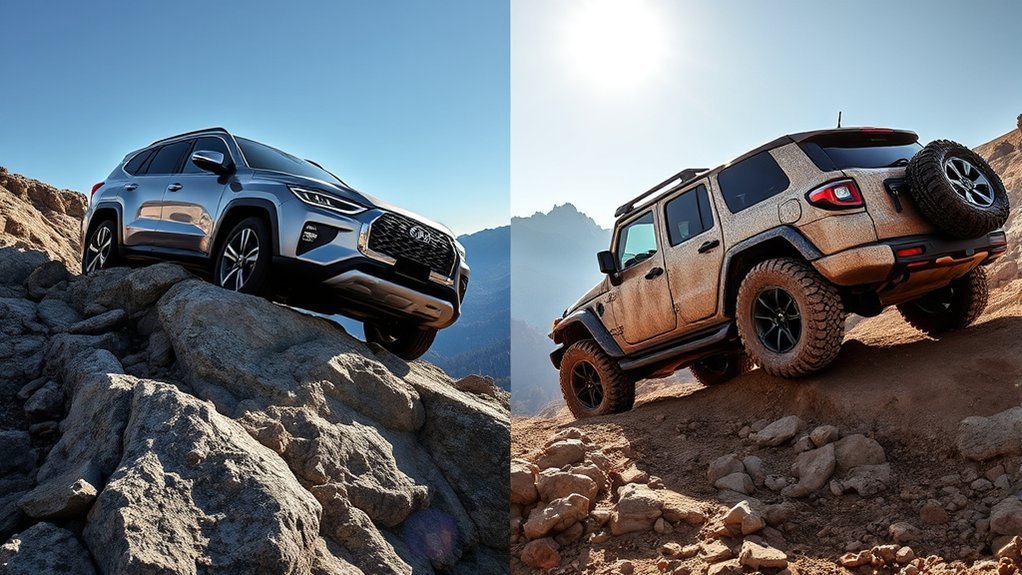
Use 4L before entering terrain where high-range gearing would require too much throttle, clutch slipping, braking, or momentum. Low range lets the engine operate in a useful part of its power band while the vehicle moves slowly.
Maximum Traction Needs
4L does not manufacture traction. Instead, it multiplies torque and allows finer control of the torque already available. Tires, differential design, lockers, suspension travel, surface conditions, and driver inputs still determine whether the wheels grip.
| Situation | Why 4L Helps | Driving Approach |
|---|---|---|
| Rock crawling | Provides slow wheel speed and precise throttle control | Crawl smoothly and avoid bouncing the drivetrain |
| Steep climb | Reduces the need for excessive throttle or clutch slip | Select the mode before starting the climb |
| Steep descent | Adds low-speed engine braking | Descend straight and avoid riding the brakes |
| Deep mud or sand | Provides torque at low speed when high range struggles | Use steady inputs; too much torque can increase wheelspin |
| Heavy low-speed pulling | Reduces strain during a slow launch or controlled pull | Stay within tow, axle, and recovery-point ratings |
Steep Terrain Navigation
Engage 4L before a steep climb or descent rather than stopping halfway to change modes. Approach the slope straight when possible, inspect the route, and avoid turning across a steep side slope.
- Use a low transmission gear and steady throttle while climbing.
- Do not build unnecessary speed before the crest.
- Use low-range engine braking on the descent.
- Avoid harsh braking that could lock or slide a tire.
- Never attempt a slope if you cannot see the route, crest, or safe exit.
If the vehicle stalls on a climb, follow the recovery procedure in its off-road guide. Do not attempt a sharp turn on the slope because the vehicle could slide sideways or roll.
Deep Sand, Mud, and Snow
High range is often the first choice when momentum is needed in firm sand or moderate snow. Low range becomes useful when the vehicle must move more slowly, climb, pull a load, or work through a deep section without repeatedly shifting or overheating the clutch.
Use gentle steering and enough throttle to maintain progress. Excess torque can spin the tires, dig them deeper, and reduce control. If forward motion stops, stop accelerating rather than continuing to excavate holes beneath the tires.
Boat Ramps, Towing, and Recovery
Some manufacturers permit 4L for a slow launch on a slippery ramp or for pulling a heavy object at very low speed. Never use low range to exceed the vehicle’s tow rating, axle rating, recovery-point rating, or tire limits.
Low range on a dry concrete ramp can also create driveline windup in a part-time system, especially while turning. Follow the exact manual and keep the maneuver as straight as possible.
Advantages and Disadvantages of 4 High

Advantages of 4 High
- Provides drive torque to the front and rear axles.
- Can reduce wheelspin when starting or climbing on loose surfaces.
- Allows more speed and momentum than low range.
- Works well for snow-covered roads, gravel, mud, and many off-road trails.
- May be engaged while moving on vehicles with an approved shift-on-the-fly system.
Disadvantages of 4 High
- Does not improve the friction available for braking or cornering.
- Can encourage overconfidence on snow, ice, or wet roads.
- May cause driveline binding, tire scrub, noise, and component stress on dry pavement when used with a part-time system.
- Can increase fuel use compared with 2H.
- Does not provide the torque multiplication or engine braking of 4L.
Ford warns that part-time 4H and 4L should not be used on dry, hard-surfaced roads because doing so can increase tire wear, create noise, and damage drive components. The same source notes that 4H is intended for snow, ice, or off-road use rather than ordinary dry-pavement driving.
Pros and Cons of Engaging 4 Low
Advantages of 4 Low
- Multiplies torque at the wheels for slow, demanding work.
- Improves throttle control over rocks, ruts, and obstacles.
- Reduces the need for clutch slipping or excessive accelerator input.
- Provides stronger low-speed engine braking on descents.
- Can reduce strain during approved low-speed pulling or plowing tasks.
Disadvantages of 4 Low
- Restricts road speed and is unsuitable for normal highway driving.
- Can make wheelspin more abrupt if the accelerator is used aggressively.
- May disable or alter traction, stability, or driver-assistance functions on some vehicles.
- Can bind a part-time drivetrain on dry, high-traction pavement.
- Requires a specific engagement procedure that may include Neutral and a stop or slow roll.
Do not force the selector if the transfer case does not complete a shift. Recheck the required transmission position, vehicle speed, brake application, and indicator status. Continuing to drive while an indicator flashes may leave the system between ranges or return it to the previous mode.
When Not to Use 4 High or 4 Low
Avoid selecting part-time 4H or 4L in these situations unless the exact manual says otherwise:
- Dry pavement with strong grip: The tires may be unable to release front-to-rear driveline stress during a turn.
- Ordinary highway driving: Use 2H, full-time high range, 4A, or the manufacturer-approved road mode.
- While wheels are spinning: A sudden engagement can shock the transfer case, axles, hubs, or driveshafts.
- At an unapproved shift speed: The request may be rejected or could damage a manual system.
- With mismatched tires: Different diameters or pressures can create continuous driveline speed differences.
- When a warning light is active: A service 4WD message or persistent flashing indicator requires diagnosis.
Warning: If steering becomes heavy, the tires hop or scrub during a tight turn, or the vehicle resists leaving 4H or 4L, driveline windup may be present. Move to a loose surface, drive straight, release the accelerator, and follow the manual’s disengagement procedure. Do not force the control.
Does Four-Wheel Drive Improve Braking or Prevent Skids?
Four-wheel drive mainly improves the vehicle’s ability to send engine torque through more than one axle. It does not add tire-road friction. All four tires already contribute to braking on a properly operating vehicle, whether the drivetrain is in 2H or 4H.
On snow or ice, stopping and turning depend on tire compound, tread, inflation, speed, road temperature, and available grip. The Colorado State Patrol warns that 4WD can provide an acceleration advantage but does not improve a vehicle’s ability to stop or turn in poor conditions.
Check tire pressure when the tires are cold and inspect tread regularly. The National Highway Traffic Safety Administration recommends checking tire pressure at least monthly and replacing tires when tread reaches the minimum safe depth.
Should You Plow in 4 High or 4 Low?
The correct plowing range depends on the truck, transfer case, plow package, snow depth, work area, and operating speed. Do not install or use a plow unless the vehicle manufacturer approves the configuration and the completed vehicle stays within its front axle, gross vehicle, tire, and electrical ratings.
As one manufacturer-specific example, Ford guidance for certain plow-equipped trucks calls for 4L in small areas at speeds below 5 mph and 4H for larger areas or lighter snow, with a much lower operating speed than normal road travel. This is not a universal procedure. Read both the truck manual and the plow manual before operating.
Ford’s current snowplowing material also discusses cooling airflow, ballast, axle loading, lighting, electrical demand, and severe-duty maintenance. Review the official Ford snowplowing guidance as an example, then use the documentation for your exact truck.
Troubleshooting a 4WD System That Will Not Shift
The Indicator Keeps Flashing
- Confirm that the transmission is in the position required by the manual.
- Reduce speed or stop if the system requires it.
- Release the accelerator and keep the wheels pointed straight.
- Wait for the indicator to remain steadily illuminated before selecting a drive gear.
- Do not cycle the control repeatedly while the system is attempting a shift.
The Vehicle Will Not Leave 4H or 4L
Driveline windup can hold the transfer-case gears under load. Move to gravel, dirt, snow, or another loose surface when safe, drive straight, release the accelerator, and try the specified procedure again. Some manuals also recommend a short, straight reverse movement.
If the mode still will not disengage, stop using the vehicle for normal pavement travel and arrange service. Do not attempt to release drivetrain stress by accelerating hard, making tight turns, or forcing a lever.
A Service 4WD Message Appears
A warning may indicate an actuator, sensor, wiring, hub, transfer-case, or control-module problem. Record the message and the conditions under which it appeared. Have the system diagnosed rather than assuming that the shift completed successfully.
Easy Maintenance Tips to Keep Your 4WD Running Smooth
Four-wheel-drive maintenance is more than operating the selector. Tire condition, fluid service, seals, boots, driveshafts, hubs, and electrical controls all affect reliable engagement.
| Maintenance Task | When to Do It | What to Check |
|---|---|---|
| Tire pressure and tread | At least monthly and before a trip | Use the door-label pressure; inspect all four tires for uneven wear or damage |
| Tire size and wear matching | Whenever tires are serviced or replaced | Use approved sizes and keep rolling diameters closely matched |
| Transfer-case and axle fluids | At the normal or severe-service interval in the manual | Correct fluid type, level, leaks, contamination, and change interval |
| Driveshafts, boots, and seals | During routine service and after hard trail use | Cuts, looseness, impact damage, grease loss, or leaking seals |
| Post-mud cleaning | After muddy trips | Remove packed mud from wheels, brakes, driveshafts, and cooling openings |
| Post-water inspection | After water reaches hubs, axles, or breathers | Check for contaminated axle, transfer-case, or transmission fluid as directed |
| System operation | Only at the interval and on the surface recommended by the manufacturer | Complete engagement, steady indicator lights, unusual noises, or warning messages |
There is no universal rule requiring every 4WD system to be engaged monthly or lubricated every three months. Use the maintenance schedule tied to the vehicle identification number, model year, powertrain, and duty cycle.
Final Thoughts on Choosing 4 High Vs 4 Low
Use 4H when a loose or consistently slippery surface requires drive torque at both axles and you still need moderate momentum. Use 4L when the job requires slow wheel speed, extra torque multiplication, or stronger engine braking.
The mode selector is only one part of safe operation. Tires, speed, visibility, slope, water depth, load, differential settings, and driver inputs all matter. Four-wheel drive can help you move through difficult conditions, but it cannot override the available tire grip.
Most importantly, verify every engagement procedure and speed limit in the official manual for your exact vehicle. A limit printed for one Jeep, Ford, Chevrolet, Toyota, or other 4WD system may not apply to another model or transfer case.
Sources
- Ford — Using Four-Wheel Drive — backs up mode definitions, dry-pavement restrictions, shifting differences, and off-road precautions.
- Jeep — 4×4 FAQ and Glossary — supports high-range versus low-range use, low-range shifting, speed qualifications, and the distinction between torque and traction.
- National Highway Traffic Safety Administration — TireWise — supports tire-pressure, tread, tire-size, and inspection guidance.
- Federal Highway Administration — Driver Safety Issues — supports hydroplaning, standing-water, speed, tread, and tire-pressure cautions.
- Utah Highway Patrol — Winter Driving Guide — supports the warning that 4WD helps a vehicle move but does not make it stop faster.
- Ford — Snow Plowing Guidance — supports model-specific 4H and 4L plowing examples, load limits, cooling, and severe-duty maintenance.
Frequently Asked Questions
Should I use 4 High or 4 Low?
Use 4H for loose or consistently slippery surfaces when you need more drive traction and moderate speed. Use 4L for slow, demanding work such as rocks, steep grades, deep mud, deep sand, controlled pulling, or low-speed plowing when approved. Follow your vehicle’s manual.
Do I want to be in 4H or 4L on snow?
4H is normally the starting choice for a snow-covered road because it allows more momentum. 4L may be useful in deep snow, on a steep grade, while pulling a load, or during very slow maneuvering. Neither mode improves the amount of braking grip available from the tires.
Can I use 4 High in heavy rain?
Use part-time 4H only when the surface is consistently slippery and the manufacturer permits it. For roads that alternate between wet and dry pavement, 4A, full-time four-wheel drive, AWD, or the normal road mode may be better. 4H cannot prevent hydroplaning.
How fast can I drive in 4 High?
There is no universal maximum. Some manuals list an engagement limit such as 55 mph, but that is not necessarily the recommended driving speed. Stay below the limit in your manual and reduce speed further for snow, gravel, mud, water, curves, visibility, and traffic.
Can I shift into 4 Low while moving?
Some vehicles require a complete stop, while others specify a slow roll near 2–3 mph with the transmission in Neutral. Do not guess. Follow the exact sequence in the owner’s manual and wait for the 4L indicator to remain steadily illuminated.
Should you plow in 4 High or 4 Low?
It depends on the approved plow setup and the vehicle manual. Some Ford guidance uses 4L for confined areas below 5 mph and 4H for larger areas or lighter snow. Other trucks may differ. Check load ratings, ballast, cooling, electrical limits, and both manuals.
When should I not use 4WD Low?
Do not use 4L for ordinary highway travel, high-speed driving, or dry high-traction pavement unless the manufacturer specifically permits the situation. Also avoid shifting while the wheels are spinning or when the required Neutral, brake, speed, or clutch conditions are not met.
Does four-wheel drive help a vehicle stop faster?
No. Four-wheel drive can improve acceleration by sending engine torque through both axles, but stopping and turning still depend on tire grip, speed, road conditions, and the braking system. Slow down and leave extra following distance on snow, ice, gravel, and wet roads.
Conclusion
Choosing between 4 High and 4 Low is not about selecting the mode with the most power. It is about matching the transfer-case range to the surface and the task. Use 4H for loose or consistently slippery conditions that require momentum. Use 4L for slow climbing, descending, crawling, pulling, or maneuvering that benefits from reduction gearing.
Avoid universal rules about speed and shifting. Check the official instructions for your exact model year and transfer case, keep all four tires properly maintained, and remember that four-wheel drive does not create extra braking or cornering grip. Used correctly, 4H and 4L can improve control while protecting the drivetrain from unnecessary strain.







Leave a Reply