

Your Vehicle Identification Number (VIN) is a useful starting point for finding your vehicle’s towing capacity, but the VIN alone is not the final answer. It can identify the exact model year and configuration, and some manufacturers use it to retrieve vehicle-specific towing data. You must still verify the ratings on the vehicle labels and in the correct owner’s manual or towing guide, account for passengers and cargo, and compare the numbers with the vehicle’s actual loaded weight.
Quick Answer
Use the 17-character VIN to identify your exact vehicle and, when available, run the manufacturer’s VIN-based towing lookup. Then verify GVWR and GAWR on the driver-door labels, find GCWR and maximum trailer weight in the owner’s manual or towing guide, and compare those ratings with actual loaded weights. The lowest limit controls.
Key Takeaways
- A VIN identifies the vehicle and may unlock manufacturer build data, but it does not universally encode a finished tow rating.
- The driver-door certification label normally provides GVWR and front/rear GAWR; GCWR and maximum trailer weight usually come from the owner’s manual, towing guide, or manufacturer lookup.
- Passengers, cargo, accessories, hitch hardware, and trailer tongue or pin weight use the tow vehicle’s payload.
- Check every limit: maximum trailer weight, GCWR, GVWR, GAWR, payload, hitch rating, trailer rating, and tire load capacity.
- The safest usable trailer weight is the lowest limit produced by those checks, confirmed with the vehicle and trailer loaded as they will travel.
At a Glance
| Time Required | About 20–45 minutes for the lookup and calculations; longer if you weigh the loaded combination |
| Difficulty | Easy to moderate |
| Tools Needed | VIN, driver-door labels, model-year owner’s manual or towing guide, calculator, and preferably a public vehicle scale |
| Cost | Usually free for online research; a public-scale fee may apply |
What Your VIN Reveals About Towing Capacity
A VIN is a unique 17-character identifier for a modern road vehicle. A decoder can identify details reported by the manufacturer, such as the make, model year, body type, engine family, drive type, and assembly plant. Those details help you select the correct towing chart or manual.
The VIN itself does not provide a universal field that states, “This vehicle can tow X pounds.” It also does not guarantee that a general decoder will display the exact axle ratio, tow package, cooling equipment, hitch rating, GVWR, GCWR, or maximum trailer weight for every vehicle.
The NHTSA VIN Decoder is useful for confirming vehicle identity and coded attributes. For a final tow rating, use the vehicle manufacturer’s records. Some manufacturers offer VIN-based tools; for example, Ford provides a towing calculator for eligible F-Series trucks. Other brands may require a model-year towing guide, build sheet, owner portal, or dealer lookup.
Note: A VIN lookup can identify the vehicle that left the factory, but it may not reveal later changes. Inspect a used vehicle for replacement axles, different tire sizes, suspension lifts, body conversions, hitch changes, and added equipment before relying on the original specifications.
Essential Terms for Understanding Towing Capacity
You need more than one number to determine whether a vehicle-and-trailer combination is within its limits. The terms below work together, and none should be checked in isolation.
| Term | What It Means | Where to Verify It |
|---|---|---|
| GVWR | Maximum allowable weight of the loaded tow vehicle, including occupants, cargo, accessories, hitch equipment, and trailer tongue or pin weight carried by the vehicle | Certification label near the driver’s door |
| GAWR | Maximum allowable load on an individual axle | Certification label near the driver’s door |
| GCWR | Maximum allowable combined weight of the loaded tow vehicle and loaded trailer | Owner’s manual, towing guide, or manufacturer lookup |
| GVW | The vehicle’s actual weight at a given time | Vehicle scale |
| Maximum trailer weight | The manufacturer’s maximum loaded trailer rating for a specific vehicle configuration and towing setup | VIN tool, owner’s manual, or model-year towing guide |
| Payload capacity | How much occupant, cargo, accessory, hitch, and supported trailer weight the vehicle can carry | Tire and Loading Information label; confirm with actual scale weight |
| Trailer GVWR or GTWR | Maximum allowable loaded weight of the trailer | Trailer certification label and manual |
| Tongue or pin weight | The portion of loaded trailer weight supported by the tow vehicle at the hitch | Tongue scale or vehicle scale |
Gross Vehicle Weight Rating
GVWR is the maximum allowable weight of the fully loaded tow vehicle. It includes the vehicle itself, fuel, occupants, cargo, aftermarket equipment, hitch hardware, and the trailer’s tongue or pin weight that presses on the vehicle. Exceeding GVWR can reduce steering, braking, tire, suspension, and handling margins.
Find GVWR on the certification label near the driver’s door. That label also lists front and rear GAWR. Do not assume that staying below GVWR automatically means the rear axle is below its rating; tongue or pin weight can place a large share of the load on the rear axle.
GCWR and Maximum Towing Capacity
GCWR is the manufacturer’s maximum for the loaded tow vehicle and loaded trailer together. A useful calculation is:
GCWR-limited trailer weight = GCWR − actual loaded tow-vehicle weight
This calculation is only one limit. The result cannot exceed the manufacturer’s published maximum trailer weight, the hitch and ball-mount ratings, the trailer’s own rating, or any GVWR, GAWR, payload, and tire limits.
Payload Capacity Explained
Payload is the weight added to the vehicle, including passengers and cargo. During towing, hitch equipment and trailer tongue or pin weight also consume payload. A basic estimate is GVWR minus curb weight, but the exact Tire and Loading Information label is usually more useful because factory options affect the vehicle’s available capacity.
For example, if a truck has a 7,000-pound GVWR and a 5,000-pound reference curb weight, the simple payload estimate is 2,000 pounds. That does not mean all 2,000 pounds are available for trailer tongue weight; people, cargo, accessories, and hitch hardware must be subtracted first.
| Example Weight | Amount |
|---|---|
| GVWR | 7,000 pounds |
| Reference curb weight | 5,000 pounds |
| Basic payload estimate | 2,000 pounds |
| Passengers, cargo, accessories, and hitch | Subtract their actual combined weight |
| Capacity left for tongue or pin weight | Whatever remains, subject to rear GAWR and hitch limits |
How to Find Your Vehicle’s Towing Capacity by VIN
Use this process to move from a VIN to a defensible towing limit. Do not stop after a generic decoder result or a model-level marketing number.
1. Record the VIN and Model Year
Copy the full 17-character VIN from the lower windshield, driver-door area, registration, or insurance record. Confirm the model year because towing charts and equipment packages can change from one year to the next.
2. Decode the Vehicle Identity
Use the NHTSA decoder to confirm the make, model year, body type, engine information, drive type, and other available attributes. Treat this as an identity check, not as a complete towing calculation.
3. Confirm the Exact Configuration
Match the vehicle to the correct configuration in the manufacturer’s records. Towing capacity can change with:
- Engine and transmission
- Two-wheel drive or four-wheel drive
- Axle ratio
- Cab, bed, wheelbase, and body style
- Factory tow package, cooling system, alternator, and integrated brake controller
- Wheel and tire package
- Factory options and curb weight
Use a manufacturer VIN lookup when one is available. Otherwise, obtain the original build sheet or option codes and match them to the exact model-year towing guide.
4. Read the Driver-Door Labels
Record the GVWR and front/rear GAWR from the certification label. Then record the occupant-and-cargo limit from the Tire and Loading Information label. The federal certification label is the right source for GVWR and GAWR, but it usually does not provide GCWR.
5. Find GCWR and Maximum Trailer Weight
Use the owner’s manual, towing supplement, official model-year towing guide, or manufacturer VIN tool to find the GCWR, maximum loaded trailer weight, maximum tongue or pin weight, and required hitch type for the exact configuration.
Read all footnotes. A published maximum may assume a specific axle ratio, tow package, hitch, driver/passenger allowance, little or no cargo, and a stated tongue-weight percentage. Added passengers, options, cargo, and hitch equipment can reduce the usable trailer weight.
6. Calculate Each Real-World Limit
Run each of these checks:
- GCWR check: Subtract the tow vehicle’s actual loaded weight from GCWR.
- Payload check: Subtract occupants, cargo, accessories, and hitch hardware from the vehicle’s occupant-and-cargo capacity. The remainder is the most tongue or pin weight the payload calculation can support.
- GVWR check: Confirm the loaded tow vehicle, including tongue or pin weight, remains at or below GVWR.
- GAWR check: Confirm the measured front and rear axle weights remain at or below their ratings.
- Equipment check: Compare the receiver, ball mount, hitch ball, weight-distributing system, coupler, safety chains, tires, and trailer ratings.
The published “maximum tow rating” is not automatically your usable limit. The lowest verified limit for the loaded vehicle, trailer, axles, payload, hitch, and tires is the number that controls.
7. Weigh the Loaded Combination
Load the vehicle and trailer as they will travel, including people, fuel, water, propane, food, tools, camping gear, and cargo. Use a public vehicle scale to measure the tow vehicle and trailer combination, the tow vehicle by itself, and individual axle groups when the scale setup allows it.
From those readings, calculate actual trailer weight and tongue or pin weight, then compare every measured value with the ratings you recorded.
Warning: Never increase a towing limit because an aftermarket hitch, brake kit, axle, spring, or engine part has a higher component rating. The vehicle combination must remain within the manufacturer’s GVWR, GAWR, GCWR, maximum trailer weight, payload, and other stated limits unless the vehicle has been formally recertified by a responsible manufacturer or alterer.
Worked Example: Why Payload Can Be the Limiting Factor
Assume the following hypothetical loaded setup. These figures are examples only; use the ratings and scale weights for your vehicle.
| Limit | Calculation | Result |
|---|---|---|
| Published maximum trailer weight | Manufacturer figure | 8,000 lb |
| GCWR limit | 13,500 lb GCWR − 6,200 lb loaded tow vehicle | 7,300 lb |
| Hitch limit | Lowest rated hitch component | 7,500 lb |
| Payload-based estimate | 700 lb available for tongue weight ÷ 0.12 example tongue-weight fraction | About 5,833 lb |
In this example, the payload-based estimate is the lowest value, so an 8,000-pound trailer would not fit the loaded setup. The final choice must also pass the front/rear GAWR, GVWR, tire, and trailer-rating checks. Use the tongue-weight percentage specified by the vehicle and trailer manufacturers rather than assuming 12% for every trailer.
Understanding GVWR and the Driver-Door Labels
The certification label near the driver’s door is one of the most important towing references on the vehicle. Under federal labeling rules, it identifies the GVWR and GAWR values set for that vehicle. It may also show tire and rim information and an axle code, depending on the manufacturer.
A separate Tire and Loading Information label states the maximum combined weight of occupants and cargo for many light vehicles. That occupant-and-cargo figure is especially useful because it reflects the vehicle as built with its factory equipment.
What the Label Does Not Show
Do not expect the certification label to provide every towing figure. GCWR, maximum trailer weight, required hitch equipment, frontal-area limits, and special towing instructions are normally found in the model-year owner’s manual, towing guide, or manufacturer database.
Why Actual Axle Weights Matter
A vehicle can be below GVWR and still overload the rear axle. Trailer tongue weight, a bed-mounted fifth-wheel hitch, cargo behind the rear axle, and passengers can shift a large share of the load rearward. A scale reading for each axle group is the best way to check this.
The Impact of Modifications on Towing Capacity
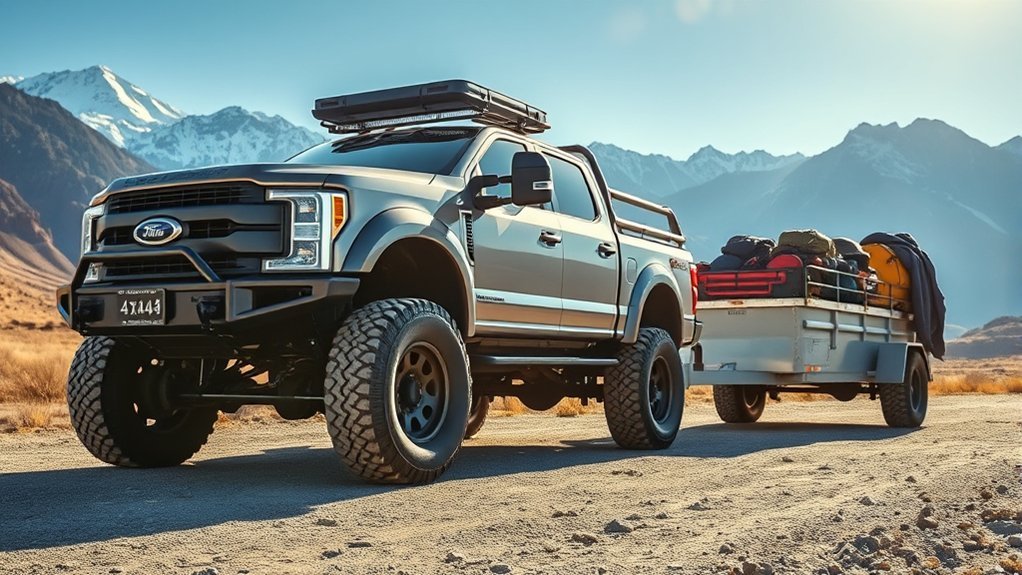
Modifications can affect payload, handling, stability, braking, cooling, hitch geometry, and drivetrain load. They do not automatically raise the vehicle manufacturer’s ratings.
- Lift kits: A higher center of gravity and changed suspension or hitch geometry can affect stability and weight-distribution setup.
- Oversized tires: Larger tire diameter can change effective gearing, acceleration, braking feel, clearance, and speedometer readings. New wheels and tires must also have suitable load ratings.
- Bed toppers, toolboxes, bumpers, winches, racks, and auxiliary tanks: Their weight reduces available payload and may increase front or rear axle load.
- Body conversions and upfits: Added bodies, service equipment, flatbeds, campers, and accessibility conversions can materially change curb weight and load distribution.
- Brake, axle, spring, or power upgrades: A stronger component may improve durability or control, but it does not by itself change the original GVWR, GAWR, GCWR, or maximum trailer rating.
After any change, recalculate payload and weigh the vehicle. Also verify that the hitch remains level and within the vehicle and hitch manufacturers’ installation instructions.
Pro Tip: Keep receipts and specifications for heavy accessories. Add their installed weight to your towing worksheet so the same equipment is not forgotten each time you calculate payload.
Trailer Loading, Tongue Weight, and Sway Prevention
Correct load balance is essential for trailer stability. For conventional trailers, many manufacturers call for tongue weight around 10% to 15% of the loaded trailer weight, while fifth-wheel and gooseneck pin-weight recommendations are often higher. Follow the exact vehicle and trailer manuals because boat trailers and other designs may use different targets.
Do not rely on a universal “60/40 rule” as a substitute for measuring tongue weight. Load heavy items low, secure them against movement, and position cargo so the measured tongue or pin weight meets the manufacturer’s range without exceeding payload, rear GAWR, hitch, or receiver limits.
Too little tongue weight can contribute to sway. Too much can overload the tow vehicle’s rear axle, reduce front-axle loading, and hurt steering and braking response.
Pro Tip: Weigh the trailer in trip-ready condition. Water, propane, batteries, generators, coolers, tools, and cargo can change both total trailer weight and tongue weight.
Safety Tips for Staying Within Towing Limits
- Verify the exact vehicle configuration by VIN, build sheet, option codes, and model-year documentation.
- Stay at or below GVWR, front and rear GAWR, GCWR, maximum trailer weight, payload, tongue or pin weight, hitch ratings, trailer GVWR, and tire load limits.
- Use the cold tire pressures specified on the vehicle and trailer labels or in the manuals; do not use the tire sidewall maximum as a universal target.
- Match the receiver, ball mount, hitch ball, coupler, safety chains, breakaway cable, and weight-distributing equipment to the load.
- Confirm that trailer brakes, lights, mirrors, and safety equipment meet the owner’s manuals and applicable state requirements.
- Secure cargo so it cannot shift, then recheck coupler latching, chains, wiring, breakaway cable, tire condition, lug nuts, and doors before departure.
- Allow more following distance, avoid abrupt steering or braking, reduce speed for weather and road conditions, and stop to inspect the setup after the first few miles.
A personal operating margin can make towing more comfortable in heat, wind, mountains, or heavy traffic, but there is no universal rule that every driver must use exactly 80% of the advertised tow rating. The non-negotiable requirement is to remain within every applicable manufacturer rating with the combination fully loaded.
Resources for Verifying Your Vehicle’s Towing Specifications
- Manufacturer VIN-based towing tools: Use one when the manufacturer supports your model. Ford’s official towing calculator is an example for eligible F-Series vehicles.
- Owner’s manual and towing supplement: Use the exact model year and market version. Read the towing-equipment, weight, braking, and tire sections.
- Official model-year towing guide: Match engine, transmission, drive type, axle ratio, cab, bed, wheelbase, and tow package. Read every footnote.
- Build sheet or dealer/manufacturer record: Use it to confirm axle ratio, factory tow package, cooling equipment, and other options not shown by a generic decoder.
- Driver-door labels: Record GVWR, GAWR, tire information, and the occupant-and-cargo limit.
- NHTSA VIN Decoder: Use it to confirm vehicle identity and manufacturer-reported coded attributes, not as the sole source of a tow rating.
- Public vehicle scale: Measure the trip-ready combination and axle loads instead of relying only on estimated curb and cargo weights.
If documents conflict, contact the vehicle manufacturer with the VIN and ask for the correct model-year towing documentation. For a used or converted vehicle, also identify the company responsible for the conversion or final-stage certification.
Frequently Asked Questions
Can towing capacity change with different vehicle configurations?
Yes. Engine, transmission, drive type, axle ratio, cab, bed, wheelbase, factory tow package, tires, and installed options can change towing and payload figures. Use the VIN and build information to match the exact configuration rather than relying on a broad model-level maximum.
How often should I check my vehicle’s towing capacity?
Recheck the numbers whenever you use a different trailer, change the load, add passengers or accessories, modify the vehicle, replace towing equipment, or buy a used vehicle with an uncertain history. Weigh the setup again when the trip-ready load changes materially.
What happens if I exceed my vehicle’s towing capacity?
Overloading can reduce steering and braking performance, overheat or damage tires and drivetrain parts, overload an axle or hitch, and increase the risk of sway or loss of control. A combination can also exceed GVWR or rear GAWR before it reaches the advertised maximum trailer weight.
Are towing capacities the same for all vehicles in one model line?
No. Two vehicles with the same model name can have different engines, axle ratios, drive systems, wheelbases, option weights, payload labels, and tow packages. Verify the individual vehicle instead of applying the highest advertised rating to every trim.
Can I find towing information for a used vehicle?
Yes. Start with the VIN, door labels, exact model-year manual, build sheet, and manufacturer towing guide. Then inspect the vehicle for conversions, different axles or tires, suspension changes, added equipment, and hitch modifications. A scale weight is especially valuable when the vehicle’s history is unclear.
Does the NHTSA VIN Decoder show exact towing capacity?
Not reliably for every vehicle. It is designed to decode manufacturer-reported VIN attributes and confirm vehicle identity. Use the vehicle manufacturer’s VIN tool, owner’s manual, towing supplement, or model-year guide for GCWR and maximum trailer weight.
Can upgraded brakes, axles, or suspension increase the official tow rating?
Not by themselves. Upgrades may improve component performance, but the original vehicle ratings do not automatically change. Treat the factory GVWR, GAWR, GCWR, and maximum trailer weight as controlling unless a responsible manufacturer or alterer has formally recertified the completed vehicle and supplied valid revised labels and documentation.
Conclusion
Your VIN helps you identify the exact vehicle and may connect you to manufacturer-specific towing data, but safe towing requires more than decoding 17 characters. Verify the model-year configuration, read the driver-door labels, find GCWR and maximum trailer weight in official manufacturer documents, subtract the real weight of passengers and cargo, and weigh the trip-ready combination. When the numbers differ, use the lowest limit. That approach protects vehicle stability, braking, tires, axles, hitch equipment, and everyone sharing the road.
Sources
- National Highway Traffic Safety Administration — VIN Decoder — explains the 17-character VIN and manufacturer-reported decoded information.
- 49 CFR § 567.4 — Vehicle Certification Label Requirements — specifies GVWR and GAWR information on the certification label.
- 49 CFR § 571.110 — Tire and Loading Information — covers occupant-and-cargo placards, tire information, and load labeling for light vehicles.
- 2026 Ford RV & Trailer Towing Guide — supports GCWR, payload deductions, tongue-load checks, axle limits, and scale measurement.
- 2026 Chevrolet Colorado/GMC Canyon Trailer Towing Supplement — supports loaded-weight calculations, tongue-weight balance, hitch limits, and axle checks.
- Ram Towing: Before You Buy — defines GVWR, GCWR, payload, tongue weight, and configuration factors that affect towing.







Leave a Reply