
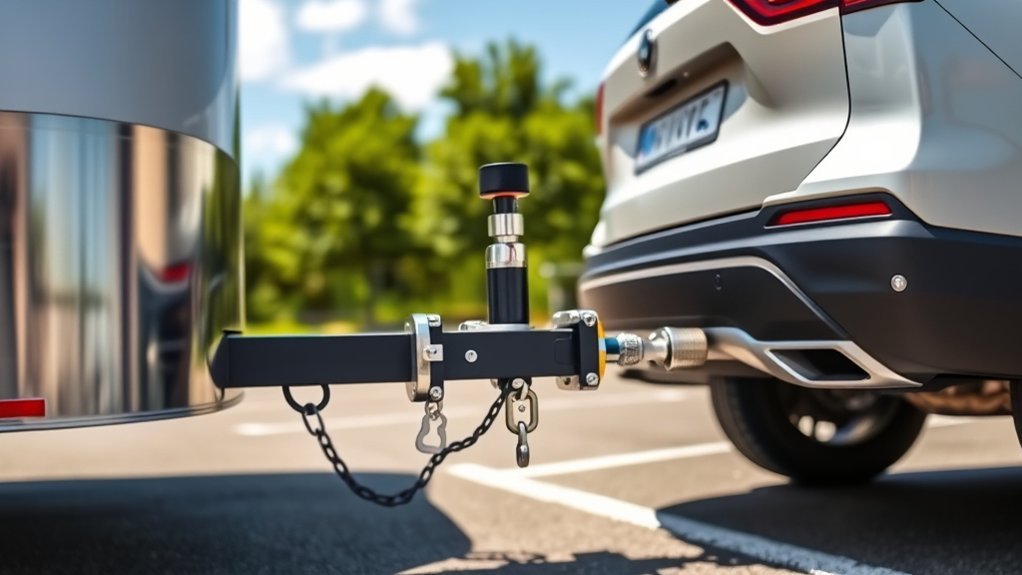
Trailer sway and poor handling often begin with load balance, not a lack of hitch accessories. Tongue weight is the portion of a loaded trailer’s weight that presses down on the tow vehicle at the coupler and hitch ball. Measuring it after the trailer is packed for travel helps you balance the load without exceeding the vehicle, hitch, axle, or tire limits.
Quick Answer
Tongue weight is the downward load a trailer places on its hitch. For most conventional ball-coupled trailers, 10–15% of the actual loaded trailer weight is a common target unless the manufacturer specifies otherwise. Measure with the trailer level and loaded for travel, then confirm that every vehicle and hitch rating remains within its limit.
Key Takeaways
- Use the trailer’s actual loaded weight, not its dry weight or advertised empty hitch weight.
- A 10–15% tongue-weight range is common for conventional trailers, but the vehicle and trailer manuals take priority.
- Tongue weight counts against the tow vehicle’s payload and can affect its GVWR and rear-axle load.
- Measure again whenever you change cargo, water, fuel, batteries, propane cylinders, or mounted accessories.
- Never exceed the lowest rating among the tow vehicle, receiver, ball mount, hitch ball, coupler, tires, and trailer.
At a Glance
| Time Required | About 15–30 minutes after the trailer is loaded |
| Difficulty | Easy with a dedicated scale; moderate with a lever or public-scale method |
| Tools Needed | Wheel chocks and either a rated tongue-weight scale, a suitable bathroom-scale lever setup, or a public vehicle scale |
| Cost | No added cost if you already own a suitable scale; public-scale fees and dedicated-scale prices vary |
Understanding Tongue Weight and Its Importance for Safe Towing
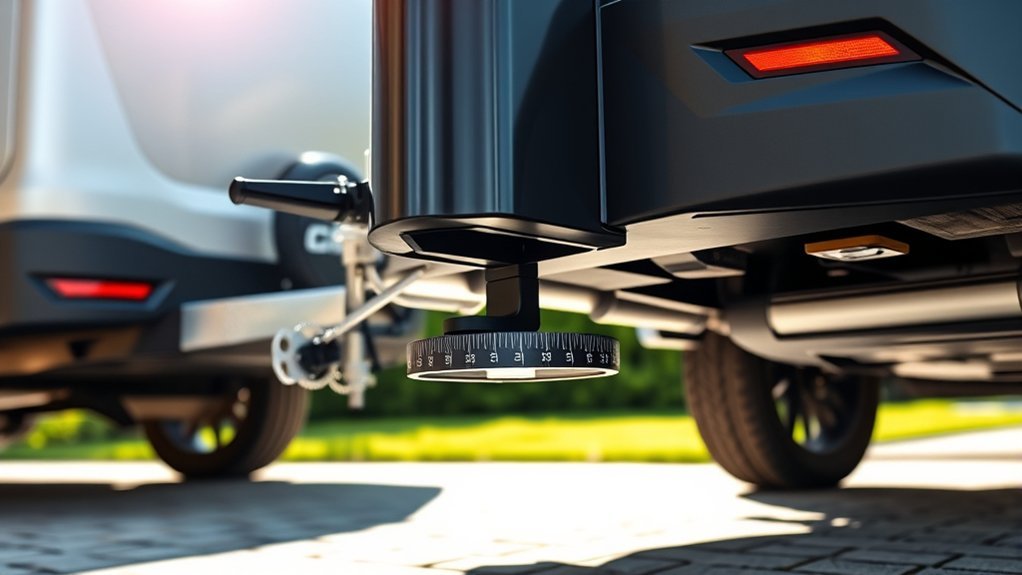
Tongue weight, often shortened to TW, is the downward load the trailer’s coupler places on the hitch ball. It is part of the trailer’s total loaded weight, but the tow vehicle must carry it through the hitch.
For many conventional ball-coupled trailers, a tongue weight of 10–15% of the total loaded trailer weight is a common target. For example, a fully loaded 10,000-lb conventional trailer would have a general screening range of 1,000–1,500 lb.
Tongue-weight percentage equals the measured tongue weight divided by the trailer’s actual loaded weight, multiplied by 100.
The load must be heavy enough at the front to help the trailer track behind the tow vehicle, but it must not exceed any vehicle, hitch, axle, tire, or trailer rating. A percentage that looks correct on paper is not safe if the resulting load is greater than the equipment can carry.
Note: The 10–15% range is not universal. Some boat and specialty trailers may use a different range. Fifth-wheel and gooseneck trailers often place a larger share of their loaded weight on the truck; for example, GM lists 15–25% for certain fifth-wheel and gooseneck applications. Follow the specific vehicle, hitch, and trailer manuals.
What Happens With Improper Tongue Weight?
Incorrect tongue weight changes how forces are shared between the trailer and tow vehicle. Too little and too much can both create problems, but they cause different symptoms.
Too Little Tongue Weight
When too much cargo is placed behind the trailer axle, the front of the trailer can become too light. That reduces the stabilizing load at the hitch and can make the trailer more likely to sway or oscillate.
Possible warning signs include:
- The trailer feels nervous or moves from side to side at speed.
- Passing trucks or crosswinds cause unusually strong movement.
- The measured tongue-weight percentage is below the trailer manufacturer’s range.
- Heavy cargo is concentrated at or behind the rear of the trailer.
A trailer can still sit level while having too little tongue weight. Trailer angle and tongue-weight percentage must therefore be checked separately.
Too Much Tongue Weight
Excessive tongue weight can use too much of the tow vehicle’s payload, overload the rear axle or tires, exceed the receiver rating, and reduce the load carried by the front axle. The result may be poor steering response, longer or less controlled braking, excessive rear suspension compression, or component damage.
Rear-end sag is a reason to stop and check the ratings, but appearance alone cannot tell you the actual tongue weight. Measure the load and compare it with the door labels, hitch labels, owner’s manual, and towing guide.
Warning: Do not tow merely because the tongue-weight percentage falls within a target range. Stop if the load exceeds the tow vehicle’s payload, GVWR, rear GAWR, receiver rating, ball-mount rating, hitch-ball rating, coupler rating, tire limits, or trailer ratings.
How to Calculate a Tongue-Weight Target
Start with the trailer’s actual loaded weight. This means the trailer as it will travel, including cargo, water, fuel, propane, batteries, tools, spare tires, racks, and accessories.
Target tongue weight = loaded trailer weight × target percentage
Tongue-weight percentage = measured tongue weight ÷ loaded trailer weight × 100
| Loaded Trailer Weight | 10% Tongue Weight | 15% Tongue Weight |
|---|---|---|
| 2,000 lb | 200 lb | 300 lb |
| 5,000 lb | 500 lb | 750 lb |
| 6,000 lb | 600 lb | 900 lb |
| 10,000 lb | 1,000 lb | 1,500 lb |
These figures are starting points, not automatic approvals. A 1,500-lb result, for example, is unsuitable if the receiver is rated for 1,100 lb or the remaining vehicle payload is only 900 lb.
Check the Vehicle and Hitch Ratings
Tongue weight becomes part of the load carried by the tow vehicle. Ram’s towing guidance states that payload plus tongue weight cannot exceed the truck’s payload capacity.
Before towing, verify all of the following:
- Payload capacity: The available capacity for passengers, cargo, added equipment, hitch hardware, and tongue weight.
- GVWR: The maximum allowed weight of the fully loaded tow vehicle.
- Front and rear GAWR: The maximum weight allowed on each axle.
- Receiver rating: Check both weight-carrying and weight-distributing ratings when applicable.
- Ball mount and hitch ball: Each must be rated for the trailer weight and tongue load.
- Trailer coupler and frame: These must support the intended load.
- Tires and wheels: Confirm their load limits and required cold inflation pressures.
- Trailer GVWR and GAWR: The loaded trailer and axle loads must remain within their ratings.
Use the information for the exact model year and configuration. Engine, drivetrain, cab, bed, axle ratio, suspension, factory towing equipment, and installed options can change the available ratings. Check the certification label, owner’s manual, hitch label, and the manufacturer’s VIN- or build-specific towing information rather than relying on a rating for a similar-looking vehicle.
How to Measure Tongue Weight Accurately

Measure the trailer in its travel-ready condition. Even a correct empty reading can change after adding water, propane, batteries, camping gear, equipment, or cargo.
Prepare the Trailer
- Park on firm, flat, level ground.
- Load the trailer as it will be used, including fluids and mounted equipment.
- Secure the cargo so it cannot move while you measure or tow.
- Chock the trailer wheels in both directions.
- Set the trailer level, with the coupler close to its normal towing height.
- Relax or disconnect weight-distribution spring bars when measuring raw tongue weight.
- Confirm that the scale, beam, supports, jack, and blocks are rated for the expected load.
Method 1: Dedicated Tongue-Weight Scale
A dedicated scale is usually the simplest method:
- Support the trailer with the tongue jack.
- Place the rated scale on a firm, level base directly below the coupler or hitch-ball contact point.
- Use strong, stable cribbing if needed to bring the top of the scale to towing height.
- Slowly raise the tongue jack until the scale carries the full coupler load.
- Read and record the weight.
- Lower the tongue jack before removing the scale or blocks.
Sherline’s manufacturer instructions say the trailer should be level, its wheels should be blocked, and the hitch should be near the height at which it rests on the tow vehicle. The scale must also remain upright and level to avoid a false reading.
Method 2: Bathroom Scale With a 3:1 Lever
A bathroom scale may work for a tongue load that exceeds the scale’s direct capacity, but only with a correctly arranged lever. The common three-to-one setup uses a strong beam supported by the scale at one end and a solid block at the other.
- Place the scale and fixed support exactly 3 feet apart.
- Place a short vertical pipe on the beam 1 foot from the fixed support and 2 feet from the scale.
- Position the pipe directly below the trailer coupler.
- Keep the trailer level, chock its wheels, and support the tongue with its jack while arranging the setup.
- Slowly transfer the coupler load onto the pipe and beam.
- Multiply the bathroom-scale reading by three.
For example, a 240-lb scale reading in this exact arrangement represents approximately 720 lb of tongue weight.
Warning: Do not use a weak board, loose bricks, unstable blocks, damaged scale, or an arrangement with guessed spacing. Keep hands, feet, and other body parts away from the supported tongue. If the expected load or setup is uncertain, use a properly rated tongue-weight scale or public vehicle scale.
Method 3: Public Vehicle Scale
A public vehicle scale can measure both tongue weight and loaded trailer weight:
- Load the tow vehicle with the same people, fuel, cargo, and hitch equipment it will carry while towing.
- Weigh the tow vehicle by itself and record the combined front- and rear-axle weight.
- Connect the loaded trailer without engaging the weight-distribution spring bars.
- Weigh the tow vehicle axles again while the trailer axles are recorded separately.
- Subtract the tow vehicle’s unhitched axle total from its hitched axle total. The difference is the approximate raw tongue weight.
- Add the tongue weight to the trailer-axle reading to obtain the loaded trailer weight.
- Divide tongue weight by loaded trailer weight and multiply by 100.
Keep passengers, cargo, fuel level, and equipment unchanged between scale passes. After measuring raw tongue weight, engage and adjust the weight-distribution system according to its instructions and use additional scale readings to verify axle loading.
| Method | Best Use | Key Requirement |
|---|---|---|
| Dedicated tongue-weight scale | Quick checks at home | Use a scale rated above the expected load and measure at towing height |
| Bathroom-scale lever | Moderate loads that exceed the scale’s direct range | Use the exact 3:1 geometry and strong, stable supports |
| Public vehicle scale | Heavy trailers and complete axle-weight checks | Keep the load unchanged between hitched and unhitched passes |
Pro Tip: Record the loaded trailer weight, tongue weight, percentage, vehicle axle weights, and cargo arrangement. Repeating a known setup is easier than rebuilding it from memory before each trip.
How to Adjust Tongue Weight Safely
If the measured tongue weight is outside the trailer manufacturer’s recommended range, adjust the cargo in small steps rather than making one large change.
- To increase tongue weight: Move suitable cargo forward, toward the trailer axle or front, without concentrating an excessive load directly on the tongue.
- To decrease tongue weight: Move suitable cargo slightly rearward while keeping enough weight forward for stability.
- Keep heavy items low: A high center of gravity can increase body roll and load transfer during turns or hard braking.
- Balance both sides: Do not correct front-to-rear balance by creating a heavy left or right side.
- Secure every item: NHTSA advises securing cargo so it cannot shift, fall, leak, or escape from the vehicle or trailer.
- Remeasure: Check the tongue weight and percentage after every meaningful cargo change.
Do not use unsecured ballast as a shortcut. Any added weight also consumes trailer capacity and increases the load that must be accelerated, controlled, and stopped.
Set the ball mount so the loaded trailer sits as close to level as its manufacturer directs. Changing hitch height may correct trailer attitude, but it is not a substitute for measuring tongue weight.
Note: A weight-distribution hitch does not erase the trailer’s actual tongue weight or create more payload. It redistributes part of the hitch load among the tow vehicle’s axles and the trailer axles. Set the trailer’s load balance first, then adjust the hitch according to the vehicle and hitch manufacturers’ instructions.
Real-World Impact of Tongue Weight on Vehicle Performance
Correct tongue weight helps the trailer remain stable behind the tow vehicle. It also helps keep axle and component loads within the limits used by the vehicle and hitch manufacturers.
Improper loading may contribute to:
- Trailer sway during lane changes, turns, crosswinds, or passing maneuvers
- Reduced steering response when excessive rear load removes weight from the front axle
- Overloaded rear tires, suspension parts, receiver, or hitch hardware
- Excessive suspension compression and poor headlight aim
- Uneven tire wear or added heat when tires or axles are overloaded
- Higher stress on the trailer frame, coupler, bearings, and running gear
- An uncomfortable or unstable driving experience
Good towing balance requires two separate checks: the trailer must sit at the correct height, and its measured tongue weight must fall within every applicable limit.
Common Tongue-Weight Mistakes
- Using dry hitch weight: Published empty figures may exclude cargo, water, propane, batteries, dealer-installed equipment, and personal gear.
- Using GVWR as the actual trailer weight: GVWR is a limit, not proof of what the trailer currently weighs. Use a scale for the travel-ready value.
- Measuring an unloaded trailer: Cargo placement can change the tongue weight by hundreds of pounds.
- Measuring at the wrong height: Raising or lowering the coupler can change the reading.
- Measuring at the tongue jack without correction: A jack mounted behind the coupler may show a different load because it is closer to the axle.
- Leaving weight-distribution bars engaged: The bars transfer part of the load and can hide the raw tongue weight.
- Checking only the percentage: The percentage does not replace payload, axle, hitch, tire, or trailer ratings.
- Assuming sag proves the result: Suspension design and added cargo affect ride height. Use actual scale readings.
- Forgetting load changes: Fresh water, waste water, fuel, coolers, motorcycles, generators, and rear-mounted carriers can alter the balance.
Frequently Asked Questions
How does tongue weight work?
Tongue weight is the downward load transferred from the trailer coupler to the tow vehicle’s hitch. Its size changes with the trailer’s total loaded weight and with the position of cargo in relation to the trailer axle. Proper load balance helps the trailer track behind the vehicle without exceeding equipment limits.
Why is tongue weight important?
Too little tongue weight can contribute to sway. Too much can exceed payload, rear-axle, tire, receiver, or hitch ratings and may reduce front-axle loading. The correct result must satisfy both the trailer manufacturer’s percentage guidance and every vehicle or component rating.
What does a 200-lb tongue weight mean?
It means the trailer places 200 lb of downward load on the hitch. That is 10% of a 2,000-lb loaded trailer, about 13.3% of a 1,500-lb trailer, and only about 6.7% of a 3,000-lb trailer. Whether it is suitable depends on the loaded trailer weight, trailer type, and all applicable ratings.
What is the easiest way to measure tongue weight?
A dedicated tongue-weight scale rated above the expected load is usually the easiest method. Place it below the coupler on a firm, level base, keep the trailer level and its wheels chocked, and transfer the full coupler load onto the scale.
Does a weight-distribution hitch reduce tongue weight?
No. It redistributes part of the hitch load among the tow vehicle’s front and rear axles and the trailer axles. It does not remove the trailer’s actual tongue weight, increase payload, or correct poorly positioned cargo.
Should tongue weight be based on dry weight or loaded weight?
Use the actual loaded trailer weight. Dry or shipping weights may omit cargo, fluids, propane, batteries, options, and accessories. Measure the trailer in the same condition in which it will travel.
Do all trailers need 10–15% tongue weight?
No. That is a common range for many conventional ball-coupled trailers. Boat trailers, specialty trailers, fifth-wheels, and goosenecks may have different recommendations. Follow the range stated by the trailer and tow-vehicle manufacturers.
Conclusion
Tongue weight works like a balance pole for the trailer, but a percentage alone cannot guarantee safe towing. Measure the trailer after it is fully loaded, keep it level during the test, and compare the result with the trailer manufacturer’s range. Then verify payload, axle, tire, receiver, hitch, and trailer limits. Recheck the measurement whenever the load changes so the rig remains balanced and within its rated capacity.
Sources
- General Motors 2026 Colorado/Canyon Trailer Towing Supplement — conventional trailer tongue-weight range, load balance, sway, vehicle load, and trailer-type exceptions
- General Motors 2026 Silverado/Sierra HD Trailer Towing Supplement — conventional, fifth-wheel, and gooseneck hitch-weight guidance
- Ram 2026 1500 Payload and Towing Weight Capacities — payload, GAWR, receiver, and manufacturer-limit considerations
- CURT: How to Measure Tongue Weight — dedicated-scale and three-to-one bathroom-scale measurement methods
- Sherline Trailer Tongue Weight Scale Guide — level-trailer setup, coupler-height measurement, scale use, loading, and weight-distribution guidance
- National Highway Traffic Safety Administration: Secure Your Load — cargo-securement responsibilities and safety guidance







Leave a Reply