
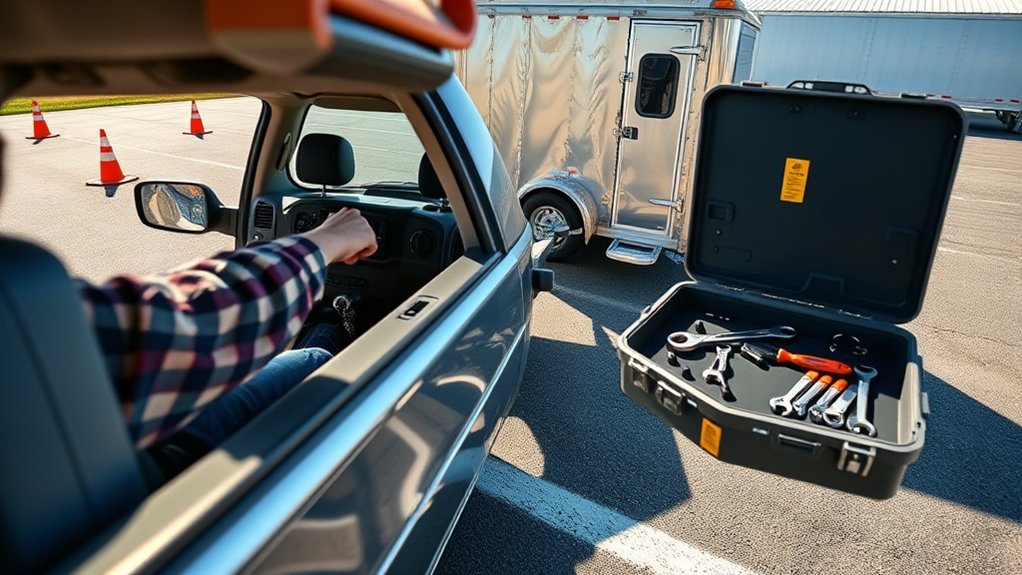
Backing up a trailer becomes much easier when you prepare the route, move at walking speed, and make small steering corrections before the trailer angle grows. The key is to control the rear of the trailer rather than react to the tow vehicle alone. Use both mirrors, stop whenever visibility is uncertain, and pull forward to reset as often as necessary.
Quick Answer
To back up a trailer, inspect the path, set up for a straight or driver-side approach, and move slowly. Hold the bottom of the steering wheel and move your hand toward the direction you want the trailer to go. Use small inputs, countersteer to follow it, and pull forward whenever the angle becomes difficult to control.
Key Takeaways
- Walk the route first and check for people, pets, posts, curbs, low branches, roof clearance, slopes, and soft ground.
- Back toward the driver’s side when practical because that side normally provides the best view.
- Hold the wheel at the bottom and move your hand toward the direction you want the trailer’s rear to travel.
- Correct drift early with small inputs; large or late corrections can quickly create a jackknife.
- A pull-forward reset is a normal safety technique, not a failed attempt.
- Stop immediately if you lose sight of your spotter or cannot confirm that the route is clear.
At a Glance
| Time Required | About 5–15 minutes for a typical maneuver; allow 30–60 minutes for a beginner practice session |
| Difficulty | Moderate for beginners; easier with a good setup and repeated practice |
| Tools Needed | Properly adjusted towing mirrors; a trained spotter, cones, and a compatible camera are helpful but optional |
| Cost | No cost with existing equipment; optional mirrors, cameras, or practice cones vary in price |
Note: Trailer designs, brake systems, cameras, hitches, and tow vehicles differ. Follow the owner’s manuals for the tow vehicle, trailer, hitch, and brake controller, and comply with applicable local towing requirements.
Step-by-Step Guide to Safe Trailer Reversing
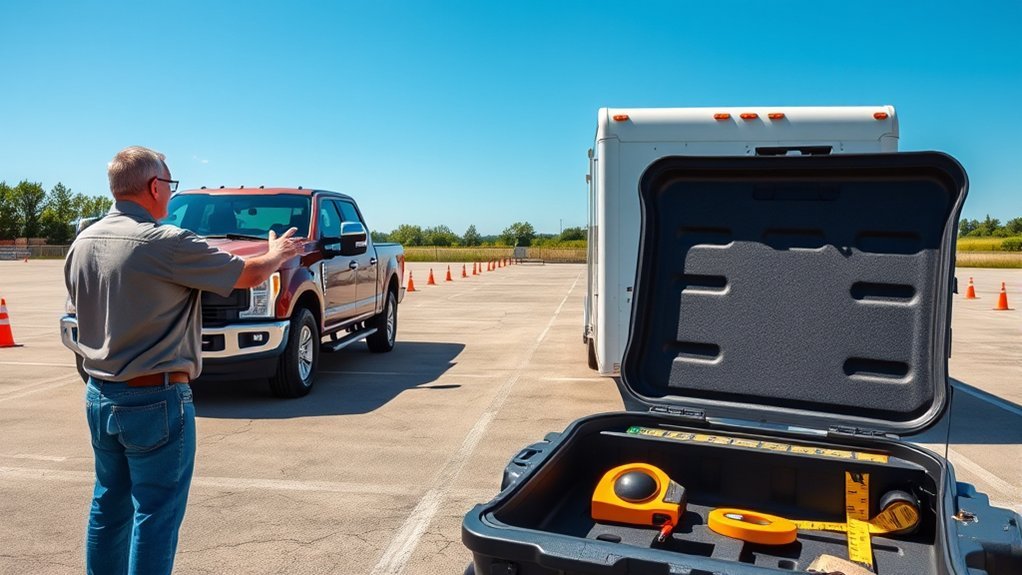
Reversing a trailer is easier when you treat it as a sequence of small decisions. Prepare the combination and the route before selecting Reverse, then stop whenever the trailer’s position becomes uncertain.
1. Inspect the Trailer and Backing Route
Confirm that the trailer is correctly connected before moving it. Check the coupler or fifth-wheel connection, hitch pin and retaining clip, safety chains, breakaway cable, electrical connector, lights, tires, cargo restraints, and any required trailer-brake system.
Next, get out and walk the complete route. Look for:
- People, children, pets, and moving vehicles
- Curbs, posts, rocks, wheel stops, fire rings, and utility hookups
- Low branches, roof overhangs, wires, signs, and other overhead hazards
- Soft shoulders, holes, mud, steep cross-slopes, and drop-offs
- Objects that will disappear below the trailer or outside the mirror view
The California Commercial Driver Handbook advises drivers to inspect the path, check side and overhead clearance, use both mirrors, back slowly, and pull forward to reposition when necessary.
Warning: Do not begin reversing while anyone is behind the trailer or standing between the trailer and a fixed object. Stop immediately when a person, animal, or vehicle enters the backing area.
2. Set Up the Approach
Whenever possible, position the tow vehicle and trailer so you can reverse in a straight line. A good setup reduces the number and size of steering corrections you will need.
If the route must curve, place the target on the driver’s side when practical. A driver-side approach lets you see more of the trailer and destination in the driver-side mirror. Passenger-side backing creates a larger blind area and normally requires more stops, walk-arounds, or assistance from a spotter.
For a campsite or perpendicular space, pull slightly past the entrance and use a shallow S-shaped setup to point the rear of the trailer toward the opening. The direction of the setup depends on which side the space is on, so examine the route before committing to the turn.
3. Adjust Mirrors and Brief the Spotter
Adjust towing mirrors so you can see along both sides of the trailer and part of the area beside its wheels. Clean camera lenses and confirm that any display is working before you move.
When using a spotter, agree on a small set of signals for stop, reverse, driver side, passenger side, straighten, distance remaining, and pull forward. Decide whether directional signals refer to the rear of the trailer or the steering wheel; referring to the trailer’s rear usually causes less confusion.
4. Use the Bottom of the Steering Wheel
Place one hand at the bottom of the steering wheel, near the 6 o’clock position. Move that hand toward the direction you want the rear of the trailer to travel:
- Move your hand left to start guiding the trailer left.
- Move your hand right to start guiding the trailer right.
This technique simplifies the otherwise counterintuitive relationship between the tow vehicle and trailer. It is also included in Ford’s published towing basics.
5. Begin Reversing Slowly
Select Reverse, release the brake gradually, and use the lowest practical speed. Avoid unnecessary throttle. Keeping the combination slow gives you time to observe the trailer, stop, and correct a small error before it becomes a large one.
Check both mirrors frequently. When one side of the trailer becomes more visible than the other, the trailer is beginning to turn toward that side. Use this change as an early cue rather than waiting until the trailer is far off line.
6. Create a Small Trailer Angle
Move the bottom of the wheel slightly toward the desired trailer direction. Hold the input only long enough to create a shallow angle between the tow vehicle and trailer. Large or prolonged steering inputs make the trailer rotate rapidly and increase the risk of a jackknife.
7. Countersteer to Follow the Trailer
Once the trailer points toward the target, begin turning the wheel the other way so the tow vehicle follows it. Drivers sometimes call this “chasing the trailer.” The goal is to prevent the hitch angle from continuing to increase while the trailer travels toward the space.
Continue alternating between very small steering inputs and countersteering. Pause when needed to study both mirrors, confirm clearance, or let the spotter move to another safe and visible position.
8. Correct Drift Early or Pull Forward
Correct a small drift as soon as you see it. If the trailer angle becomes too sharp, the tow vehicle cannot follow the trailer, or the destination disappears from view, stop. Shift to a forward gear and pull ahead until the combination is straighter, then reset the approach.
Pro Tip: Plan to use pull-ups. Experienced drivers reposition before a poor angle becomes a dangerous one; they do not force every maneuver to work in a single continuous reverse.
9. Stop, Position, and Secure the Trailer
Stop with enough clearance for doors, ramps, slide-outs, loading equipment, or campsite connections. Place the transmission in Park or the appropriate gear and apply the parking brake before anyone approaches the wheels or hitch.
Wheel chocks are for securing a parked trailer, not for use while the combination is moving. Once the driver confirms that the vehicle is secured, place chocks according to the trailer manufacturer’s instructions and the direction of any slope. Remove and store them before moving again.
Understanding Your Trailer: Dynamics and Handling
The hitch forms a pivot between the tow vehicle and trailer. When the tow vehicle’s rear moves one way, the trailer initially rotates the other way. The larger the hitch angle becomes, the faster the trailer can continue turning, which is why late corrections often turn into overcorrections.
Trailer dimensions also affect the response. A short bumper-pull trailer often reacts quickly to steering input, while a longer trailer usually changes direction more gradually. Fifth-wheel and gooseneck trailers pivot closer to the tow vehicle’s rear axle, so their reference points and timing differ from a conventional ball-hitch trailer.
Turning radius matters in tight areas. The trailer’s wheels follow a different path from the tow vehicle, and the trailer body may swing beyond its tire path. Check both the inside wheel path and the outside rear corner rather than watching only the hitch or center of the trailer.
The safest correction is usually the earliest one. A small change made while the trailer is nearly straight is easier to control than a large change made after the hitch angle has grown.
How Load Distribution Affects Handling
A properly secured and balanced load helps the trailer respond consistently. Ford’s general towing guidance recommends placing approximately 60% of allowable cargo weight in the front half of a conventional trailer and 40% in the rear, while remaining within the required tongue- or king-pin-weight limits.
This 60/40 guideline concerns cargo placement, not transferring 60% of the total trailer weight onto the hitch. Always remain within the tow vehicle’s payload, axle, hitch, tire, gross vehicle, gross combined, and trailer ratings. Use the loading and tongue-weight instructions supplied for the specific equipment.
Recognizing an Excessive Hitch Angle
A jackknife develops when the angle between the tow vehicle and trailer becomes so sharp that control is reduced or the trailer can contact the tow vehicle. Warning signs include:
- The front corner of the trailer rapidly approaching the tow vehicle
- The trailer rotating even though the desired direction has already been reached
- The tow vehicle running out of room to follow the trailer
- The destination disappearing from the useful mirror view
- Increasing tire scrub, binding, or unusual resistance
Do not wait for contact. Stop and pull forward while the combination is still recoverable.
Essential Tools for Backing Up a Trailer
You can back a trailer without specialized electronics, but suitable visibility and basic safety equipment make the process easier.
- Towing mirrors: Properly adjusted mirrors should provide a view along both trailer sides and help you judge wheel and corner clearance.
- Spotter: A trained helper can watch blind areas, overhead clearance, and the final stopping distance while remaining safely visible to the driver.
- Trailer-mounted camera: A compatible rear camera can show the area behind the trailer. A standard tow-vehicle camera may show only the hitch or the area immediately behind the tow vehicle.
- Cones or soft markers: These are useful for practice and for identifying the edges of a destination without using rigid objects that could damage the trailer.
- Wheel chocks: Carry correctly sized chocks for parking and securing the trailer after movement has stopped.
- Additional lighting: Portable area lighting can improve visibility at night, provided it does not blind the driver or spotter.
If the trailer has brakes, inspect and test the system before towing. Use the normal service brakes and any manual controller exactly as directed by the tow vehicle, controller, and trailer manufacturers. A trailer-brake control is not a general-purpose steering or straightening tool.
Common Trailer Backing Mistakes to Avoid
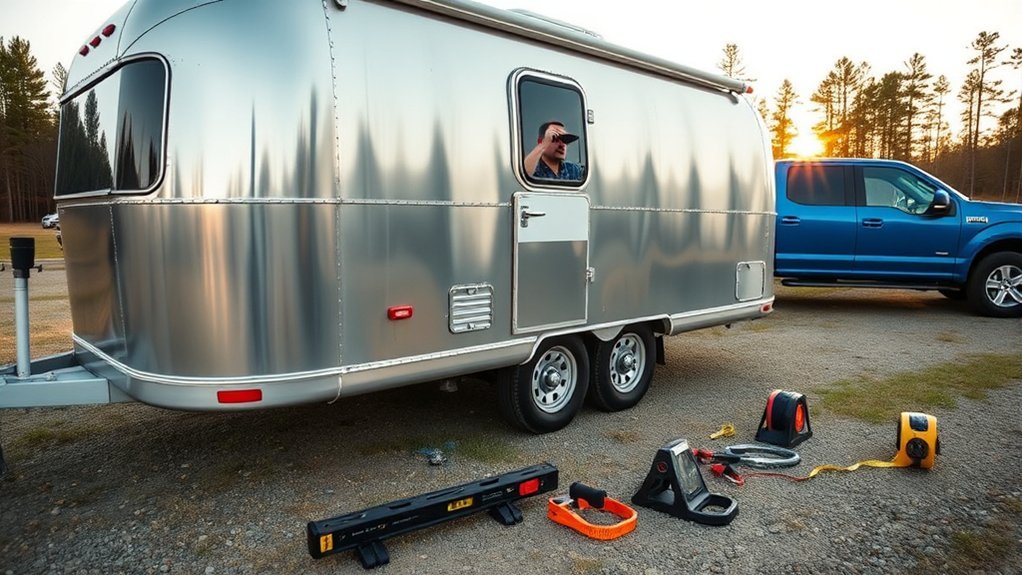
Most trailer-backing problems begin with a poor setup, excessive speed, or a correction that is larger than necessary. Recognizing those patterns early prevents damage and reduces stress.
Oversteering and Loss of Control
Large, abrupt turns create trailer angle quickly. When the driver sees the trailer moving too far and responds with another large turn, the combination begins to swing from one correction to the next.
Use a small steering input, observe the response, and countersteer before the angle becomes severe. When a correction is not working, stop and pull forward instead of adding more steering.
Neglecting Surroundings Before Reversing
Mirrors cannot show every low, high, or side obstacle. Circle the combination before reversing and use the G.O.A.L. method: Get Out And Look. Repeat the walk-around whenever the path becomes uncertain or the trailer blocks your view of a hazard.
Do not assume that an area remains clear after the first inspection. Children, pets, pedestrians, vehicles, and campground traffic can enter the route while you are moving.
Rushing the Reversing Process
Pressure from traffic, bystanders, or waiting drivers can tempt you to hurry. Stop, reset, and wait for a safe opening instead. A slow maneuver with several pull-ups is safer than a fast attempt made with incomplete visibility.
Other common mistakes include:
- Watching only one mirror for too long
- Continuing to reverse after losing sight of the spotter
- Relying solely on a camera or parking sensor
- Turning the wheel repeatedly without pausing to observe the trailer
- Backing toward the passenger side when a safer driver-side setup is available
- Refusing to pull forward because it feels like starting over
How to Use Spotters Effectively for Guidance
A spotter can improve visibility, but only when the driver and spotter follow a clear safety system. The spotter should guide the maneuver without entering the path of the tow vehicle or trailer.
Use these rules:
- Use one primary spotter: Multiple people giving directions can create conflicting commands.
- Agree on signals first: Establish clear signals for stop, reverse, driver side, passenger side, straighten, pull forward, and distance remaining.
- Maintain visual contact: The driver must be able to see the spotter in a mirror or directly.
- Stop when contact is lost: The driver should stop immediately rather than guessing where the spotter moved.
- Stay out of the travel path: The spotter must not stand directly behind the trailer, between the trailer and an obstacle, or in another pinch zone.
- Move only after the vehicle stops: When the spotter needs a new position, signal the driver to stop before changing locations.
- Keep the stop signal absolute: Either the driver or spotter may stop the maneuver at any time.
These principles align with OSHA’s backing and spotter guidance, which calls for agreed signals, continuous visual contact, and an immediate stop when the driver loses sight of the spotter.
Warning: Never assume that silence means “keep moving.” When a signal is unclear, the spotter disappears, or communication fails, stop the vehicle and resolve the problem before continuing.
Why Slow and Steady Wins When Reversing a Trailer
Low speed gives the driver time to interpret mirror changes, communicate with a spotter, and stop before a correction becomes excessive. Speed does not make the trailer respond more accurately; it only reduces the time available to manage the response.
Precision Over Speed
Make one small input and wait long enough to see its effect. Keep your foot ready to brake, scan from one mirror to the other, and pause whenever the trailer begins moving faster than you can comfortably evaluate it.
Slow movement helps you:
- Correct drift before the hitch angle grows
- Watch both the trailer wheels and outside corners
- Confirm that the spotter remains visible
- Stop before reaching a curb, wall, vehicle, or hookup
Avoiding Accidents
The following simple responses address the most common backing errors:
| Common Mistake | Safer Response |
|---|---|
| Oversteering | Stop, reduce the input, and pull forward if the angle is already large |
| Ignoring blind spots | Use both mirrors, a safe spotter, and repeated walk-arounds |
| Skipping clearance checks | Inspect the ground, sides, corners, and overhead route |
| Rushing | Wait for a clear area and move at the lowest practical speed |
| Losing the spotter | Stop immediately and re-establish visual contact |
Better Control Techniques
- Use the bottom-wheel technique to simplify the desired trailer direction.
- Make small inputs and pause to observe the response.
- Countersteer once the trailer points toward the target.
- Alternate your view between both mirrors rather than staring at one side.
- Use familiar trailer corners, wheel positions, or body seams as reference points.
- Pull forward whenever alignment or visibility becomes poor.
Mastering Tight Spots and Angles
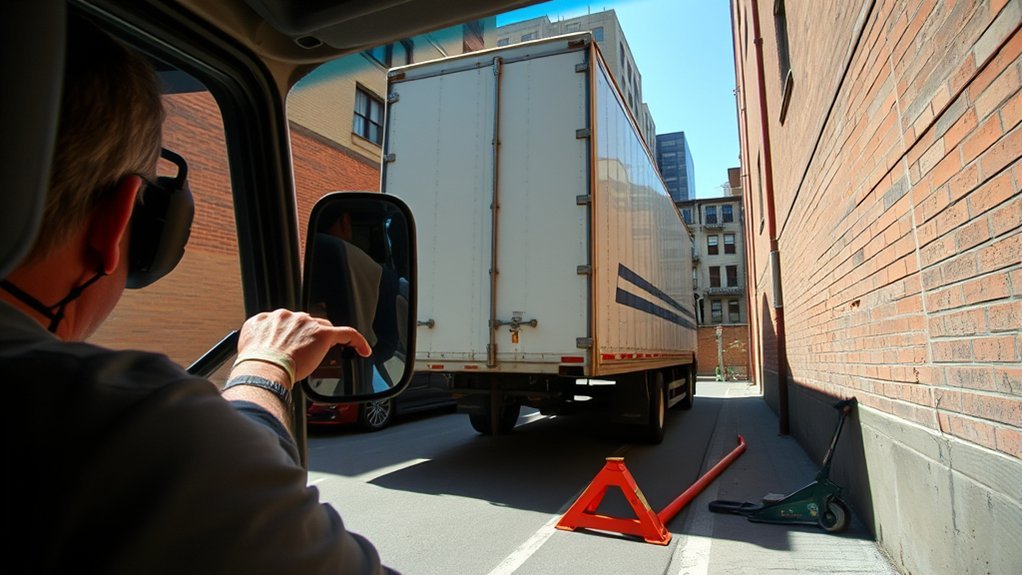
Tight spaces are usually won or lost during the setup. Give the tow vehicle enough room to swing, point the trailer toward the opening with a shallow angle, and avoid starting so close that the tow vehicle cannot follow the trailer.
Keep your hand at the bottom of the wheel and use small, incremental movements. Watch the inside trailer wheel for curbs and obstacles, but also check the outside rear corner for swing clearance. Roll down the windows when doing so improves communication and does not create another distraction.
In a tight space, create only enough trailer angle to enter the opening. Then begin following the trailer before the angle continues to increase.
An S-shaped setup can help align the trailer before the reverse begins. Pull past the destination, steer away from the space to create a shallow trailer angle, and then straighten the tow vehicle as room permits. Because the correct direction depends on the location of the space, walk the route and visualize the maneuver first.
When backing toward the passenger side cannot be avoided, stop more often. Use a properly positioned spotter and repeat the G.O.A.L. check whenever the trailer blocks the destination from view.
The Role of Technology: Backup Cameras and Mirrors
Towing mirrors, cameras, and sensors improve awareness, but each has limits:
- Tow-vehicle backup camera: Commonly shows the hitch area or the space directly behind the tow vehicle. The trailer may block most of that view after it is connected.
- Trailer-mounted camera: Can provide a view behind the trailer when it is properly installed, powered, paired, and positioned.
- Dynamic guide lines: May show the tow vehicle’s predicted path rather than the trailer’s path unless the system includes a compatible, configured trailering mode.
- Parking sensors and rear braking systems: May be blocked, disabled, or affected by an attached trailer. Consult the vehicle manual.
- Towing mirrors: Show the trailer’s sides but still leave low, rear, and cross-traffic blind areas.
NHTSA’s driver-assistance guidance explains that a backup camera can help drivers see behind a vehicle but does not replace mirrors or physically looking around the vehicle.
Note: Clean every lens before backing. Dirt, darkness, glare, rain, and a poor camera angle can hide a person or obstacle even when the display appears to be working.
Backing on Slopes, Soft Ground, and at Night
Slopes
Avoid backing on a steep grade when a flatter approach is available. Trailer weight can increase the effort needed to stop and may cause the combination to roll unexpectedly if the driver changes pedals or gears abruptly.
Keep the spotter away from the downhill travel path. Once the rig is fully positioned, apply the parking brake, select Park or the appropriate gear, and confirm that the combination is secure before anyone places wheel chocks.
Soft or Uneven Ground
Inspect mud, sand, gravel, ruts, holes, and shoulder edges before entering. Soft ground can change the trailer’s response and may allow a wheel to sink or slide. Avoid using speed or sudden throttle to force the trailer through an uncertain area.
Night and Low Visibility
Use adequate area lighting and clean mirrors and lenses. Watch for shadows that can conceal posts or people. When visibility is poor, stop more often and walk the route with a flashlight rather than relying on a dim camera image.
What to Do If the Trailer Starts to Jackknife
- Stop reversing immediately. Do not try to rescue a rapidly increasing angle with another large steering input.
- Check the area before moving forward. Confirm that people and obstacles are clear of the tow vehicle’s forward path.
- Pull forward slowly. Steer as needed to reduce the angle and bring the tow vehicle and trailer closer to alignment.
- Reset the approach. Reposition with more space or a shallower starting angle.
- Inspect after contact or binding. If the trailer touched the tow vehicle or the hitch, wiring, chains, breakaway cable, bodywork, or tires were strained, stop and inspect before continuing.
Do not use wheel spin, abrupt acceleration, or a manual trailer-brake control to force the combination straight. When the angle repeatedly becomes excessive, change the setup rather than repeating the same steering sequence.
Practice Makes Perfect: Building Your Trailer Reversing Skills
Practice on a level, open area away from traffic, pedestrians, and fixed obstacles. Use soft cones or markers to create a route and work through one skill at a time.
- Straight-line reverse: Back along a painted line while keeping an equal amount of trailer visible in both mirrors.
- Small corrections: Let the trailer drift slightly, correct it, and return to a straight line.
- Gentle offset: Move the trailer from one marked lane to another using a shallow angle.
- Driver-side turn: Practice backing into a wide space located on the driver’s side.
- Pull-forward reset: Intentionally stop, pull ahead, and improve the approach.
- Spotter practice: Rehearse the same hand signals until both people respond consistently.
Use the same tow vehicle and trailer whenever possible while learning because mirror views, hitch position, steering ratio, and trailer length affect your reference points. Increase the difficulty only after you can stop, reset, and maintain control during the simpler exercises.
Frequently Asked Questions
What is a simple trick for backing up a trailer?
Hold the steering wheel at the bottom and move your hand toward the direction you want the rear of the trailer to travel. Use only a small movement. Once the trailer points toward the destination, countersteer so the tow vehicle follows it.
What is the 60/40 rule for trailers?
The common 60/40 guideline means placing approximately 60% of the allowable cargo weight in the front half of a conventional trailer and 40% in the rear. It does not mean putting 60% of the total trailer weight on the hitch. The final load must remain within all tongue-weight, axle, tire, hitch, trailer, and tow-vehicle ratings.
What should you not do when backing up a trailer?
Do not rush, make large repeated steering inputs, continue after losing sight of a spotter, rely only on a camera, leave wheel chocks in place while moving, or force a developing jackknife. Stop and pull forward whenever the route or trailer angle becomes uncertain.
What is the hardest part of backing up a trailer?
The hardest part is judging when to stop the initial steering input and begin following the trailer. Beginners often continue turning after the trailer already points toward the destination, causing the hitch angle to grow too quickly.
Which way do you turn the steering wheel when reversing a trailer?
With your hand at the bottom of the wheel, move that hand toward the desired trailer direction. Move it left for the trailer’s rear to begin moving left and right for the trailer’s rear to begin moving right. Then turn the wheel back the other way to follow and straighten the trailer.
How do you recover when a trailer starts to jackknife?
Stop reversing before the angle becomes severe. Check the forward path, shift to a forward gear, and pull ahead slowly until the combination straightens. Reposition and begin again with a better setup and smaller steering inputs.
Is a backup camera enough for reversing a trailer?
No. A tow-vehicle camera may show only the hitch area, and even a trailer-mounted camera can miss side, low, or overhead hazards. Use both mirrors, inspect the route, get out and look when uncertain, and use a safely positioned spotter when needed.
Where should a trailer-backing spotter stand?
The spotter should stand where the driver can see them while remaining outside the tow vehicle’s and trailer’s travel paths. The spotter should never stand directly behind the trailer, between the trailer and a fixed object, or in another pinch zone. If visual contact is lost, the driver must stop.
Conclusion
Backing up a trailer takes patience, but the process becomes manageable when you prepare the route and control the trailer with small, early corrections. Use both mirrors, move slowly, communicate clearly with a spotter, and get out to look whenever visibility is incomplete. A weekend camper or first-time utility-trailer driver who practices straight backing, gentle turns, and pull-forward resets in an open area will be better prepared for tight campsites and driveways. The goal is not a perfect one-pass maneuver; it is a controlled, safe result.
Sources
- California DMV — Combination Vehicles — backing direction, path inspection, mirror use, slow movement, drift correction, and pull-ups
- Occupational Safety and Health Administration — Backing Safety Solutions — spotter signals, visual contact, positioning, and stop procedures
- National Highway Traffic Safety Administration — Driver Assistance Technologies — backup-camera functions and limitations
- Ford — 2024 Towing Guide — cargo distribution, practice, bottom-wheel steering, small inputs, and general towing basics







Leave a Reply