
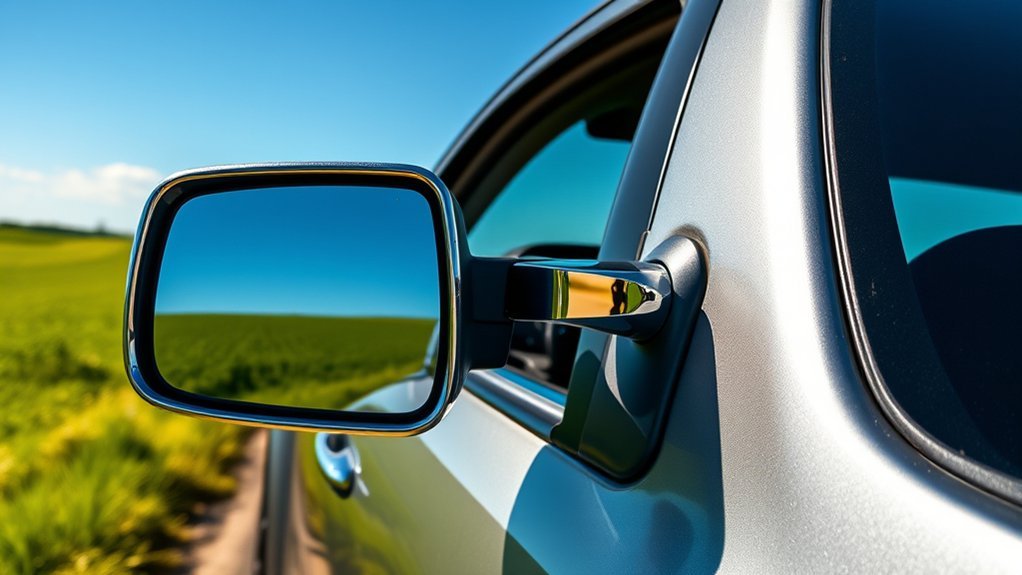
Towing mirrors extend your view past a wide trailer or load so you can better monitor nearby traffic, the trailer’s position, and the road behind you. The right mirrors must fit your vehicle securely, extend far enough for useful sightlines, and retain any factory features you need. They reduce blind spots, but they do not remove every blind area or replace a direct traffic check.
Quick Answer
Use towing mirrors when your trailer or load blocks the view from the factory mirrors or when applicable law requires additional rear visibility. Choose a stable, vehicle-compatible design that lets you see along both trailer sides. Adjust the mirrors after hitching, verify the view before every trip, and continue checking blind spots directly.
Key Takeaways
- Towing mirrors reduce blind areas but cannot show every vehicle, cyclist, pedestrian, or obstacle.
- Select mirrors by exact vehicle fitment, trailer width, extension range, stability, and factory-feature compatibility.
- Power-adjustable glass does not always mean the mirror also power-folds or telescopes electrically.
- Set the mirrors with the trailer hitched and straight, then confirm the view from your normal driving position.
- Mirror laws vary by state, so verify current requirements through official state sources before traveling.
At a Glance
| Time Required | About 10–20 minutes to fit and adjust add-on mirrors; approximately 45–120 minutes for many complete replacement assemblies |
| Difficulty | Easy for clip-on, strap-on, or slide-on mirrors; moderate or advanced for wired replacement mirrors |
| Tools Needed | Cleaning cloth and supplied hardware for add-on mirrors; trim tool, screwdrivers, sockets, and a torque wrench for many replacements |
| Cost | Add-on mirrors are generally the lower-cost choice. Complete heated, powered, camera-equipped, or blind-spot-compatible assemblies cost more and may need professional installation. |
Warning: Do not rely only on mirrors, a rear camera, a trailer camera, or a blind-spot warning system. These aids can still leave unseen areas. Check traffic directly before changing lanes, merging, turning, or backing, and use a spotter when visibility is limited.
What Are Towing Mirrors and Why Are They Important?

Towing mirrors are larger, wider, or extendable exterior mirrors designed to improve the driver’s view around a trailer or wide load. You may need them when the trailer blocks the useful view from the factory mirrors, when you cannot see along both sides of the trailer, or when state law requires a certain mirror arrangement or rearward view.
The goal is not to see only the side of your truck. A useful setup should show a narrow reference portion of the tow vehicle or trailer while also showing the adjacent lane and the roadway behind it. This helps you judge where the trailer is tracking during turns, lane changes, and tight maneuvers.
NHTSA’s mirror guidance explains that outside mirrors can be positioned to maximize visibility, but blind spots can still remain. Towing mirrors therefore supplement careful observation rather than replacing it.
A properly adjusted towing mirror should help you see along the trailer, into the nearby traffic lane, and toward the road behind you without creating the false impression that every blind spot is covered.
How Towing Mirrors Enhance Safety While Towing
A trailer can block the center rearview mirror and extend beyond the field of view provided by standard side mirrors. Towing mirrors move the useful viewing area outward so you can gather more information before making a maneuver.
Properly selected and adjusted mirrors can help you:
- See approaching traffic before merging or changing lanes.
- Watch the trailer’s position as it follows through a turn.
- Notice unusual trailer movement, a loose cover, or an obvious tire problem.
- Monitor clearance near curbs, barriers, fuel pumps, and campsites.
- See more of the area beside the trailer while backing with a spotter.
- Meet applicable mirror and rear-visibility requirements.
Mirrors cannot tell you everything about trailer sway, tire condition, or traffic location. A convex spot mirror provides a wider field of view, for example, but it also makes vehicles appear smaller and farther away. Use the flat main glass to judge distance and the convex section mainly to check a wider area.
Pro Tip: Ask a helper to walk from behind the trailer toward each side while you remain in the normal driving position. Track the helper through the mirrors and direct view. This reveals gaps between the flat glass, convex glass, and what you can see by turning your head.
Different Types of Towing Mirrors
Towing mirrors fall into several groups. The best choice depends on how often you tow, how wide the trailer is, how much vibration you can tolerate, and whether you need factory electrical features.
Clip-On and Strap-On Towing Mirrors
Universal clip-on or strap-on mirrors attach to the existing mirror housing. They are usually affordable and can be removed when the trailer is not connected.
- Best for: Occasional towing or use with more than one compatible vehicle.
- Advantages: Low commitment, quick installation, and no door-panel removal.
- Limitations: Fit varies, straps may loosen, and poorly supported designs may vibrate at highway speed.
The attachment must not crack the factory housing, cover the original glass, interfere with folding, or block a built-in turn signal or camera.
Custom Slide-On Mirrors
Custom slide-on mirrors fit over the original mirror housing and are shaped for a specific vehicle or mirror design. They often look cleaner and vibrate less than loosely fitted universal mirrors.
- Best for: Drivers who tow regularly but do not want to replace the factory assemblies.
- Advantages: Vehicle-specific fit, simple removal, and good stability when correctly installed.
- Limitations: They fit only listed mirror shapes and may not work after a factory mirror change.
Replacement Telescoping Mirrors
Replacement towing mirrors take the place of the original exterior mirrors. The housings or mirror heads slide outward for towing and retract for normal driving. These are often the most stable option for frequent towing.
- Best for: Frequent towing, wide travel trailers, equipment trailers, and long-term ownership.
- Advantages: Strong mounting, wide extension range, larger glass, and possible factory-style electrical features.
- Limitations: Higher cost, more involved installation, exact fitment requirements, and possible programming or calibration.
Camera-Integrated Mirror Systems
Some current vehicles use mirror-mounted cameras, trailer cameras, or a digital rearview display. These systems can add useful views, but they do not automatically make an incompatible replacement mirror safe to install. A camera may require the correct bracket, wiring, software, aiming procedure, or calibration.
Note: A product described as a “power towing mirror” may have power-adjustable glass but manual telescoping or manual folding. Confirm each feature separately before ordering.
Should You Choose Manual or Power Towing Mirrors?
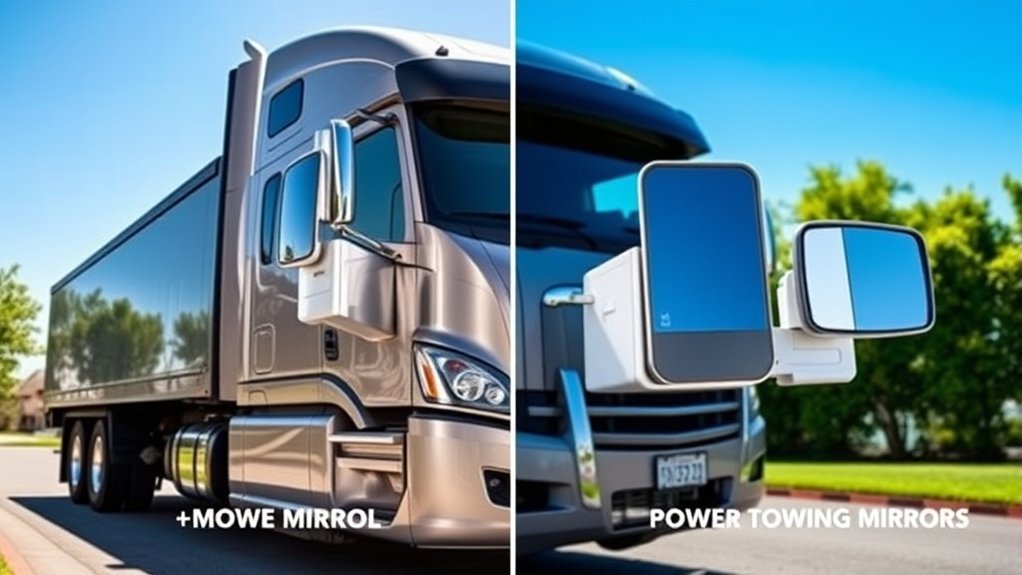
Manual towing mirrors are usually simpler and less expensive. You adjust the glass, extend the housing, or fold the mirror by hand. They are a practical choice when several drivers do not share the vehicle and the mirrors need little adjustment after setup.
Power mirrors let you adjust the mirror glass from inside the cab. Depending on the vehicle and assembly, they may also offer power folding, power telescoping, memory positions, heating, turn signals, puddle lamps, blind-spot indicators, or cameras.
Do not assume all of those functions are included. An official Ford towing-mirror example combines power-adjustable and heated glass with manual telescoping. Ford also notes that supported functions depend on the equipment originally installed on the vehicle.
Choose manual mirrors when:
- You tow only a few times per year.
- You want the lowest-complexity setup.
- You do not need memory, heating, cameras, or blind-spot indicators.
- You are comfortable adjusting both mirrors by hand.
Choose powered replacement mirrors when:
- You tow often or share the vehicle with another driver.
- You need to adjust the glass while seated.
- You want to retain compatible heating, lighting, memory, or warning features.
- You have confirmed the part number, connector, option codes, and required programming.
What Are Adjustable and Telescopic Towing Mirrors?
An adjustable towing mirror lets you change the angle of the glass. A telescopic mirror also lets you move the housing or mirror head farther outward. The extension helps the driver see past a wider trailer instead of seeing mostly the trailer’s front wall.
Extend each mirror only as far as needed to create a useful view. Excess extension adds vehicle width and can make the mirror easier to strike on a narrow road, at a toll booth, in a parking structure, or beside another vehicle.
Many towing mirrors combine two glass sections:
- Flat main glass: Provides a less distorted image and is better for judging distance.
- Convex spot glass: Shows a wider area but makes traffic appear smaller and farther away.
The California DMV’s mirror guidance warns drivers about this distance distortion in convex mirrors. Do not use a convex section alone to decide whether there is enough room to move into another lane.
Other available features include heated glass, integrated turn signals, approach lights, power fold, memory, blind-spot indicators, and cameras. Each feature must match the vehicle’s wiring and software. A mirror that physically bolts to the door is not necessarily electrically compatible.
How to Use and Adjust Towing Mirrors for Safe Towing
Adjust the mirrors after the trailer is fully hitched, loaded for travel, and positioned straight behind the tow vehicle. Trailer angle changes the sightline, so a useful adjustment cannot be confirmed while the trailer is sharply turned.
Proper Mirror Setup
- Park in a safe, level area. Straighten the tow vehicle and trailer and set the parking brake.
- Use your normal seating position. Set the seat, steering wheel, and head restraint before touching the mirrors.
- Extend both towing mirrors evenly. Move them outward until the trailer no longer fills most of the useful glass.
- Set the flat driver-side glass. Keep only a narrow portion of the vehicle or trailer visible as a reference. Use the rest of the glass to show the lane beside and behind the trailer.
- Set the flat passenger-side glass. Aim for a similar view along the passenger side, allowing for the greater distance from your eyes.
- Set the convex sections. Aim them toward the trailer wheels, lower side area, and adjacent lane without duplicating the entire flat-mirror view.
- Check the full transition. Have a helper move through the rear and side areas so you can identify where the person disappears from one view and appears in another.
- Make a final road check. At low speed in a safe area, confirm that vehicles move predictably from the rearward view into the side mirrors and then into direct view.
Some states specify a minimum rearward viewing distance. Where such a rule applies, set and select the mirrors so the combination meets that requirement. Do not assume the same distance applies in every state.
Effective Adjustment Techniques
Too much tow vehicle or trailer in the mirror wastes viewing area. Too little reference can make it harder to judge where the trailer sits. A narrow strip of the trailer’s side is usually enough to provide orientation while leaving most of the glass available for traffic.
Readjust the mirrors when:
- A different driver changes the seat position.
- You connect a different trailer.
- The trailer width or load shape changes.
- An add-on mirror slips or is removed and reinstalled.
- The vehicle is heavily loaded and its ride height changes.
- You notice vibration, glare, or a new blind area.
At night, avoid aiming the mirrors so that headlights are reflected directly into your eyes. Heated glass can clear light frost or condensation when the vehicle supports that function, but it does not replace scraping heavy ice or snow from the housing and glass.
Safety Maintenance Practices
Before each towing trip:
- Clean the flat and convex glass.
- Confirm that add-on straps, clips, screws, and pads are secure.
- Check the housings for cracks or excessive movement.
- Verify that both mirrors remain in position after closing the doors.
- Test power adjustment, heating, turn signals, cameras, and blind-spot indicators when equipped.
- Make sure the mirrors do not obstruct another required lamp or camera.
Recheck add-on mirrors after the first few miles of a trip. Temperature, vibration, and wind load can allow a loose strap or clamp to shift even when it seemed secure while parked.
How to Install and Replace Towing Mirrors
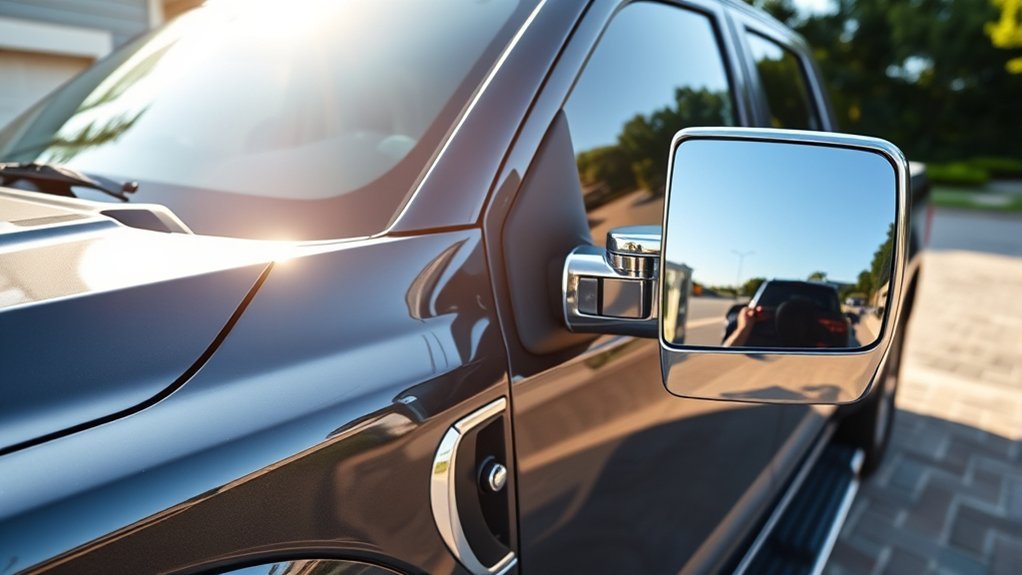
Add-on towing mirrors and complete replacement assemblies require different procedures. Clip-on, strap-on, or custom slide-on mirrors can often be fitted without tools. Complete replacement mirrors may require interior trim removal, electrical disconnection, precise fastener torque, and feature testing.
Warning: Follow the service procedure for the exact year, make, model, trim, and mirror option. Do not guess fastener torque or probe unfamiliar wiring. Door-mounted cameras, blind-spot indicators, memory systems, and other electronics may require programming or calibration after replacement.
Tools Needed for Installation
Temporary add-on mirrors may require only the supplied clips, knobs, straps, or retaining hardware. Clean the contact surfaces before fitting them so trapped dirt does not scratch the factory housing.
A complete replacement commonly requires:
- Model-specific repair or installation instructions
- Plastic trim-removal tools
- Phillips and flat screwdrivers as specified
- Metric or SAE sockets that match the vehicle
- A ratchet and suitable extensions
- A torque wrench with the required range
- Painter’s tape or a protective cloth for painted surfaces
- Work gloves and eye protection
Some vehicles allow access through a small triangular trim panel. Others require partial or complete door-panel removal. Confirm the correct procedure before prying on any trim.
Step-by-Step Installation Process
Installing Clip-On, Strap-On, or Slide-On Mirrors
- Confirm that the product lists your original mirror shape or vehicle as compatible.
- Clean and dry the factory mirror housing and all protective pads.
- Position the add-on mirror without covering the original glass, lamp, sensor, or camera.
- Attach each clip, strap, screw, or hand knob in the order provided by the manufacturer.
- Tighten the hardware evenly by hand. Do not crush or distort the factory housing.
- Fold and unfold the original mirror carefully to check for interference.
- Adjust the added glass from the normal driving position.
- Shake the assembly gently and correct any looseness before driving.
Installing Complete Replacement Towing Mirrors
- Verify the replacement part number, connector, mounting pattern, glass type, and every electrical feature.
- Park on a level surface, turn the vehicle off, and follow the service instructions for electrical isolation.
- Protect the door paint and remove the required trim panel or interior door panel.
- Support the original mirror while disconnecting its electrical connector and removing the mounting fasteners.
- Lift the original mirror away without pulling the wiring against the door opening.
- Route the new harness correctly and seat the new mirror against its gasket or sealing surface.
- Install and tighten the fasteners to the manufacturer’s specified torque and sequence.
- Reconnect the harness and reinstall all trim clips, vapor barriers, and panels correctly.
- Test adjustment, heat, folding, memory, lights, cameras, and warning indicators.
- Complete any required programming, aiming, or calibration before depending on the affected feature.
Troubleshooting Common Towing Mirror Problems
The add-on mirror vibrates: Confirm that all pads contact the housing, shorten loose straps, retighten hand knobs evenly, and verify exact fitment. Replace cracked straps or worn pads rather than adding makeshift hardware.
The mirror slips inward: Inspect the telescoping detent, clamp, or locking screw. Do not continue driving if the assembly cannot hold its position.
Power adjustment does not work: Recheck the connector and part compatibility. A matching plug shape does not prove that the pin arrangement, module, or software is correct.
Heat, turn signals, memory, or blind-spot indicators are missing: Confirm that the replacement supports the factory option and that the original vehicle was equipped and wired for it.
A camera image is crooked or a driver-assistance warning appears: Stop relying on the affected function and obtain the manufacturer-required aiming or calibration service.
Wind noise develops: Check the mounting gasket, trim seating, mirror extension, and door-panel clips. A gap at the mounting surface may also allow water into the door.
Essential Features to Consider When Choosing Towing Mirrors
Start with exact fitment rather than price or appearance. A mirror should mount securely, provide enough outward extension, and support the functions your vehicle needs.
- Vehicle compatibility: Match the year, make, model, trim, factory mirror shape, connector, and option package.
- Extension range: The mirror should move far enough outward to create a view along both trailer sides.
- Stable mounting: Choose rigid brackets, close-fitting housings, and replaceable protective pads.
- Flat and convex glass: A two-section design can combine distance judgment with a wider side view.
- Adjustment method: Confirm whether the glass, fold, and telescope functions are manual or powered.
- Heating: Useful in frost and condensation when the vehicle and mirror support the circuit.
- Integrated lighting: Turn signals and approach lights must be compatible with the vehicle’s wiring.
- Blind-spot indicator: The correct icon or lamp does not guarantee the replacement communicates with the vehicle’s system.
- Camera compatibility: Verify mounting, connector, image orientation, programming, and calibration requirements.
- Memory and auto-fold: Confirm these functions separately because they may use different motors or modules.
- Weather sealing: Check the mounting gasket and connector seals on replacement assemblies.
- Retracted width: Make sure the mirrors can be safely retracted for parking, garages, car washes, or narrow roads.
Ignore unsupported sizing shortcuts such as selecting a mirror by “diameter” for every few feet of vehicle length. What matters is the actual view from the driver’s seat with the specific vehicle, trailer, load, and seating position.
State-Specific Legal Requirements for Towing Mirrors
There is no single sentence that describes every U.S. state’s towing-mirror law. Some statutes specify the number or location of mirrors. Others require an unobstructed view for a stated distance. A law may require adequate mirrors without using the product term “towing mirror.”
Federal Motor Vehicle Safety Standard No. 111 contains rear-visibility and mirror requirements for different classes of newly manufactured vehicles. It does not replace the state operating laws that apply when an owner tows on public roads. The current text is available in 49 CFR §571.111.
Examples of state differences include:
- California: California DMV guidance states that registered motor vehicles must have at least two mirrors, including one on the left, with a clear rearward view for at least 200 feet. It also states that left- and right-side exterior mirrors are required when a trailer or load blocks the view to the rear. See the California Commercial Driver’s Handbook.
- Utah: Utah Code §41-6a-1627 requires a left-side mirror and, except for motorcycles, an interior-center or exterior right-side mirror. The mirrors must provide a view of the highway to the rear. That cited section does not state a 200-foot distance.
Before an interstate towing trip:
- List every state through which you will travel.
- Open each state legislature, motor-vehicle agency, highway patrol, or DMV website.
- Search for current mirror, rearview, trailer, and obstructed-view requirements.
- Check whether the rule changes when the load blocks the interior mirror.
- Use mirrors that meet the strictest applicable requirement on your route.
Note: This article provides general safety information, not legal advice. Statutes and agency guidance can change. Verify the current official rule for your vehicle, trailer, load, and travel route.
Maintenance Tips for Keeping Towing Mirrors in Good Condition
Inspect towing mirrors before every towing trip. A mirror that has shifted, cracked, lost electrical functions, or developed excessive vibration may no longer provide the view you expect.
- Clean the glass: Use an automotive glass cleaner and a clean microfiber cloth. Avoid abrasive pads.
- Clean mounting surfaces: Remove dirt beneath slide-on shells, clips, and protective pads to reduce scratching.
- Inspect straps and clips: Replace hardened, cracked, stretched, or missing pieces.
- Check telescoping movement: Extend and retract both sides and confirm that they lock or hold position.
- Check folding movement: Do not force a powered folding mirror by hand unless the owner’s manual permits it.
- Inspect electrical functions: Test adjustment, heating, lamps, memory, cameras, and blind-spot indicators.
- Check the mounting base: Look for movement, damaged seals, corrosion, loose fasteners, or water entry.
- Remove snow and ice: Clear the housing before extending, retracting, or folding the mirror.
- Prepare for automatic car washes: Retract, fold, or remove add-on mirrors as directed by the mirror and vehicle manufacturers.
- Store removable mirrors carefully: Keep the glass protected and retain all pads, knobs, straps, and vehicle-specific adapters together.
After any mirror strike, inspect more than the glass. The folding joint, mounting base, wiring, camera aim, and door sheet metal can also be damaged.
Frequently Asked Questions
How do you properly set towing mirrors?
Hitch and straighten the trailer, sit in your normal driving position, and extend the mirrors only as far as needed. Aim each flat mirror so a narrow part of the vehicle or trailer remains visible while most of the glass shows the adjacent lane and road behind. Aim convex sections toward the lower trailer side and nearby lane, then verify the blind areas with a helper.
How can I tell if a mirror is a two-way mirror?
This question is unrelated to automotive towing mirrors. The common finger-touch or fingernail test is not reliable because it mainly indicates where a reflective coating is located. So-called one-way mirrors are partially reflective glass, and whether a person can see through them depends heavily on the lighting difference between the two sides. Do not use the finger test as proof of privacy or surveillance.
Do you legally have to use towing mirrors?
It depends on the state, your mirror arrangement, and whether the trailer or load blocks the required rearward view. Some laws require mirrors on both sides when the center view is blocked, while others specify a viewing distance. Check current official requirements for every state on your route.
How should a regular car mirror be positioned?
Set the seat first. Adjust each outside mirror slightly outward so only a small amount of the vehicle is visible and more of the adjacent roadway appears. Even with improved adjustment, look directly toward the blind area before changing lanes. When towing, readjust after the trailer is connected and straight.
Do trailer cameras replace towing mirrors?
No. Cameras can improve the view behind or beside a trailer, but lenses can be dirty, blocked, delayed, distorted, or disabled. Cameras also may not satisfy mirror requirements. Use them as supplements to correctly fitted mirrors and direct observation.
Should towing mirrors stay extended when you are not towing?
Usually not. Retracting or removing them reduces vehicle width and the chance of striking another vehicle, pedestrian, garage opening, or roadside object. Follow the vehicle and mirror manufacturer’s instructions, and keep any legally required mirror view available.
Conclusion
Towing mirrors can make trailer travel safer and less stressful when the factory mirrors do not provide a useful view around the load. Choose a stable design that fits the exact vehicle, extends far enough to show both trailer sides, and supports any factory functions you need. Adjust the mirrors only after hitching the trailer, inspect them before every trip, and remember that mirrors and cameras still leave limits. Correct equipment, direct traffic checks, and compliance with current state law must work together.
Sources
- National Highway Traffic Safety Administration — Minimize Blind Spots Using Outside Mirrors — Mirror positioning, remaining blind spots, and direct checks before lane changes
- Electronic Code of Federal Regulations — 49 CFR §571.111 — Federal rear-visibility and mirror standards for vehicle classes
- California Department of Motor Vehicles — Driving Safely — California mirror requirements, trailer-straight adjustment, and convex-mirror limitations
- Utah Legislature — Utah Code §41-6a-1627 — Utah mirror-location and rear-view requirements
- Ford — Power-Adjustable Manual-Telescoping Trailer Tow Mirrors — Example of separate power-adjustment, heating, lighting, and manual-telescoping features
- University of Illinois Physics Van — One-Way Mirrors — Partially reflective glass and the role of lighting







Leave a Reply