
Knowing your vehicle’s towing capacity means more than finding one advertised number. A safe setup must stay within the limits for the tow vehicle, trailer, hitch, axles, tires, and payload after passengers, cargo, and tongue or king-pin weight are included. The best way to confirm the setup is to use vehicle-specific manufacturer data and weigh the fully loaded combination.
Quick Answer
Your safe towing limit is not one number produced by a single formula. Use the maximum loaded trailer weight for your exact vehicle configuration, then confirm that actual loaded weights stay below GCWR, GVWR, front and rear GAWR, payload, hitch, tire, and trailer limits. The lowest remaining limit controls.
Key Takeaways
- Start with the manufacturer’s tow rating for your exact model year, engine or motor, drivetrain, axle ratio, wheelbase, cab, trim, and factory towing equipment.
- Do not treat GCWR minus curb weight as a complete towing-capacity calculation; passengers, cargo, accessories, and hitch load change the result.
- Tongue or king-pin weight counts against the tow vehicle’s payload and rear-axle limits.
- A weight-distribution hitch, brake controller, larger radiator, or stronger suspension may improve control or durability, but ordinary aftermarket upgrades do not automatically raise the manufacturer’s certified ratings.
- Use a public scale with the vehicle and trailer loaded as they will travel. The lowest applicable rating is the limit that matters.
At a Glance
| Time Required | 15–30 minutes for document checks; about 30–60 minutes more for scale verification |
| Difficulty | Moderate |
| Tools Needed | Owner’s manual, model-year towing guide, door labels, calculator, tire gauge, and access to a public vehicle scale |
| Cost | Document checks are free; public-scale fees vary by location |
Understanding Towing Capacity: Definitions and Key Terms
Towing terminology can be confusing because some terms are ratings set by a manufacturer, while others describe the actual weight measured on a scale. Mixing them up can produce an unsafe answer.
| Term | What It Means |
| GVWR | Gross Vehicle Weight Rating: the maximum allowable loaded weight of the tow vehicle, including occupants, cargo, accessories, and trailer tongue or king-pin load. |
| GVW | Gross Vehicle Weight: the tow vehicle’s actual loaded weight at a given moment. |
| GAWR | Gross Axle Weight Rating: the maximum allowable load on a specific axle. Check both front and rear limits. |
| GCWR | Gross Combined Weight Rating: the maximum allowable combined weight of the loaded tow vehicle and loaded trailer. |
| GCW | Gross Combined Weight: the actual loaded weight of the tow vehicle and trailer together. |
| Curb weight | The vehicle’s weight with required fluids and standard equipment, but generally without occupants or cargo. Manufacturer definitions can differ slightly, so use the definition in the vehicle’s documentation. |
| Payload | The allowable combined weight of occupants and cargo. Hitch hardware, aftermarket accessories, and trailer tongue or king-pin load can consume payload. |
| Maximum loaded trailer weight | The manufacturer’s vehicle-specific trailer-weight limit when the vehicle is properly equipped and all stated assumptions and restrictions are met. |
| Tongue or king-pin weight | The downward load the trailer places on the hitch. Conventional, fifth-wheel, and gooseneck trailers may use different target percentages specified by the manufacturer. |
The 2026 Ford RV & Trailer Towing Guide, for example, clearly separates ratings from actual scale weights and explains that tongue or king-pin load is part of the tow vehicle’s cargo load. Other brands use similar concepts, but their limits and assumptions must be checked in their own manuals and towing guides.
How to Determine Your Vehicle’s Safe Towing Limit
A subtraction formula can help identify one constraint, but it cannot replace the manufacturer’s vehicle-specific tow rating. Follow this process before selecting or loading a trailer.
1. Identify the Exact Vehicle Configuration
Use the VIN, owner’s manual, model-year towing guide, build sheet, or manufacturer towing calculator to confirm the engine or motor, transmission, drivetrain, axle ratio, wheelbase, cab and bed configuration, trim, suspension package, wheels and tires, and factory tow equipment. Two vehicles that look identical may have different ratings.
Modern manufacturer tow ratings may be developed using SAE J2807, a recommended practice that establishes performance criteria and a calculation method for tow-vehicle GCWR and trailer weight rating. Do not assume every vehicle, market, or model year uses the same test basis.
2. Find Each Rating in the Correct Place
- Owner’s manual or towing guide: GCWR, maximum loaded trailer weight, required tow package, hitch type, frontal-area restrictions, tongue or king-pin guidance, and trailer-brake instructions.
- Safety certification label: GVWR and front/rear GAWR, usually on the driver-side door or pillar.
- Tire and Loading Information label: the vehicle-specific statement showing the maximum combined weight of occupants and cargo.
- Hitch, receiver, ball mount, and coupler labels: maximum trailer and tongue-weight ratings for each component.
- Trailer certification label: trailer GVWR and axle ratings.
Note: The driver-door area normally provides GVWR, GAWR, tire, and loading information. It does not universally list GCWR, curb weight, or the exact maximum trailer weight. Those values usually come from the owner’s manual, towing guide, build data, or a manufacturer tool.
3. Calculate Remaining Payload
Start with the occupant-and-cargo limit on the Tire and Loading Information label:
Remaining payload = labeled occupant-and-cargo capacity − people − cargo − added accessories − applicable hitch hardware
The trailer’s tongue or king-pin weight must fit inside the remaining payload. It also must not push the loaded vehicle above GVWR or the rear axle above GAWR. The NHTSA FMVSS No. 110 test procedure reproduces the required load-limit steps and notes that trailer load transferred to the vehicle reduces available cargo capacity.
4. Calculate the GCWR Margin
Weigh the tow vehicle as it will travel, including the driver, passengers, cargo, fuel, accessories, hitch equipment, and any items carried in the cab or bed. Then use:
GCWR-based trailer margin = GCWR − actual loaded tow-vehicle weight
This number is only one ceiling. It does not override the manufacturer’s maximum loaded trailer weight, payload, GAWR, hitch limits, tire limits, trailer GVWR, or any required equipment and operating restrictions.
5. Use the Lowest Applicable Limit
Your permitted loaded trailer weight cannot exceed the lowest of these applicable limits:
- the vehicle-specific maximum loaded trailer weight;
- the remaining GCWR margin;
- the trailer’s own GVWR and axle ratings;
- the receiver, ball mount, hitch ball, coupler, and weight-distribution-system ratings;
- the limit created by remaining payload, rear GAWR, and actual tongue or king-pin weight;
- the load capacity of the installed tires and wheels; and
- any manufacturer restriction for trailer type, frontal area, speed, brakes, or required equipment.
Warning: Never use a calculated result to exceed a rating printed in the owner’s manual, towing guide, certification label, tire label, hitch label, or trailer label. Do not tow when any required braking, lighting, breakaway, coupling, or safety-chain equipment is missing or inoperative.
6. Verify the Loaded Combination on a Scale
Load the vehicle and trailer for the trip, including water, propane, batteries, tools, food, luggage, passengers, pets, and hitch equipment. At a public scale, obtain enough readings to confirm:
- the tow vehicle’s total loaded weight;
- front-axle and rear-axle loads;
- the trailer’s axle load;
- the combined vehicle-and-trailer weight; and
- tongue or king-pin weight, using a suitable scale method or dedicated tongue-weight scale.
Compare every measured value with its rating. Reweigh after major cargo, hitch, suspension, wheel, or trailer changes.
Worked Example
Assume a properly equipped vehicle has a 7,000-pound maximum loaded trailer rating and a 13,500-pound GCWR. The fully loaded tow vehicle weighs 5,800 pounds, leaving a 7,700-pound GCWR margin. Its receiver is rated for a 7,500-pound trailer and 750 pounds of tongue weight, and the trailer GVWR is 6,800 pounds.
The preliminary trailer ceiling is 6,800 pounds because the trailer GVWR is the lowest of the four trailer-weight limits. That is not the final answer. The actual tongue weight must still fit within the 750-pound hitch limit, remaining payload, rear GAWR, and GVWR. If a scale shows 720 pounds of tongue weight and every axle and tire remains within its rating, the combination passes those checks. If tongue weight is 820 pounds, cargo must be redistributed or reduced within the trailer maker’s guidance, vehicle cargo must be removed, or a lighter trailer/load is needed.
Why GVWR, GAWR, and GCWR All Matter
No single rating protects every part of the towing system. Staying below GCWR does not prove that the rear axle, payload, hitch, or tires are within limits, and staying below GVWR does not prove that the trailer or combination is acceptable.
Understanding GVWR and Payload
GVWR protects the tow vehicle as a complete loaded vehicle. Passengers, cargo, aftermarket equipment, hitch hardware, and tongue or king-pin weight all contribute to GVW. Payload can become the controlling limit before the advertised trailer rating is reached, especially on heavily optioned vehicles or when several passengers and bed-mounted accessories are carried.
NHTSA explains that GVWR is assigned by the manufacturer and reflects how braking, tires, suspension, steering, drivetrain, and other load-bearing systems are expected to perform. Its vehicle-modification interpretation also notes that modifications can reduce load-carrying capacity.
Use GCWR Correctly
GCWR is a rating supplied by the manufacturer; it is not calculated by adding curb weight, GVWR, and trailer weight. The value you calculate or measure is GCW:
Actual GCW = actual loaded tow-vehicle weight + actual loaded trailer weight.
Actual GCW must remain at or below GCWR. The tow vehicle’s service brakes are generally designed around the vehicle’s GVWR, not the entire GCWR, which is why a properly functioning trailer-brake system may be required by the manufacturer or by law for heavier trailers.
Can Enhancements Increase Towing Capacity?
Ordinary aftermarket upgrades do not automatically increase the manufacturer’s published maximum trailer weight, GVWR, GAWR, or GCWR. A higher-rated hitch cannot make the rest of the vehicle stronger, and helper springs cannot create more axle, tire, brake, frame, cooling, or drivetrain capacity.
Some equipment can still make towing safer or help the vehicle perform as designed:
- Factory towing package: may be required for a higher published rating when installed as part of the original vehicle configuration.
- Weight-distribution hitch: can redistribute hitch load and improve handling when the vehicle and hitch maker require or allow it, but it does not permit any rating to be exceeded.
- Trailer brake controller: operates compatible trailer brakes and can improve controlled stopping.
- Correctly rated tires and wheels: maintain the load capacity specified for the vehicle; inflating or upgrading tires does not raise GVWR or GAWR.
- Transmission or engine cooling equipment: may be part of a required factory tow package and can help manage heat, but a retrofit alone does not establish a new tow rating.
- Extended mirrors, sway-control equipment, and a level hitch setup: can improve visibility and stability when correctly selected and adjusted.
Pro Tip: Before buying an upgrade, ask for the exact rating it affects and the manufacturer document that authorizes the change. If the seller cannot show that your vehicle’s official rating changes, treat the product as a handling, durability, or convenience aid—not extra towing capacity.
Mistakes That Reduce Towing Margin and Stability
Many towing problems come from using an advertised maximum without accounting for the vehicle’s real configuration and load. Others come from modifications or cargo placement that reduce payload, change handling, or overload one component.
Common Modifications That Affect Capacity
- Larger wheels or oversized tires: add unsprung and rotating mass, may change effective gearing, and can reduce clearance or tire load margin if not properly selected.
- Lift or lowering kits: can alter suspension geometry, hitch height, headlight aim, braking behavior, and the vehicle’s center of gravity.
- Heavy bumpers, winches, toolboxes, toppers, racks, and auxiliary tanks: consume payload before the trailer is attached and may place more load on one axle.
- Replacement tires with inadequate load capacity: can become the weakest link even when every published vehicle rating appears acceptable.
- Unapproved hitch extensions or adapters: can reduce allowable tongue load because they increase leverage on the receiver.
- Power modifications: may increase acceleration but do not prove that the brakes, frame, cooling, axles, tires, or hitch can safely carry more weight.
Improper Load Distribution
Too little tongue weight or cargo concentrated behind the trailer axles can promote sway. Too much tongue or king-pin weight can overload the tow vehicle’s payload, rear axle, hitch, suspension, or tires.
A common starting point for many conventional cargo trailers is to place about 60% of cargo weight in the front half and 40% in the rear, while keeping the load low, centered side to side, and securely tied down. This is a loading guideline—not permission to ignore the trailer maker’s specified tongue-weight range. Travel trailers, boat trailers, toy haulers, fifth-wheels, and specialty trailers may require different placement.
Conventional trailer tongue weight is often around 10% to 15% of loaded trailer weight, while fifth-wheel or gooseneck pin weight is commonly higher. Use the exact range stated by the tow-vehicle and trailer manufacturers because a universal percentage does not fit every design.
Braked vs. Unbraked Towing Capacity: Key Differences
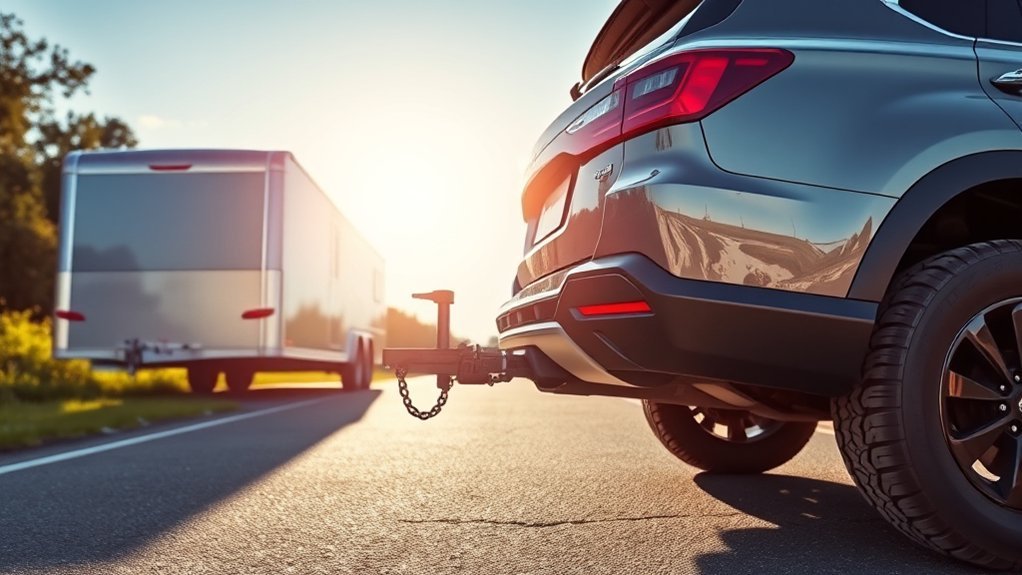
A braked trailer has its own service brakes. Depending on the system, an in-vehicle controller, surge coupler, or other approved mechanism activates them. An unbraked trailer relies on the tow vehicle for stopping, so manufacturers and local laws often impose much lower weight limits.
The phrase “braked towing capacity” is common in some markets, while many U.S. manuals instead provide a maximum trailer weight plus a separate threshold or condition requiring trailer brakes. Always follow the instructions for the vehicle’s market and model year.
- Check the owner’s manual: confirm when trailer brakes and a controller are required or recommended.
- Check local law: brake, breakaway-switch, lighting, safety-chain, registration, and speed requirements vary by jurisdiction.
- Match the controller to the brakes: electric and electric-over-hydraulic systems require compatible equipment and correct adjustment.
- Test before travel: verify brake operation, breakaway function, lights, wiring, coupler lock, chains, and emergency equipment.
- Allow more stopping distance: even a correctly equipped trailer changes braking, steering, acceleration, and lane-change behavior.
How Modifications Affect Payload, Stability, and Ratings
Vehicle changes can affect towing even when the published trailer rating stays the same. Added weight reduces payload. A taller ride height can increase sway sensitivity. Different tires can change load capacity, sidewall behavior, and effective gearing. Bed-mounted equipment can shift weight toward the rear axle.
Document every modification and its installed weight. Recalculate remaining payload, verify tire and wheel ratings, correct hitch height, and reweigh the loaded combination. For structural, brake, suspension, steering, axle, powertrain, or certification changes, consult the vehicle manufacturer or a qualified vehicle alterer. Do not rely on a parts advertisement as proof of a higher legal or manufacturer-approved rating.
Towing Safety: How to Stay Within Limits
There is no universal rule requiring every driver to use only 80%, 85%, or 90% of a vehicle’s tow rating. A personal buffer can be sensible for severe terrain, heat, wind, frequent towing, limited experience, or uncertain cargo, but it does not replace any stated rating or requirement.
Use this pre-trip checklist:
- Confirm the vehicle, trailer, hitch, ball, coupler, tires, wheels, and brake equipment are all rated for the actual load.
- Check cold tire pressures against the tow vehicle and trailer manufacturers’ labels—not the tire sidewall maximum unless specifically directed.
- Verify lug-nut torque, wheel-bearing condition, fluid levels, lights, safety chains, breakaway cable, coupler latch, hitch pin, and electrical connector.
- Secure cargo low and evenly, maintain the specified tongue or king-pin weight, and prevent liquids or loose cargo from shifting.
- Use the required tow/haul mode, transmission setting, speed restriction, or weight-distribution setup in the owner’s manual.
- Plan for longer stopping distances, wider turns, reduced acceleration, crosswinds, downhill speed control, and greater clearance.
- Stop after the first few miles to recheck the hitch, straps, tires, hubs, and cargo, then inspect again at regular breaks.
Choosing the Right Trailer for Your Towing Needs
Choose a trailer by its loaded weight, not its empty or “dry” weight. Include options, batteries, propane, water, fuel, food, tools, luggage, dealer-installed equipment, and cargo. The trailer’s GVWR can be a useful conservative screening number when the final loaded weight is unknown.
Also consider trailer type. A conventional travel trailer applies tongue weight behind the rear axle. A fifth-wheel or gooseneck places a larger pin load over or near the truck’s rear axle and needs adequate bed, payload, rear-GAWR, tire, and hitch capacity. A tall enclosed trailer may stay under the weight limit yet exceed the vehicle maker’s frontal-area guidance or create more wind resistance than a low utility trailer.
Before purchase, compare the proposed trailer with:
- the exact vehicle’s maximum loaded trailer rating and GCWR;
- remaining payload after real passengers, accessories, and cargo;
- front and rear GAWR;
- receiver and hitch ratings for the intended hitch type;
- the expected tongue or king-pin weight;
- trailer-brake and breakaway requirements;
- maximum trailer frontal area and any speed restrictions; and
- the route, grades, altitude, temperature, wind exposure, charging or fuel stops, and available parking space.
Frequently Asked Questions
What factors affect my vehicle’s towing capacity besides weight?
The exact powertrain, drivetrain, axle ratio, wheelbase, body configuration, factory tow package, cooling system, brakes, suspension, tires, hitch type, trailer frontal area, and manufacturer restrictions can all affect the published rating or safe operation. Passengers, accessories, and cargo reduce the capacity available for hitch load.
Can towing capacity change with different trailer types?
Yes. A vehicle may have different limits or equipment requirements for conventional, fifth-wheel, gooseneck, braked, and unbraked trailers. Trailer shape, frontal area, hitch load, brake system, and coupling method also affect which vehicle and hitch ratings apply.
How does terrain impact towing performance?
Steep grades increase powertrain heat and lengthen downhill braking demands. High altitude can reduce the performance of some combustion engines, while heat, cold, wind, loose surfaces, and rain can reduce traction or range. Follow the manufacturer’s grade, speed, transmission, cooling, and braking guidance and leave a larger operating margin for demanding routes.
Is there a towing capacity for electric vehicles?
Yes. An electric vehicle may tow only when the manufacturer provides a rating and approved equipment for that model and market. Towing adds weight and aerodynamic drag, so energy use rises and driving range can fall substantially. Plan charging stops with the trailer attached and follow the EV maker’s hitch, brake, speed, tire, and range guidance. Tesla’s Model Y towing instructions are one manufacturer-specific example.
What accessories can enhance towing safety and stability?
Depending on the vehicle and trailer, useful equipment can include a correctly rated weight-distribution hitch, compatible sway control, trailer brake controller, extended mirrors, tire-pressure monitoring, wheel chocks, a tongue-weight scale, and a breakaway system. Use only equipment approved for the combination and set it up according to both manufacturers’ instructions.
Does a weight-distribution hitch increase towing capacity?
Not by itself. It can redistribute load between the tow vehicle’s axles and improve handling when correctly adjusted, and some vehicles require one above a stated trailer weight. You must still stay within the vehicle, axle, payload, tire, receiver, hitch, and trailer ratings.
Should I follow an 80% towing rule?
An 80% target is a personal planning buffer, not a universal manufacturer or legal rule. It may be useful for harsh conditions or added comfort, but a setup at 80% can still be unsafe if payload, an axle, tires, hitch, brakes, or tongue weight are overloaded. Verify every rating and actual scale weight.
Conclusion
Safe towing starts with the manufacturer’s rating for the exact vehicle and ends with real loaded weights. Confirm maximum trailer weight, GCWR, GVWR, both GAWRs, payload, hitch limits, tire limits, trailer ratings, and tongue or king-pin weight. Use the lowest applicable limit, follow all brake and equipment requirements, and verify the finished setup on a scale before relying on it for travel.
Sources
- SAE International J2807_202411 — performance criteria and methodology used to determine tow-vehicle GCWR and trailer weight rating.
- 2026 Ford RV & Trailer Towing Guide — definitions, scale-weight concepts, payload, tongue load, cargo distribution, and vehicle-specific towing restrictions.
- NHTSA FMVSS No. 110 Test Procedure — required occupant-and-cargo load-limit calculation and trailer-load transfer guidance.
- NHTSA Interpretation 23087.rbm — GVWR, load-carrying capacity, and the effects of vehicle modification.
- Tesla Model Y Owner’s Manual: Towing and Accessories — EV-specific towing equipment, braking, loading, and range considerations.







Leave a Reply