
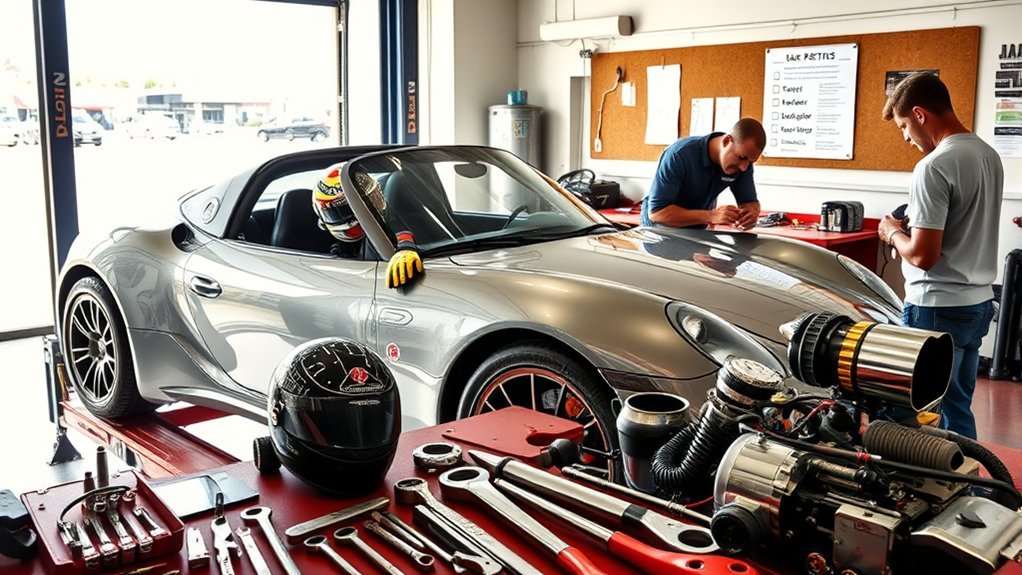
A successful track day starts well before you enter pit lane. Choose a novice-friendly event, verify its vehicle and helmet rules, inspect your brakes and tires, and pack enough equipment to solve small problems without improvising. On the day, attend every briefing, build speed gradually, monitor the car and your body, and stop immediately when something feels wrong.
Quick Answer
To prepare for a track day, register in the correct experience group, confirm the organizer’s helmet and vehicle rules, inspect the brakes, tires, wheels, fluids, battery, steering, and restraints, and remove every loose item. Bring water, food, sun protection, a tire gauge, an air pump, and the tools required for safe minor adjustments.
Key Takeaways
- Choose a structured novice or HPDE event with coaching, controlled passing, and clear run-group rules.
- The event’s supplemental regulations determine which helmets, vehicles, passengers, and modifications are permitted.
- Brakes, tires, wheel fasteners, fluids, battery security, steering, suspension, seats, and belts require inspection before the event.
- Use the vehicle placard as a cold tire-pressure baseline, then record hot pressures and make only small, informed adjustments.
- Treat warning lights, a soft brake pedal, fluid leaks, overheating, severe vibration, or driver illness as reasons to end the session.
- Track days are for smooth, predictable skill development—not racing other participants or chasing a lap time at any cost.
At a Glance
| Time Required | About 1–2 hours for home preparation, plus the full event day and travel time |
| Difficulty | Beginner to intermediate; professional inspection is recommended when service history or vehicle condition is uncertain |
| Tools Needed | Tire-pressure gauge, portable inflator, vehicle-specific torque wrench and socket, basic hand tools, flashlight, pressure log, wheel chocks, and safe lifting equipment if required |
| Cost | Varies by track, event length, instruction, helmet rental, travel, consumables, and optional track-day insurance |
Warning: General guidance never overrides the event regulations, vehicle owner’s manual, tire manufacturer’s instructions, or a qualified technician’s inspection. Do not drive on track with a fluid leak, damaged tire, loose wheel, soft brake pedal, active safety-related warning light, or unresolved steering or suspension fault.
How to Choose the Right Track Day for Your Experience Level
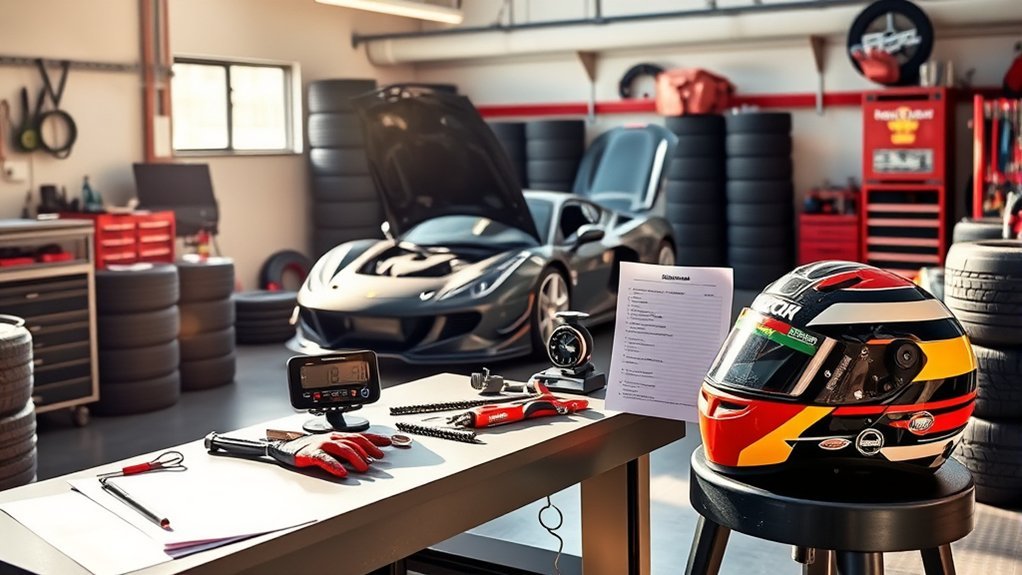
Begin with an honest assessment of your experience. A first-time driver should normally choose a novice HPDE or track-day group rather than an open-lapping, time-attack, or competition session.
Look for an organizer that provides classroom instruction, coached sighting laps, controlled passing zones, and individual feedback. The National Auto Sport Association’s HPDE program, for example, describes one-on-one instruction as a central part of its beginner program, while SCCA track events use experience groups and controlled passing rather than wheel-to-wheel racing.
Do not choose an event only because the circuit has a famous name or appears easy in a video game. Compare the complete event format:
- Instruction: Is an instructor included, optional, or unavailable?
- Run groups: Are novice, intermediate, and advanced drivers separated?
- Passing rules: Are passes limited to straights, designated zones, and point-bys?
- Session format: Is the event paced, session-based, open-lapping, or timed?
- Track configuration: Which layout will be used, and are there blind crests, close barriers, or limited runoff?
- Emergency support: Are corner workers, recovery vehicles, and medical personnel present?
- Weather policy: Does the event continue in rain, extreme heat, or lightning?
- Noise limit: What sound-testing method and maximum level apply?
Pro Tip: Register for the novice group when you are new to that circuit, even if you have driven at another track. Learning the layout, pit entry, flag stations, and local passing rules is more important than moving into a faster group.
Confirm Driver and Vehicle Eligibility Before Paying
Read the registration page and supplemental regulations before you pay. Confirm the minimum age, accepted license, waiver process, helmet standard, instructor policy, passenger rules, cancellation policy, and vehicle restrictions.
A stock street car is often acceptable when it is in good working order, but “stock” does not guarantee eligibility. Current SCCA guidance notes exceptions for certain high-center-of-gravity vehicles and convertibles. Individual venues may also restrict trucks, SUVs, crossovers, battery-electric vehicles, plug-in hybrids, or hybrids because of rollover risk, recovery equipment, charging, fire-response capability, or local rules.
Convertible requirements deserve special attention. Factory hoops, pop-up protection, windshield frames, and cosmetic “style bars” are not automatically accepted everywhere. Review the organizer’s written policy, including the current Track Night in America convertible requirements, and then check the individual venue page for stricter rules.
Note: An exhaust system that is legal on the road can still exceed a circuit’s sound limit. Confirm the current limit and testing procedure before traveling, especially after installing an aftermarket exhaust.
Essential Tools and Equipment for a Successful Track Day
A well-organized paddock kit helps you make safe, small adjustments without turning the day into a repair project. Pack only what you know how to use, label your equipment, and secure everything during transport.
Required Personal Safety Gear
- Approved helmet: Verify the exact certification category and year accepted by the organizer. Snell SA is designed for automobile competition, and the Snell Foundation maintains a certified SA2025 helmet list. Some events also accept specified older Snell, FIA, SFI, M, or K standards.
- Closed-toe shoes: Use secure, thin-soled shoes that allow accurate pedal control.
- Clothing: Bring long pants and long sleeves even when the organizer permits short sleeves. Natural-fiber clothing is a sensible default unless a fire-resistant suit is required.
- Eye protection: Required for some open cars and useful when using an open-face helmet.
- Gloves: Optional at many beginner events but useful for grip and comfort. Competition-rated gloves may be required at higher safety levels.
A helmet must fit snugly without creating pressure points, shifting when you move your head, or interfering with the seat, head restraint, or roof. Do not buy solely by hat size, and do not assume a damaged or heavily used helmet will pass inspection.
Basic Track-Day Tool Kit
- Accurate tire-pressure gauge
- Portable air compressor or inflator
- Torque wrench covering the manufacturer’s wheel-fastener specification
- Correct socket for the lug nuts or wheel bolts
- Basic sockets, screwdrivers, pliers, and adjustable wrench
- Flashlight or headlamp
- Work gloves and clean shop towels
- Tire-pressure and temperature log
- Painter’s tape, removable numbers, and a marker if required
- Duct tape and zip ties for temporary securing only—not for repairing safety-critical parts
- Wheel chocks
- Vehicle jack, jack pad, and correctly rated jack stands if lifting is genuinely necessary
Warning: Never place any part of your body beneath a vehicle supported only by a hydraulic or factory emergency jack. Work on firm, level ground, chock the remaining wheels, use the manufacturer’s lifting points, and support the vehicle with correctly rated jack stands.
Comfort, Food, and Paddock Supplies
- Water in several smaller containers
- Balanced electrolyte drink for prolonged heavy sweating
- Easy-to-digest meals and snacks
- Cooler with ice packs
- Sunscreen, sunglasses, and a hat
- Folding chair and shade canopy that can be securely weighted
- Rain jacket and dry socks
- Phone charger or battery bank
- Printed or downloaded schedule, rules, track map, and emergency contact details
- Prescription medication and any medically required supplies
Keep tools and drinks accessible in the paddock, but remove them from the vehicle before every session. A loose bottle, phone, floor mat, tool, or camera can interfere with the pedals or become a projectile.
Car Preparation for Your Track Day: Key Checks
Complete the main inspection several days before the event so there is time to obtain parts or arrange professional service. Do not wait until the night before to discover worn brake pads, a leaking shock, or a damaged tire.
Brakes
- Measure the remaining brake-pad material rather than judging only through the wheel spokes.
- Inspect both the inner and outer pads because they may wear at different rates.
- Check rotors for severe cracking, heavy scoring, damage, or thickness below the manufacturer’s limit.
- Inspect accessible hoses and fittings for cracking, rubbing, swelling, dampness, or leaks.
- Confirm that the pedal is firm and consistent. A soft, sinking, or unusually long pedal requires inspection before track use.
- Check the brake-fluid level and service history. If the fluid is old, contaminated, unknown, or unsuitable for the expected heat, have the system inspected and serviced correctly.
Track driving creates much more brake heat than normal commuting. New drivers should begin with healthy brakes and substantial reserve pad material rather than trying to use the last portion of an old set.
Warning: End the session immediately if the brake pedal becomes soft, braking force drops, the car pulls sharply under braking, smoke appears, or a brake warning illuminates. Reduce speed smoothly, signal pit entry, and have the car inspected before returning to the track.
Tires and Tire Pressure
Inspect every tire for cuts, cords, bulges, punctures, abnormal wear, embedded objects, valve damage, and rubbing marks. Verify that the size, load rating, and speed rating are suitable for the vehicle and event.
The vehicle placard or owner’s manual provides the normal cold inflation specification. The NHTSA TireWise guidance explains that this value applies when the tires are cold and that the sidewall’s maximum pressure is not the vehicle’s recommended setting.
- Record all four pressures before driving.
- Begin from a safe cold baseline approved by the vehicle or tire manufacturer and event organizer.
- Check pressures immediately after each session using the same gauge.
- Record the hot readings, ambient temperature, handling, and visible shoulder wear.
- Make small, equal, deliberate adjustments unless the car requires different front and rear pressures.
- Do not bleed a hot tire down to the door-placard cold pressure.
- Recheck the tires after they cool and restore appropriate road pressures before driving home.
Pro Tip: Write down pressures instead of relying on memory. A simple log reveals whether changes improved consistency or merely changed the way the car felt for one lap.
Wheels and Fasteners
- Inspect wheels for cracks, bends, missing weights, and contact marks.
- Confirm that every lug nut or wheel bolt is present and undamaged.
- Use the vehicle manufacturer’s torque specification and tightening sequence.
- Torque fasteners when they are cool unless the manufacturer or event provides a different approved procedure.
- If rechecking after a session, allow the brakes and wheels to cool first.
- Do not apply lubricant or anti-seize to the threads unless the vehicle manufacturer specifically requires it.
Fluids, Cooling, and Leaks
- Check engine oil on level ground using the manufacturer’s procedure.
- Inspect coolant, brake fluid, transmission fluid, power-steering fluid, and differential fluid where applicable.
- Look under the car and around the engine, transmission, hoses, radiator, reservoirs, and filters for leaks.
- Confirm that the radiator and cooling openings are not blocked by debris.
- Verify that warning lights and temperature displays operate normally.
- Carry only fluids approved for the vehicle, and transport them upright in sealed containers outside the passenger compartment.
Warning: Never open a pressurized coolant cap while the system is hot. On hybrids and electric vehicles, do not touch, disconnect, lift against, or attempt to repair orange high-voltage cables or traction-battery components. Follow the manufacturer’s emergency and service procedures.
Steering, Suspension, Battery, and Restraints
- Check for steering looseness, clunks, binding, or fluid leaks.
- Inspect accessible ball joints, tie rods, bushings, dampers, springs, and wheel bearings for play or damage.
- Confirm that the battery is firmly secured and its terminals are protected against accidental contact.
- Check that the driver’s seat is firmly mounted and cannot rock or slide unexpectedly.
- Inspect the seat belt for cuts, fraying, damaged buckles, and proper retraction.
- Confirm that the throttle and brake pedals move freely and cannot be obstructed by a floor mat.
- Check mirrors, brake lights, and any organizer-required rain or tow equipment.
Do not install a racing harness, fixed-back seat, roll bar, or head-and-neck restraint as an isolated upgrade. These parts must form a compatible, rule-compliant occupant-protection system. When the car retains its original seat and airbag system, the original three-point belt is often the correct arrangement unless the organizer and qualified installer approve a complete alternative.
Night-Before Checklist
- Remove loose objects from the cabin, trunk, cargo area, door pockets, and under the seats.
- Remove or securely anchor removable floor mats as the organizer requires.
- Secure approved cameras with the required mount and secondary tether.
- Install the correct tow eye if required and ensure it is fitted to the designated structural mounting point.
- Fill the fuel tank to the level recommended for the event without overfilling.
- Charge the phone and any lap timer permitted by the organizer.
- Pack the license, registration material, waiver documents, helmet, clothing, tools, food, and water.
- Check the weather, route, gate opening time, and final event messages.
- Sleep adequately and avoid alcohol.
Track Day Timetable: What to Expect
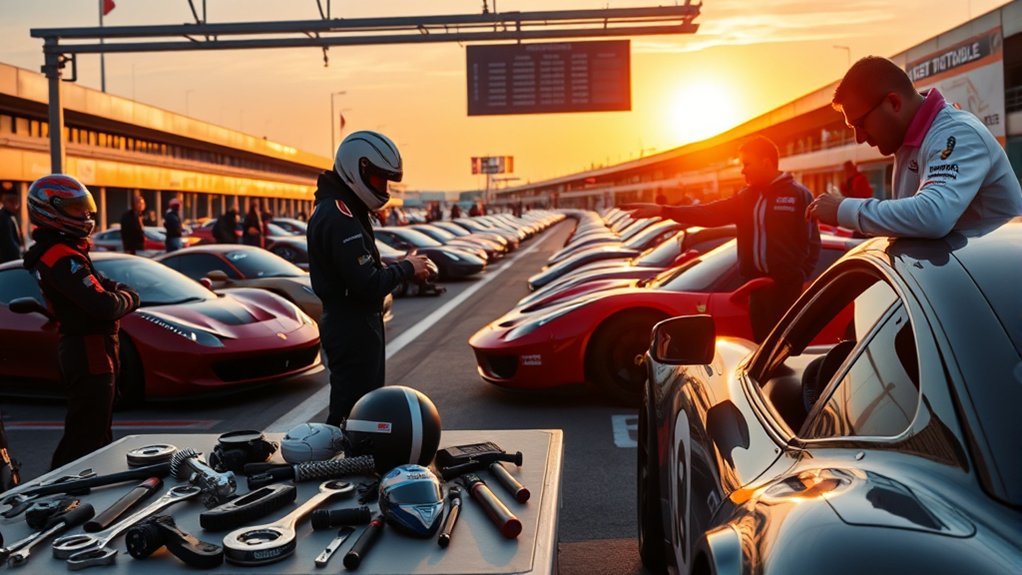
No single timetable applies to every track day. A full-day club event may open early in the morning, while an evening Track Night may not begin until the afternoon. Use the organizer’s final email and schedule as the controlling information.
A typical sequence looks like this:
| Stage | What Happens | Your Priority |
|---|---|---|
| Arrival and check-in | Waiver, credentials, numbers, helmet verification, and paddock assignment | Arrive early enough to avoid rushing |
| Technical inspection | Self-tech form, spot inspection, or full inspection depending on the event | Disclose problems honestly and correct them before driving |
| Drivers’ meeting | Flags, passing, pit entry, emergency response, sound, and local hazards | Listen carefully and ask about anything unclear |
| Sighting or paced laps | Drivers learn the layout, flag stations, pit entry, and line | Observe rather than chase the car ahead |
| Driving sessions | Run groups rotate through sessions that may last roughly 15–30 minutes | Build pace gradually and leave a margin |
| Between-session checks | Tires, brakes, fluids, fasteners, fuel, hydration, and instructor review | Find small changes before they become failures |
| Final session and departure | The car is restored to road condition and the paddock is cleaned | Do not treat the drive home as another session |
How to Avoid Common Track Day Mistakes
Overlooking Vehicle Preparation
Passing an event’s tech check does not guarantee that the vehicle will survive repeated high-speed sessions. The driver remains responsible for monitoring the car throughout the day.
Before every session:
- Walk around the vehicle.
- Look for fluid beneath it.
- Check tire condition and pressure.
- Confirm that wheel fasteners were inspected as planned.
- Check fuel level.
- Remove tools, drinks, phones, and other loose items.
- Confirm that the hood, trunk, doors, and tow-eye covers are secure.
- Verify that no new warning light is active.
- Press the brake pedal before entering the grid.
After every session, check for new vibration, odor, noise, smoke, leaking fluid, tire damage, brake-pedal change, or temperature warning. A mechanical problem does not become safer because the next session is about to begin.
Ignoring Safety Protocols
The drivers’ meeting is mandatory information, not a formality. Flags, passing zones, point-by methods, pit entry, red-flag procedures, and sound rules can differ between organizations and venues.
The following guide reflects common meanings, but the event briefing always controls. The SCCA Rules of the Track provides a detailed reference.
| Signal | Common Meaning | Driver Response |
|---|---|---|
| Yellow | Hazard or incident ahead | Slow, remain alert, and do not pass unless specifically permitted |
| Red | Session stopped for extreme danger | Follow the event’s stopping procedure and wait for official direction |
| Black | Report to pit lane or officials | Acknowledge the signal and enter the pits safely without another fast lap |
| Black with orange disc | Possible mechanical problem | Reduce load on the car and report directly to the designated pit location |
| Blue | Faster traffic is approaching | Check mirrors and give the required point-by at the next permitted location |
| Checkered | Session complete | Finish the lap at reduced pace and return to the paddock as directed |
Treating the Event Like a Race
A standard track day is not permission to race another participant. Avoid late lunges, blocking, passing without permission, tailgating, or trying to “win” a session. Drive predictably, leave space, and allow faster traffic through according to the event’s point-by rules.
Smooth inputs, clear communication, and predictable decisions matter more than one fast lap.
Adding Speed Too Quickly
Use the first laps to warm the tires and brakes, confirm the car’s condition, and identify flag stations. Increase pace in small steps while maintaining consistent braking points and smooth steering.
Do not follow another driver beyond your comfort level. A faster car may have different tires, brakes, suspension, aerodynamics, or driver experience. Drive your own reference points and follow your instructor’s direction.
What to Do After a Spin or Off-Track Excursion
- Keep the car predictable and avoid immediately rejoining the driving line.
- Follow the organizer’s re-entry procedure and wait for a safe opening or marshal instruction.
- Drive slowly enough to detect vibration, steering changes, or debris.
- Report to the pits when required.
- Inspect the tires, wheels, underbody, brakes, suspension, and cooling openings before returning.
- Clean dirt or grass from hot components only when it is safe to do so.
If the car becomes disabled on course, follow the event briefing. Unless there is fire or immediate danger, remaining belted and helmeted in the vehicle may be safer than stepping onto an active circuit. Obey the nearest marshal or emergency worker.
Why Safety Briefings and Drivers’ Meetings Matter
The drivers’ meeting explains the rules for that event and configuration. It may cover:
- Flag or light signals
- Passing zones and point-by methods
- Pit-out and blend-line rules
- Pit-in signals and speed limits
- Red-flag and stopped-car procedures
- Sound monitoring
- Local hazards, surface changes, and runoff areas
- Rules for passengers and instructors
- Emergency contacts and medical locations
- Changes caused by weather or track conditions
Stand where you can hear, silence your phone, and ask questions before the meeting ends. Do not rely on rules from another track or a previous organizer.
Strategies for Staying Hydrated and Energized on Track Day
Track driving is mentally demanding, and helmets, long clothing, sunlight, hot pavement, and limited airflow can add significant heat stress. Begin the day hydrated and drink between sessions instead of waiting until you feel thirsty.
Current CDC/NIOSH heat guidance recommends frequent small amounts of water during moderate activity in heat and balanced electrolyte drinks when heavy sweating continues for several hours. It also cautions against excessive fluid intake.
- Keep cool water within easy reach in the paddock.
- Drink regularly between sessions.
- Use balanced electrolytes during prolonged sweating rather than relying only on highly caffeinated or sugary drinks.
- Eat normal meals and light snacks containing carbohydrates, protein, and some salt unless a clinician has restricted your diet.
- Avoid alcohol before and during the event.
- Rest in shade or air conditioning when possible.
- Use extra caution when taking medication or managing a condition that affects heat tolerance or fluid balance.
Warning: Stop driving and seek medical assistance for confusion, fainting, severe dizziness, loss of coordination, vomiting, chest pain, an unusually severe headache, or hot skin with altered mental status. Do not attempt to “push through” suspected heat illness.
Mental Preparation Tips for Track Day Success
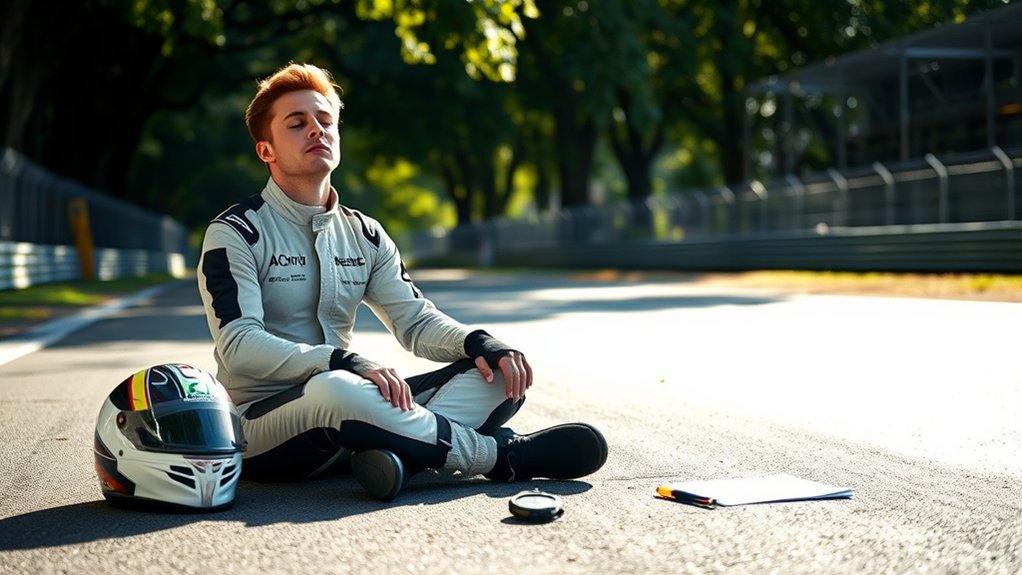
Visualize Your Success
Review the circuit map and mentally rehearse a calm lap. Focus on flag stations, pit entry, braking zones, turn-in points, apex areas, and track-out space rather than imagining a record lap.
A useful mental checklist is:
- Eyes up and looking ahead
- Hands relaxed
- Brake in a straight line while learning
- Release the brake smoothly
- Use one deliberate steering input
- Apply throttle progressively
- Check mirrors on the straights
- Give clear point-bys
- Signal pit entry early
Embrace the Learning Curve
Set process goals instead of lap-time goals. A first session can focus on finding flag stations. The next can focus on consistent braking points. Later sessions can improve vision, line, smoothness, and traffic management.
| Goal | Action | Measure of Progress |
|---|---|---|
| Learn the circuit | Identify every flag station and pit entry | No surprise corners or rushed pit entries |
| Improve consistency | Use repeatable braking and turn-in references | Fewer mid-corner corrections |
| Manage traffic | Check mirrors and give timely point-bys | Passes occur calmly in permitted areas |
| Protect the car | Use warm-up and cool-down laps and monitor symptoms | Stable temperatures, pressures, and brake feel |
Manage Your Expectations
A successful day does not require maximum speed. It means finishing with a healthy car, understanding the circuit better, and knowing what to practice next.
- Leave room for mistakes and changing conditions.
- Do not compare your pace with a modified car or experienced driver.
- Take a session off when tired, overheated, frustrated, or distracted.
- End early when the tires, brakes, weather, or driver condition no longer support safe laps.
- Ask the instructor for one or two priorities rather than trying to correct everything at once.
Between-Session Checklist
Complete a short inspection as soon as the car is safely parked:
- Look beneath the car for fluid.
- Check tire pressure, tread surface, sidewalls, and pickup debris.
- Inspect visible brake components and note any change in pedal feel.
- Listen for ticking, scraping, grinding, or hissing that was not present earlier.
- Check temperature displays and warning messages.
- Confirm fuel level.
- Review instructor feedback while it is fresh.
- Drink, eat, cool down, and assess your concentration.
Do not touch brake rotors, calipers, exhaust components, turbochargers, radiators, or other hot parts. Give the car time to cool before checking wheel torque or performing work near the brakes.
What to Do After Your Track Day: Post-Event Inspection and Reflection
Before leaving the venue, return the car to a safe road configuration:
- Set road-appropriate tire pressures after the tires have cooled sufficiently.
- Remove temporary numbers, tape, transponders, and organizer equipment.
- Confirm that the hood, trunk, wheel hardware, tow equipment, and interior items are secure.
- Check fluid levels and look for leaks.
- Inspect the tires for damage, cords, cuts, or severe shoulder wear.
- Confirm that the brake pedal remains firm.
- Clean debris from cooling openings.
- Do not drive home if the vehicle has a warning light, vibration, leak, brake problem, overheating symptom, or damaged tire.
At home, perform a more detailed inspection when the car is cool. Review brake-pad wear, tires, wheels, suspension, fluids, and underbody condition. Visible metal in drained oil, a new knock, heavy smoke, persistent warning messages, or abnormal fluid loss requires professional diagnosis rather than guesswork.
Document the day in a notebook or spreadsheet:
- Cold and hot tire pressures
- Ambient weather
- Fuel used
- Brake-pad and tire wear
- Vehicle symptoms
- Setup changes
- Instructor comments
- Personal goals for the next event
Review lap data only after considering traffic, weather, tire condition, and instruction. A slower but smoother lap may show more progress than a faster lap built on late braking and large corrections.
Frequently Asked Questions
Can I participate in a track day with a stock vehicle?
Usually, yes. Many HPDE and track-day programs are designed for safe street cars in good working order. However, the organizer may restrict convertibles, high-center-of-gravity vehicles, trucks, SUVs, crossovers, electric vehicles, hybrids, race-prepared cars, or vehicles with certain modifications. Read the event-specific eligibility and technical-inspection rules before registering.
What should I wear for a track day?
Wear the helmet certification required by the organizer, closed-toe shoes, and secure clothing that does not interfere with the controls. Bring long pants and long sleeves even when they are not mandatory. Some advanced, timed, open-car, or competition sessions require fire-resistant clothing, gloves, or additional safety equipment.
Are there age restrictions for track-day participants?
Yes, but the minimum age and license requirements vary. Many programs require an adult driver with a valid license, while some organizations allow qualified minors under specific licensing, instructor, and parental-waiver rules. Verify the written requirements before registering or traveling.
How do I find a track day near me?
Search the event calendars of established sanctioning bodies, local sports-car clubs, circuit operators, and recognized HPDE organizers. Compare the run groups, instruction, vehicle rules, safety requirements, cancellation terms, and final schedule rather than choosing only by price or distance.
Is insurance coverage necessary for a track-day event?
Supplemental physical-damage insurance is not universally required, but you should never assume that a normal road policy covers on-track damage. Read your policy, ask the insurer for a written answer, review the event waiver, and consider a separate HPDE or track-day policy if you cannot comfortably absorb the vehicle’s loss, deductible, or track-property charges.
What tire pressure should I use on a track day?
There is no universal track pressure. Begin with a safe cold baseline from the vehicle or tire manufacturer and any organizer guidance. Record hot pressures immediately after each session and make small changes based on the tire, vehicle, temperature, wear pattern, and instructor or tire-technician advice. Never bleed a hot tire down to its cold door-placard value.
Do I need track-focused brake pads or brake fluid?
Not every novice event requires track-specific parts, but the braking system must be healthy and suitable for the car, tires, circuit, pace, and session length. A heavy or powerful vehicle may overheat ordinary pads and old fluid quickly. Ask a qualified technician or experienced event instructor about the appropriate pad material, remaining thickness, fluid specification, and service condition.
What should make me stop driving during a session?
Pit immediately for a soft or sinking brake pedal, loss of braking force, overheating, smoke, a fluid smell or leak, severe vibration, steering changes, tire damage, an oil-pressure warning, a mechanical flag, or any new safety-related warning. You should also stop when you feel dizzy, confused, nauseated, unusually tired, angry, or unable to concentrate.
Conclusion
Track-day preparation is less about buying performance parts and more about removing uncertainty. Choose the correct event, verify every rule, start with a mechanically sound vehicle, and bring only equipment you can use safely. On track, build speed gradually, communicate clearly, respect flags and point-bys, and leave enough margin to respond when conditions change.
After each session, inspect the car and yourself. Missing one run is cheaper than damaging a tire, overheating the brakes, or continuing while fatigued. A successful track day ends with a healthy driver, a safe vehicle, and a clear plan for the next skill to improve.
Sources
- Sports Car Club of America — How Do I Get on Track? — Basic entry, vehicle, equipment, and insurance considerations
- SCCA Time Trials — Rules of the Track — Flags, passing signals, pit entry, stopped-car procedures, and novice passing
- Track Night in America — Convertible Policy — Rollover-protection and venue-specific convertible requirements
- Sports Car Club of America — Racing Helmet Certifications — Certification categories, dates, fit, and rule verification
- National Highway Traffic Safety Administration — TireWise — Cold tire pressure, placard specifications, tread, and tire inspection
- CDC/NIOSH — Heat-Stress Recommendations — Hydration, electrolytes, heat exposure, and rest guidance







Leave a Reply