
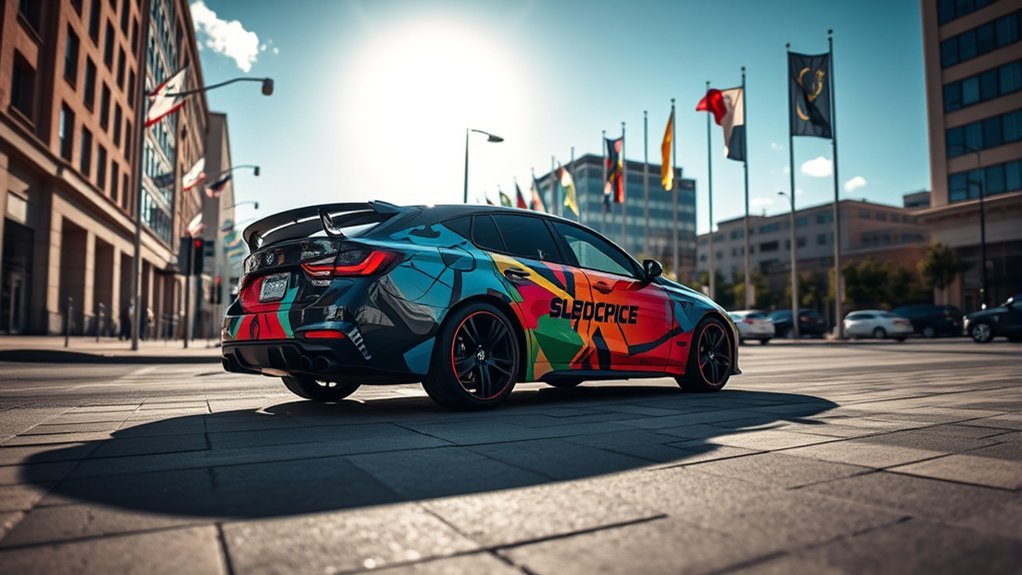
A vinyl wrap is usually a legal way to change your car’s color, protect sound paint, or display business graphics. Problems arise when the film covers required equipment, blocks the driver’s view, alters a license plate, imitates an official vehicle, or conflicts with registration, parking, lease, or commercial-carrier rules. The exact requirements depend on where and how the vehicle is used.
Quick Answer
Yes, car wraps are generally legal in the United States. However, a wrap cannot obscure license plates, required lights, reflectors, legal window visibility, or safety equipment. Color-reporting, advertising, commercial-vehicle, parking, HOA, lease, and insurance requirements vary, so check the rules that apply where the vehicle is registered and operated.
Key Takeaways
- Vinyl wraps are normally legal, but the finished vehicle must still comply with plate, lighting, window, visibility, and equipment laws.
- Do not assume that every state requires a DMV update after a color change. Check the official agency for the state where the car is registered.
- Advertising graphics alone do not automatically turn a passenger car into a federally regulated commercial motor vehicle.
- HOA, apartment, lease, and private parking restrictions are separate from public traffic laws.
- Inspect the paint, rust, repairs, sensors, and ownership agreement before paying for a wrap.
Note: This article provides general U.S. legal and safety information, not legal advice. Vehicle laws and agency procedures change. Confirm the current rule with your state motor-vehicle agency, local government, insurer, property agreement, or a qualified attorney when a citation, commercial operation, or ownership dispute is involved.
Is It Legal to Wrap Your Car?
There is no general federal ban on wrapping a privately owned passenger car. A full color-change wrap, partial wrap, roof wrap, racing stripe, or business graphic is normally lawful when it does not interfere with equipment or information that the law requires to remain visible and functional.
The legal question is therefore not limited to whether vinyl may be placed on a car. You also need to consider:
- Whether the license plates and registration decals remain clear and readable
- Whether required lamps and reflectors still work as designed
- Whether window film blocks the driver’s view or violates tint rules
- Whether cameras, radar units, parking sensors, or other safety systems are affected
- Whether the design resembles a police, fire, ambulance, or other official vehicle
- Whether the vehicle is leased, financed, commercially operated, or parked on property with private restrictions
- Whether the state where the vehicle is registered requires any record update
The legal problem is rarely the vinyl itself. It is what the wrap covers, imitates, changes, or prevents from working.
What Can Make a Car Wrap Illegal?
Covered or Altered License Plates and Registration Decals
Never apply wrap film to a license plate or position vinyl so that it blocks any part of the plate, registration sticker, jurisdiction name, plate number, or other required marking. Keep the plate visible from the angles required by your state, and do not use tinted, reflective, or decorative film on the plate itself.
For example, California Vehicle Code §5201 requires plates to be clearly visible, legible, and unobstructed. Florida Statutes §320.061 prohibits altering the original appearance of a license plate or applying material that interferes with its visibility or legibility.
Warning: A legal body wrap does not make a wrapped, tinted, painted, or otherwise altered license plate legal. Have the installer trim the film cleanly around the plate, plate light, mounting area, and registration decals.
Covered Lights, Reflectors, and Markers
Do not wrap over headlights, taillights, brake lights, turn signals, side-marker lamps, center brake lamps, reflectors, or the license-plate light. This includes clear, tinted, smoked, perforated, or translucent wrap film if it changes the equipment’s brightness, color, visibility, or reflective performance.
Federal Motor Vehicle Safety Standard No. 108 establishes requirements for required lamps, reflective devices, and related equipment. In addition, 49 U.S.C. §30122 generally prohibits manufacturers, distributors, dealers, and motor-vehicle repair businesses from knowingly making a federally required safety device or design element inoperative.
State equipment laws determine whether an in-use vehicle may be driven with covered, recolored, or impaired lighting. A professional wrap installer should cut around these components rather than treating them as part of the body panel.
Window Wraps and Driver Visibility
Opaque vinyl should not be placed on a windshield or any window the driver must see through. Perforated window film is commonly used on rear glass for advertising, but it must still comply with state rules governing visibility, tint, reflectivity, mirrors, and required openings.
As one example, California Vehicle Code §26708 restricts materials placed on windshields and certain side and rear windows, subject to defined exceptions. Other states use different visible-light-transmission, placement, and mirror requirements.
Do not cover required inspection, emissions, parking, toll, or registration stickers unless the issuing agency specifically permits relocation or replacement. Avoid cutting or moving an official sticker without first checking the agency’s instructions.
Cameras, Sensors, and Safety Systems
Modern vehicles may have forward cameras, blind-spot radar, parking sensors, ultrasonic sensors, infrared emitters, antennas, hands-free liftgate sensors, and calibration targets built into bumpers, windshields, mirrors, grilles, or body trim. Even thin film can affect some components or make service more difficult.
Give the installer the vehicle’s year, make, model, and trim so the exact sensor locations can be checked. Review the owner’s manual and any manufacturer service information before wrapping a bumper, grille, windshield area, mirror housing, or emblem that contains electronics.
Do not cover VIN plates, certification labels, tire-information labels, airbag warnings, high-voltage warnings, fuel labels, emergency-exit markings, or other required safety information.
Police and Emergency-Vehicle Look-Alike Designs
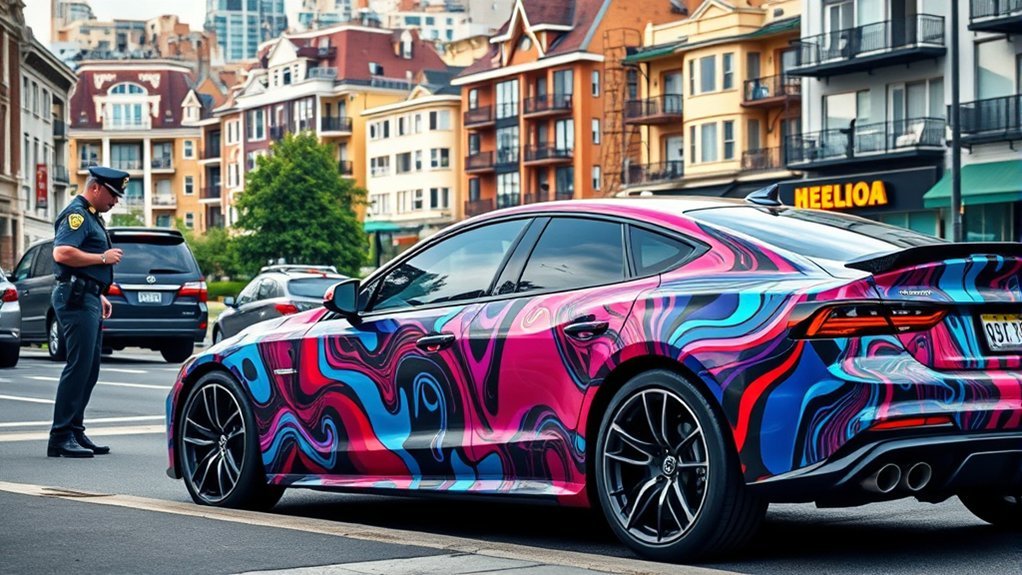
A wrap should not make an ordinary vehicle appear to be an active police car, fire vehicle, ambulance, school bus, government vehicle, or other restricted official vehicle. Laws vary by state and may regulate combinations of paint schemes, insignia, seals, wording, badges, reflective striping, and emergency lights.
For example, California Vehicle Code §27605 restricts vehicles painted in a manner resembling a motor vehicle used by a peace officer or traffic officer, subject to specific exceptions. A movie prop, promotional vehicle, or retired emergency vehicle may need markings covered or removed whenever it is driven on a public road.
Key State Regulations Affecting Car Wraps
State requirements do not follow one national color-change rule. Registration documents, title systems, and reporting procedures differ, and online articles often confuse a color field on a title application with a legal duty to report every later cosmetic change.
State-Specific Color and Registration Rules
| Jurisdiction | What the Current Official Material Shows | Practical Step |
|---|---|---|
| California | The reviewed DMV body-change procedures and REG 256 Statement of Facts address changes such as body type, motive power, axles, use, and weight. They do not list an ordinary vinyl color change as a routine body-change category. | Do not rely on a blanket online claim. Ask California DMV about an unusual vehicle, title discrepancy, structural alteration, or commercial-registration issue. |
| Texas | The April 2026 Texas Motor Vehicle Registration Manual says vehicle color is not required to be entered in the registration system. | A color field used during a title transaction should not be treated as proof that every later wrap must be reported. Contact TxDMV for a record-specific question. |
| Florida | The commonly cited wrap issue is the prohibition on altering or obscuring the license plate, not a general ban on changing the body color with vinyl. | Keep the original plate fully visible and contact FLHSMV if the vehicle’s registration record presents a separate color question. |
| Other States | A state may record vehicle color differently or have a procedure that applies to permanent paint changes, reconstructed vehicles, taxi permits, fleets, or law-enforcement identification. | Check the official DMV, MVA, BMV, DOL, or motor-vehicle department for the state where the vehicle is registered. |
Pro Tip: When contacting the agency, ask a narrow question: “Does a temporary vinyl color-change wrap require an amended title or registration for this vehicle?” Record the date, office, representative, and any form or code section provided.
Advertising Permit and Commercial-Vehicle Requirements
Placing a company name or advertisement on a passenger car does not, by itself, automatically make the car a federally regulated commercial motor vehicle. Commercial status may depend on the owner, business use, gross weight or weight rating, passenger capacity, cargo, hazardous materials, and the laws of the state or city involved.
A business should separately check:
- State registration and commercial-plate rules
- Local parking restrictions for commercial or oversized vehicles
- Taxi, limousine, delivery, mobile-vending, or transportation permits
- Federal or state motor-carrier requirements
- Airport, port, campus, condominium, and private-property rules
- Permissions for copyrighted artwork, photographs, logos, and trademarks
- Ordinary truth-in-advertising requirements for claims printed on the wrap
Advertising content remains subject to normal intellectual-property and consumer-protection law. The U.S. Patent and Trademark Office explains the role of trademarks, while the Federal Trade Commission’s truth-in-advertising guidance explains that advertising claims must be truthful, non-deceptive, and supported when required.
There is no general rule requiring every vehicle with advertising to obtain a “mobile advertising permit” simply because it crosses state lines. A permit may be required for a particular business activity or jurisdiction, but that must be verified under the actual local or industry-specific rule.
How Local Laws Affect Car Wraps
A wrap that complies with state equipment law can still create a local parking or business-use issue. Municipalities may regulate where certain commercial vehicles may park, how long vehicles may remain in one place, whether a vehicle is being used primarily as a stationary advertising display, and whether a business activity requires a local permit.
State and Local Rules to Check
Before installation, review rules from each level that applies to the vehicle:
- State motor-vehicle agency: Registration records, vehicle classification, title questions, inspection requirements, and plate rules.
- State vehicle code: Windows, lamps, reflectors, plates, visibility, official-vehicle appearance, and equipment requirements.
- City or county: Commercial parking, mobile advertising, street-storage, sign, taxi, delivery, and business-license rules.
- Industry regulator: Motor-carrier, taxi, rideshare, school-transport, hazardous-material, or regulated-service requirements.
- Private agreement: HOA covenants, apartment rules, employer fleet policies, lease terms, and private parking contracts.
Use official government pages rather than relying solely on an installer, forum post, social-media video, or article that lists all 50 states without citing the underlying law.
HOA Guidelines and Restrictions
HOA restrictions are private property rules rather than state traffic laws. An association may restrict the overnight parking of commercial vehicles, vehicles displaying business graphics, oversized vans, trailers, or vehicles parked in common areas. The exact authority comes from the declaration, covenants, bylaws, adopted parking rules, and applicable state HOA law.
A personal color-change wrap may be treated differently from a large business advertisement. Do not assume that every visible wrap violates an HOA rule or that every association has authority to regulate the design itself. Read the provision and its definitions before drawing a conclusion.
HOA Rules for Car Wraps
Complete these checks before wrapping a vehicle that will regularly be parked in an HOA, condominium, apartment, or managed community:
- Search the governing documents for “commercial vehicle,” “advertising,” “signage,” “vehicle appearance,” “parking,” “street parking,” and “garage.”
- Check whether the rule applies to the vehicle’s use, size, registration class, graphics, or all four.
- Determine whether public streets are controlled by the association or by the city.
- Ask for a written interpretation or approval when the wording is unclear.
- Keep the approval, application, photographs, and correspondence with the vehicle records.
- Confirm whether temporary visitor, loading, service-provider, or emergency exceptions apply.
Possible consequences depend on the documents and governing law. They may include a notice, hearing, fine, loss of parking privileges, or towing when towing is properly authorized. A disagreement over the meaning or enforceability of a covenant may require advice from an attorney familiar with community-association law in that state.
Note: An HOA violation does not necessarily mean the wrap is illegal to drive on a public road. It may instead mean that the vehicle cannot be parked in a particular private community under that community’s agreement.
Can Your Car Be Wrapped? What to Check First
Most passenger cars, trucks, vans, and SUVs can be wrapped, but legal eligibility and a successful installation are different questions. The wrap material needs a clean, stable, compatible surface, and the owner must have permission to modify the vehicle.
| Vehicle Condition or Status | What to Check |
|---|---|
| Sound factory paint | Usually the best candidate. Inspect for chips, scratches, contamination, and prior repair work. |
| Rust, peeling clear coat, or failing paint | Repair the underlying problem first. Vinyl does not stop corrosion or restore unstable paint. |
| Repainted panels or body filler | Confirm curing time, adhesion, and removal risk with the paint shop and film installer. |
| Textured or unpainted plastic | Some films will not bond reliably. Use only products and primers approved for the substrate. |
| Classic or collector vehicle | Age alone does not prohibit wrapping. Evaluate fragile paint, prior restoration work, compound curves, trim, and the effect on provenance or value. |
| Leased or financed vehicle | Review the contract and obtain written consent if required. The owner may charge for paint damage, residue, missing emblems, or incomplete removal. |
| Vehicle under paint or corrosion warranty | Read the warranty and document the paint before installation. Coverage can depend on the cause of damage and installation method. |
The 3M Vehicle Prep for Success guide recommends inspecting rust, paint quality, scratches, dents, and other defects before installation. Defects may remain visible through the film, weaken adhesion, or increase the chance of paint damage during removal.
Pro Tip: Photograph every panel, edge, chip, scratch, emblem, sensor, and repaired area in good lighting before installation. Have the installer record pre-existing defects on the work order and keep the film product name, lot information, warranty, and invoice.
Pre-Wrap Legal and Practical Checklist
- Identify the vehicle precisely. Record the year, make, model, trim, body style, registration class, and primary use.
- Check the state registration record. Ask the official agency whether a temporary vinyl color change requires an update for that vehicle.
- Review equipment laws. Confirm rules for plates, lights, reflectors, windows, mirrors, and inspection stickers.
- Map cameras and sensors. Use the owner’s manual and manufacturer information rather than guessing from appearance.
- Check ownership documents. Review lease, finance, fleet, employer, and warranty terms.
- Check parking restrictions. Read HOA, apartment, workplace, airport, campus, and municipal commercial-parking rules.
- Evaluate commercial obligations. Determine whether the vehicle’s actual operation triggers state or federal carrier requirements.
- Review the artwork. Remove unauthorized logos, deceptive claims, official seals, and designs that could imitate an emergency vehicle.
- Inspect the surface. Correct rust, failing paint, contamination, dents, and unfinished repairs.
- Choose a qualified installer. Ask which film, preparation process, edge treatment, heating procedure, and warranty will be used.
- Ask the insurer about coverage. Determine whether the wrap’s value is covered and whether business use changes the policy.
- Keep documentation. Save approvals, agency answers, photographs, invoices, warranties, artwork permissions, and removal instructions.
Avoid These Common Mistakes When Wrapping Your Car
Relying on an Unsourced 50-State List
DMV procedures and vehicle codes change. Verify important claims through the agency or statute instead of assuming that a list copied across several websites is current.
Wrapping Over Rust or Unstable Paint
Vinyl is not a repair material. Rust, peeling clear coat, loose paint, open scratches, dents, and body filler can remain visible or cause early failure. Removal may also pull away unstable or poorly bonded paint.
Covering Plates, Lights, Windows, or Sensors
Have the installer identify every required light, reflector, plate, camera, sensor, antenna, label, and sticker before disassembly. Do not assume that a translucent or perforated product is acceptable merely because some light or visibility remains.
Overstretching the Film
Excessive stretching can thin the film, alter the color, weaken adhesive performance, and cause lifting around recesses, corners, and edges. Complex bumpers and deep channels require the film manufacturer’s approved installation method.
Using the Wrong Heat or Post-Heating Procedure
Heating requirements vary by film, adhesive, surface, stretch level, recess, and manufacturer. Skipping required post-heating may allow lifting or shrinkage, while excessive heat can damage the film, paint, plastic, electronics, or nearby trim.
Follow the selected product’s technical bulletin, including its specified temperature range and measurement method. The current 3M Application: Vehicles guide provides product-specific preparation, application, edge, cleaning, and removal considerations.
Ignoring Curing and Cleaning Instructions
Ask how long to wait before washing, waxing, using a pressure washer, or exposing freshly wrapped edges to harsh weather. Keep high-pressure spray away from seams and edges, and use cleaning products approved for the film’s finish.
Failing to Plan for Removal
Wraps should be removed within the film manufacturer’s recommended service period and with an approved process. A film left far beyond its intended life may become brittle, leave adhesive, or require more labor to remove. Professional removal is especially important on repainted, repaired, or collector vehicles.
Forgetting the Insurer, Lessor, or Vehicle Owner
There is no universal rule that every private owner must report every wrap to an insurer. However, disclosure may be important when the owner wants the wrap’s cost covered, uses the vehicle for business, changes the vehicle’s stated use, or is subject to a lease or fleet policy.
What Are the Safety Standards for Car Wraps?
A wrap does not have one separate federal “car-wrap standard.” Instead, the finished vehicle must continue to comply with the equipment and use requirements that apply to it.
| Area | Safe Compliance Approach |
|---|---|
| Required lighting | Do not cover, tint, recolor, relocate, or reduce the performance of required lamps. |
| Reflectors and markers | Cut around required reflectors and reflective markers. Do not assume body-colored film may cover them. |
| License plates | Keep the plate, registration decals, jurisdiction name, and plate light clear and legible. |
| Windows | Follow the state’s rules for windshield placement, tint, reflectivity, visibility, and required mirrors. |
| Cameras and sensors | Leave detection areas unobstructed and follow the vehicle manufacturer’s service instructions. |
| Reflective or chrome finishes | Check state rules for glare, reflectivity, permitted colors, and official-vehicle resemblance before installation. |
| Commercial markings | Preserve every legal name, USDOT number, unit number, weight marking, permit, and other identifier required for that operation. |
The federal 50-foot marking rule is not a requirement for every wrapped vehicle that travels between states. It applies to covered commercial motor vehicles and motor carriers subject to FMCSA vehicle-marking requirements. Covered vehicles generally must display the motor carrier’s legal or trade name and USDOT number in sharp contrast and in a form legible during daylight from 50 feet while the vehicle is stationary.
Business owners who are uncertain whether their operation is covered should use FMCSA’s official Do I Need a USDOT Number? guidance and check any separate state requirement.
What to Do if You Face Legal Issues With Your Wrap
If an officer, motor-vehicle agency, property manager, insurer, or other authority questions the wrap, first identify the exact rule involved. A plate-obstruction warning, window-tint citation, HOA notice, registration question, and commercial-carrier violation require different responses.
| Action | What to Do |
|---|---|
| Review the cited rule | Obtain the statute, ordinance, covenant, policy clause, or regulation number rather than relying on a verbal summary. |
| Document the vehicle | Photograph the wrap, plate, lights, windows, sensors, parking location, notice, and any measurement or test result. |
| Preserve communications | Keep emails, letters, agency messages, installer records, approvals, receipts, and names of the people involved. |
| Correct an immediate hazard | Stop driving when the wrap blocks a plate, lamp, windshield, or safety device. Have the affected film removed or trimmed safely. |
| Contact the responsible authority | Ask what evidence, inspection, correction, hearing, appeal, or registration form is required and note all deadlines. |
| Consult a legal professional | Seek jurisdiction-specific advice for a disputed citation, towing action, repeated fine, commercial enforcement matter, or contract dispute. |
If the issue may lead to a claim or concerns business use, liability, theft, vandalism, or damage to the wrap, review the insurance policy and notify the insurer as required by that policy. Do not remove evidence needed for a dispute, but do not continue operating a vehicle with an obvious visibility or safety hazard.
Frequently Asked Questions
What car are you not allowed to wrap?
There is no nationwide list of ordinary passenger-car models that may never be wrapped. Restrictions usually concern ownership permission, unstable paint, required equipment, official-vehicle appearance, historical value, commercial use, or vehicle-specific cameras and sensors. A leased, fleet, emergency, collector, or specialty vehicle may require additional approval.
Is it legal to wrap your car in the United States?
Yes, a car wrap is generally legal. The completed vehicle must still comply with state and local rules for plates, lamps, reflectors, windows, visibility, inspection items, safety systems, registration, advertising, parking, and official-vehicle appearance.
Do I have to tell the DMV if I wrap my car?
It depends on the state, vehicle, and type of change. There is no single nationwide notification rule. Texas’s April 2026 registration manual says color is not required in its registration system, while the reviewed California DMV body-change materials do not list an ordinary vinyl color change as a routine body-change category. Verify the current rule with the agency where your vehicle is registered.
Are reflective car wraps illegal?
Not automatically. Rules for highly reflective, mirrored, chrome, fluorescent, or official-looking finishes vary. The wrap must not impair required lamps or reflectors, create an unlawful official-vehicle appearance, obscure markings, or violate a state rule on glare, color, or reflectivity.
Can I put a wrap over my car windows?
Opaque film should not cover glass needed for driving visibility. Perforated graphics may be permitted on some rear windows, but windshield, front-side-window, tint, reflectivity, mirror, and visibility rules differ by state. Do not cover required stickers, cameras, brake lights, or defroster-related components without checking the applicable instructions.
Can I wrap a leased or financed car?
Possibly, but review the contract first. The legal owner or lender may require consent, professional installation, complete removal before return, or payment for damaged paint, missing trim, adhesive residue, or reduced value. Obtain any required approval in writing.
Does an advertising wrap automatically make my car a commercial vehicle?
No. Graphics alone do not automatically make every passenger car a federally regulated commercial motor vehicle. Classification may depend on ownership, business use, weight or weight rating, passenger capacity, cargo, hazardous materials, and state or local definitions. Business owners should check registration, insurance, parking, licensing, and motor-carrier requirements separately.
Conclusion
Wrapping a car is usually legal, but a compliant installation requires more than choosing an acceptable color. Keep the plates, lights, reflectors, windows, cameras, sensors, stickers, and required markings unobstructed. Check the registration agency instead of assuming that a color-change report is required, and separate public vehicle laws from commercial-carrier, HOA, lease, insurer, and private parking rules.
Before installation, inspect the paint, document the vehicle, review the artwork, and use the selected film manufacturer’s instructions. A few checks before the wrap is applied are far less expensive than correcting damaged paint, removing noncompliant film, disputing a citation, or replacing graphics that violate an agreement.
Sources
- 49 CFR §571.108, Lamps, Reflective Devices, and Associated Equipment, and 49 U.S.C. §30122 — federal lighting requirements and the prohibition applicable to businesses that make required safety equipment inoperative.
- Federal Motor Carrier Safety Administration: Marking of Commercial Motor Vehicles — legal name, USDOT number, contrast, and 50-foot legibility requirements for covered vehicles.
- California Vehicle Code §5201 and California Vehicle Code §26708 — plate visibility and restrictions on material applied to vehicle windows.
- Florida Statutes §320.061 — prohibition on altering or obscuring license plates.
- Texas Motor Vehicle Registration Manual, April 2026 — Texas registration-system guidance concerning vehicle color.
- 3M Application: Vehicles, May 2026 — vehicle inspection, film application, window visibility, care, and removal guidance.





Leave a Reply