
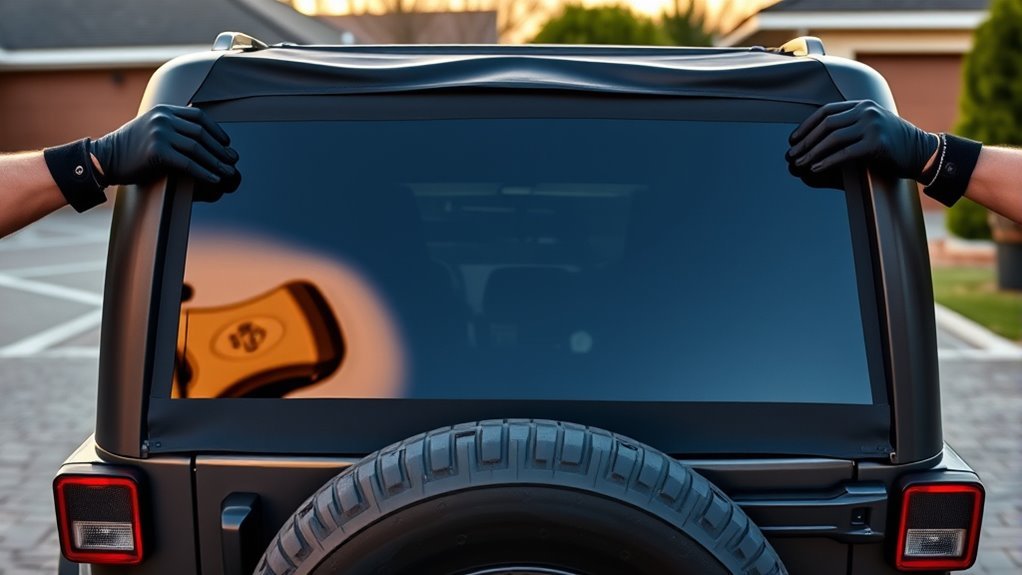
Yes, you can put a hardtop on a Jeep Wrangler that was sold with a soft top. The physical swap is usually straightforward when the top matches the Wrangler’s exact generation and door count. The bigger challenge is making the rear wiper, washer, defroster, and dome light work on a vehicle that lacks factory hardtop wiring.
Quick Answer
A compatible hardtop can replace a soft top, but it cannot be installed over it. Match the top to the Jeep’s generation, model year, and two- or four-door body. You may also need mounting brackets, fasteners, a vehicle-side wiring kit, washer plumbing, new controls, and scan-tool configuration.
Key Takeaways
- A Wrangler hardtop must match the body generation and door count; a JK, JL, TJ, or YJ top is not a universal fit.
- The hardtop can be installed physically without activating every electrical feature, but the rear wiper, washer, defroster, and dome light may need a model-specific conversion kit.
- “TIPM reprogramming” is not the right blanket term for every Wrangler. Follow the correct Mopar kit procedure for your VIN and generation.
- Use the fastener type and torque values in the owner’s manual for your exact model year; JK and JL specifications differ.
- Use four capable adults or a properly rated hardtop hoist for the rear shell, then inspect the seals and perform a gentle water test.
At a Glance
| Time Required | Allow one afternoon for a first physical installation on a prepared Jeep; a full wiring conversion is a separate, longer job. |
| Difficulty | Moderate for the top itself; advanced for factory-style wiring, switch replacement, connector work, and vehicle configuration. |
| Tools Needed | Model-specific Torx driver, ratchet, inch-pound torque wrench, trim tools, protective blankets, helpers or a rated hoist, and a multimeter for electrical testing. |
| Cost | Used takeoff prices vary widely. A current OEM four-door JL hardtop lists at about $3,595 MSRP before shipping, paint, wiring, hardware, or labor. |
Can You Put a Hardtop on a Soft-Top Jeep?
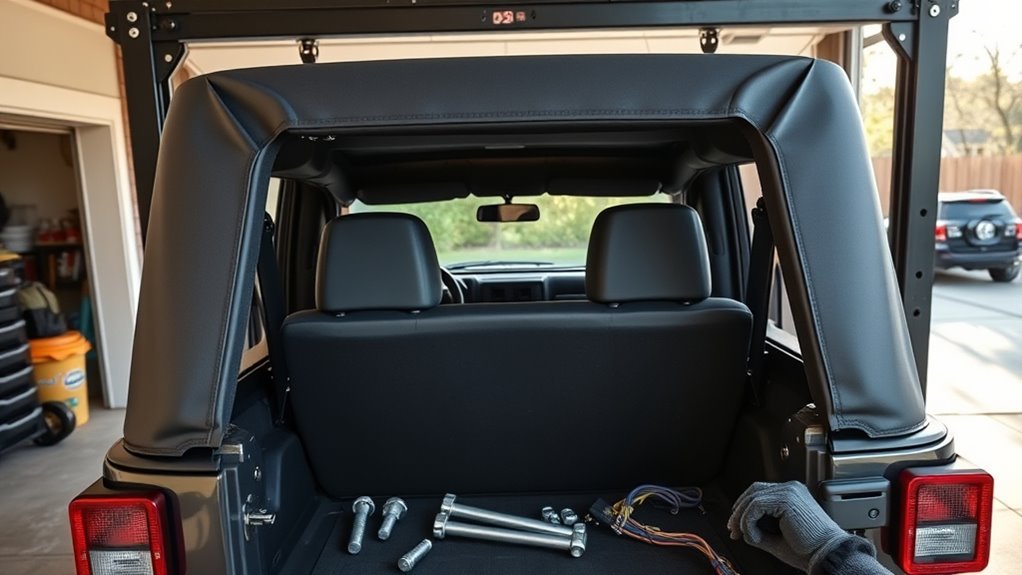
Yes. On a compatible Wrangler, the rear hardtop shell and removable front panels attach to factory body locations after the soft top, door surrounds, and any interfering soft-top brackets are removed. The hardtop should sit flush on the body, and the lift glass should have an even gap.
The physical top and the electrical features are two separate decisions. You can install a correct hardtop and drive without an operating rear wiper or defroster, provided the top is fully secured and the unused connectors are protected. For full factory-style operation, a soft-top vehicle may need a wiring conversion kit, washer hose and pump changes, the correct control switch, and vehicle configuration with a scan tool.
A hardtop normally gives better security, less fabric flutter, and improved cold-weather comfort. A soft top remains easier to fold or remove quickly. The best choice depends on climate, storage space, budget, and how often you want open-air driving.
| Conversion Goal | What You Need |
|---|---|
| Weather-tight physical installation | Correct top, seals, brackets, latches, bolts, front panels, and model-specific torque procedure |
| Rear wiper and washer | Complete top with wiper motor, vehicle-side harness, washer plumbing, correct control switch, and configuration as required |
| Rear defroster and dome light | Intact defroster grid and lamp, correct vehicle-side circuits, controls, fuses, and configuration as required |
Check Hardtop Compatibility Before Buying
Do not buy by appearance alone. Wrangler hardtops are generation- and body-specific. The official Mopar catalog lists separate hardtop part numbers for two-door and four-door JL Wranglers, and JK hardtops are listed separately from JL tops.
Be especially careful with a 2018 Wrangler. Jeep sold the outgoing JK and the newer JL during that model year, so “fits a 2018 Wrangler” is not enough. Confirm the VIN, generation, door count, and hardtop part number before paying or arranging freight.
Compatibility Checklist
- Generation: YJ, TJ, JK, and JL use different bodies, mounting details, glass, and electrical connectors.
- Door count: A two-door top does not fit a four-door Unlimited body, and a four-door top does not fit a two-door body.
- Exact model year: Verify the seller’s part number and the receiving Jeep’s VIN, especially at generation changeovers.
- Top completeness: Confirm that the rear glass, hinges, gas struts, wiper motor, wiring pigtail, washer fitting, defroster tabs, dome light, seals, and front panels are present.
- Mounting hardware: Used takeoff tops may be missing bolts, nut plates, front-panel latch brackets, locating hardware, or trim pieces.
- Electrical option: Check the left rear cargo area for the factory hardtop connector and washer hose. Their absence means more retrofit work.
- Condition: Inspect for cracked fiberglass, repaired corners, delamination, bent glass hinges, damaged seals, cut wiring, and broken defroster tabs.
Note: A used hardtop may bolt on even when its electrical connector does not match your Jeep. Mechanical fit does not prove electrical compatibility.
Parts and Wiring You May Need
Physical Installation Parts
- Correct rear hardtop shell for the Jeep’s generation and door count
- Matching removable front panels and storage bag, if applicable
- All body, B-pillar, or J-rail fasteners required by the model
- Front-panel receiver or latch brackets if they are not already installed
- Undamaged perimeter, lift-glass, and front-panel seals
- Protective caps or storage provisions for unused soft-top hardware
Rear Wiper, Washer, Defroster, and Dome Light
A complete hardtop usually carries the rear wiper motor, rear glass, defroster grid, dome light, and top-side connector. A conversion kit supplies the missing vehicle-side parts. Depending on the generation and equipment, that may include a wiring harness, washer hose, dual-outlet washer pump or reservoir connection, multifunction switch or control panel, terminals, clips, and instructions for updating the vehicle configuration.
Do not assume the conversion also adds heated mirrors. On Wranglers already equipped with heated mirrors, the mirrors may operate with the rear defroster. The hardtop kit does not create heated mirror elements in mirrors that do not already have them.
| Wrangler | Correct Programming Language | What to Do |
|---|---|---|
| JK | Vehicle configuration; older kit instructions also involve the TIPM during wiring | Follow the exact kit instructions. Mopar’s JK procedure adds rear-defroster and rear-wiper/washer sales codes, then restores the vehicle configuration. |
| JL | Vehicle configuration with the required hardtop and defroster options | Use the current VIN-matched Mopar kit and its configuration steps. Do not describe every JL job as “TIPM reprogramming.” |
| TJ or YJ | Model-specific conventional wiring | Use the correct factory diagram or complete conversion harness for the exact year; connector and switch arrangements vary. |
Warning: Factory-style wiring kits can require battery disconnection, trim removal, steering-column switch work, connector terminal changes, and scan-tool configuration. Incorrect work can damage modules, disable safety systems, or create a short. Use a qualified Jeep technician if you are not comfortable reading the exact Mopar instructions.
How to Install a Hardtop on a Soft-Top Jeep
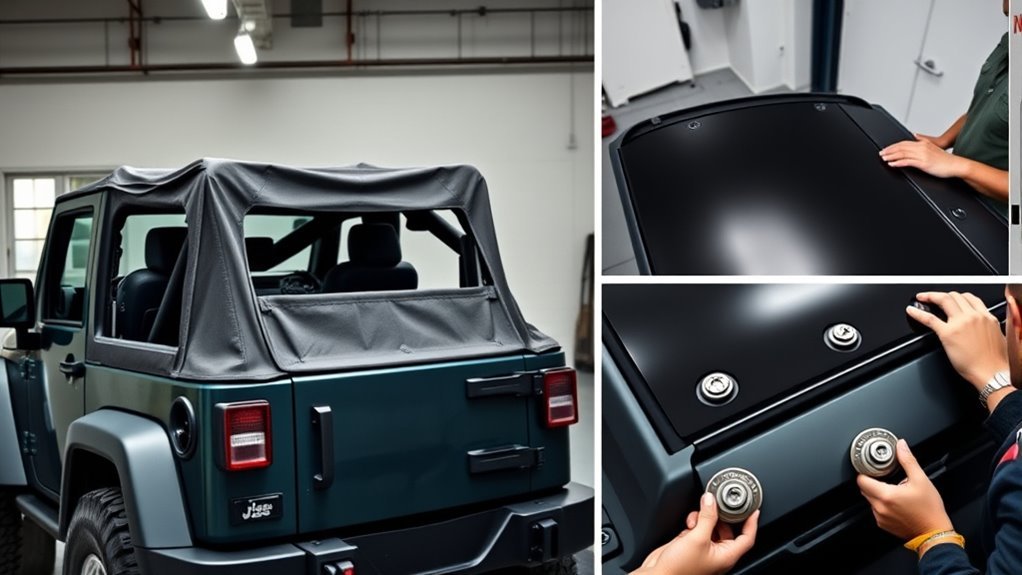
- Verify the top and instructions. Match the hardtop part number to the VIN, generation, and door count. Download the owner’s manual and installation instructions for that exact model year.
- Inventory every part. Lay out the bolts, brackets, front panels, seals, electrical connector, washer fitting, and lift-glass hardware. Do not lift the shell until missing parts are resolved.
- Park on a level surface. Set the parking brake, open the doors, protect painted edges with clean blankets, and make room around the Jeep.
- Remove the soft top completely. Remove the windows, top assembly, door surrounds, and any model-specific pivot brackets or retainers that interfere with the hardtop. Store the soft windows flat and protected from scratches.
- Clean and inspect the sealing surfaces. Remove dirt from the body rails, windshield header, front panels, and seals. Replace torn, crushed, hardened, or missing weatherstripping.
- Lift the rear shell safely. Use four capable adults positioned at the corners, as Jeep’s owner manuals direct, or use a properly rated hardtop hoist. Keep fingers away from pinch points.
- Set and align the shell. Lower it straight down. Confirm that it sits flush on both sides and that the lift glass has a uniform gap before inserting fasteners.
- Start every fastener by hand. Do not use an impact wrench. Snug the fasteners evenly, then torque them with an inch-pound torque wrench to the specification for the exact model year and mounting location.
- Connect available services. Attach the vehicle-side wiring connector and washer hose only if the correct factory connector or completed conversion kit is present. Secure the hose and wiring so they cannot rattle or be pinched.
- Install the front panels. Follow the owner’s manual for panel order, locating pins, L-shaped locks, and header latches. Make sure the panels sit flush with no overhang.
- Test before driving. Check all latches and fasteners, close the lift glass and swing gate slowly, test the dome light, wiper, washer, and defroster, then perform a low-pressure water test.
Example JK and JL Torque Values
Torque is not universal. The figures below show why the exact owner’s manual matters.
| Example Vehicle | Fastener Location | Published Specification |
|---|---|---|
| 2016 Wrangler JK | Hardtop-to-body Torx fasteners | 88 in-lb ± 22 in-lb (10 N·m ± 2.5 N·m) |
| 2024 Wrangler JL | Hardtop to B-pillar | 119 in-lb ± 23 in-lb (13.5 N·m ± 2.7 N·m) |
| 2024 Wrangler JL | Hardtop to J-rail | 154 in-lb ± 30 in-lb (17.5 N·m ± 3.5 N·m) |
Warning: These are model-year examples, not universal specifications. Verify the manual for your VIN before tightening. Over-tightening can crack the top, distort a seal, or damage a threaded insert.
Pro Tip: Photograph each soft-top bracket before removal and store its fasteners in labeled bags. Seasonal swaps are much faster when the hardware stays sorted by left, right, front, and rear position.
DIY vs. Professional Installation
A prepared Jeep with factory hardtop wiring is a reasonable DIY project for an owner who has helpers, a torque wrench, and the correct manual. A full conversion harness is a different job. It may involve interior trim, connector terminals, controls, washer plumbing, and vehicle configuration.
| Choose DIY When | Choose a Professional When |
|---|---|
| The top is confirmed compatible and complete | The top or wiring part number is uncertain |
| The Jeep already has the connector and washer hose | The vehicle needs a full conversion harness or new controls |
| You have four helpers or a rated hoist | You lack safe lifting equipment or indoor space |
| You own an inch-pound torque wrench | Scan-tool configuration or electrical diagnosis is required |
Cost, Time, and Storage
Price depends on whether the top is used, black textured, paintable, or body-color. The current Mopar four-door JL black hardtop kit lists at about $3,595 MSRP. Shipping, tax, paint, a wiring kit, missing brackets, seals, professional labor, and configuration are extra. Used takeoff tops can cost less, but damage and missing hardware can erase the savings.
| Cost Item | What Changes the Price |
|---|---|
| Hardtop | New OEM, used OEM, aftermarket, two-door or four-door, textured or paintable |
| Freight and paint | Oversize shipping, crate condition, local body-shop rates, and color match |
| Electrical conversion | Generation, heated-steering-wheel or control configuration, missing washer parts, and kit availability |
| Labor and configuration | Local shop rate, prior technician experience, trim work, connector repair, and diagnostic time |
| Storage equipment | Padded floor cart, wall stand, manual hoist, or powered ceiling lift |
For storage, keep the shell supported at safe contact points on a padded cart or stand. Protect the paint, glass, seals, wiring connector, and washer fitting. A ceiling hoist must be rated for the top and anchored to suitable structure, not just drywall or an unverified ceiling point.
Do not assume the hardtop itself can support roof cargo. Follow the Jeep owner’s manual and the rack manufacturer’s vehicle-specific limits. The rack, mounting system, moving vehicle limit, and parked static limit can all differ.
Common Problems and Troubleshooting
Water Leaks
Leaks usually begin with dirt, damaged weatherstripping, panel misalignment, an uneven lift-glass gap, or incorrect fastener tension. Start with the least invasive checks.
- Dry the interior and identify where the water first appears.
- Clean the body rails, front-panel channels, header, and seals with mild soap and water.
- Inspect for folded, torn, hardened, or displaced seals.
- Confirm that the rear shell and front panels sit flush.
- Verify fastener torque with the exact model-year specification.
- Run a gentle garden-hose test from low to high, one small area at a time.
- Replace damaged OEM-style weatherstripping before applying any adhesive or sealer.
Avoid generic seam sealer, thread-locking compound, or added foam unless the factory repair procedure calls for it. The wrong product can block drainage, hold a panel out of position, damage paint, or make later service difficult.
Wind Noise, Rattles, and Squeaks
| Likely Source | Check | Safe First Fix |
|---|---|---|
| Front-panel whistle | Locating pins, panel order, header latches, dust on seals | Remove, clean, and reinstall the panels exactly as the manual directs |
| Rear-shell creak | Loose or unevenly tightened fasteners | Verify seating and torque; do not simply tighten beyond specification |
| Harness rattle | Loose connector, hose, or trim clip in the left rear cargo area | Route and retain the harness with the correct clips and grommets |
| Lift-glass knock | Uneven glass gap, latch alignment, worn bumpers | Recheck shell position and inspect the glass hardware before adjustment |
Rear Wiper, Washer, or Defroster Does Not Work
- Confirm that the hardtop connector is fully seated and locked.
- Check that the washer hose is connected, not kinked, and routed away from pinch points.
- Inspect the rear-glass defroster tabs and grid for visible damage.
- Verify the correct fuse locations in the owner’s manual.
- Confirm that the correct controls and conversion harness were installed for the VIN.
- Scan the vehicle for faults and verify that the required hardtop options were added to the vehicle configuration.
- Do not bypass the factory control strategy with an improvised high-current switch unless a qualified automotive electrician designs and protects the circuit.
Parts Are Missing or Hard to Find
Start with the VIN and the hardtop’s molded or labeled part number. Ask a Jeep parts department to identify superseded kit numbers and individual service parts. A complete used takeoff package is often easier to finish than a bare shell because small brackets, bolts, controls, connectors, and trim pieces add up quickly.
Frequently Asked Questions
How much does it cost to change a soft-top Jeep to a hardtop?
The top is the largest expense. A new OEM four-door JL hardtop currently lists at about $3,595 MSRP, before shipping, tax, paint, wiring, hardware, and labor. A used takeoff can reduce the price, but inspect it closely and price every missing part before buying.
Can you install a hardtop without removing the soft top?
No. The soft-top assembly, door surrounds, and any interfering brackets must be removed so the hardtop can sit directly on the body and seal correctly. Do not trap a folded soft top under the rear shell.
Will any Jeep Wrangler hardtop fit my Wrangler?
No. Match the generation, exact body style, and door count. A JK top does not fit a JL, and two-door and four-door tops use different shells. A 2018 Wrangler also requires extra care because both JK and JL models exist.
Do all soft-top Wranglers have hardtop wiring?
No. Some have factory connectors and washer plumbing, while others need a full vehicle-side conversion kit. Check the left rear cargo area and verify equipment by VIN before ordering parts.
Does the Jeep need dealer programming after the swap?
Programming is not needed merely to secure the top, but it may be required to activate factory-style rear-wiper, washer, defroster, or related functions after a conversion harness is installed. The correct procedure depends on the Wrangler generation and kit.
Can one person install a Jeep hardtop?
Not safely by hand. Jeep owner manuals call for four adults to handle the rear hardtop. A single person can manage the job only with a properly rated, correctly installed hoist designed to control the shell without damaging the Jeep or top.
Conclusion
You can convert a soft-top Jeep Wrangler to a hardtop, but the job starts with exact fitment, not guesswork. Verify the VIN, generation, door count, part number, hardware, seals, and electrical plan before lifting the shell. Use safe lifting help, follow the model-year torque specifications, test every function, and fix alignment or seal problems before adding adhesives. Done correctly, the swap gives you a secure, quieter, and more weather-resistant setup without creating leaks or electrical problems.
Sources
- 2026 Jeep Wrangler Owner’s Manual — current model-year operating, top, safety, and service guidance.
- 2024 Jeep Wrangler JL Owner’s Manual — hardtop lifting, alignment, installation, and location-specific torque specifications.
- 2016 Jeep Wrangler JK Owner’s Manual — JK hardtop removal, installation, handling, and torque specifications.
- Official Mopar Jeep Wrangler Catalog — separate two-door and four-door hardtop part numbers and hardtop features.
- Mopar Hard Top Kit 82215142AB — current four-door JL fitment, separate wiring-kit requirement, and MSRP.
- Mopar JL Hardtop Conversion Kit Instructions K6862532 — model-specific wiring, controls, washer plumbing, and vehicle-configuration procedure.




Leave a Reply